

Illustrative consultation about reassessing a previously root-treated tooth
Restorative Dentistry

Root Canal Retreatment in Burlington

Not every retreatment conversation begins with pain. When an X-ray raises a question about a tooth you had treated before, you can come from Burlington to have it explained, compared with older images, and planned through to the final repair.

A finding, not a feeling

A shadow on the X-ray, and no pain at all

It can be unsettling to hear that a tooth you feel nothing in might need more work. Yet a root-treated tooth can show signs on imaging that healing has stalled or that a new problem has developed, all without causing discomfort. Retreatment is one way of addressing that, when the evidence suggests it could help you keep the tooth.

A finding on its own does not decide the plan. Your clinician needs to interpret it alongside your treatment history, any earlier images, the state of the crown, and whether the tooth could be restored well afterward. Sometimes watching is reasonable; sometimes further testing or treatment makes more sense. You should understand which, and why.

Coming in from Burlington, bring the details you have: the approximate year of the first root canal, the clinic that did it, and the report or image that raised the concern. We will review the tooth, describe what else would help clarify things, and talk about involving a root canal specialist if that seems wise.

Have the imaging finding explained
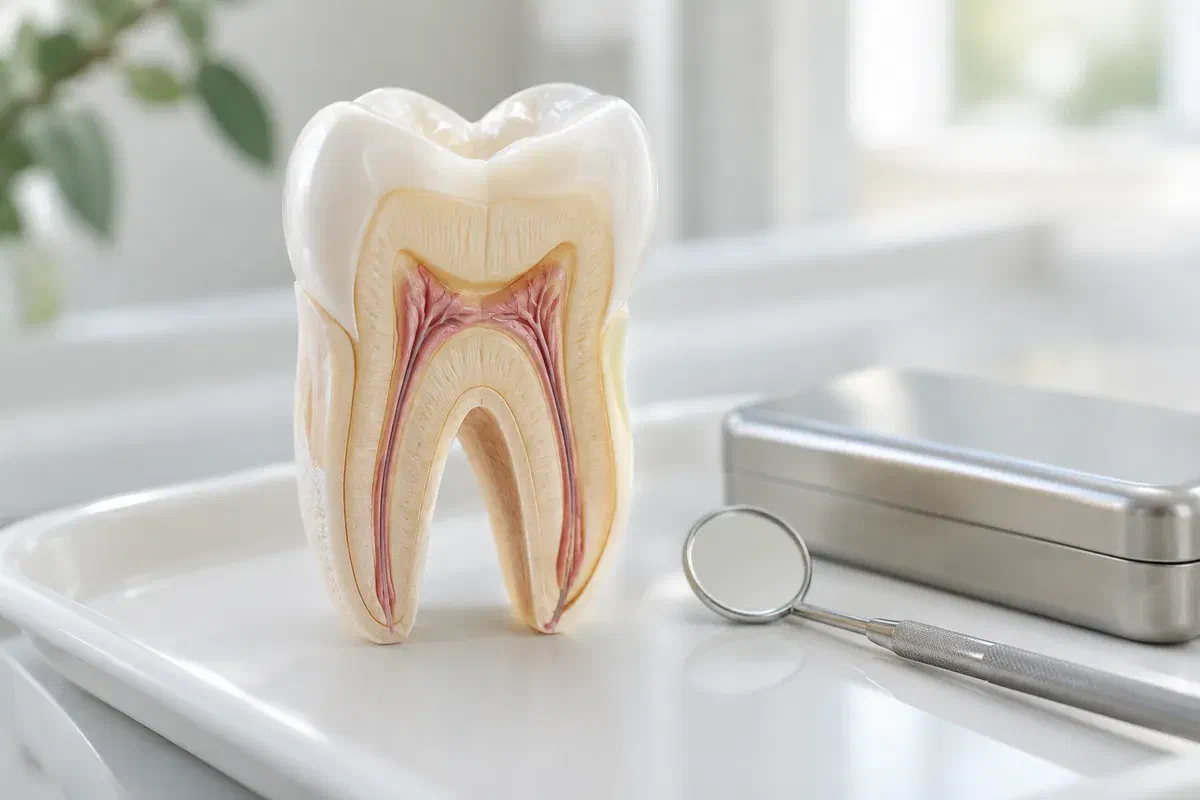
Illustrative cutaway molar teaching model used to explain the root canal space
Why a review gets suggested

Signs can be seen as well as felt.

Tell us how the concern came to light and how the tooth has felt since the first treatment. Your account frames the exam, though it does not confirm a diagnosis by itself.

Soreness that has returned

Some people do feel something: pressure on biting, or an ache that drifts around the area. Say whether it is constant or triggered. Other sources are considered alongside the treated tooth before more canal work is proposed.

An image that changed

The most common quiet trigger is a radiograph showing a change near the root end. Ask what was seen, how it compares with past images, and whether a period of observation or more investigation is advised. A tooth can feel normal while healing remains incomplete.

A restoration that let go

A lost crown, new decay at a filling edge, or a cracked repair can expose a previously treated tooth. Explain when it happened and how long the tooth was uncovered. The restoration and the canals are assessed as one problem.

Attend any planned review even if the tooth stays comfortable. If pain starts, swelling shows up, or a gum bump keeps reappearing before that date, call so the team can rethink the timing.

What retreatment can achieve

Resolve the question while keeping your own tooth.

When a tooth is suitable, retreatment is another opportunity to deal with a problem within the canal system, ideally before it causes symptoms. The clinician should set out why the findings support it and what might limit the result. Keeping a natural tooth is a valuable aim, as long as a good restoration can follow.

Expect to discuss the existing crown or filling, any post, the amount of tooth left, and what is known of the original treatment. Ask what would have to be removed to reach the canals. Seeing the whole pathway makes it easier to compare retreatment with monitoring or other options.

Patient information: AAE — understanding endodontic retreatment

A stated reason for treating

Ask exactly what the retreatment aims to address and which uncertainties remain. With a painless tooth, the reasoning matters even more. You should be able to explain to yourself why intervention is being suggested over watching.

A specialist read where useful

Previously treated teeth can be harder to evaluate. An endodontist may be suggested to review the imaging, examine the tooth, or carry out the retreatment. Ask what that visit will clarify and how the results return to your restoring dentist.

The rebuild mapped out early

Agree on the final seal and protective restoration before starting. Ask about likely visits and costs for that stage. The plan for the tooth continues well beyond the day the canals are resealed.

What happens next

Compare, decide, treat, review

Visit numbers and order vary with each tooth. Ask who handles each stage and how the tooth will be protected in between.

  1. Compare old and new information

    Share any earlier images or reports along with your treatment history. Examination and suitable new imaging show the tooth and the bone around it. Further tests or a specialist opinion may come before a recommendation.

  2. Decide between watching and treating

    The clinician explains whether retreatment suits the tooth, the possible difficulties, and the alternatives, including monitoring. Ask about access through the crown, the estimate, and how unexpected findings during treatment would be handled.

  3. Treat the canals again

    If you proceed, the old root filling is removed where necessary, and the canals are reassessed, cleaned and resealed. The tooth is isolated and comfort measures are used. More than one appointment is sometimes needed.

  4. Restore, then reimage over time

    Arrange the agreed final restoration and follow-up. Confirm whether someone else will place the crown. Reviews, often including later imaging, assess healing and function rather than relying on how the tooth feels in the first weeks.

After each visit

Look after the tooth while the plan is in progress.

Ask for instructions that match the work done that day. A temporary cover, a completed restoration, and an unfinished stage need slightly different care.

Protect it when eating

Wait for the freezing to fade before you eat, and follow advice on how hard to bite. Avoid crunching ice or hard candy on that side. If the temporary loosens, call the treating clinic rather than waiting until the next appointment.

Report any new symptoms

A tooth that was painless before treatment can feel tender for a while afterward. Tell the clinician if discomfort is rising, the bite feels high, or swelling appears. Follow the pain advice given, and check before taking medication that may not suit your health.

Keep the long-term reviews

Follow-up for healing may continue after the crown is finished, sometimes with a different clinician. Ask how records will be shared and who to contact. A completed restoration does not replace the recommended review of the root treatment.

Options to discuss

Watch, retreat, refer or replace

Ask why each reasonable option suits your tooth or does not. A sound recommendation balances the condition inside the roots with the tooth’s long-term ability to function.

If the canals can be revisited

Nonsurgical retreatment

The tooth is reopened from the top and the canals are treated again. Existing restorations can make access more complex. Ask what the clinician expects to correct and how the access will be sealed and the tooth protected.

If a different approach may fit

Endodontic surgical assessment

For selected teeth, a specialist may consider treatment around the root tip. Surgery and retreatment handle different situations and may be combined. Ask why a surgical view is relevant for you rather than assuming it is the obvious next step.

If keeping the tooth is unrealistic

Removal and a replacement discussion

A badly compromised tooth may not have a sensible way to be retained. Discuss why, what extraction would involve, and possible replacements. Ask for the full sequence and maintenance for each so the options can be compared evenly.

Frequently asked

Clearing up the painless-tooth puzzle

Ask us to explain the diagnosis and treatment order before you decide. If you have more than one estimate, look at what each actually includes.

(905) 876-4488
What does a dark area around a root on an X-ray mean?
It can indicate inflammation or incomplete healing in the bone near the root, though images need careful interpretation. The clinician compares it with earlier films where possible and examines the tooth before suggesting anything. Ask what the finding most likely represents in your case.
Is it safe to leave a painless finding alone for a while?
Sometimes monitoring is reasonable, and sometimes treatment is advised sooner. It depends on the finding, the history and the tooth. Ask what would be watched, when it would be checked again, and which symptoms should prompt a call before then.
How will we know if the retreatment worked?
Comfort is one sign, but healing is usually judged over time through examination and follow-up imaging. The timing of those reviews varies. Ask when the first check will be and what the clinician will be looking for.
My X-ray was taken elsewhere. Can you use it?
Earlier images can be very helpful for comparison, so ask the other clinic to share them. New imaging may still be needed to see the tooth as it is today. Bring any report you were given, along with the clinic’s name.
If my crown looks fine, does it still need to come off?
Not always. Some teeth are retreated through an opening in the existing crown, while others need it removed for better access or because it is no longer sound. Ask which approach is proposed, the reasons, and whether a new crown is in the estimate.
Can retreatment be arranged around a commute from Burlington?
Ask for the expected number of visits and which ones are longest when planning begins. Monday to Thursday evening hours may suit, and grouping the planning and treatment conversations can reduce extra trips where clinically sensible.
Burlington retreatment reviews

Get a clear answer about that finding.

Book a review at our Bronte Street practice for a previously treated tooth. Bring any images or reports, and we will explain what they show, whether a specialist should weigh in, and the restorative steps that could follow.

Pain that is growing or new swelling is a reason to call the clinic directly rather than wait on an online request.

Visit Milton Dental Clinic
Unit 1, 342 Bronte St. S, Milton, ON L9T 5B7
Get directions Clinic hours
Monday–Thursday
11am–7pm
Friday–Sunday
By appointment only

Areas we serve

  • Milton
  • Oakville
  • Mississauga
  • Georgetown
  • Halton Hills
  • Acton
  • Campbellville
  • Brampton
  • Burlington
  • Puslinch
  • Rockwood
  • Erin
  • Caledon
  • Etobicoke
  • Old Milton
  • Bronte Meadows
  • Timberlea
  • Dorset Park
  • Dempsey
  • Clarke
  • Beaty
  • Coates
  • Harrison
  • Scott
  • Willmott
  • Ford
  • Bowes
  • Cobden
  • Walker
  • Mountain View
  • Milton Heights
  • Hawthorne Village
  • Valley View
  • Fallingbrook
  • Nassagaweya
  • Trafalgar
  • Esquesing
  • Nelson
  • Brookville
  • Moffat
  • Glen Williams
  • Norval
  • Limehouse
  • Stewarttown
  • Ashgrove
  • Hornby
  • Silver Creek
  • Speyside
  • Scotch Block
  • North Oakville
  • River Oaks
  • Glen Abbey
  • West Oak Trails
  • Palermo
  • Bronte Creek
  • College Park
  • Joshua Creek
  • Uptown Core
  • Preserve
  • Iroquois Ridge
  • Lisgar
  • Meadowvale
  • Meadowvale Village
  • Churchill Meadows
  • Erin Mills
  • Central Erin Mills
  • Streetsville
  • East Credit
  • Creditview
  • Heartland
  • Sheridan
  • Mount Pleasant
  • Credit Valley
  • Huttonville
  • Churchville
  • Springbrook
  • Northwest Brampton
  • Bram West
  • Fletcher's Meadow
  • Fletcher's Creek South
  • Alton Village
  • Orchard
  • Millcroft
  • Headon Forest
  • Tansley
  • Brant Hills
  • Tyandaga
  • Kilbride
  • Lowville
  • Aberfoyle
  • Morriston
  • Arkell
  • Hillsburgh
  • Freelton
  • Carlisle
  • Waterdown
  • Flamborough
  • Mountsberg

How can we help?

Milton Dental Clinic

Have a question about your smile? Choose the option that works best for you.

For urgent dental concerns, please call.
Messages are reviewed during clinic hours.