

Illustrative consultation about reassessing a previously root-treated tooth
Restorative Dentistry

Root Canal Retreatment in Old Milton

Dental work from decades past can still be doing its job, or it can start to show its age. If a root-treated tooth is acting up, our team near Old Milton can reassess it and explain what retreatment and rebuilding would involve.

Older dental work, a fresh question

Your treated tooth has a history worth piecing together.

Plenty of people around Milton’s historic downtown carry root canals placed fifteen or twenty years ago, sometimes by a dentist who has since retired. Most of those teeth keep working quietly. Now and then, though, one stops healing as hoped or is reached by new decay or a broken repair, and going back into the canals may help keep it.

Feeling something in an old treated tooth is not the same as needing that treatment redone. Your clinician has to sort out whether the trouble lies in the canals, a crack, the gum, a tired crown, or a neighbouring tooth. The question to settle is what a second procedure would fix, and whether the tooth could be rebuilt soundly afterward.

Old Milton sits a short way from our Bronte Street practice, which makes an unhurried first conversation easy to arrange. Jot down what you recall: roughly when, where, and whether a crown went on afterward. From there we can examine the tooth, explain what further information would help, and discuss a specialist when one is warranted.

Ask us to reassess an older root canal
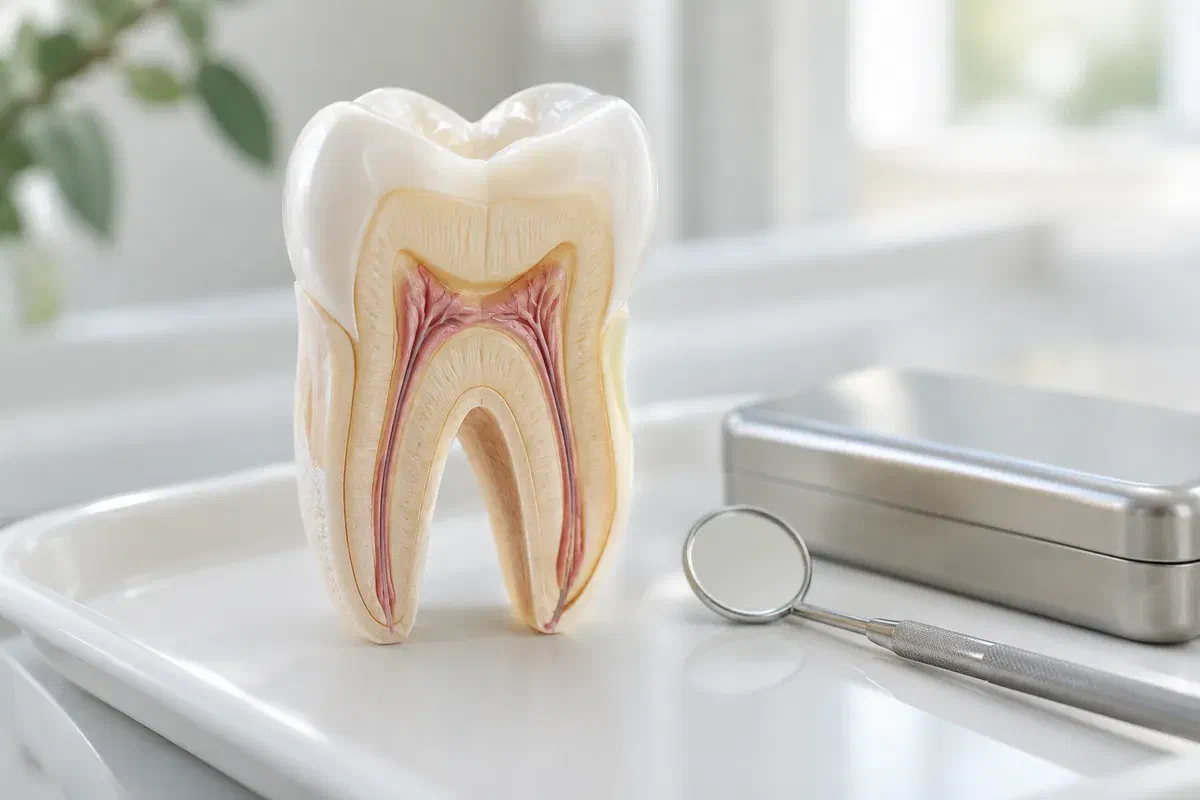
Illustrative cutaway molar teaching model used to explain the root canal space
Changes worth mentioning

Years of quiet, and then a change

Let us know when the new feeling started and how it compares with what you remember from the original treatment. That account shapes the examination without confirming a cause by itself.

An ache that had long since faded

You might notice the tooth again when chewing, or feel a dull pressure in the general area. Explain whether it is steady or tied to biting or tapping. Other possible sources are ruled in or out before further canal work is suggested.

Something seen on a newer X-ray

A routine image can reveal a change near the root tip with no symptoms at all. Ask what the image shows and whether earlier films exist for comparison. Watching, testing further, or treating are all possibilities, and the absence of pain does not settle which applies.

Wear and tear on the crown above

Long-serving crowns and fillings can loosen, chip or develop decay at their edges. If one has failed, say when and whether the tooth was left uncovered for a while. What is happening above the gum and inside the roots are assessed side by side.

Hold on to any review appointment even if things calm down. If pain worsens, swelling appears, or a small gum bump keeps coming back before your visit, get in touch so we can look at the timing.

Why revisit an old root canal

Saving a long-serving tooth is worth a careful look.

For the right tooth, retreatment is a second opportunity to deal with a problem inside the root canal system. You should hear why the evidence points to it and which factors might hold back the result. Keeping a tooth you have had all your life is a good goal, as long as it can be restored properly once the canals are done.

With older dental work in particular, the discussion should include the crown or filling, any post placed long ago, the amount of tooth remaining, and whatever is known of the first treatment. Ask what would need to be removed to get access. Seeing every stage laid out helps you compare retreatment honestly with the other reasonable paths.

Patient information: AAE — understanding endodontic retreatment

Knowing what the retreatment is for

Ask whether the concern relates to the original canal work or to something that happened later. The clinician should name the aim and the remaining unknowns. A sore tooth alone does not justify going back in without a defined purpose.

A specialist where the history is complex

Materials and methods used years ago can make re-entry trickier. An endodontist may be asked to evaluate the tooth or perform the work. Find out what that referral would answer and how the report reaches whoever will restore the tooth.

Planning the tooth’s next decade

Agree on the final seal and covering before starting the canal work. Ask how many visits and what costs the restoration stage is likely to involve. A tooth retreated without a plan for rebuilding it is only half looked after.

Step by step

From old records to a restored tooth

The number of visits and their order depend on the tooth. Ask who looks after each stage and how the tooth is protected while it waits for the next.

  1. Collect what is known and examine

    Bring any paperwork or the name of the clinic that did the first root canal. We examine the tooth and take suitable images of it and the surrounding bone. Further testing or a specialist opinion may be needed before advice is given.

  2. Review the options together

    The clinician explains whether retreatment is a good fit, what might complicate it, and what else could be done. Ask how an old crown or post would be handled, what the estimate covers, and how surprises during treatment would be managed.

  3. Redo the canal work

    Should you proceed, the previous root filling is removed as needed, and the canals are re-examined, cleaned and sealed. The tooth is isolated and kept comfortable. Certain teeth take more than one sitting to finish this part.

  4. Restore it and follow healing

    Schedule the final restoration and review appointments that were agreed. Confirm whether another clinician will place the crown. Follow-up looks at comfort, chewing and healing over time instead of judging the result by the first few days.

While the work is underway

Treat the temporary gently and keep moving forward.

Ask for care advice that fits exactly what happened at your appointment. A provisional cover, a completed restoration, and a stage still in progress need slightly different handling.

Be careful what you bite

Don’t eat until the freezing has gone, and follow guidance on how firmly to use the tooth. Avoid testing it on anything hard. If a temporary filling or crown comes loose, contact the treating office for advice instead of leaving it until your next visit.

Note how the symptoms change

Tell the clinician if pain is climbing, the bite feels tall, or any swelling shows up. Describe when it started and what makes it worse. Follow the pain-control advice you were given, and check first if a medication might interact with your other prescriptions.

Attend every review that is booked

You may have restorative and healing appointments with different people. Ask how records will be shared and who to call with a question. Finishing the crown does not remove the need for a scheduled check on the root treatment.

Your choices, side by side

Retreat, operate, or replace?

Ask why each sensible option suits your tooth or does not. A good recommendation considers the canals and the tooth’s ability to function for years after treatment.

Going back in through the crown

Nonsurgical retreatment

The canals are reopened from the biting surface and treated once more. Long-standing crowns and posts can add steps. Ask what the clinician hopes to correct and how the access will be closed and the tooth shielded afterward.

Approaching the root from another side

Endodontic surgical assessment

For selected teeth, a specialist may consider treating the end of the root through the gum. This addresses different situations than retreatment, and the two are sometimes combined. Ask why surgery is being raised for your tooth instead of assuming it comes next.

When the tooth cannot be kept sensibly

Removal and a replacement discussion

Some teeth are too compromised to save with confidence. Discuss the reasons, what removal would mean, and suitable replacement options. Request the whole sequence and long-term care needs for each so they can be weighed evenly.

Questions we hear

Answers for teeth with a long past

We can walk you through the diagnosis and the order of treatment before you commit. If you have estimates from elsewhere, check what each one includes.

(905) 876-4488
The dentist who did my original root canal has retired. Can you still get my records?
Often it is possible. Practices that close or change hands usually arrange for records to be kept. Tell us what you remember and we can discuss how to request them. If records cannot be found, current examination and imaging still allow the tooth to be assessed.
Are older root canal materials a problem for retreatment?
Different materials and techniques have been used over the years, and some can make removal more involved. That is one reason a specialist opinion may be suggested. Ask how the existing filling material affects the plan and what it means for the likely number of visits.
My crown is twenty years old. Should it be replaced at the same time?
That depends on its fit, its condition, and how the canals would be reached. Sometimes a crown is kept, sometimes access requires removing it, and sometimes it is already due for replacement. Ask which applies to your tooth and how the estimate reflects it.
Could my symptoms be coming from a different tooth?
Yes. Discomfort can be hard to pin to a single tooth, and gum problems or neighbouring teeth can produce similar feelings. Testing and imaging help locate the source. Retreatment is only considered once the treated tooth is identified as the likely cause.
Do I have to repeat treatment if the X-ray change has no symptoms?
Not automatically. A painless finding may be monitored, investigated further, or treated, depending on what it shows and how it compares with older images. Ask the clinician to explain the reasoning and what would prompt a change of plan.
How should I handle new swelling while waiting for a specialist?
Call the clinic that referred you or the specialist’s office and describe what has changed. They can judge whether you should be seen sooner. A booked consultation in the future is not a reason to sit on increasing pain or swelling.
Old Milton retreatment visits

Let’s find out what that old root canal needs now.

Book an assessment at our Bronte Street practice for a tooth treated in the past. Bring any records or names you remember, and we will review the findings, the case for specialist input, and the restorative work that may follow.

Worsening pain or new swelling is a reason to phone the clinic directly rather than wait for an online request to be answered.

Visit Milton Dental Clinic
Unit 1, 342 Bronte St. S, Milton, ON L9T 5B7
Get directions Clinic hours
Monday–Thursday
11am–7pm
Friday–Sunday
By appointment only

Areas we serve

  • Milton
  • Oakville
  • Mississauga
  • Georgetown
  • Halton Hills
  • Acton
  • Campbellville
  • Brampton
  • Burlington
  • Puslinch
  • Rockwood
  • Erin
  • Caledon
  • Etobicoke
  • Old Milton
  • Bronte Meadows
  • Timberlea
  • Dorset Park
  • Dempsey
  • Clarke
  • Beaty
  • Coates
  • Harrison
  • Scott
  • Willmott
  • Ford
  • Bowes
  • Cobden
  • Walker
  • Mountain View
  • Milton Heights
  • Hawthorne Village
  • Valley View
  • Fallingbrook
  • Nassagaweya
  • Trafalgar
  • Esquesing
  • Nelson
  • Brookville
  • Moffat
  • Glen Williams
  • Norval
  • Limehouse
  • Stewarttown
  • Ashgrove
  • Hornby
  • Silver Creek
  • Speyside
  • Scotch Block
  • North Oakville
  • River Oaks
  • Glen Abbey
  • West Oak Trails
  • Palermo
  • Bronte Creek
  • College Park
  • Joshua Creek
  • Uptown Core
  • Preserve
  • Iroquois Ridge
  • Lisgar
  • Meadowvale
  • Meadowvale Village
  • Churchill Meadows
  • Erin Mills
  • Central Erin Mills
  • Streetsville
  • East Credit
  • Creditview
  • Heartland
  • Sheridan
  • Mount Pleasant
  • Credit Valley
  • Huttonville
  • Churchville
  • Springbrook
  • Northwest Brampton
  • Bram West
  • Fletcher's Meadow
  • Fletcher's Creek South
  • Alton Village
  • Orchard
  • Millcroft
  • Headon Forest
  • Tansley
  • Brant Hills
  • Tyandaga
  • Kilbride
  • Lowville
  • Aberfoyle
  • Morriston
  • Arkell
  • Hillsburgh
  • Freelton
  • Carlisle
  • Waterdown
  • Flamborough
  • Mountsberg

How can we help?

Milton Dental Clinic

Have a question about your smile? Choose the option that works best for you.

For urgent dental concerns, please call.
Messages are reviewed during clinic hours.