

Illustrative consultation with a patient bringing records for another dental opinion
Restorative Dentistry

Root Canal Second Opinions in Acton

Told you need a root canal, then a post, then a crown, and wondering how it all adds up? From Acton, book a second opinion in Milton to review the findings and every stage of the plan, from first visit to final restoration.

Seeing the whole plan

The root canal is only chapter one.

A treatment plan can arrive as a list of unfamiliar items: root canal, core build-up, possibly a post, then a crown. It is easy to feel that the plan keeps growing. People often ask why each step is there, whether all of it is necessary, and how it compares with removing the tooth. A second opinion lets you work through that list item by item.

You won’t be promised a shorter or cheaper plan. The reviewing dentist may agree with every step, suggest checking something before committing, or describe another sensible sequence. The aim is for you to understand why each stage is proposed, what is still uncertain, and what the whole route would ask of you.

For people in Acton, travelling for several appointments is part of the decision, so it helps to see the full sequence at the start. Bring the written plan and any records. We will examine the tooth, explain what each stage is for, and tell you if an endodontist’s view would help with a particular question.

Go through your treatment plan with us
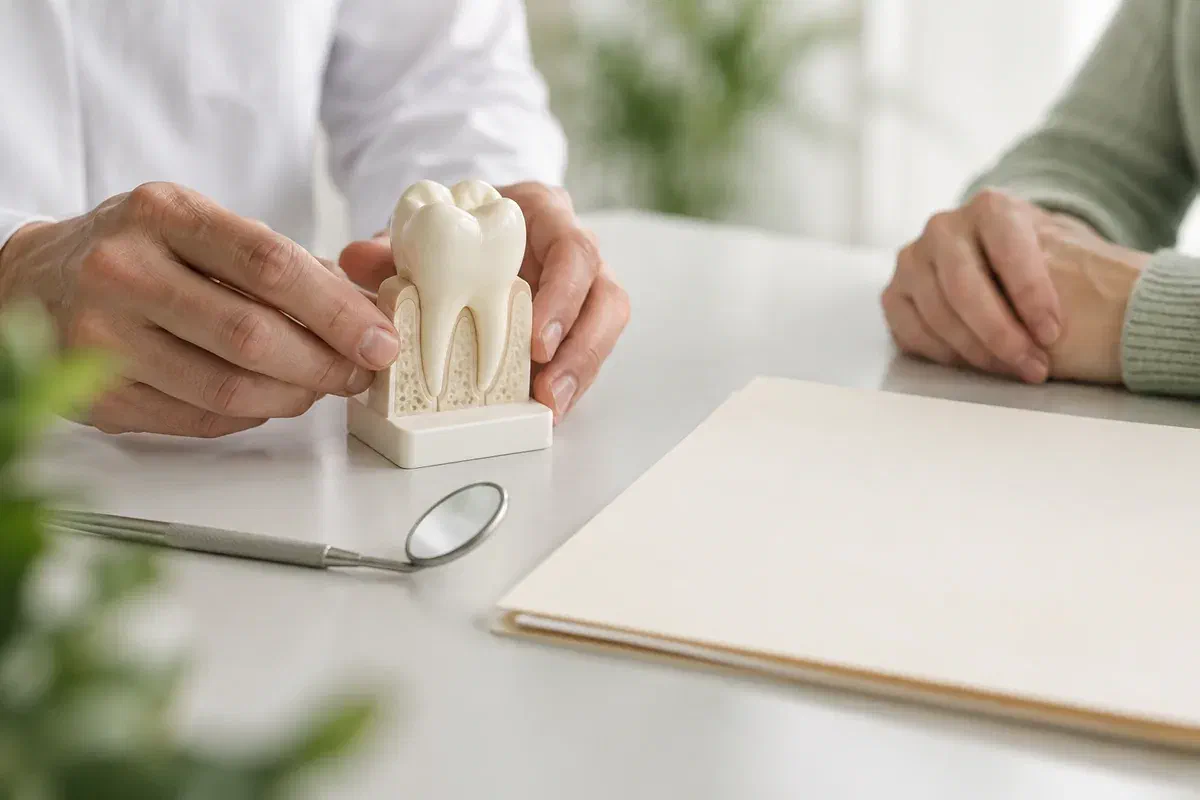
Illustrative review of a tooth model and a plain records folder at a consultation
Common questions about long plans

Which step are you unsure about?

It helps to point to the part of the plan that worries you. It could be the reason for the root canal, a later stage, how the pieces fit together, or a symptom that hasn’t gone away.

Why the tooth needs treatment at all

Before thinking about crowns, it is worth knowing what is wrong. Ask what the examination found inside the tooth or near the root, and how that leads to the recommendation. Each stage of the plan should trace back to that finding.

Why the plan has so many parts

A root canal, a build-up, a crown and extraction with replacement can each add visits and cost. Bring your plan and any others you have been given. Sometimes one plan lists every stage while another shows only the first, which makes them hard to compare.

Why a treated tooth needs more work

If a tooth that already had a root canal now needs retreatment, a new crown or removal, share what you know of its past. The amount of tooth left and the condition of the restoration shape what is possible, and a specialist can help in harder cases.

Severe or growing pain, swelling of the face or a damaged tooth should be seen promptly. Please don’t wait for a planning appointment; describe those symptoms when you call.

What you gain from a review

Understand every stage before you commit to the first.

A careful consultation tells you which parts of the plan are firmly needed and which depend on what is found along the way. Ask what is known now, what will only be clear during treatment, and what might change the later steps. That helps you plan without expecting every detail to be fixed.

Teeth that have had a root canal often need a strong restoration afterwards, which is why a build-up and crown frequently appear in the plan. If the tooth is removed instead, there is usually a separate decision about replacing it. Looking at each full route lets you compare visits, upkeep and cost over time.

Patient information: AAE — seeking informed choices before irreversible care

Your practical limits considered

Tell us how many trips you can manage, whether anxiety is a concern, how much keeping the tooth matters, and what cost you are weighing. These priorities don’t change the clinical findings, but they help us talk about realistic sequencing.

Alternatives at each stage

Ask whether there are different options for the restoration as well as the root canal itself, and what each would achieve. If something is not recommended, ask why. You should know what is clinically unsuitable versus simply a trade-off.

Someone responsible for each step

Confirm who will do which stage, who sends records and who books the next appointment. If your regular dentist will place the crown, ask how our findings will reach them. Long plans work best when every hand-off is clear.

How the review works

Plan in hand, tooth in view.

Say you are booking a second opinion on a treatment plan. We may need to examine and test the tooth, not just read the plan, so allow enough time.

  1. Bring the written plan

    Share the full plan and any estimate, along with X-rays or reports you can get. Note which stages, if any, have already been completed. We can explain how to have records transferred securely from the other office.

  2. Tell us about the tooth

    Explain what you have felt, when it started and what makes it worse. Mention past work on the tooth, medications and relevant health conditions. This helps the dentist understand why the plan was put together the way it was.

  3. Examine the tooth and restoration

    The dentist checks the tooth, the existing filling or crown, and how much sound structure remains. Additional imaging may be suggested if it answers a question the existing images can’t. Ask what each check is meant to show.

  4. Walk through each stage

    We go through the plan step by step: what is needed now, what can wait, and what depends on later findings. Ask about timing and the effects of delay. We agree the next action and how our opinion will be shared.

Planning ahead

Turn a long plan into a manageable one.

You may leave with a clearer plan rather than treatment that day. Keep the notes, and know what to do while you organise the next steps.

Check every estimate for the same stages

Make sure each plan lists the assessment, root canal, temporary protection, build-up and final restoration. If removal is offered, check whether replacement is separate. A short plan can look simpler simply because it leaves later stages out.

Know who protects the tooth between stages

After a root canal, a temporary filling may stay in place until the crown is ready. Confirm who to call if it loosens or the tooth becomes sore. Tell both offices about any change in who is doing which stage.

Ask how long each gap can be

Some stages should follow fairly closely, since a root-treated tooth without its final restoration may be more likely to break. Ask about reasonable timing. If the schedule is hard, say so and plan it together.

Where the review may land

The same plan, a revised plan, or more questions.

A second opinion gives you an assessment, not a guaranteed result. Ask what supports each recommendation and how firm it can be at this stage.

When each stage is justified

Follow the plan as written

We may agree that the root canal and the restoration that follows are a sensible way to save the tooth. You can still talk about comfort, materials for the crown and who will carry out each step. Understanding why every part is there can make the plan feel less daunting.

When something else fits better

Change the sequence or the approach

The findings might support a different restoration, another order of steps or a different treatment altogether. Ask what led to that view and what it would mean for the tooth in the long run. A revised plan should come with clear reasons.

When one question is still open

Investigate a specific stage

Some teeth need closer study before the plan can be confirmed. That is the kind of question an endodontist, a root canal specialist, is trained to answer. Ask what a referral is meant to answer and how the tooth should be protected until then.

Patient information: AAE — the role of an endodontist

Acton questions about treatment plans

What each stage is for.

Circle the parts of your plan you least understand and bring it along. That keeps the visit focused.

(905) 876-4488
Why does a tooth often need a crown after a root canal?
Teeth that need root canal treatment have often lost a lot of structure to decay or earlier fillings, and they can be more prone to cracking. A crown or other strong restoration helps protect them. Ask whether your tooth specifically needs one.
What is a core build-up, and do I need one?
A build-up replaces missing tooth structure so a crown has a solid base. Whether you need one depends on how much tooth remains. Ask the dentist to show you why it is part of your plan.
Does every root canal need a post?
No. A post is used in some teeth when extra support is needed for the restoration. Ask whether one is planned for your tooth and why.
Can I leave the crown for later and just have the root canal now?
Delaying the final restoration can leave the tooth more vulnerable. Ask how long a temporary is meant to last and what the risks of waiting would be for your tooth.
My plan only lists a root canal. Should I expect more stages?
Possibly. Some plans show only the first stage. Ask the office that wrote it whether a build-up or crown is likely afterwards, so you can compare it fairly with others.
If I’m coming from Acton, can stages be grouped to cut down on trips?
Sometimes stages can be planned efficiently, but some need healing time or lab work in between. Mention your travel when you book and the team can discuss realistic scheduling.
Root canal second opinions for Acton

Understand the whole plan before you start it.

Arrange a planning review at our Bronte Street office in Milton. Bring the written plan and your questions, and we will examine the tooth, explain each stage and help you choose a sensible next step.

If a stage has already been started or the tooth is getting worse, please phone when booking so the team can understand the urgency.

Visit Milton Dental Clinic
Unit 1, 342 Bronte St. S, Milton, ON L9T 5B7
Get directions Clinic hours
Monday–Thursday
11am–7pm
Friday–Sunday
By appointment only

Areas we serve

  • Milton
  • Oakville
  • Mississauga
  • Georgetown
  • Halton Hills
  • Acton
  • Campbellville
  • Brampton
  • Burlington
  • Puslinch
  • Rockwood
  • Erin
  • Caledon
  • Etobicoke
  • Old Milton
  • Bronte Meadows
  • Timberlea
  • Dorset Park
  • Dempsey
  • Clarke
  • Beaty
  • Coates
  • Harrison
  • Scott
  • Willmott
  • Ford
  • Bowes
  • Cobden
  • Walker
  • Mountain View
  • Milton Heights
  • Hawthorne Village
  • Valley View
  • Fallingbrook
  • Nassagaweya
  • Trafalgar
  • Esquesing
  • Nelson
  • Brookville
  • Moffat
  • Glen Williams
  • Norval
  • Limehouse
  • Stewarttown
  • Ashgrove
  • Hornby
  • Silver Creek
  • Speyside
  • Scotch Block
  • North Oakville
  • River Oaks
  • Glen Abbey
  • West Oak Trails
  • Palermo
  • Bronte Creek
  • College Park
  • Joshua Creek
  • Uptown Core
  • Preserve
  • Iroquois Ridge
  • Lisgar
  • Meadowvale
  • Meadowvale Village
  • Churchill Meadows
  • Erin Mills
  • Central Erin Mills
  • Streetsville
  • East Credit
  • Creditview
  • Heartland
  • Sheridan
  • Mount Pleasant
  • Credit Valley
  • Huttonville
  • Churchville
  • Springbrook
  • Northwest Brampton
  • Bram West
  • Fletcher's Meadow
  • Fletcher's Creek South
  • Alton Village
  • Orchard
  • Millcroft
  • Headon Forest
  • Tansley
  • Brant Hills
  • Tyandaga
  • Kilbride
  • Lowville
  • Aberfoyle
  • Morriston
  • Arkell
  • Hillsburgh
  • Freelton
  • Carlisle
  • Waterdown
  • Flamborough
  • Mountsberg

How can we help?

Milton Dental Clinic

Have a question about your smile? Choose the option that works best for you.

For urgent dental concerns, please call.
Messages are reviewed during clinic hours.