

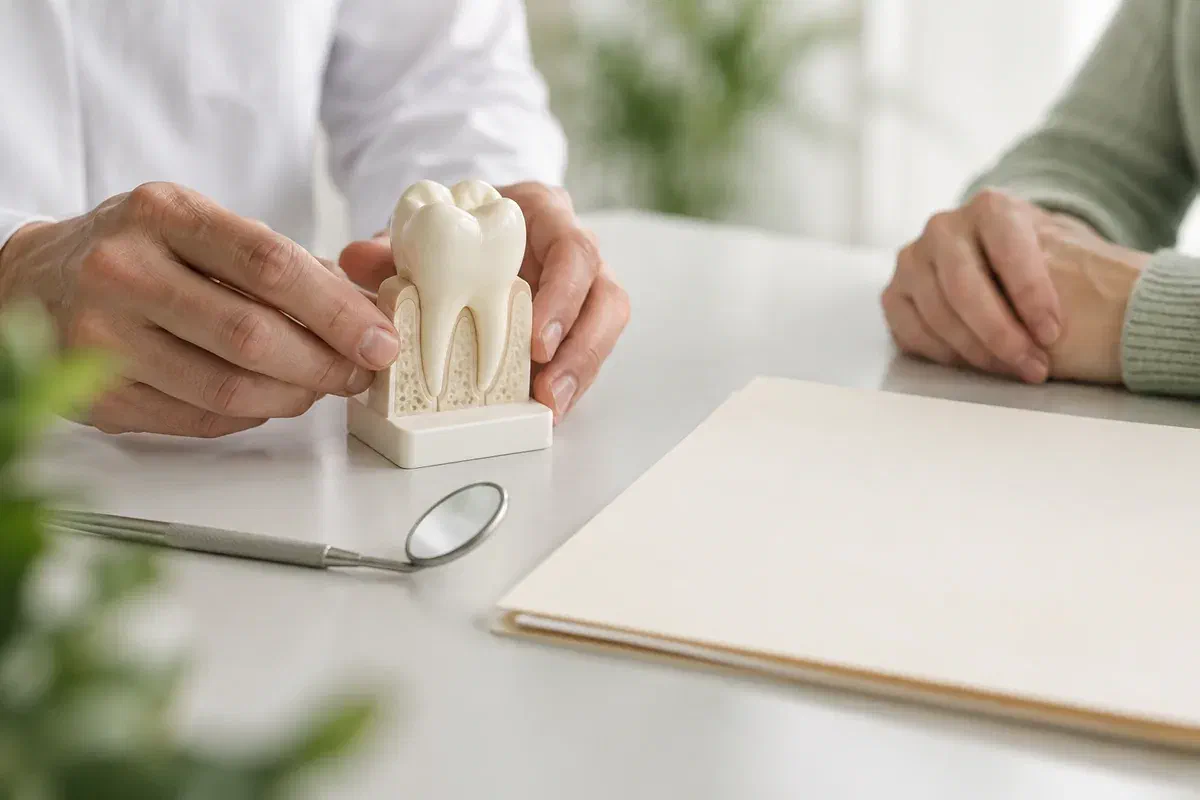
Illustrative consultation with a patient bringing records for another dental opinion
Restorative Dentistry

Root Canal Second Opinions in Georgetown

A tooth that has twinged since a deep filling, and now a root canal is on the table? Book a second opinion in Milton from Georgetown to look at what the testing shows, what else could explain the pain, and your options.

When the ache won’t settle

A cold drink, a sharp twinge, and a big decision.

It often starts small. A tooth that had a large filling or a crown keeps reacting to cold, or aches when you bite, and weeks later you are told the nerve may not recover. You might wonder whether it just needs more time, whether something else is causing the pain, or whether a root canal is really the next step.

Another dentist’s assessment can’t promise you a particular answer. It may agree that the nerve is unlikely to settle, recommend more testing or monitoring, or identify a different reasonable plan. What it does offer is a clearer understanding of the evidence, the uncertainty, and the practical consequences of each choice.

Coming from Georgetown, bring the plan you were given and anything you have about the earlier filling or crown. We examine and test the tooth, explain what the results suggest, and let you know when an endodontist could help pin down a tricky diagnosis. Describing the pain in everyday words is all we need.

Have a lingering ache looked at again
Illustrative review of a tooth model and a plain records folder at a consultation
Where the uncertainty often lies

Is it the nerve, the bite, or something else?

Tooth pain can have several sources, and that is often what prompts a second opinion. Let us know whether you are questioning the diagnosis, the treatment, the full plan or a symptom nobody has explained.

You’re not sure the nerve is the problem

Sensitivity after deep dental work sometimes eases with time, and sometimes signals lasting nerve inflammation. Ask what tests suggested the nerve won’t recover and what other explanations were considered. The recommendation should rest on findings, not just on how long the tooth has hurt.

One dentist says wait, another says treat

Monitoring, adjusting a filling or bite, a root canal, or removal can all come up. Bring every plan you have heard so we can compare what each involves. Different advice can reflect different information or timing, not necessarily a major disagreement.

The tooth had a root canal before

If the painful tooth is already root-treated and retreatment or removal is suggested, tell us the history. Remaining structure, the restoration and possible causes of pain all matter, and these teeth sometimes benefit from a specialist’s assessment.

A twinge you can live with is one thing, but throbbing that keeps you up, facial swelling or a broken tooth needs prompt care. Please mention any of these when you call.

Why a second assessment helps

Separate the signs from the guesses.

With lingering pain, the most important question is often how certain the diagnosis is. Ask which test results are clear, which are borderline, and what would change the picture. Knowing whether the evidence is strong or mixed makes it easier to decide between treating now and watching for a while.

Look at the full sequence too. A root canal after recent dental work is often followed by a new build-up or crown, while extraction raises its own replacement question. Understanding every stage helps you plan your time and budget, not only the next appointment.

Patient information: AAE — seeking informed choices before irreversible care

Your priorities in the mix

Maybe you want to keep the tooth at almost any cost, or you are tired of the pain and want it resolved. Perhaps scheduling or expense is the concern. These priorities sit alongside the findings and help us talk about the options that genuinely fit.

Honest alternatives

Ask what each option, including waiting, would achieve and what it risks. If one isn’t recommended, ask the reason. You should come away knowing which choices are clinically unsuitable and which are possible with trade-offs.

Clarity about who acts next

Agree on who will send records, arrange a referral or book further care. If you will go back to your own dentist, ask how our findings will be shared. You shouldn’t have to wonder whose move it is.

How we approach a painful tooth

Testing matters as much as talking.

When booking, tell us you want a second opinion on a root canal recommendation. Testing is often central to these visits, so the appointment may take more than a quick look at an X-ray.

  1. Share the recent dental history

    Tell us which tooth is involved, what work was done recently and what is now proposed. Pass on any reports or images you have. Mention whether further treatment is already booked, and ask us how records can be requested securely.

  2. Describe the pain precisely

    Is it sharp or dull? Triggered by cold, heat or chewing? Does it linger after the trigger is gone, or wake you at night? Note any change over time, plus medications and relevant health conditions. These details are clues.

  3. Test the tooth

    The dentist examines the tooth and its neighbours and uses tests suited to the question, such as response to cold or tapping. New imaging is suggested only when it would help answer something. Ask what each test is checking for.

  4. Interpret the results together

    We explain whether the findings support a root canal, suggest monitoring or another approach, or need a specialist’s look. Ask what waiting might mean and how quickly symptoms should be reassessed. You leave knowing the next step and who is arranging it.

While you think it over

Keep an eye on the tooth and the plan.

You may leave with guidance rather than treatment. Keep notes of what was found and know what to watch for in the meantime.

Track how the tooth behaves

If monitoring is suggested, note whether the pain is easing, steady or getting worse, and what triggers it. Ask when the tooth should be rechecked. A simple record can make the next assessment more useful.

Clarify who you call for problems

If treatment began elsewhere, confirm who handles a temporary filling or a flare-up. A second-opinion visit doesn’t automatically make us responsible for every stage. Tell both offices about any change you agree to.

Compare full plans before choosing

Make sure estimates cover the same steps: assessment, root canal, temporary protection and final restoration. If extraction is mentioned, check whether replacement is quoted separately. Only then compare time and cost.

Possible directions

Treat it, watch it, or dig deeper.

The review is an assessment and does not guarantee any treatment or outcome. Ask what the conclusion rests on and how confident the dentist can be.

When the nerve is unlikely to recover

Proceed with a root canal

If testing points to a nerve that won’t settle, a root canal may be the reasonable way to keep the tooth and relieve the problem. Discuss comfort, the restoration afterwards and whether your usual dentist will do the work.

When a different explanation fits

Try another approach first

Sometimes the findings suggest monitoring, adjusting a restoration, or another route. Ask what made the difference and how long it is sensible to wait. Any change should come with a clear explanation and a plan for checking progress.

When the source of pain is unclear

Get a specialist diagnosis

Pain that is hard to pin down may need more detailed testing. An endodontist specializes in root canal care and diagnosing tooth pain. Ask what the referral is meant to clarify and how to manage symptoms in the meantime.

Patient information: AAE — the role of an endodontist

Georgetown questions about lingering pain

Sensitive tooth, uncertain diagnosis.

Before your visit, write down when the pain happens and what you most want to know. Both help the dentist focus.

(905) 876-4488
Can sensitivity after a new filling go away on its own?
Sometimes it does settle over time. If it lingers, worsens or wakes you at night, that may point to nerve inflammation. The dentist will look at the tooth and test it to judge which is more likely.
How do dentists tell whether a tooth’s nerve can recover?
They combine your description of the pain with examination, tests such as cold or tapping, and imaging where helpful. No single test is perfect, so ask how the findings fit together and how confident the conclusion is.
Could my bite be causing the pain rather than the nerve?
A high filling or crown can make a tooth sore to chew on. The dentist can check your bite as part of the assessment. Ask whether this was considered and what it would mean for the plan.
Is it risky to wait and monitor a painful tooth?
It can be reasonable in some cases and not in others. Ask what signs would mean the tooth needs treatment sooner, and how long monitoring is sensible for you.
Will you redo the tests my first dentist already did?
Some tests may be repeated because responses can change over time and the dentist needs to see the tooth directly. Existing X-rays may be enough, or new ones may be suggested if they answer a specific question.
Can I go back to my own dentist if your opinion agrees with theirs?
Yes. A second opinion doesn’t mean changing dentists. Ask how our findings can be sent to them so treatment can continue smoothly.
Second opinions for Georgetown

Let’s find out what that ache is telling you.

Arrange an assessment with our team on Bronte Street in Milton. Bring the recommendation, notes on your symptoms and any records, and we will test the tooth and talk through the most sensible next step.

If the pain is getting worse or treatment has already begun, please phone when booking so the team can judge how quickly you should be seen.

Visit Milton Dental Clinic
Unit 1, 342 Bronte St. S, Milton, ON L9T 5B7
Get directions Clinic hours
Monday–Thursday
11am–7pm
Friday–Sunday
By appointment only

Areas we serve

  • Milton
  • Oakville
  • Mississauga
  • Georgetown
  • Halton Hills
  • Acton
  • Campbellville
  • Brampton
  • Burlington
  • Puslinch
  • Rockwood
  • Erin
  • Caledon
  • Etobicoke
  • Old Milton
  • Bronte Meadows
  • Timberlea
  • Dorset Park
  • Dempsey
  • Clarke
  • Beaty
  • Coates
  • Harrison
  • Scott
  • Willmott
  • Ford
  • Bowes
  • Cobden
  • Walker
  • Mountain View
  • Milton Heights
  • Hawthorne Village
  • Valley View
  • Fallingbrook
  • Nassagaweya
  • Trafalgar
  • Esquesing
  • Nelson
  • Brookville
  • Moffat
  • Glen Williams
  • Norval
  • Limehouse
  • Stewarttown
  • Ashgrove
  • Hornby
  • Silver Creek
  • Speyside
  • Scotch Block
  • North Oakville
  • River Oaks
  • Glen Abbey
  • West Oak Trails
  • Palermo
  • Bronte Creek
  • College Park
  • Joshua Creek
  • Uptown Core
  • Preserve
  • Iroquois Ridge
  • Lisgar
  • Meadowvale
  • Meadowvale Village
  • Churchill Meadows
  • Erin Mills
  • Central Erin Mills
  • Streetsville
  • East Credit
  • Creditview
  • Heartland
  • Sheridan
  • Mount Pleasant
  • Credit Valley
  • Huttonville
  • Churchville
  • Springbrook
  • Northwest Brampton
  • Bram West
  • Fletcher's Meadow
  • Fletcher's Creek South
  • Alton Village
  • Orchard
  • Millcroft
  • Headon Forest
  • Tansley
  • Brant Hills
  • Tyandaga
  • Kilbride
  • Lowville
  • Aberfoyle
  • Morriston
  • Arkell
  • Hillsburgh
  • Freelton
  • Carlisle
  • Waterdown
  • Flamborough
  • Mountsberg

How can we help?

Milton Dental Clinic

Have a question about your smile? Choose the option that works best for you.

For urgent dental concerns, please call.
Messages are reviewed during clinic hours.