

Illustrative consultation about a removable denture and repair arrangements
Restorative Dentistry

Same-Day Denture Repairs in Acton

Second or third time the same crack has appeared? From Acton, call to describe the break and its history. We can talk about a prompt repair and, just as important, about what might keep causing it.

A break you have seen before

Why does it keep cracking in the same place?

A first break can feel like bad luck. A second one along the same line starts to feel like a pattern, and it usually is one. Dentures tend to fracture where stress collects, and that stress often has a cause: a fit that has loosened as the gums change, a bite that lands unevenly, or material that has been mended more than once already.

Getting the denture usable again is still the priority, and a clean acrylic break can sometimes be handled promptly. A recurring fracture, though, may be a signal that impressions, a reline, lab work or a different plan deserve consideration. The repair method, the age of the material and the condition of earlier repairs all shape what is sensible. Same-day work stays something to confirm after an examination.

If you are calling from Acton, please mention the history as well as the break. Let our Bronte Street team know the kind of denture, when and how often it has broken, and whether your gums feel sore. That helps us plan an assessment, tell you what to bring and suggest how to manage while it is out.

Book an assessment for a recurring break
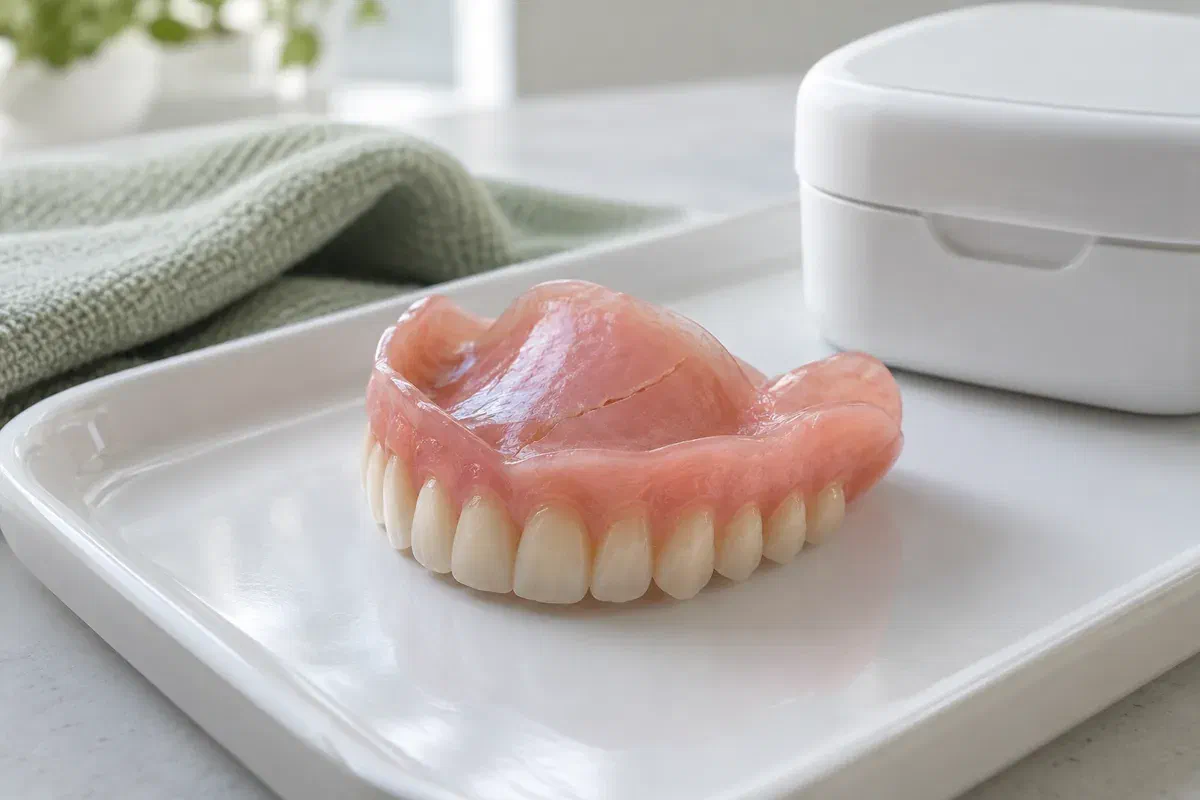
Illustrative upper denture with a fine fracture in its pink acrylic base
The history we would like to hear

Earlier repairs are part of the story.

Everyday words are perfectly fine. The more you can tell us about previous breaks and how the denture has felt lately, the better the visit can be prepared.

Where the base has failed, and how often

Is the new crack running along an old repair line or somewhere new? Is it a fine line or a full separation? Keep every piece in a hard case. Avoid squeezing the parts together in your mouth, which can make the break longer.

Teeth or clasps that keep coming loose

A denture tooth that detaches repeatedly, or a clasp that keeps loosening, can point to bite pressure in that spot. Save the part and mention any implant attachments. Leave the denture out rather than risk the piece coming off while eating.

How the fit has changed over time

Looseness, rocking, food collecting underneath and new sore spots are all worth mentioning. Joining the acrylic again will not solve a fit problem that may be causing the breaks. This information helps decide whether repair alone is worth doing.

Repeated home fixes tend to make matters worse. Glue, sanding and heat can distort the denture and weaken the area that keeps breaking.

What a considered repair can achieve

Fix it now, and understand it for next time.

When the denture is still a reasonable candidate, repairing it can bring back a familiar appliance with less disruption than starting fresh. For a recurring break, the visit is also a chance to look for the reason behind it. Ask whether the repair is meant as a long-term answer or a holding measure while something else is planned.

The clinician will consider the break, the earlier repairs, how evenly the denture rests on your gums, your bite and any natural teeth. If those suggest the denture will keep failing, a reline, adjustment or replacement may be more useful than another quick repair, and you should know what will still be uncertain afterward.

Patient information: ADA — professional adjustment and repair of partial dentures

An honest view of the old repairs

Ask how the previous repairs have held up and whether the material around them is still sound. Mending acrylic, refixing a tooth and replacing a clasp are separate tasks, each with its own timing and estimate.

A plan for the days ahead

Check when to leave the denture, whether you need to return for a fitting and how it will come back to you. Mention work, transport or care commitments. A clear arrangement saves frustration later.

Tracking down the underlying cause

Ask what might be putting stress on that area, such as fit, bite or the way the denture was built. A fit review or another long-term option might be offered. That is often what breaks the cycle of repeat repairs.

How we approach a repeat break

Repair and investigate, one step at a time.

How long it takes depends on the damage and on whether the cause needs to be addressed too. Some of it can be settled on the phone; the rest becomes clear once the denture is examined.

  1. Share the full history

    Describe the denture, the current break and the earlier ones, plus any pain or sore areas. Mention implants. Ask about appointment times rather than planning on a same-day completion.

  2. A closer look

    Bring every piece, plus any records from when the denture was made or previously repaired. The clinician checks the damage, old repair sites, the fit and your bite. Impressions may be taken if needed.

  3. Talk through the options

    Discuss whether another repair is sensible, whether the fit should be addressed, the estimate and the limits. Lab work can affect timing. Before you leave, settle how meals will work without the denture and who will phone you when it is ready.

  4. Fitting with the bite in mind

    Once repaired, the denture is tried in to confirm seating, comfort and an even bite, since uneven contact can contribute to repeat breaks. Ask about wearing and care, and book any follow-up before you leave.

Protecting the repair

Small habits that can help it last.

Follow the instructions for your denture and its repair. If pressure or movement feels different, tell the clinician instead of adjusting the appliance at home.

Notice where the force goes

Ask about any food or wearing limits after the repair. Pay attention to whether one area takes more pressure when you chew. If the denture will not seat or becomes sore, get advice instead of biting down to force it.

Avoid accidental drops

Use a cleaner suited to the material and any attachments. Clean it over a towel or water-filled basin, since a fall onto a hard sink can crack a weakened area. Ask about storage, and avoid hot water that could warp it.

Return for the fit review

With a history of breaks, routine checks matter even more. Attend any adjustment visit offered and mention lingering looseness, sore spots or chewing changes. If a reline or new denture was suggested, set a time to revisit it.

Patient information: CDA — caring for dentures

Choosing what comes next

Another repair, or a different answer?

With a recurring break, ask whether the work will fix today’s crack, the fit behind it, or both, and how much life the denture realistically has left.

When the material is still strong

One more repair

If the acrylic around the break remains sound and the fit is reasonable, a further repair may be sensible. The clinician will say what to expect from it. Finishing within the day relies on the repair type and on lab and appointment schedules.

When fit may be causing the breaks

Repair together with a reline or adjustment

A denture that rocks or rests unevenly can concentrate stress. Improving the fit may help the repair last. These are separate procedures, so ask whether they can be done together or one after the other.

When repairs keep failing

A new denture, with a stopgap

An appliance that has been repaired many times, or no longer suits your mouth, may be ready for replacement. Ask about interim options and a realistic timeline. One more temporary repair can bridge the gap if you know that is its purpose.

Questions about repeat breaks

When a denture breaks again.

A description on the phone helps with planning, but understanding a recurring break usually means examining the denture and your mouth in person.

(905) 876-4488
How many times can a denture be repaired?
There is no fixed number. It depends on the material around the break, the quality of earlier repairs and how well the denture fits. The clinician can tell you whether another repair is likely to hold or whether replacement is worth discussing.
Could my bite be causing the denture to break?
It can contribute. If the teeth meet unevenly or you clench or grind, more stress may fall on certain areas. The clinician can check how your teeth come together during the assessment.
Is a reline likely to stop it cracking again?
A reline can improve how evenly the denture is supported, which may reduce stress on weak areas, but it is not a guarantee. The clinician can explain whether your fit is part of the problem.
Why did my denture break after I dropped it only a short distance?
A denture weakened by earlier repairs or thin areas may fracture more easily. Handling it over a towel or water can help. Mention the drop and any previous breaks when you call.
Can a stronger material be used for the repair?
Repair materials and methods vary depending on the denture and the type of break. Ask the clinician which approach suits your appliance and what limitations it may have.
I am in Acton and the denture keeps breaking. How do I avoid repeated trips?
Call ahead and describe the break history so the team can plan a longer assessment if needed. Ask whether lab time is likely, and bring all pieces and records so the cause can be looked at in one visit where possible.
Acton denture repairs

Let’s look at the break and the reason behind it.

Call our Bronte Street practice with your denture’s history at hand. We can arrange an assessment, tell you what to bring and talk through whether another repair, a fit review or a new denture makes most sense.

Please call before you come in. Same-day repair can only be confirmed after an examination, and an online request does not lock in a repair time.

Visit Milton Dental Clinic
Unit 1, 342 Bronte St. S, Milton, ON L9T 5B7
Get directions Clinic hours
Monday–Thursday
11am–7pm
Friday–Sunday
By appointment only

Areas we serve

  • Milton
  • Oakville
  • Mississauga
  • Georgetown
  • Halton Hills
  • Acton
  • Campbellville
  • Brampton
  • Burlington
  • Puslinch
  • Rockwood
  • Erin
  • Caledon
  • Etobicoke
  • Old Milton
  • Bronte Meadows
  • Timberlea
  • Dorset Park
  • Dempsey
  • Clarke
  • Beaty
  • Coates
  • Harrison
  • Scott
  • Willmott
  • Ford
  • Bowes
  • Cobden
  • Walker
  • Mountain View
  • Milton Heights
  • Hawthorne Village
  • Valley View
  • Fallingbrook
  • Nassagaweya
  • Trafalgar
  • Esquesing
  • Nelson
  • Brookville
  • Moffat
  • Glen Williams
  • Norval
  • Limehouse
  • Stewarttown
  • Ashgrove
  • Hornby
  • Silver Creek
  • Speyside
  • Scotch Block
  • North Oakville
  • River Oaks
  • Glen Abbey
  • West Oak Trails
  • Palermo
  • Bronte Creek
  • College Park
  • Joshua Creek
  • Uptown Core
  • Preserve
  • Iroquois Ridge
  • Lisgar
  • Meadowvale
  • Meadowvale Village
  • Churchill Meadows
  • Erin Mills
  • Central Erin Mills
  • Streetsville
  • East Credit
  • Creditview
  • Heartland
  • Sheridan
  • Mount Pleasant
  • Credit Valley
  • Huttonville
  • Churchville
  • Springbrook
  • Northwest Brampton
  • Bram West
  • Fletcher's Meadow
  • Fletcher's Creek South
  • Alton Village
  • Orchard
  • Millcroft
  • Headon Forest
  • Tansley
  • Brant Hills
  • Tyandaga
  • Kilbride
  • Lowville
  • Aberfoyle
  • Morriston
  • Arkell
  • Hillsburgh
  • Freelton
  • Carlisle
  • Waterdown
  • Flamborough
  • Mountsberg

How can we help?

Milton Dental Clinic

Have a question about your smile? Choose the option that works best for you.

For urgent dental concerns, please call.
Messages are reviewed during clinic hours.