

Illustrative consultation about a removable denture and repair arrangements
Restorative Dentistry

Same-Day Denture Repairs in Oakville

A front tooth popping off a denture is unsettling, and so is a crack you can feel with your tongue. From Oakville, phone ahead to explain the damage, check repair availability and find out what the assessment will look at.

A gap where a denture tooth used to be

What if the tooth is gone but the base is fine?

Quite often the first sign of trouble is small: a denture tooth lifts away while you bite into an apple, or you spot a fine line running through the acrylic as you rinse it at night. Nothing hurts, yet smiling or speaking clearly suddenly feels harder. It is reasonable to want it sorted quickly, and the first job is understanding what has failed and why.

A tooth that has simply come unbonded can sometimes be reattached without much delay. Still, the reason it came loose matters. A bite that strikes that spot too hard, a thin section of base or a fit that has shifted can all play a part, and some of those need impressions, lab work or a different plan. Until the denture has been examined, same-day repair stays a possibility to check, not a certainty.

If you are travelling up from Oakville, a quick call to our Bronte Street practice can save a wasted trip. Mention whether the appliance is a full, partial or implant-retained denture, what came off or cracked, and whether your gums are tender. The team can explain the assessment, the items to bring and how to manage while the denture is being worked on.

Arrange an assessment for a damaged denture
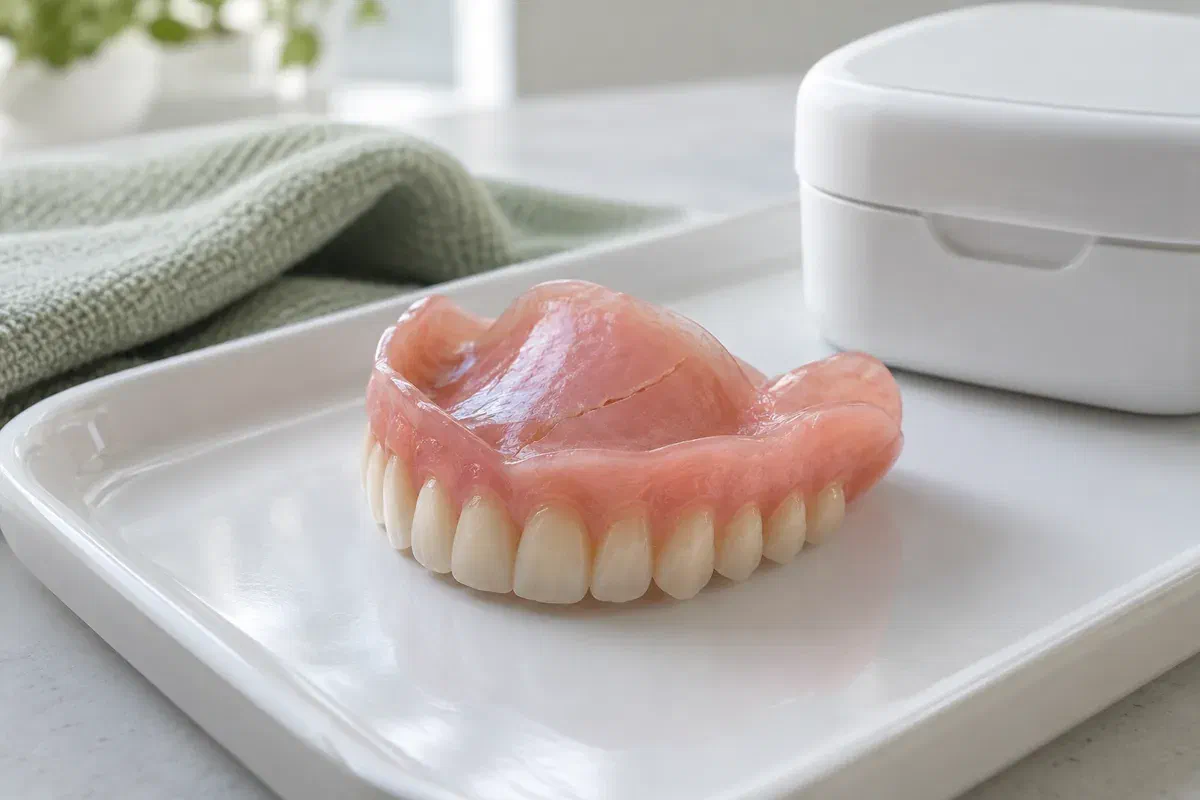
Illustrative upper denture with a fine fracture in its pink acrylic base
Before you pick up the phone

Three kinds of damage, three different conversations.

Precise terms are not required. Describing what you can see and how the denture had been feeling gives the team a better idea of how to plan your visit.

A crack through the gum-coloured acrylic

Tell us if the line is faint, if the denture has come apart, or if a corner is missing. Store all of it in a hard-sided case. Avoid flexing the pieces or pushing them into place to test the bite, which can extend the crack.

A missing tooth, clasp or attachment

Find and keep whatever came away. Metal clasps and implant fittings mean a different kind of repair, so say if your denture has either. A loose part can drop out while you talk or chew, so it is better to leave the denture out.

Signs it was struggling before the break

Mention looseness, a rocking feeling, sore patches or previous repairs. Fixing the broken area does not by itself correct a poor fit. That background helps the clinician judge whether a repair will be enough or whether more is needed.

Skip the glue and the emery board. Home repairs and reshaping can throw off the fit, weaken the acrylic and complicate the professional repair that follows.

Why speed can be worthwhile

A repaired denture can get you back to normal sooner.

When the damage is repairable, mending the denture you already have can cut short the time you spend without teeth and avoid jumping straight into a replacement. Ask early whether the planned repair is intended for the long run or to cover a gap while another treatment is organised.

That said, a fast fix is only helpful if the denture still suits your mouth. The clinician considers the break together with your gums, bite and any natural teeth that support it. A denture that keeps breaking, has worn teeth or moves too much may need another approach, and you should understand what will remain after the repair.

Patient information: ADA — professional adjustment and repair of partial dentures

Clarity on the work involved

Ask the clinician to name the damaged part and outline the repair. Bonding a tooth back on, mending a split base and fitting a new clasp are distinct pieces of work, which helps explain differences in time and estimate.

A schedule you can count on

Find out when to leave the denture, whether a try-in appointment follows and how it will come back to you. Let the team know about transport or language needs. Agreeing on this beats assuming it will be finished on the spot.

Attention to the cause

When a tooth or section keeps failing, ask what may be stressing it. A bite check or fit review may be suggested. That helps separate today’s repair from steps that could make another break less likely.

What the repair visit involves

Describe, examine, agree, fit.

The time needed depends on the damage and on the work involved. The team will say what can be settled ahead of time and what has to wait for the clinician to see it.

  1. Call to describe the problem

    Explain the type of denture, what broke, and whether there is pain or a cut. Mention implants or any earlier repair. Ask about appointment times and how to bring it in, rather than planning around a same-day deadline.

  2. Assessment in the chair

    Bring the denture, any loose teeth or fragments and any notes from when it was made. The clinician reviews the damage, the fit, and the gums or supporting teeth. Impressions or other records may be needed to plan the repair well.

  3. Agreement on the repair

    Discuss whether repair fits your situation, what it involves, the estimate and its limitations. Lab steps or new components can affect timing. Confirm how to manage meanwhile and how you will be contacted if anything changes.

  4. A check before it goes home

    The finished denture should be assessed for seating, comfort and how your teeth meet. Ask about wearing and cleaning it again. If the fix is temporary or further work is suggested, make sure that next step is clear.

Settling back in

Give the repaired denture a fair trial, gently.

Follow the instructions given for your denture and its repair. If a new rub or a wobble appears, tell the clinician rather than adjusting it on your own.

Start with ordinary meals

Ask whether to avoid certain foods for a while. Notice how the denture feels as you talk and eat everyday meals. If it does not sit down properly or becomes sore, get advice instead of biting firmly to force it.

Clean it where a drop is harmless

Use a cleaner made for its material and any attachments. Hold it over a towel or a basin of water so a slip is cushioned. Ask how best to store it out of your mouth, and avoid hot water, which can bend the acrylic.

Book the review you were offered

A repair does not replace routine checks of your mouth and denture. Keep any adjustment appointment and mention ongoing looseness, soreness or changes in chewing. If a reline or new denture was discussed, ask when to revisit it.

Patient information: CDA — caring for dentures

Which kind of fix fits

Quick is helpful only when it is also right.

A reattached tooth solves one problem; a loose fit is another. Ask which of the two the plan is meant to address, and how much of the appliance is still dependable.

When it can keep doing its job

Fixing the current denture

A repairable crack, a lost tooth or a similar fault can often be addressed while keeping the denture. The clinician will mention any limits. A same-day finish depends on the type of repair and on clinic and lab availability that day.

When fit has also been an issue

A repair plus a fit review

A denture that was slipping or sore may need adjustment or a reline in addition to the repair. Those are separate procedures with their own reasons. Ask whether they can be done in one visit or should be spread out.

When repair would fall short

A new denture, with a stopgap if needed

A badly broken, repeatedly mended or poorly fitting denture may be due for replacement. Ask about temporary options and a realistic schedule. A short-term repair can sometimes help, provided you understand it is there to cover the wait.

Repair questions we hear often

Before you make the trip from Oakville.

Describing the damage by phone helps us plan, but a reliable recommendation usually depends on seeing the denture and your mouth together.

(905) 876-4488
Why did a tooth come off my denture when I was not biting anything hard?
Bonds can weaken with time, and a bite that puts extra force on one tooth can loosen it gradually. A thin area of base may also be involved. The clinician can look at the bite and the attachment area to understand what happened.
Can a lost denture tooth be replaced if I cannot find the original?
Often a replacement tooth can be selected to match, though this may take more time than reattaching the original. Mention when you call that the tooth is missing so the team can explain what the repair may involve.
Is it safe to wear my denture with a tooth missing?
It depends on what else is loose or sharp. Ask the team when you phone. If neighbouring teeth feel unsteady or the area is rough, it is usually better to keep the denture out and eat soft foods until it is seen.
My partial denture’s clasp snapped. Can that be mended quickly?
Clasp repairs differ from acrylic repairs and may involve lab work. Bring the denture and any broken pieces, and mention the clasp when you call. The clinician can explain the options and expected timing after looking at it.
Will fixing the crack make my loose denture feel tighter?
Not usually. Joining the break does not change how the denture fits against your gums. If it was loose before, mention when that started. An adjustment, reline or replacement may be discussed alongside the repair.
How should I plan a repair visit if I am coming from Oakville?
Call first so the team can discuss timing and whether you may need to leave the denture and return. Bring all the pieces in a sturdy container and allow for the possibility of a second visit for fitting.
Planning a denture repair from Oakville

One call can save an unnecessary trip.

A short conversation with our Bronte Street team lets us hear what came off or cracked, suggest an appointment and explain how a loose tooth or broken base is usually assessed. You will know what to pack before you leave home.

Phone before setting out. We can only say whether a repair will be ready the same day after seeing the denture, and an online request does not hold a repair slot.

Visit Milton Dental Clinic
Unit 1, 342 Bronte St. S, Milton, ON L9T 5B7
Get directions Clinic hours
Monday–Thursday
11am–7pm
Friday–Sunday
By appointment only

Areas we serve

  • Milton
  • Oakville
  • Mississauga
  • Georgetown
  • Halton Hills
  • Acton
  • Campbellville
  • Brampton
  • Burlington
  • Puslinch
  • Rockwood
  • Erin
  • Caledon
  • Etobicoke
  • Old Milton
  • Bronte Meadows
  • Timberlea
  • Dorset Park
  • Dempsey
  • Clarke
  • Beaty
  • Coates
  • Harrison
  • Scott
  • Willmott
  • Ford
  • Bowes
  • Cobden
  • Walker
  • Mountain View
  • Milton Heights
  • Hawthorne Village
  • Valley View
  • Fallingbrook
  • Nassagaweya
  • Trafalgar
  • Esquesing
  • Nelson
  • Brookville
  • Moffat
  • Glen Williams
  • Norval
  • Limehouse
  • Stewarttown
  • Ashgrove
  • Hornby
  • Silver Creek
  • Speyside
  • Scotch Block
  • North Oakville
  • River Oaks
  • Glen Abbey
  • West Oak Trails
  • Palermo
  • Bronte Creek
  • College Park
  • Joshua Creek
  • Uptown Core
  • Preserve
  • Iroquois Ridge
  • Lisgar
  • Meadowvale
  • Meadowvale Village
  • Churchill Meadows
  • Erin Mills
  • Central Erin Mills
  • Streetsville
  • East Credit
  • Creditview
  • Heartland
  • Sheridan
  • Mount Pleasant
  • Credit Valley
  • Huttonville
  • Churchville
  • Springbrook
  • Northwest Brampton
  • Bram West
  • Fletcher's Meadow
  • Fletcher's Creek South
  • Alton Village
  • Orchard
  • Millcroft
  • Headon Forest
  • Tansley
  • Brant Hills
  • Tyandaga
  • Kilbride
  • Lowville
  • Aberfoyle
  • Morriston
  • Arkell
  • Hillsburgh
  • Freelton
  • Carlisle
  • Waterdown
  • Flamborough
  • Mountsberg

How can we help?

Milton Dental Clinic

Have a question about your smile? Choose the option that works best for you.

For urgent dental concerns, please call.
Messages are reviewed during clinic hours.