

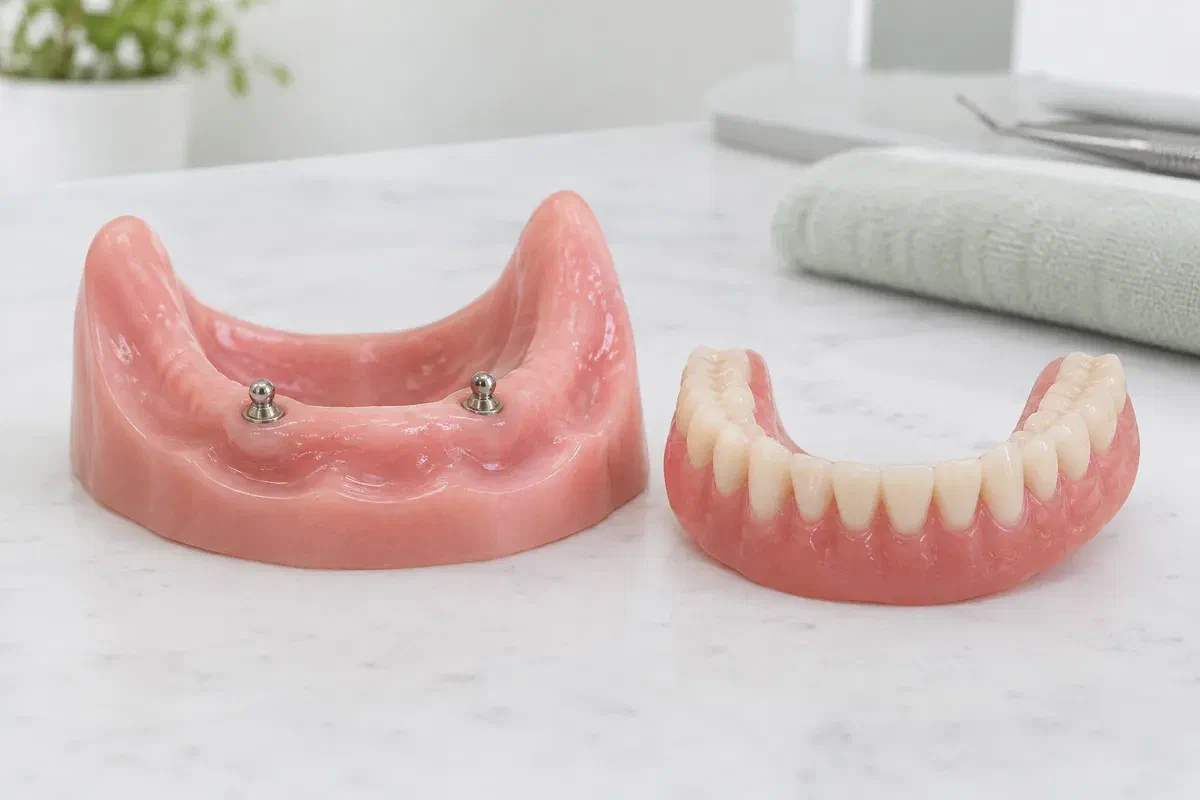
Illustrative discussion of a removable implant-retained denture
Restorative Dentistry

Snap-In Dentures in Burlington

Picture the end of the day: you unclip your teeth, rinse them and clean around small implant attachments. For people in Burlington weighing snap-in dentures, we explain that routine, plus suitability, handling and long-term upkeep.

Start with the bathroom sink

The evening routine tells you a lot.

It can help to imagine a snap-in denture at ten o’clock at night. You release it from the implant attachments, clean it, clean the attachment points in your mouth, and store it as instructed until morning. During the day those attachments help hold it steady. The design chosen for you decides the details.

That nightly step is exactly what separates it from a fixed implant bridge, which stays in and is cleaned in place. It also differs from a conventional denture with no implant connection. Comfort, handling, cleaning access, cost and the treatment needed before you can chew on the new teeth all vary among the three.

Coming from Burlington, you can expect the first appointment to focus on your present experience. What slips, what rubs, what you avoid? We examine your mouth, explain whether further implant assessment would help, and talk about whether a removable attachment design is sensible. Your current appliance is useful to bring.

Learn about removable implant dentures
Illustrative lower-jaw model with attachment heads beside a removable overdenture
Signs it may be time to ask

Small compromises that add up.

Denture looseness can come from the appliance, the gums or both. A detailed description lets the team judge whether attachments are worth investigating at all.

Avoiding certain foods or words

If you skip apples, cut everything small or speak carefully on the phone, say so. Explain whether previous adjustments helped and for how long. Implant attachments may be considered, but a better-fitting conventional denture is sometimes the first thing to try.

Hoping for security you can still remove

A removable appliance suits people who like cleaning their teeth out of the mouth. Fixed teeth suit others. Tell us which way you lean, because whether the denture comes out is a core design choice from the first plan onward.

Wondering whether the routine is manageable

Unclipping a denture needs some grip, and cleaning small attachments needs decent eyesight and steady hands. Mention any limits or the help you have at home. The plan should be realistic for you, not just attractive on paper.

A loose denture does not automatically mean implants are the answer. Where implants already support an appliance that now moves, the attachment parts and the implants both require assessment.

Two sides of the same design

Steadier by day. Hands-on at night.

Implant attachments may help a suitable removable denture feel more stable than one held by the gums alone. Connect that idea to the parts of your week that matter, such as dinners with friends or a long walk while chatting. Ask what remaining movement is considered normal.

Your share of the work is real. Inserts wear down with use, the base and teeth need checking, and the tissue around every implant must be kept clean daily and reviewed professionally. A complete plan maps out these future visits instead of ending the story at the fitting.

Patient information: Leeds Teaching Hospitals — removable implant overdentures

Implant positions planned for you

Assessment settles how many implants are suitable and where they go. Your upper and lower jaws may not follow the same plan. Ask why the arrangement proposed suits your anatomy rather than accepting a single typical number.

Full access at cleaning time

With the denture out, the fitting surface and the attachment heads are within reach. Ask the hygienist or dentist to show you which brushes to use and how to angle them. Access is worth little if the routine feels impossible.

No mystery about the mechanism

Ask to watch the attachment engage on a model and to feel the release yourself. Learn which components wear and get replaced. Knowing the mechanism makes your comparison with other replacements far more practical.

Getting from plan to placement

Assessment, design, healing, fitting.

Several visits and sometimes more than one clinician are usually involved. Before agreeing, ask for the full sequence, approximate timing and what you will wear between stages.

  1. An honest look at your starting point

    Your gums, ridges, current denture, medical history and goals are reviewed. Imaging and further implant planning may be recommended. Tell the dentist about smoking, past implant care and any handling or cleaning difficulty.

  2. Agreeing on what will be made

    You talk through implant suitability, the attachment arrangement, appearance and maintenance needs. The dentist explains whether your present denture can be adapted or a new one is preferable, and confirms which surgical, restorative and review costs are included.

  3. Implant work and healing time

    If implants are needed, they are placed and given time to heal before the attachments take on their role. Implants you already have are examined. You will hear when connection can happen and how to manage until then.

  4. Fitting night-one ready

    Fit, retention, bite and appearance are checked. You practise clipping in and releasing under supervision, then go over the cleaning method, overnight storage and the early appointments booked for adjustments.

Night-time habits that protect the design

Clean it, store it, notice changes.

Your attachment system and denture materials determine the exact steps. Take home written guidance and practise it in the chair first.

A gentle release, every time

Lift the denture out with the motion you were shown rather than prying at one corner. In the morning, seat it the same careful way, never by biting it home. If it suddenly feels tight, loose or different, give us a call.

Brush the appliance, then the attachments

Clean the teeth, fitting surface and attachment housings with products suited to your materials. Then clean the implant connections in your mouth with the brushes demonstrated. Ask before switching to a new soak, as some can affect metal components.

Treat lost grip as information

A worn insert is a common reason for reduced hold, but tissue or denture changes can be responsible too. Report movement, soreness, bleeding or a damaged piece, and resist replacing parts yourself. Keep your reviews for the implant sites.

Other ways to replace a full arch

Compare the routines, not just the smiles.

For each suitable option, ask how it is cleaned, maintained and repaired. The appearance of the teeth is one factor among several.

No implant surgery involved

Traditional denture

A new or refitted denture can be the right answer for some mouths. Ask what fit to expect and what its limits will be. Upkeep remains, but the path and parts are simpler than for an implant-retained appliance.

Attachments, removable teeth

Snap-in overdenture

Implant retention is combined with a denture you lift out. Different attachment systems have different needs. Look at stability, handling, cleaning and maintenance for the actual system offered, not the friendly nickname.

Teeth that are not removed at home

Fixed implant bridge

A fixed bridge stays in place and is cleaned around and beneath with special tools. Implant, space and upkeep requirements are different. Ask if it suits you and how its overall commitment compares with removable teeth.

Patient information: ITI — fixed and removable implant replacement considerations

Burlington snap-in denture FAQs

Care questions, answered plainly.

Watching someone demonstrate cleaning can be more useful than any leaflet. Ask to see the routine on a model before you decide.

(905) 876-4488
What tools will I need to clean around the attachments?
This depends on your attachment system and gum health. Soft brushes, small interdental brushes or specific aids may be suggested. Ask the team to show you each one and to confirm which products are safe for your denture materials.
How should I store the denture overnight?
Follow the storage advice given for your appliance and materials, which may include keeping it clean and moist. Ask what container and solution to use, and whether any cleansers should be avoided because of the attachments.
Does a snap-in denture have to come out every night?
Removable overdentures are generally taken out for cleaning and to rest the tissues overnight, but follow the specific instructions given to you. Temporary guidance may apply after treatment, so ask the clinician what is right in your case.
Can I use regular toothpaste on my denture?
Some toothpastes can be abrasive on denture materials. Ask which cleaners are recommended for your appliance and attachments. The implant areas in your mouth may have separate product advice from the denture itself.
What if my gums feel sore around the implants?
Mild tenderness can have several causes, but ongoing soreness, bleeding or swelling should be checked. Contact the clinic and describe what you notice. Keep cleaning gently as instructed unless advised otherwise.
Can a family member help with my daily care?
Yes, and it can be worth bringing them to the fitting visit so they learn the technique too. Discuss any help you rely on during planning, since it may influence which attachment design is most practical.
From Burlington to our chair

Let us show you the routine, step by step.

Book time at our Bronte Street practice to discuss a removable implant denture. Bring your present appliance and any questions about grip, cleaning, handling and the stages leading to your finished teeth.

If a current implant denture loosens without warning or becomes painful, explain what changed when you call to book.

Visit Milton Dental Clinic
Unit 1, 342 Bronte St. S, Milton, ON L9T 5B7
Get directions Clinic hours
Monday–Thursday
11am–7pm
Friday–Sunday
By appointment only

Areas we serve

  • Milton
  • Oakville
  • Mississauga
  • Georgetown
  • Halton Hills
  • Acton
  • Campbellville
  • Brampton
  • Burlington
  • Puslinch
  • Rockwood
  • Erin
  • Caledon
  • Etobicoke
  • Old Milton
  • Bronte Meadows
  • Timberlea
  • Dorset Park
  • Dempsey
  • Clarke
  • Beaty
  • Coates
  • Harrison
  • Scott
  • Willmott
  • Ford
  • Bowes
  • Cobden
  • Walker
  • Mountain View
  • Milton Heights
  • Hawthorne Village
  • Valley View
  • Fallingbrook
  • Nassagaweya
  • Trafalgar
  • Esquesing
  • Nelson
  • Brookville
  • Moffat
  • Glen Williams
  • Norval
  • Limehouse
  • Stewarttown
  • Ashgrove
  • Hornby
  • Silver Creek
  • Speyside
  • Scotch Block
  • North Oakville
  • River Oaks
  • Glen Abbey
  • West Oak Trails
  • Palermo
  • Bronte Creek
  • College Park
  • Joshua Creek
  • Uptown Core
  • Preserve
  • Iroquois Ridge
  • Lisgar
  • Meadowvale
  • Meadowvale Village
  • Churchill Meadows
  • Erin Mills
  • Central Erin Mills
  • Streetsville
  • East Credit
  • Creditview
  • Heartland
  • Sheridan
  • Mount Pleasant
  • Credit Valley
  • Huttonville
  • Churchville
  • Springbrook
  • Northwest Brampton
  • Bram West
  • Fletcher's Meadow
  • Fletcher's Creek South
  • Alton Village
  • Orchard
  • Millcroft
  • Headon Forest
  • Tansley
  • Brant Hills
  • Tyandaga
  • Kilbride
  • Lowville
  • Aberfoyle
  • Morriston
  • Arkell
  • Hillsburgh
  • Freelton
  • Carlisle
  • Waterdown
  • Flamborough
  • Mountsberg

How can we help?

Milton Dental Clinic

Have a question about your smile? Choose the option that works best for you.

For urgent dental concerns, please call.
Messages are reviewed during clinic hours.