

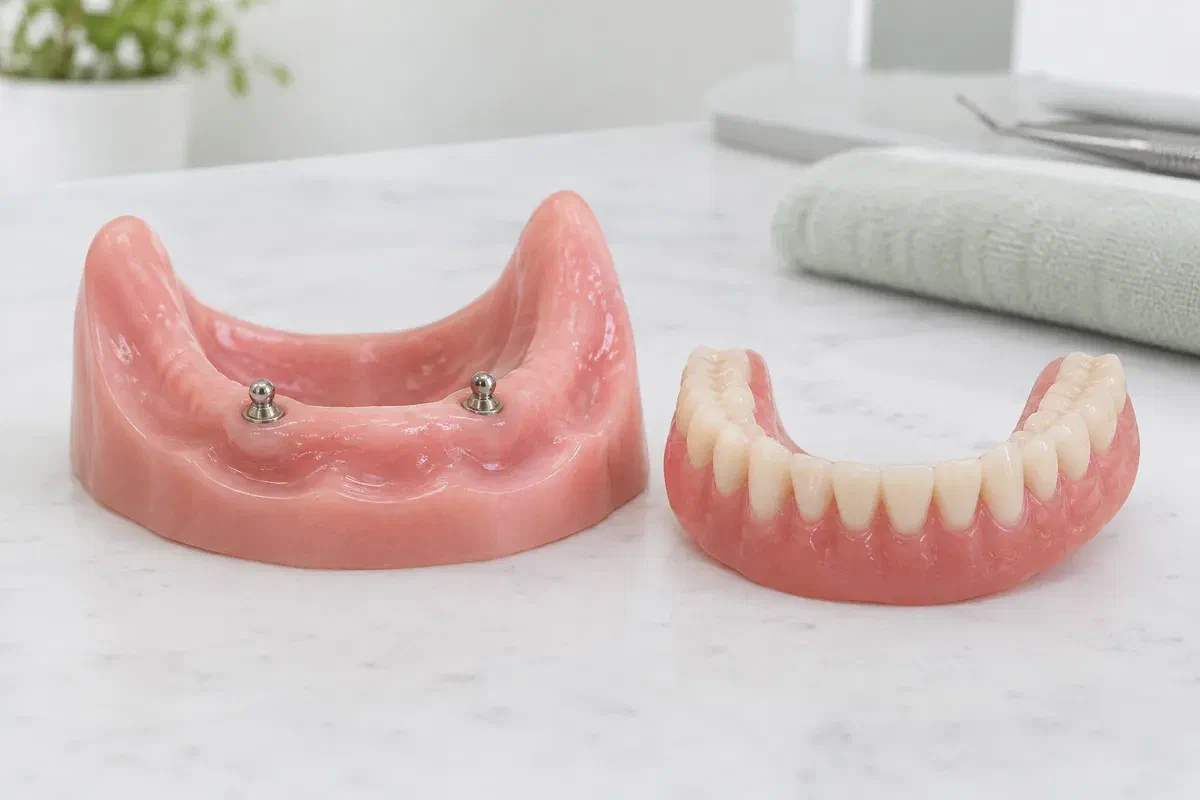
Illustrative discussion of a removable implant-retained denture
Restorative Dentistry

Snap-In Dentures in Halton Hills

What do you wear while implants heal, and when does the new denture finally click into place? For people across Halton Hills, we explain the snap-in denture timeline, suitability, everyday handling and long-term care.

The in-between months

Most of the work happens before the click.

People tend to picture the finished result: a denture pressing onto small implant attachments and holding firm. Less often do they picture the stretch before it. A snap-in denture is a removable appliance retained by implants, and getting there may include planning, surgery, healing and an interim denture.

It also helps to place it among the alternatives. A conventional denture uses no implants and sits on the gums. A fixed implant bridge stays in your mouth and is not something you take out. Those designs vary in comfort, how cleaning works, how long treatment runs and what it costs overall.

From Georgetown, Acton, Glen Williams or the smaller hamlets of Halton Hills, the starting point is the same. We ask how your current denture behaves, examine your mouth, and explain whether implant assessment is worth pursuing. Bring the appliance you use now, as it may play a part during healing.

Ask about the treatment timeline
Illustrative lower-jaw model with attachment heads beside a removable overdenture
Where the conversation begins

Something has to change. What, exactly?

A denture can lose stability for different reasons. A clear account helps the team judge the appliance, the tissues underneath and whether implant attachments belong in the plan.

Hold that no longer feels dependable

Note the moments it fails you, perhaps biting into corn on the cob or speaking at length. Mention any relines and how long their benefit lasted. Attachments may be suggested, though a better conventional fit is sometimes considered first.

A preference for teeth you can lift out

You may value taking the denture out to clean, or you may want something that never leaves your mouth. Raise it early. That single preference steers implant planning, the appliance design and the maintenance that follows.

Concerns about everyday handling

Joint pain, limited reach, eyesight changes or relying on a partner for help all deserve mention. The finished denture has to be clipped in, released and cleaned without strain, which matters as much as its appearance.

Implants are not the automatic fix for a loose denture. If you already wear an implant appliance that has started moving, the attachment hardware and the implants both need to be evaluated.

Worth the wait?

A firmer fit that still needs looking after.

When the mouth is suitable, implant attachments can give a removable denture more stability than gum support alone. Weigh that against the treatment time involved and the situations where you want the improvement. Ask what residual movement is typical for the proposed design.

Once fitted, the work shifts to maintenance. Attachment inserts wear, the denture base and teeth need periodic checks, and the gum around each implant must be cleaned daily and examined at reviews. Knowing this before you begin makes the overall commitment clearer.

Patient information: Leeds Teaching Hospitals — removable implant overdentures

Implant placement decided case by case

Assessment determines how many implants are appropriate and where they should sit. The two jaws often need different approaches. Ask for the reasoning behind your recommended layout instead of assuming a fixed formula.

Surfaces you can actually reach

Taking the denture out exposes its underside and the attachment points in the mouth. Request a demonstration of brushes and angles. Good access is helpful only if the cleaning routine is one you can maintain.

A connection explained in person

Ask to see the attachments on a model and to try clicking the denture on and off. Find out which parts are expected to wear. Understanding the mechanism makes comparing options much more concrete.

Step by step

From first exam to finished denture.

Several visits, sometimes with different clinicians, are typical. Ask about the order of stages, approximate gaps between them and what you will wear during healing.

  1. Examine and listen

    The dentist reviews your gums, ridges, existing denture, health history and goals. Imaging may be arranged if implants are being considered. Let us know about smoking, earlier implant work and anything that makes handling your denture awkward.

  2. Map out the design and stages

    Implant suitability, the attachment arrangement, appearance and maintenance are discussed, along with whether your current denture can serve during healing or later be modified. Ask which surgical, restorative and review costs the estimate covers.

  3. Heal before connecting

    If implants are placed, they need time to heal before the attachments are put into regular use. Existing implants are assessed too. Your clinician will explain the interim arrangement, what to avoid, and when connection can happen.

  4. Fit and learn the routine

    The new or adapted denture is checked for fit, hold, bite and appearance. You practise putting it in and taking it out with support, and go over cleaning, overnight care and the first adjustment appointments.

After the fitting

Small habits, long-lasting attachments.

Every attachment system has its own care needs. Ask for written guidance and a demonstration to repeat at home.

Press, don’t bite

Position the denture with your fingers and press it home as you practised. Biting down to force a connection can damage parts. Contact us if it becomes hard to remove or the click feels different from usual.

Care for the appliance and the gums

Lift the denture out and brush its teeth, the underside and the attachment recesses with suitable products. Then clean gently around each implant abutment in your mouth. Ask us first before trying a new cleaner, since some can affect metal.

Keep an eye on retention

Inserts wear down over time, but looseness can also reflect tissue or denture changes. Report movement, soreness, bleeding or damage instead of replacing components at home. Regular reviews help keep the implant sites healthy.

Other full-arch routes

Timelines and routines differ by design.

For every design you are offered, find out how it is cleaned, kept in good order and repaired, and roughly how long it takes from the first visit to the finished teeth. Appearance is just one factor.

Shorter path, no implants

Conventional denture

A new or relined denture can be appropriate without surgery. Ask what fit you can reasonably expect from your ridges. It still needs regular attention, though it avoids the healing stages an implant-retained appliance requires.

Implant hold, removable teeth

Snap-in overdenture

Implants add retention while the denture still comes out. Each attachment system has its own demands. Look at stability, handling, cleaning and expected upkeep for the specific design, rather than the label alone.

Non-removable, where appropriate

Fixed implant bridge

A fixed bridge remains in place and must be cleaned beneath with special aids. It typically has different implant and space requirements. Ask whether it suits your mouth and how its total timeline and care compare.

Patient information: ITI — fixed and removable implant replacement considerations

Halton Hills questions

Timing, healing and what to expect.

Seeing the attachments on a model makes the stages much easier to follow. Ask the clinician to walk you through the full timeline.

(905) 876-4488
How long does the whole snap-in denture process usually take?
It varies with whether implants are needed, how healing progresses and whether the denture is new or adapted. Ask for an estimated timeline at the planning stage, and expect it to be adjusted if healing needs more time.
Will I go without teeth at any point during treatment?
Plans usually aim to provide an interim denture or adjust your existing one, but arrangements vary. Ask exactly what you will wear at each stage, and for how long, so there are no surprises. If an interim denture is planned, find out whether it may need softening or adjusting as the gums settle after surgery.
Why can’t the attachments be used straight after implants are placed?
Implants often need a healing period before they are relied upon, though approaches vary by case. Your clinician will explain the timing for your situation and what loading is appropriate during healing.
Can I reuse my current denture after treatment?
In some cases an existing denture can be adapted to connect to attachments. It depends on its condition, fit, space and the implant plan. The clinician will examine it and explain whether adapting or replacing it is the better option.
What discomfort is normal after implant placement?
Some tenderness is common after surgery, and your clinician will explain what to expect, how long it usually lasts and how to manage it. Increasing pain, swelling, fever or discharge should be reported promptly.
Who should I call if something feels wrong during healing?
Contact the clinic and describe what you are noticing, including when it started and whether it is getting better or worse. Have your treatment details and medication list handy. For severe symptoms outside office hours, seek appropriate urgent care.
Book from Halton Hills

Start with a realistic timeline.

Visit our Bronte Street practice to discuss a removable implant denture and map out the stages. Bring the denture you wear today and questions about hold, cleaning, handling and the healing period ahead.

If an implant denture you already wear loosens suddenly or begins to hurt, let us know what changed when you call.

Visit Milton Dental Clinic
Unit 1, 342 Bronte St. S, Milton, ON L9T 5B7
Get directions Clinic hours
Monday–Thursday
11am–7pm
Friday–Sunday
By appointment only

Areas we serve

  • Milton
  • Oakville
  • Mississauga
  • Georgetown
  • Halton Hills
  • Acton
  • Campbellville
  • Brampton
  • Burlington
  • Puslinch
  • Rockwood
  • Erin
  • Caledon
  • Etobicoke
  • Old Milton
  • Bronte Meadows
  • Timberlea
  • Dorset Park
  • Dempsey
  • Clarke
  • Beaty
  • Coates
  • Harrison
  • Scott
  • Willmott
  • Ford
  • Bowes
  • Cobden
  • Walker
  • Mountain View
  • Milton Heights
  • Hawthorne Village
  • Valley View
  • Fallingbrook
  • Nassagaweya
  • Trafalgar
  • Esquesing
  • Nelson
  • Brookville
  • Moffat
  • Glen Williams
  • Norval
  • Limehouse
  • Stewarttown
  • Ashgrove
  • Hornby
  • Silver Creek
  • Speyside
  • Scotch Block
  • North Oakville
  • River Oaks
  • Glen Abbey
  • West Oak Trails
  • Palermo
  • Bronte Creek
  • College Park
  • Joshua Creek
  • Uptown Core
  • Preserve
  • Iroquois Ridge
  • Lisgar
  • Meadowvale
  • Meadowvale Village
  • Churchill Meadows
  • Erin Mills
  • Central Erin Mills
  • Streetsville
  • East Credit
  • Creditview
  • Heartland
  • Sheridan
  • Mount Pleasant
  • Credit Valley
  • Huttonville
  • Churchville
  • Springbrook
  • Northwest Brampton
  • Bram West
  • Fletcher's Meadow
  • Fletcher's Creek South
  • Alton Village
  • Orchard
  • Millcroft
  • Headon Forest
  • Tansley
  • Brant Hills
  • Tyandaga
  • Kilbride
  • Lowville
  • Aberfoyle
  • Morriston
  • Arkell
  • Hillsburgh
  • Freelton
  • Carlisle
  • Waterdown
  • Flamborough
  • Mountsberg

How can we help?

Milton Dental Clinic

Have a question about your smile? Choose the option that works best for you.

For urgent dental concerns, please call.
Messages are reviewed during clinic hours.