

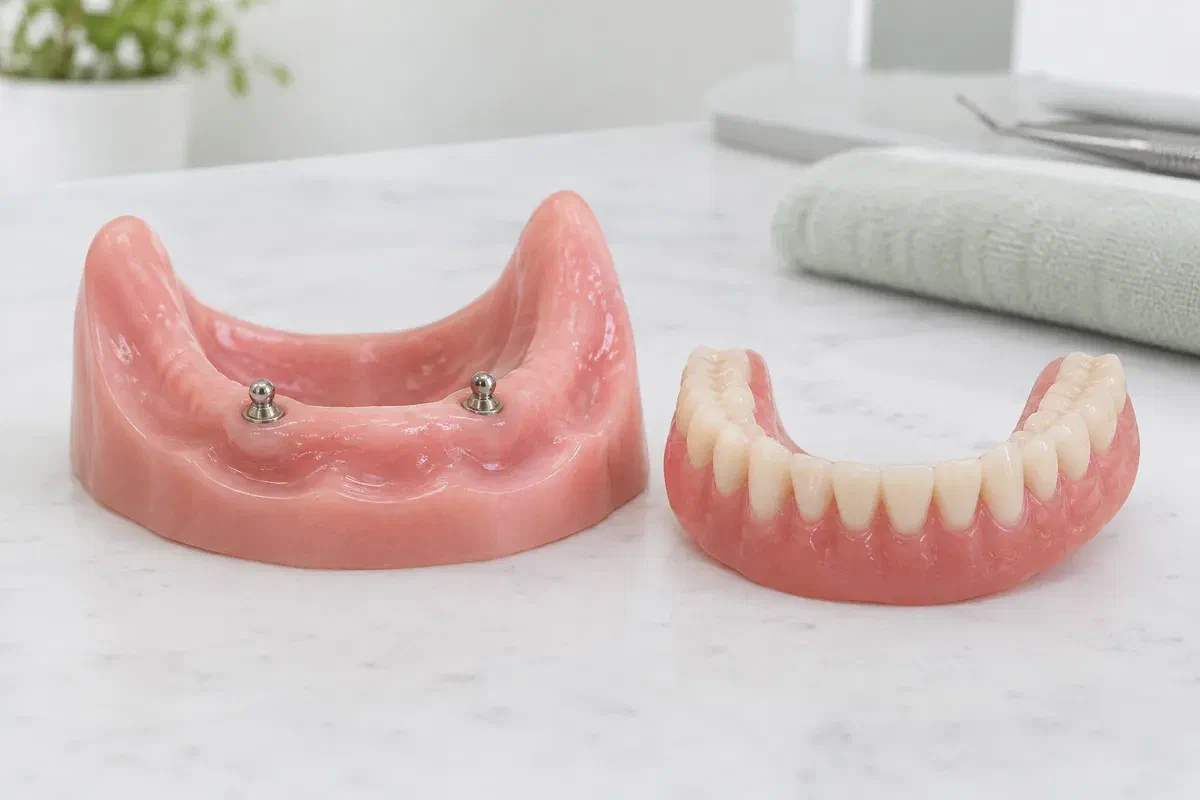
Illustrative discussion of a removable implant-retained denture
Restorative Dentistry

Snap-In Dentures in Mississauga

Tired of pressing your denture back into place mid-sentence? For adults in Mississauga, we explain how a removable snap-in denture links to implant attachments, who may be suited, and what daily handling and long-term upkeep involve.

Talking, laughing, presenting

When your teeth move, so does your attention.

A loose lower denture can turn a meeting, a phone call or a family celebration into an exercise in vigilance. Snap-in dentures are one way people try to change that. The appliance clips onto attachments connected to dental implants for added hold, yet it still comes out for cleaning and overnight as directed.

It is worth knowing what it is not. A fixed implant bridge is fastened in and not removed by you, and an ordinary denture has no implant link at all. Those differences affect how the teeth feel, how you reach them to clean, what the treatment costs and how many stages come before the final fit.

For people coming from Mississauga, including western neighbourhoods such as Meadowvale and Churchill Meadows, the first visit is mostly listening. Tell us where your current teeth let you down. We examine your mouth, explain any further implant assessment, and discuss whether a removable attachment approach fits. Bring your denture along.

See if snap-in dentures may suit you
Illustrative lower-jaw model with attachment heads beside a removable overdenture
Moments people describe to us

Hesitation, clicking, a hand over the mouth.

Several factors can make a denture unstable. The clearer your description, the better the team can evaluate the appliance, the gums and whether attachments might help.

Slipping when you speak

Certain sounds, long conversations or speaking up in a group may dislodge a loose denture. Note which situations trigger it and whether earlier adjustments made a lasting difference. A refit could help, or implant attachments may be worth assessing.

Security without giving up removal

Perhaps you want teeth that stay steady but would still like to take them out and clean them properly. Perhaps fixed teeth appeal more. Share your view early, since removability is built into the design from the first sketch.

A routine you can keep up

Busy schedules, limited dexterity or changing eyesight can all affect daily care. Let us know about these, and about anyone who helps you. Seating, releasing and cleaning the appliance should fit your real life, not an ideal one.

Implants are not the cure for every unstable denture. When existing implants sit under an appliance that has started to move, both the attachment components and the implants should be examined.

What attachments may change

Steadier conversations, ongoing care.

For suitable mouths, attachments can help a removable denture resist the lifting and rocking that often come with speech or chewing. Relate that to the parts of your day where you notice it most. Ask what movement is normal with the specific design and what improvement is realistic.

Maintenance comes with the territory. Inserts wear, the denture base and teeth still need periodic checks, and the tissue around each implant requires daily cleaning and professional monitoring. Build those visits into your expectations rather than seeing the fitting as the final step.

Patient information: Leeds Teaching Hospitals — removable implant overdentures

A layout that fits your anatomy

How many implants and where they sit are decided through assessment. The upper and lower jaws can need quite different plans. Ask the clinician to explain why the proposed arrangement suits you instead of assuming a fixed number.

Room to reach every surface

Removing the denture opens up access to its fitting surface and to the attachment heads. Ask for a demonstration of the tools and how to hold them. That access is only valuable if you can repeat the steps each evening.

An appliance you can explain to others

Ask to see the connection on a model and to try seating and removing it. Find out which parts may need replacing over time. Understanding the mechanism helps you compare the everyday experience with alternatives.

Mapping out treatment

A plan with clear milestones.

Treatment often involves multiple stages and possibly more than one clinician. Ask for the order, approximate intervals and interim denture arrangements, so you can plan around work and family.

  1. Understand your mouth and goals

    The dentist reviews your gums, current appliance, health history and what you hope to change. Imaging and further implant planning may follow. Mention smoking, previous implant treatment and any difficulty handling your denture.

  2. Decide on the restoration

    Implant suitability, attachment arrangement, appearance and long-term care are discussed. Find out whether your present denture might be adapted or a new one is recommended, and which surgical, restorative and follow-up costs the plan includes.

  3. Work through implant stages

    Where implants are needed, placement and healing come before the attachments carry their intended load. Existing implants are evaluated. The clinician explains when the denture can be connected and what to do in the meantime.

  4. Fit, practise and fine-tune

    The denture is checked for fit, hold, bite and appearance. You practise putting it in and taking it out with guidance, then review cleaning, overnight instructions and the early follow-up appointments for adjustments.

Making the new teeth part of your day

Habits that keep the connection reliable.

The exact routine depends on your attachment system and materials. Request written instructions and a demonstration you can repeat at home.

Seat it with your fingers

Press the denture into position the way you were taught, rather than biting down to make it click. If it will not connect, stop and check. Call the clinic if removal gets difficult or the connection feels different after an adjustment.

Clean in two places

Out of the mouth, clean the denture teeth, fitting surface and attachment housings with recommended products. In the mouth, clean around each implant connection using the tools demonstrated. Ask before introducing a new cleanser, as some may affect metal parts.

Pay attention to changes

Reduced hold can come from a worn insert, but also from changes in the gums or denture. Report movement, soreness, bleeding or a broken piece rather than replacing parts yourself, and keep up with reviews of the implant sites.

Alternatives worth weighing

Different designs, different daily lives.

For every suitable option, ask how it is cleaned, maintained and repaired. Looks matter, but they are not the whole decision.

For those preferring no implants

A well-fitted conventional denture

A new or adjusted denture may serve well without surgery. Ask what fit and limitations are realistic for your mouth. It still needs regular care, though its stages and components differ from those of an implant-retained appliance.

When attachments match your goals

An implant-retained overdenture

This adds implant retention while keeping the denture removable. Attachment designs vary in what they demand. Compare stability, handling, cleaning and maintenance for the system proposed rather than relying on the word snap-in.

When non-removable teeth are suitable

A fixed implant bridge

A fixed bridge stays in during daily life and needs cleaning access beneath it. Implant, space and upkeep requirements differ. Ask whether it is appropriate for you and how the total commitment compares with removable teeth.

Patient information: ITI — fixed and removable implant replacement considerations

Questions from Mississauga

Before you commit, ask these.

A quick demonstration on a model can answer questions that are hard to put into words. Ask to see insertion, removal and cleaning.

(905) 876-4488
Will a snap-in denture stop clicking when I talk?
Attachments aim to reduce movement, which may help, but any denture can make some noise. Sounds can also come from the bite or fit. Mention clicking at your adjustment visits so the cause can be looked at.
How long does it take to get used to speaking with the new denture?
Adjustment varies from person to person. A new appliance can feel unfamiliar for a while, and practising aloud may help. If speech or comfort does not improve, the team can check the fit and make adjustments.
Can I take time off work for the treatment stages?
Ask for the sequence of appointments in advance so you can plan time away. Some stages, such as implant placement, may need more recovery time than a fitting visit. The clinician can explain what to expect after each one.
Is the snap-in connection strong enough that it never comes loose?
No attachment holds forever without maintenance. Inserts wear and tissues change, so retention can gradually reduce. Report any change in hold so the cause can be identified and, if appropriate, worn parts replaced.
Can I wear my old denture while implants heal?
Sometimes the existing denture can be adjusted for use during healing, but this depends on the plan and your mouth. The clinician will give you specific instructions about what to wear and when.
Who carries out the implant surgery?
Implant treatment may involve different clinicians for different stages. Ask who will place the implants, who will make and fit the denture, and how they coordinate. Knowing this helps you understand the plan and its timing.
Mississauga to our Milton office

Book a conversation, not a commitment.

Arrange an assessment at our Bronte Street practice to look at a removable implant denture. Bring the appliance you wear now and questions about stability, cleaning, handling and each stage toward the result you want.

If your existing implant denture suddenly becomes loose or sore, describe the change when you call so we can plan accordingly.

Visit Milton Dental Clinic
Unit 1, 342 Bronte St. S, Milton, ON L9T 5B7
Get directions Clinic hours
Monday–Thursday
11am–7pm
Friday–Sunday
By appointment only

Areas we serve

  • Milton
  • Oakville
  • Mississauga
  • Georgetown
  • Halton Hills
  • Acton
  • Campbellville
  • Brampton
  • Burlington
  • Puslinch
  • Rockwood
  • Erin
  • Caledon
  • Etobicoke
  • Old Milton
  • Bronte Meadows
  • Timberlea
  • Dorset Park
  • Dempsey
  • Clarke
  • Beaty
  • Coates
  • Harrison
  • Scott
  • Willmott
  • Ford
  • Bowes
  • Cobden
  • Walker
  • Mountain View
  • Milton Heights
  • Hawthorne Village
  • Valley View
  • Fallingbrook
  • Nassagaweya
  • Trafalgar
  • Esquesing
  • Nelson
  • Brookville
  • Moffat
  • Glen Williams
  • Norval
  • Limehouse
  • Stewarttown
  • Ashgrove
  • Hornby
  • Silver Creek
  • Speyside
  • Scotch Block
  • North Oakville
  • River Oaks
  • Glen Abbey
  • West Oak Trails
  • Palermo
  • Bronte Creek
  • College Park
  • Joshua Creek
  • Uptown Core
  • Preserve
  • Iroquois Ridge
  • Lisgar
  • Meadowvale
  • Meadowvale Village
  • Churchill Meadows
  • Erin Mills
  • Central Erin Mills
  • Streetsville
  • East Credit
  • Creditview
  • Heartland
  • Sheridan
  • Mount Pleasant
  • Credit Valley
  • Huttonville
  • Churchville
  • Springbrook
  • Northwest Brampton
  • Bram West
  • Fletcher's Meadow
  • Fletcher's Creek South
  • Alton Village
  • Orchard
  • Millcroft
  • Headon Forest
  • Tansley
  • Brant Hills
  • Tyandaga
  • Kilbride
  • Lowville
  • Aberfoyle
  • Morriston
  • Arkell
  • Hillsburgh
  • Freelton
  • Carlisle
  • Waterdown
  • Flamborough
  • Mountsberg

How can we help?

Milton Dental Clinic

Have a question about your smile? Choose the option that works best for you.

For urgent dental concerns, please call.
Messages are reviewed during clinic hours.