

Illustrative discussion of a removable implant-retained denture
Restorative Dentistry

Snap-In Dentures in Oakville

Torn between teeth that stay in and teeth you can lift out? If you are coming from Oakville, we can compare a removable snap-in denture with other implant choices, covering suitability, handling and long-term care.

Fixed or removable?

The question that shapes every other choice.

Most full-arch conversations eventually arrive at one fork in the road: do you want teeth that come out, or teeth that stay? A snap-in denture sits on the removable side. It connects to attachments joined to dental implants, which help hold it, yet you take it out for cleaning and at night as advised.

On the other side of that fork is a fixed implant bridge, which you do not remove yourself. Behind both is the conventional denture, which has no implant connection at all. Each differs in cleaning access, comfort, the number of treatment stages and overall cost, so it pays to understand them side by side.

When you visit from Oakville, we start by asking what your current teeth or denture make difficult. Then we examine your mouth, explain whether implant assessment is the logical next step, and talk honestly about whether a removable attachment design fits your priorities. Bring any appliance you wear now.

Compare implant denture options
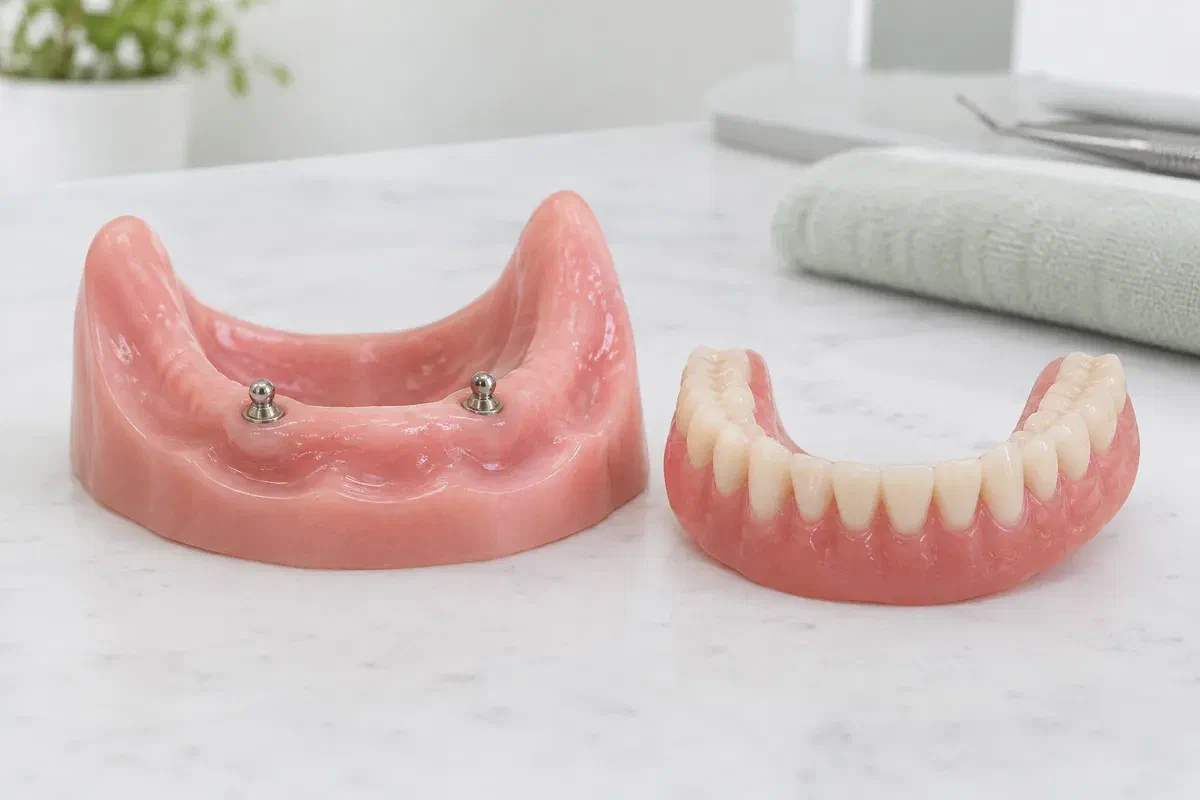
Illustrative lower-jaw model with attachment heads beside a removable overdenture
What tips the balance

Three things worth saying out loud at the first visit.

Loose dentures have more than one possible cause. Sharing specifics lets the team weigh the appliance, the supporting tissues and the role attachments might play.

When movement gets in the way

Describe the situations where your denture rocks or shifts, such as a business lunch or a long phone call. Say whether relines or adjustments have helped in the past. Attachments are one route, though improving the present fit may be considered first.

How you feel about removability

Some people value the freedom to take the teeth out and clean them at the sink. Others find the idea of a fixed bridge more appealing. Be candid, because this preference is central to the design rather than a minor detail.

Whether the routine suits your hands

Grip strength, fine finger control, eyesight and any help you rely on all affect daily care. Putting the denture in, unclipping it and cleaning it must feel manageable. A good plan respects those needs alongside appearance.

Implant attachments do not solve every denture complaint. If implants are already in place and the appliance has loosened, both the denture components and the implants need to be assessed.

Benefits, with the fine print

What a removable implant design can offer.

For the right candidate, attachments can help a removable denture stay more securely than one resting on the gums. Ask how that might translate to the activities that matter most to you. Find out what movement remains normal and what change in stability is realistic.

The trade is ongoing maintenance. Attachment inserts wear, the denture still needs periodic review, and the tissue around implants needs daily cleaning plus professional monitoring. Factor those visits into the comparison with fixed options, since both designs ask for continued care.

Patient information: Leeds Teaching Hospitals — removable implant overdentures

Implants arranged for your arch

Assessment determines how many implants are suitable and where. The upper and lower jaws frequently differ. Ask why a recommended layout suits your bone and restoration, rather than assuming snap-in always means a set number.

Easier reach for cleaning

Taking the denture out exposes its underside and the attachments in your mouth. Ask the team to demonstrate the tools and motions. Access is only an advantage if the routine is one you will really follow.

A design you can picture

Request a look at the connection on a model, and try seating and releasing it if possible. Ask which parts typically need replacing. That hands-on understanding makes comparing removable and fixed designs much easier.

The path to fitting

What happens, and in what order?

Treatment can span several stages and clinicians. Ask for the sequence, likely gaps between visits and what you will wear in the interim before you decide.

  1. Assessment and goals

    The dentist reviews your mouth, existing appliance, health history and what you hope to change. Imaging and further implant planning may be arranged. Mention smoking, earlier implant treatment and any trouble cleaning your current denture.

  2. A design decision

    Together you discuss implant suitability, the attachment arrangement, tooth appearance and maintenance. You will learn whether your present denture could be adapted or a new one is advised, and which surgical, restorative and follow-up fees are covered.

  3. Implant placement and healing, if needed

    New implants are placed and allowed to heal before attachments are relied upon. Existing implants are evaluated. The clinician tells you when connection can happen and what to wear or avoid in the meantime.

  4. Fitting and hands-on practice

    Fit, retention, bite and appearance are confirmed. You rehearse insertion and removal with the team until you feel confident. Cleaning, overnight wear and early adjustment appointments are reviewed before you go.

Once the denture is fitted

A routine for what comes out and what remains.

Follow instructions tailored to your attachment system and materials. Ask for them in writing and a demonstration you can copy.

Insert and remove with care

Place the denture using the method you were taught. Do not bite it into position when it will not seat. Contact the clinic if removing it becomes hard or the connection feels unusual, especially after an adjustment.

Clean the denture and the implant sites

With the appliance out, clean its teeth, fitting surface and attachment housings using recommended products. Clean around the implant connections in your mouth with the tools shown. Check before using any cleanser that could harm metal parts.

Book a check when hold changes

Inserts wear, though looseness can stem from other changes too. Report movement, tenderness, bleeding or damage rather than swapping parts on your own. Keep scheduled reviews for the appliance and implant health.

Side by side

Removable, retained or fixed.

Ask how each suitable option is cleaned, maintained and repaired. Appearance matters, but it is only part of the decision.

If you prefer to skip implants

Conventional denture

A new or adjusted denture without implant surgery can be appropriate. Ask what fit and limits are realistic for your mouth. It still needs care, though its treatment path and parts differ from an implant-retained appliance.

If attachments suit your goals and anatomy

Removable implant overdenture

Implants provide retention and you can still take the denture out. Attachment systems vary in their requirements. Weigh stability, handling, cleaning and maintenance for the specific system, not just the snap-in label.

If teeth that stay in are appropriate

Fixed implant restoration

A fixed bridge remains in place every day and needs cleaning access underneath. Its implant, space and upkeep needs are different. Ask whether it is suitable and how the full commitment compares with a removable option.

Patient information: ITI — fixed and removable implant replacement considerations

Oakville questions, answered

Weighing the options? Start here.

A demonstration model often explains the difference faster than a diagram. Ask the clinician to show you the wearing and cleaning routine for each design.

(905) 876-4488
Why would someone choose removable over fixed implant teeth?
Reasons vary. Some people value being able to clean the appliance out of the mouth, and the implant requirements may differ. Suitability depends on your anatomy and goals, so discuss both designs with the dentist rather than starting from a preference alone.
Is cleaning easier with a snap-in denture or a fixed bridge?
Each has its own routine. A removable denture comes out for cleaning, while a fixed bridge needs special tools to reach beneath it. Ask for a demonstration of both and consider which you could manage consistently.
Can a snap-in denture be converted to fixed teeth later?
That depends on implant number, position and the space available, which are set during planning. Do not assume a future switch is possible. If you think you may want fixed teeth one day, raise it before treatment begins.
Do upper and lower snap-in dentures work the same way?
Not always. The upper and lower jaws differ in bone, shape and how a denture is supported, so implant plans and designs may differ too. Ask the clinician to explain the approach proposed for each arch.
Will the denture feel bulky?
A removable denture covers some gum and palate area, and the amount depends on the design and your anatomy. Ask how much coverage is planned, and what adjustment period to expect while your mouth gets used to it.
Which costs should I compare between options?
Look beyond the initial treatment. Include implant stages, the appliance, reviews, hygiene visits, attachment replacements, adjustments and possible repairs. Comparing complete long-term plans gives a more accurate picture than comparing a single fee.
Consultations for Oakville

Sit down with both options in front of you.

Plan a visit to our Bronte Street practice to explore a removable implant denture. Bring your current appliance and questions about stability, cleaning, handling and the steps toward the result you want.

If an implant denture you already have suddenly loosens or hurts, mention that change when you call so we can arrange the right appointment.

Visit Milton Dental Clinic
Unit 1, 342 Bronte St. S, Milton, ON L9T 5B7
Get directions Clinic hours
Monday–Thursday
11am–7pm
Friday–Sunday
By appointment only

Areas we serve

  • Milton
  • Oakville
  • Mississauga
  • Georgetown
  • Halton Hills
  • Acton
  • Campbellville
  • Brampton
  • Burlington
  • Puslinch
  • Rockwood
  • Erin
  • Caledon
  • Etobicoke
  • Old Milton
  • Bronte Meadows
  • Timberlea
  • Dorset Park
  • Dempsey
  • Clarke
  • Beaty
  • Coates
  • Harrison
  • Scott
  • Willmott
  • Ford
  • Bowes
  • Cobden
  • Walker
  • Mountain View
  • Milton Heights
  • Hawthorne Village
  • Valley View
  • Fallingbrook
  • Nassagaweya
  • Trafalgar
  • Esquesing
  • Nelson
  • Brookville
  • Moffat
  • Glen Williams
  • Norval
  • Limehouse
  • Stewarttown
  • Ashgrove
  • Hornby
  • Silver Creek
  • Speyside
  • Scotch Block
  • North Oakville
  • River Oaks
  • Glen Abbey
  • West Oak Trails
  • Palermo
  • Bronte Creek
  • College Park
  • Joshua Creek
  • Uptown Core
  • Preserve
  • Iroquois Ridge
  • Lisgar
  • Meadowvale
  • Meadowvale Village
  • Churchill Meadows
  • Erin Mills
  • Central Erin Mills
  • Streetsville
  • East Credit
  • Creditview
  • Heartland
  • Sheridan
  • Mount Pleasant
  • Credit Valley
  • Huttonville
  • Churchville
  • Springbrook
  • Northwest Brampton
  • Bram West
  • Fletcher's Meadow
  • Fletcher's Creek South
  • Alton Village
  • Orchard
  • Millcroft
  • Headon Forest
  • Tansley
  • Brant Hills
  • Tyandaga
  • Kilbride
  • Lowville
  • Aberfoyle
  • Morriston
  • Arkell
  • Hillsburgh
  • Freelton
  • Carlisle
  • Waterdown
  • Flamborough
  • Mountsberg

How can we help?

Milton Dental Clinic

Have a question about your smile? Choose the option that works best for you.

For urgent dental concerns, please call.
Messages are reviewed during clinic hours.