

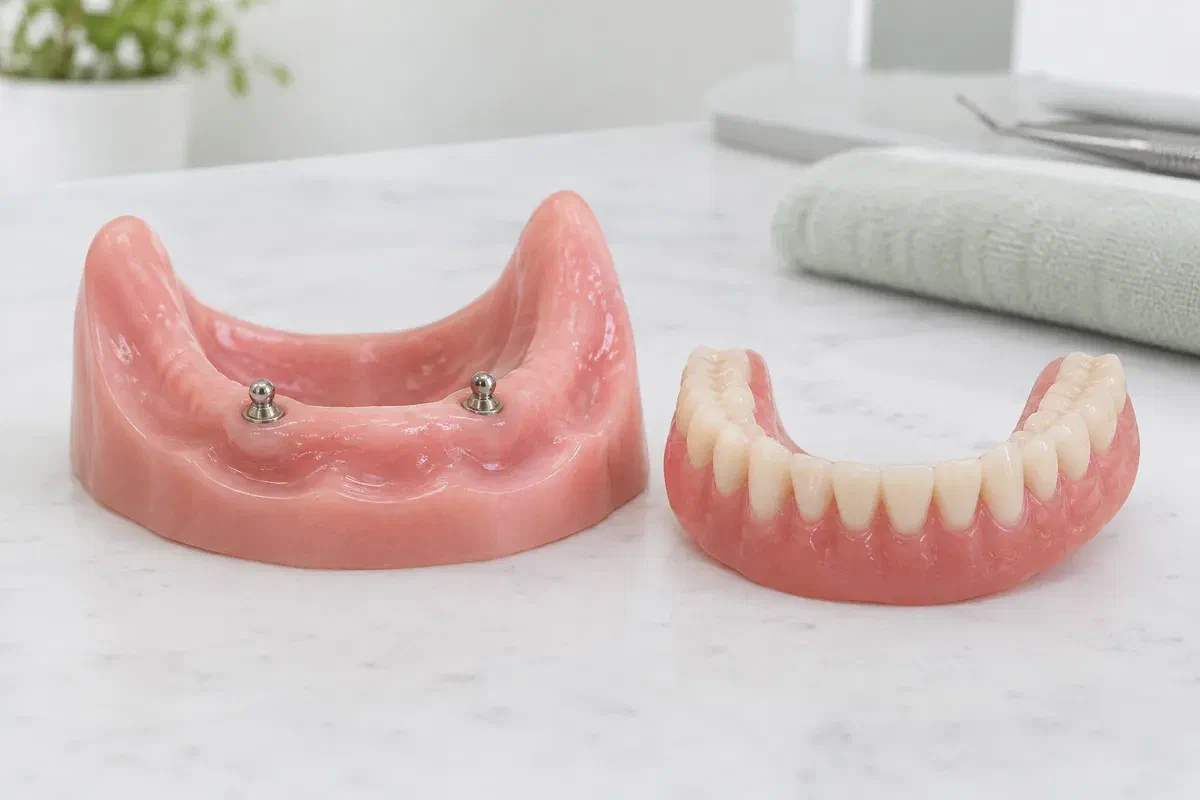
Illustrative discussion of a removable implant-retained denture
Restorative Dentistry

Snap-In Dentures in Rockwood

Before you agree to a snap-in denture plan, a few good questions can save confusion later. For adults in Rockwood, we explain how removable implant-retained dentures work, who may be suited, and what to ask about handling, cleaning and upkeep.

Before you say yes

Good questions make for a clearer plan.

It is easy to leave a consultation with a treatment name and not much else. So start with the basics. In plain terms, you are looking at a denture you can lift out that clips onto attachments joined to dental implants. Those attachments improve retention, but you still take the denture out for cleaning and overnight as instructed.

Next, ask what it is being compared with. A conventional denture involves no implant surgery and rests on the gums. A fixed implant bridge stays in the mouth and is not removed at home. The three differ in how they feel, how they are cleaned, what they cost and how many steps lie between today and the finished teeth.

When you visit from Rockwood, we encourage you to bring a written list. We will hear what frustrates you about your current situation, examine your mouth, and explain whether implant assessment is worth taking further. Bring any denture you wear now, since its condition and fit will shape several of the answers.

Bring your questions to a consultation
Illustrative lower-jaw model with attachment heads beside a removable overdenture
What you might be weighing

Three questions to answer for yourself first.

A loose denture can have several causes. Thinking through your own priorities before the visit helps the team assess the appliance, the gums and the role attachments might play.

When does my denture fail me?

Jot down the situations, perhaps chewing crusty bread, speaking for a long time or laughing. Note whether relines or adjustments made a lasting difference. That record helps decide whether attachments or an improved conventional fit should come first.

Do I want to keep removing my teeth?

Some people find removal reassuring for cleaning, while others would rather have fixed teeth. Decide how you feel before planning starts, because whether the denture comes out drives almost every other decision.

Can I manage the routine?

Be honest about grip, eyesight and any help you get at home. Seating, releasing and cleaning the denture must be practical every day. The plan should reflect those realities alongside the appearance you hope for.

Implant attachments are not the answer to every denture problem. If implants already support a denture that has begun moving, both the attachments and the implants need to be assessed.

Weighing the benefit

How much steadier, and at what ongoing cost?

For suitable mouths, attachments may give a removable denture noticeably more hold than gum support alone. Ask how that is likely to show up in the activities you care about. A useful follow-up question is what movement will still be considered normal.

Then ask about maintenance. Inserts wear, the denture base and teeth need periodic review, and the gum around each implant needs daily cleaning plus professional monitoring. Ask how often reviews are expected and what tends to be replaced, so the commitment is clear from the outset.

Patient information: Leeds Teaching Hospitals — removable implant overdentures

Why this many implants?

The number and position of implants follow from assessment of your jaw and the planned restoration. Upper and lower arches often differ. Ask the clinician to explain why the suggested arrangement suits you rather than a standard figure.

How will I clean it?

Taking the denture out gives access to its underside and to the attachments in your mouth. Ask for a demonstration of the brushes and movements. Access only helps if the routine is one you can keep doing.

What does the connection feel like?

Ask to try seating and releasing a denture on a model. Find out which parts wear and how they are replaced. Those answers help you compare the everyday experience with other options.

Mapping the stages

Who does what, and when?

Several appointments and sometimes more than one clinician are involved. Ask for the sequence, approximate intervals and interim denture arrangements in writing.

  1. Where does assessment begin?

    The dentist reviews your mouth, current denture, medical history and goals, and may arrange imaging if implants are being considered. Be ready to discuss smoking, any previous implant care and handling difficulties. It is also a good moment to ask how the findings will be explained to you afterwards.

  2. What exactly is being proposed?

    Ask about implant suitability, attachment type, appearance and maintenance. Find out whether your current denture could be modified or a replacement is recommended, and which costs for surgery, the appliance and follow-up are included.

  3. What happens during healing?

    Where implants are placed, a healing period usually comes before the attachments are relied upon. Existing implants are assessed. Ask what you will wear in the meantime and what to avoid.

  4. What will I learn at the fitting?

    Fit, retention, bite and appearance are checked. You practise seating and removing the denture with guidance, and go over cleaning, overnight care and the early adjustment visits that follow.

Questions about daily care

What will my routine actually involve?

Care instructions depend on your attachment system and materials. Ask for them in writing and a demonstration before you leave.

Is there a right way to put it in?

Seat the denture with your fingers using the method you practised. Do not bite it into place. If it will not connect normally or becomes difficult to remove, contact the clinic rather than forcing it.

What do I clean, and with what?

Clean the denture teeth, the underside and the attachment areas with recommended products. Then clean gently around the implants in your mouth using the tools demonstrated. Ask before trying any new soak or cleaner.

When should I call?

Inserts wear, but looseness can also come from changes in the gums or denture. Report movement, soreness, bleeding or a damaged part, and leave replacement to the team. Keep the reviews you were advised to book.

Questions about alternatives

What else could work for me?

Every suitable option deserves the same three questions: how is it cleaned, what upkeep does it need, and what happens when something breaks? Appearance is only part of the comparison.

Without implant surgery

Could a conventional denture be enough?

A new or adjusted denture may be appropriate. Ask what fit is realistic for your mouth and what its limits will be. It still needs care, but the treatment path and components are simpler.

If attachments suit your anatomy

Is a snap-in overdenture right for me?

Implants add retention while the denture remains removable. Attachment systems vary. Compare the hold, handling, cleaning and upkeep of the specific design proposed instead of relying on the snap-in label.

If non-removable teeth are appropriate

Would a fixed bridge suit me better?

A fixed bridge stays in and needs special cleaning underneath. Implant, space and maintenance needs differ. Ask whether it is suitable and how the full commitment compares with a removable design.

Patient information: ITI — fixed and removable implant replacement considerations

Rockwood questions

More to add to your list.

A model can help you visualise the answers. Ask to see how the denture goes in, comes out and is cleaned.

(905) 876-4488
What should a written estimate for a snap-in denture include?
Ask for each stage to be listed: assessment, imaging, implant placement if needed, the denture or adaptation, fitting and early adjustments. Ask separately about expected review, hygiene and maintenance costs, so you can see the whole picture.
Can I get a second opinion before deciding?
Yes. Implant treatment is a significant decision, and it is reasonable to take time. Ask for copies of relevant records or imaging if you would like another clinician to review the plan.
What questions should I ask about the attachment system?
Ask what type of attachment is proposed, how firmly it holds, which parts wear, how often they are typically replaced and whether replacement parts are readily available for that system.
Does insurance cover snap-in dentures?
Coverage varies widely between plans, and we cannot predict what yours will pay. Ask the clinic for treatment codes and an estimate you can submit to your insurer for a predetermination before starting.
What are the risks of implant treatment?
As with any surgical procedure, there are risks, which your clinician will explain based on your health and the plan. Ask about healing, possible complications and what happens if an implant does not integrate. Mention any health conditions or medications, as these can affect the discussion.
How do I know a snap-in denture is right for me, rather than a regular denture?
There is no single answer. It depends on your anatomy, health, goals and how you feel about surgery, removability and upkeep. A thorough assessment and an honest comparison of options will help you decide.
Consultations for Rockwood

Bring the list. We’ll work through it.

Arrange a visit to our Bronte Street practice to discuss whether a removable implant denture makes sense for you. Bring your current denture and every question about hold, cleaning, handling and the stages involved.

If a current implant denture loosens suddenly or starts to hurt, please mention it when you phone so we can arrange the right type of visit.

Visit Milton Dental Clinic
Unit 1, 342 Bronte St. S, Milton, ON L9T 5B7
Get directions Clinic hours
Monday–Thursday
11am–7pm
Friday–Sunday
By appointment only

Areas we serve

  • Milton
  • Oakville
  • Mississauga
  • Georgetown
  • Halton Hills
  • Acton
  • Campbellville
  • Brampton
  • Burlington
  • Puslinch
  • Rockwood
  • Erin
  • Caledon
  • Etobicoke
  • Old Milton
  • Bronte Meadows
  • Timberlea
  • Dorset Park
  • Dempsey
  • Clarke
  • Beaty
  • Coates
  • Harrison
  • Scott
  • Willmott
  • Ford
  • Bowes
  • Cobden
  • Walker
  • Mountain View
  • Milton Heights
  • Hawthorne Village
  • Valley View
  • Fallingbrook
  • Nassagaweya
  • Trafalgar
  • Esquesing
  • Nelson
  • Brookville
  • Moffat
  • Glen Williams
  • Norval
  • Limehouse
  • Stewarttown
  • Ashgrove
  • Hornby
  • Silver Creek
  • Speyside
  • Scotch Block
  • North Oakville
  • River Oaks
  • Glen Abbey
  • West Oak Trails
  • Palermo
  • Bronte Creek
  • College Park
  • Joshua Creek
  • Uptown Core
  • Preserve
  • Iroquois Ridge
  • Lisgar
  • Meadowvale
  • Meadowvale Village
  • Churchill Meadows
  • Erin Mills
  • Central Erin Mills
  • Streetsville
  • East Credit
  • Creditview
  • Heartland
  • Sheridan
  • Mount Pleasant
  • Credit Valley
  • Huttonville
  • Churchville
  • Springbrook
  • Northwest Brampton
  • Bram West
  • Fletcher's Meadow
  • Fletcher's Creek South
  • Alton Village
  • Orchard
  • Millcroft
  • Headon Forest
  • Tansley
  • Brant Hills
  • Tyandaga
  • Kilbride
  • Lowville
  • Aberfoyle
  • Morriston
  • Arkell
  • Hillsburgh
  • Freelton
  • Carlisle
  • Waterdown
  • Flamborough
  • Mountsberg

How can we help?

Milton Dental Clinic

Have a question about your smile? Choose the option that works best for you.

For urgent dental concerns, please call.
Messages are reviewed during clinic hours.