

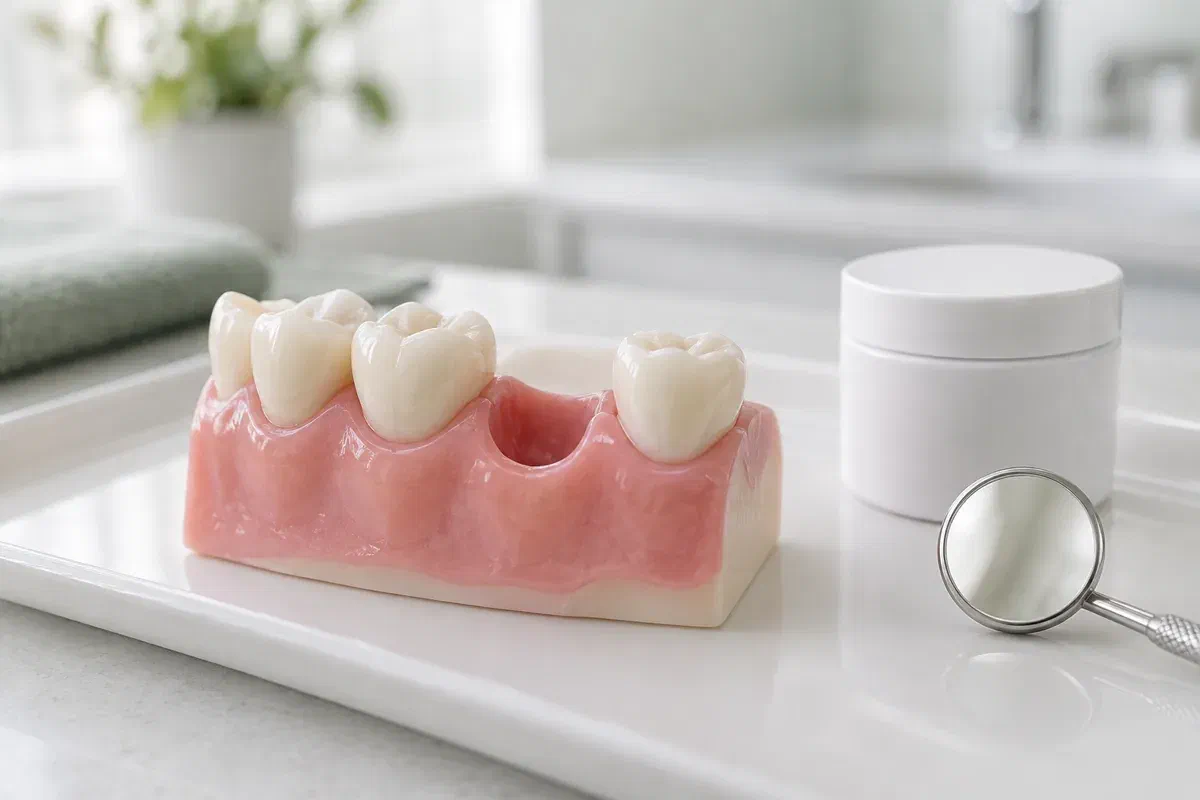
Illustrative consultation about an extraction site and future replacement planning
Restorative Dentistry

Socket Preservation in Milton

You have just heard that a tooth may need to come out. Before the removal is booked, talk with us in Milton about whether caring for the empty socket makes sense, which materials might be used, and how healing shapes the replacement choices ahead.

When removal is on the table

The question after “it has to come out” is often “then what?”

Hearing that a tooth cannot be kept tends to fill your head with the extraction itself. Yet the space it leaves behind matters too. Every tooth sits in a bony socket, and once the roots are gone, that area heals and gradually changes contour. Socket preservation is a step a clinician may suggest during the removal to help limit part of that change when it suits your plan.

In practice it usually means placing graft material into the fresh socket, sometimes covered by a membrane or similar barrier. The exact method depends on what the site looks like and your health history. It cannot save the tooth, prevent every bit of natural remodelling, or promise that an implant will be possible later.

Here in Milton, the most useful moment to ask is before the extraction date is set. Tell us why the tooth is coming out, what you already know about the area, and which replacements you are wondering about. That conversation links what happens on the day with the choices you may face once things have healed.

Ask about the socket before removal
Illustrative dental teaching model showing an empty socket between neighbouring teeth
Situations worth mentioning early

What you hope to do with the gap shapes the advice.

Nobody expects you to arrive with a final decision. Simply share the possibilities on your mind so the clinician can say whether preserving the site is worth discussing.

An implant is one possibility

Let the dentist know if you might want an implant in time. How much bone remains and where the replacement tooth would sit both feed into that planning. Ask whether preservation could help in this particular spot and which further checks would still come before any implant work.

You haven’t decided what fills the space

A bridge, a removable partial denture, or a future implant consultation may all be on your list. Bring them up before the tooth is removed if you can. The clinician can describe how the shape of the healed area might affect each route, without treating today’s step as a promise of the next.

The tooth or socket has known problems

An infection, bone loss around the root, or a cracked socket wall can change what is possible. Ask what the imaging already shows and what can only be judged once the tooth is out. Any likely change of approach belongs in the consent discussion before the appointment.

Whether to remove the tooth and whether to preserve the socket are two separate questions. Where time allows, ask about reasonable ways to keep the tooth before agreeing to an extraction that cannot be undone.

What preservation is meant to do

Keeping doors open, with honest expectations.

The goal is to soften some of the shrinkage that follows an extraction so the site better suits the replacement you may choose. Ask the clinician how much difference they expect for your tooth, in its position, with your plans. A good explanation ties the recommendation to your situation instead of treating grafting as routine after every removal.

Preservation also adds materials, fees, instructions to follow, and review visits. People heal differently, and more grafting may still be needed when a replacement is planned. Weigh what it could achieve, where it falls short, and what letting the socket heal on its own would mean for the treatment you have in mind.

Patient information: British Dental Journal — socket preservation

Tied to what replaces the tooth

Ask how this socket connects to the tooth, bridge, or appliance you may pick later. A model or an image often makes the location and contours easier to picture. You should understand why it is being suggested, even if no replacement is happening soon.

Materials explained beforehand

Graft and membrane products come from several types of source. Mention any preference or concern before the day. Ask which product is planned, why it fits this site, and whether choosing something else would alter the expected treatment.

Reviews that go past comfort

Ask when the site will be checked and what will show it is ready for the next stage. A gum that feels settled does not tell you everything about healing underneath. A booked review gives you a clear time to return to replacement choices.

From first conversation to review

Four stages, each with room for questions.

The steps vary with the tooth and the socket. Ask which parts are fixed in advance and which might shift once the tooth has been removed.

  1. Assess the tooth and talk through the future

    The clinician looks at the tooth, the tissue around it, any relevant imaging, and your medical history. You discuss why removal is advised and whether preservation fits. Mention smoking, medicines, past healing trouble, and your early thoughts on replacement.

  2. Agree on how the site will be cared for

    Go over where the materials come from, the likely technique, fees, and alternatives. Ask about stitches or a covering and whether anything will have to be taken out later. Settle what you will wear or use for appearance and chewing during healing.

  3. Extraction and socket care on the day

    If the agreed plan goes ahead and the site allows it, the clinician removes the tooth and carries out the preservation steps. What they find may change the approach. You receive comfort measures and written instructions for the procedure that was actually done.

  4. Check healing and plan what follows

    Keep the follow-up appointment and call about concerns in between. More examination or imaging may come before a replacement is confirmed. Ask whether the area needs extra preparation and when to revisit the remaining options.

The weeks after the extraction

Your instructions are written for this socket.

Hold on to the written aftercare sheet and our contact details. The technique, the materials, and any temporary tooth all influence what is right for you while the area heals.

Leave the site undisturbed

Follow the guidance on rinsing, brushing nearby, eating, and exercise. Resist pulling your lip back to look or touching the socket with a finger or tongue. Check with the team before trying a new mouthwash or cleaning aid on the area.

Confirm how to use a temporary tooth

A removable replacement or your current denture may need adjusting, or wearing less, so it does not press on the healing site. Bring it to planning visits and ask when it can go back in. Fitting comfortably does not prove the pressure is acceptable.

Report changes and keep appointments

Let the team know about pain that is getting worse, bleeding you did not expect, discharge, or worries about stitches or the covering. Say when it began and follow their advice. Never try to replace graft material or adjust the wound yourself.

Patient information: Cambridge University Hospitals — graft materials and healing considerations

Ways the site can be handled

Match today’s step to the long-term aim.

Sockets differ, so the approach does too. Ask how the condition of this one and your replacement preferences steer the recommendation.

When grafting is not chosen

Letting the socket heal naturally

A socket can heal without graft material, and the ridge and options are assessed afterwards. Ask what changes to expect and whether extra site work might be needed later. Choosing this route should be an informed decision for your situation, not a belief that future care is ruled out.

When caring for the fresh socket suits the plan

Grafting at the time of extraction

Graft material, and a covering if indicated, are placed as part of the plan you agreed. Ask about the expected benefit, the limits, and the aftercare. It does not rule out more grafting once the final replacement is being planned.

When findings point to a different order

Another sequence or a staged approach

Some sites call for ridge augmentation later or another carefully considered method. Placing an implant straight away is its own suitability question. Ask what the alternative involves and how the area will be looked after while the next step is weighed.

Socket preservation questions

Clear answers before the day of removal.

Bring questions about the extraction and about the planned socket care. They are related decisions, but each deserves its own explanation.

(905) 876-4488
Will preserving the socket make my extraction appointment longer?
It adds steps to the visit, so the appointment may take somewhat more time than a simple removal. Ask the clinician how they plan the appointment and what to expect afterwards, so you can arrange your day and any help getting home if advised.
I smoke. Does that change whether socket preservation is suggested?
Smoking can affect healing, so tell the clinician honestly about it, along with vaping or other tobacco use. They can explain how it may influence the recommendation and aftercare. Ask what support is available if you would like to cut down around the procedure.
Do I need to know whether I want an implant before we talk about the socket?
No. It helps to share the options you are thinking about, but the decision does not need to be final. Caring for the site does not commit you to an implant. Ask how preservation fits each reasonable replacement path.
Is the graft material something I can see or feel afterwards?
The area is usually covered or stitched as part of the plan, and the clinician will tell you what is normal to notice while it heals. Ask what to expect, and call if you are concerned that material or a covering has moved or come away.
If the socket turns out to be more damaged than expected, what happens?
What the clinician finds can change whether preservation is still appropriate or which technique suits. Talk about that possibility before the day and ask how such decisions are made. Any change should be explained, including what it means for aftercare and later planning.
Once the area has healed, how soon should I come back to discuss a replacement?
There is no single timetable. The clinician will suggest a review based on the site and procedure, and further imaging may be needed before replacement is confirmed. Let us know your preferred timing so the review can be planned around it.
Extraction planning in Milton

Bring the tooth, the questions, and your plans.

Book a conversation at our Bronte Street practice before a planned removal whenever you can. We will look at the tooth, walk through the socket care options, and help you see how healing ties into the replacement decisions that may follow.

If the tooth is hurting or swelling is starting, call for advice about being seen rather than waiting while you think about a replacement.

Visit Milton Dental Clinic
Unit 1, 342 Bronte St. S, Milton, ON L9T 5B7
Get directions Clinic hours
Monday–Thursday
11am–7pm
Friday–Sunday
By appointment only

Areas we serve

  • Milton
  • Oakville
  • Mississauga
  • Georgetown
  • Halton Hills
  • Acton
  • Campbellville
  • Brampton
  • Burlington
  • Puslinch
  • Rockwood
  • Erin
  • Caledon
  • Etobicoke
  • Old Milton
  • Bronte Meadows
  • Timberlea
  • Dorset Park
  • Dempsey
  • Clarke
  • Beaty
  • Coates
  • Harrison
  • Scott
  • Willmott
  • Ford
  • Bowes
  • Cobden
  • Walker
  • Mountain View
  • Milton Heights
  • Hawthorne Village
  • Valley View
  • Fallingbrook
  • Nassagaweya
  • Trafalgar
  • Esquesing
  • Nelson
  • Brookville
  • Moffat
  • Glen Williams
  • Norval
  • Limehouse
  • Stewarttown
  • Ashgrove
  • Hornby
  • Silver Creek
  • Speyside
  • Scotch Block
  • North Oakville
  • River Oaks
  • Glen Abbey
  • West Oak Trails
  • Palermo
  • Bronte Creek
  • College Park
  • Joshua Creek
  • Uptown Core
  • Preserve
  • Iroquois Ridge
  • Lisgar
  • Meadowvale
  • Meadowvale Village
  • Churchill Meadows
  • Erin Mills
  • Central Erin Mills
  • Streetsville
  • East Credit
  • Creditview
  • Heartland
  • Sheridan
  • Mount Pleasant
  • Credit Valley
  • Huttonville
  • Churchville
  • Springbrook
  • Northwest Brampton
  • Bram West
  • Fletcher's Meadow
  • Fletcher's Creek South
  • Alton Village
  • Orchard
  • Millcroft
  • Headon Forest
  • Tansley
  • Brant Hills
  • Tyandaga
  • Kilbride
  • Lowville
  • Aberfoyle
  • Morriston
  • Arkell
  • Hillsburgh
  • Freelton
  • Carlisle
  • Waterdown
  • Flamborough
  • Mountsberg

How can we help?

Milton Dental Clinic

Have a question about your smile? Choose the option that works best for you.

For urgent dental concerns, please call.
Messages are reviewed during clinic hours.