

Illustrative conversation about an interim tooth repair and the next appointment
Restorative Dentistry

Temporary Dental Restorations in Halton Hills

Dinner with a temporary filling or crown raises practical questions. For households across Halton Hills, here is how to eat, clean and plan until the tooth is properly finished.

The first meal afterwards

Supper, a temporary, and a little caution

For many people, the moment a temporary restoration becomes real is the first meal after the appointment. Suddenly there is a question about every crust and caramel. It helps to start with what you actually have: a temporary filling closing a tooth between visits, a provisional crown over a tooth shaped for a final one, or another short-term repair placed for one stage of care.

Whatever form it takes, the repair has a genuine job. It protects the tooth, gives you a usable surface for gentle chewing, and holds things in place while the next visit is arranged. What it can handle is narrower than a finished restoration, and how long it should stay depends on the material, the tooth and why it was placed.

Anywhere in Halton Hills, from Georgetown and Acton to Glen Williams, you want the practical details before leaving: what was done today, what is still ahead, which foods to set aside and what changes justify a call. If your temporary came from another clinic, bring any paperwork and we can check its condition and the intended next step.

Get practical advice about your temporary
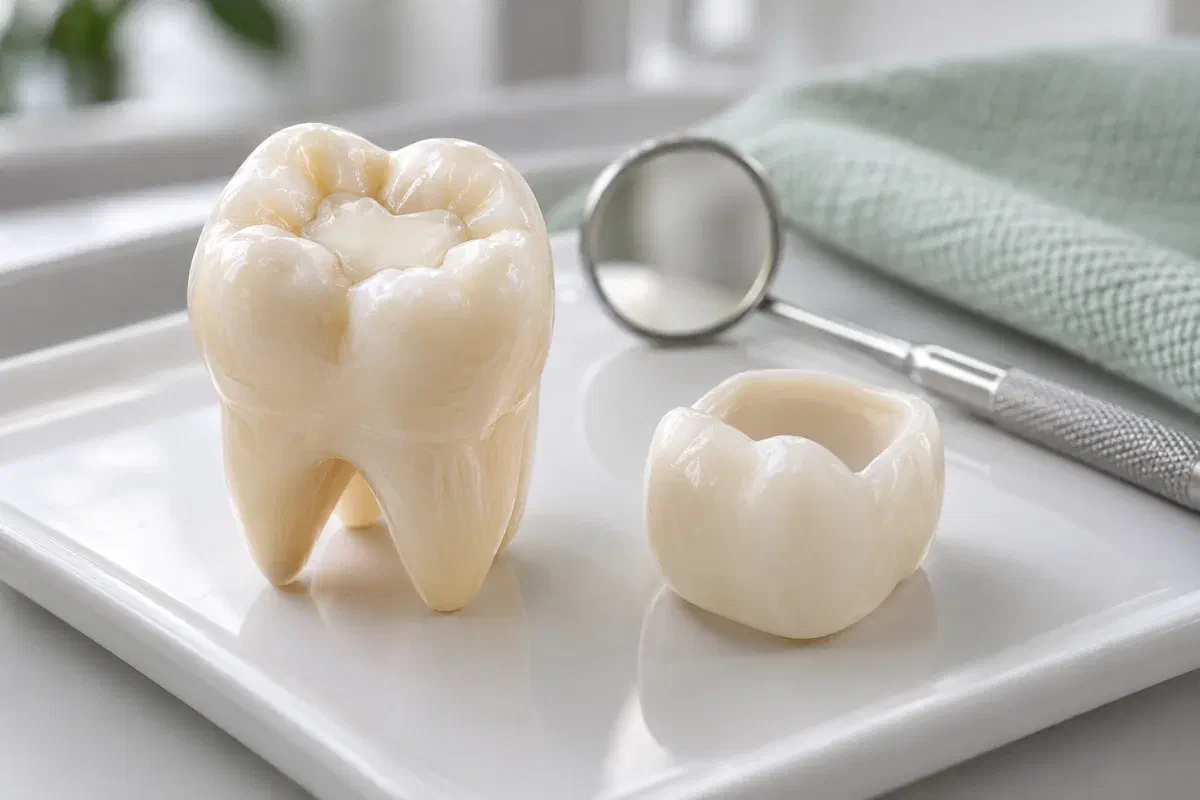
Illustrative molar model with a temporary filling beside a separate temporary crown
Different routes to the same question

How did you end up with a temporary?

The reason behind the repair shapes what you can expect from it. Tell us about the treatment and what you were told at the time.

A broken tooth patched in a hurry

If a cusp broke over a weekend meal and an urgent visit followed, the patch may have been intended only as first aid. Ask what it was for and whether more diagnosis or a final repair is still needed. Comfortable chewing does not mean the work has ended.

A crown that is still being made

Provisional crowns and bridges cover prepared teeth until the final piece arrives. Note the fitting date and ask what to avoid at meals. If a family event, harvest season or holiday might clash with that date, let us know when booking.

A tooth partway through canal treatment

A temporary filling often seals the tooth between root canal appointments or until a permanent filling or crown is placed. Ask whether the canals are complete. The answer explains what the next appointment is for and who to call.

You cannot tell from colour or comfort whether a filling is meant to be temporary. Ask the clinic that placed it to be certain.

Why it is worth the fuss

A short-term repair that keeps care on schedule

With a planned temporary in place, treatment can move forward in stages while the tooth stays covered. Its purpose might be sealing an access opening, guarding a prepared surface, or providing a provisional form for chewing and appearance. Your dentist can tell you which applies, and that answer shapes how cautious to be at the table.

Living with the temporary for a while can also teach the dentist something. Mention how your bite feels on it, whether food tends to pack around it and how easy it is to keep clean. Where relevant, those observations may help shape the final restoration, although a temporary is not always intended to reproduce every detail of it.

Patient information: Leeds Teaching Hospitals — temporary protection during crown treatment

A clear list of things to avoid

Ask which foods and habits to steer away from and how long the interval is planned to last. Short-term materials are chosen for a set stretch, not for an open-ended delay. With the limits clear, eating becomes much less guesswork.

Knowing what the next visit achieves

Find out whether the coming appointment is a check, a continuation of treatment or the placement of the final restoration. Each is different in length and purpose. You should be able to say what remains without decoding clinical notes.

A plan if it gives way

Agree in advance which clinic to phone if the repair loosens, cracks or starts to ache, especially when a specialist shares the care. Keep that number near your appointment card. Early contact lets us fit in a check before the next stage is put at risk.

How the appointment goes

Assess, explain, place, plan

Details differ with the tooth and the stage of care. Ask us to explain how the temporary fits within the whole plan, including separate visits or estimates.

  1. Find out what the tooth needs

    The dentist checks the tooth, your symptoms and any work already done. If there is an earlier temporary, describe whether it has worn or shifted. This assessment shows what needs covering or a closer look before going further.

  2. Talk through the temporary

    We explain what it is made of, what you can chew, its limits and how long it should last. Ask whether its role is comfort, protecting prepared tooth structure or sealing an opening, and which parts of treatment are still to come.

  3. Place and adjust

    The temporary filling, crown or other interim piece goes in, and the clinician checks its shape, contacts and how your teeth meet. If it feels tall when you bite or an edge catches, now is the time to say so.

  4. Leave with a date and instructions

    We agree when the next step will happen and give you food, cleaning and contact advice for this repair. When laboratory or specialist work is involved, we explain how those appointments will line up.

Meals and routines

Eat sensibly, clean gently, come back on time

Your instructions depend on what was placed. A provisional crown can need different handling from a temporary filling.

Choose the softer option

Wait until numbness wears off, then favour softer foods and the other side of your mouth if advised. Popcorn kernels, hard bread crusts, toffee and gum can all be hard on interim materials. If eating normally is awkward, tell us rather than persisting.

Clean around it carefully

Keep brushing and cleaning as usual, using the technique shown for the temporary area. With some provisional crowns, floss is drawn out sideways rather than lifted. If floss snags or an edge moves, stop pulling and call.

Keep the completion appointment

If you have to reschedule, phone so the temporary’s limits can be considered in choosing a new date. Feeling comfortable is not a reason to keep it indefinitely. Ask whether a check is needed if the wait grows longer.

Patient information: CDA — stages of root canal care and restoration

The choice after the interval

Each route depends on what the tooth shows

When you come back, the dentist will suggest completing, continuing the interval or reassessing, based on the tooth’s present condition.

When the next stage is not ready

A little longer with the temporary

The current repair may still suit the tooth, perhaps after it is touched up or renewed. Ask for the reason and a date for the next check. Choosing to wait should be an agreed decision, not a default because nothing hurts.

When the tooth can be completed

The finished restoration

A filling, crown, bridge or another agreed restoration can close out the stage. Ask what tells the dentist it is time and which checks come before placement. The right choice depends on how much tooth remains and what has been done to it.

When symptoms or findings shift the picture

A closer look

Ongoing tenderness, a crack or an unexpected finding may call for more investigation before the final repair. The dentist will explain the concern and what interim cover makes sense while it is sorted out. New temporary material on its own does not fix the underlying cause.

Halton Hills questions

Eating, drinking and daily life with a temporary

Instructions given while you are numb are easy to forget. Ask again whenever you need, and we will help you understand the stage you are in.

(905) 876-4488
Can I drink hot coffee or tea with a new temporary?
Usually yes, once the numbness has gone so you can judge temperature safely. Some people notice more sensitivity to hot or cold for a while. If sensitivity is severe, lasting or getting worse, call the clinic so the tooth can be checked.
Which foods are most likely to dislodge a provisional crown?
Sticky and chewy foods such as toffee, caramel and gum are common culprits, along with very hard items like nuts or ice. Follow the specific advice you were given, and chew on the opposite side when you can.
Is food getting caught around my temporary a sign of a problem?
Temporaries do not always have the same contacts as a final restoration, so some food trapping can happen. If it is new, frequent or comes with soreness, the fit may need checking. Mention it at your next visit or call sooner if it bothers you.
Should I avoid eating on that side completely?
Not necessarily, but many dentists suggest favouring the other side for harder foods. Your instructions will depend on the type of temporary and the tooth. Ask if you are unsure how cautious to be.
Can a temporary filling change how my bite feels?
It can. If your teeth meet differently or one spot feels high, call the clinic. A small adjustment is often all that is needed, and a high spot can make the tooth sore if left.
What if I accidentally bite something hard and the temporary cracks?
Avoid chewing on it further and call for advice. The team can tell you whether it needs to be seen soon. Keep any loose pieces if they come away and avoid pushing anything back into place.
From across Halton Hills

Let’s get you back to normal meals.

Our Bronte Street practice can check a temporary filling or crown and plan the appointment that completes the tooth. Bring whatever treatment details you have, and we will look at the repair and explain what happens next.

Call if a temporary comes out or the tooth becomes painful. Online booking is for non-urgent appointments.

Visit Milton Dental Clinic
Unit 1, 342 Bronte St. S, Milton, ON L9T 5B7
Get directions Clinic hours
Monday–Thursday
11am–7pm
Friday–Sunday
By appointment only

Areas we serve

  • Milton
  • Oakville
  • Mississauga
  • Georgetown
  • Halton Hills
  • Acton
  • Campbellville
  • Brampton
  • Burlington
  • Puslinch
  • Rockwood
  • Erin
  • Caledon
  • Etobicoke
  • Old Milton
  • Bronte Meadows
  • Timberlea
  • Dorset Park
  • Dempsey
  • Clarke
  • Beaty
  • Coates
  • Harrison
  • Scott
  • Willmott
  • Ford
  • Bowes
  • Cobden
  • Walker
  • Mountain View
  • Milton Heights
  • Hawthorne Village
  • Valley View
  • Fallingbrook
  • Nassagaweya
  • Trafalgar
  • Esquesing
  • Nelson
  • Brookville
  • Moffat
  • Glen Williams
  • Norval
  • Limehouse
  • Stewarttown
  • Ashgrove
  • Hornby
  • Silver Creek
  • Speyside
  • Scotch Block
  • North Oakville
  • River Oaks
  • Glen Abbey
  • West Oak Trails
  • Palermo
  • Bronte Creek
  • College Park
  • Joshua Creek
  • Uptown Core
  • Preserve
  • Iroquois Ridge
  • Lisgar
  • Meadowvale
  • Meadowvale Village
  • Churchill Meadows
  • Erin Mills
  • Central Erin Mills
  • Streetsville
  • East Credit
  • Creditview
  • Heartland
  • Sheridan
  • Mount Pleasant
  • Credit Valley
  • Huttonville
  • Churchville
  • Springbrook
  • Northwest Brampton
  • Bram West
  • Fletcher's Meadow
  • Fletcher's Creek South
  • Alton Village
  • Orchard
  • Millcroft
  • Headon Forest
  • Tansley
  • Brant Hills
  • Tyandaga
  • Kilbride
  • Lowville
  • Aberfoyle
  • Morriston
  • Arkell
  • Hillsburgh
  • Freelton
  • Carlisle
  • Waterdown
  • Flamborough
  • Mountsberg

How can we help?

Milton Dental Clinic

Have a question about your smile? Choose the option that works best for you.

For urgent dental concerns, please call.
Messages are reviewed during clinic hours.