

Illustrative conversation about an interim tooth repair and the next appointment
Restorative Dentistry

Temporary Dental Restorations in Oakville

Your crown is being made and a provisional one is standing in. Coming from Oakville, learn how to live with it for now and what has to happen before the final fitting.

The weeks before fitting day

A stand-in crown on a prepared tooth

Once a tooth has been shaped for a crown, it usually cannot be left bare while the permanent piece is made. A provisional crown covers it in the meantime. The same idea applies to other interim repairs, such as a temporary filling that seals a tooth between visits, each placed for a specific part of a larger plan.

Think of the provisional as a working cover with a short lease. It shields the prepared surface, keeps a shape you can chew with, and helps the gap until fitting day pass more smoothly. It is not built like the final crown, though, and how long it should stay depends on its material, the tooth and why it was needed.

Before leaving, ask what was done at this visit and what the fitting appointment will involve. Driving in from Oakville, it helps to have the date, the food and cleaning advice and the warning signs written down. If a provisional was placed at another office, bring the details and we can assess its condition and the intended next step.

Talk about your provisional crown
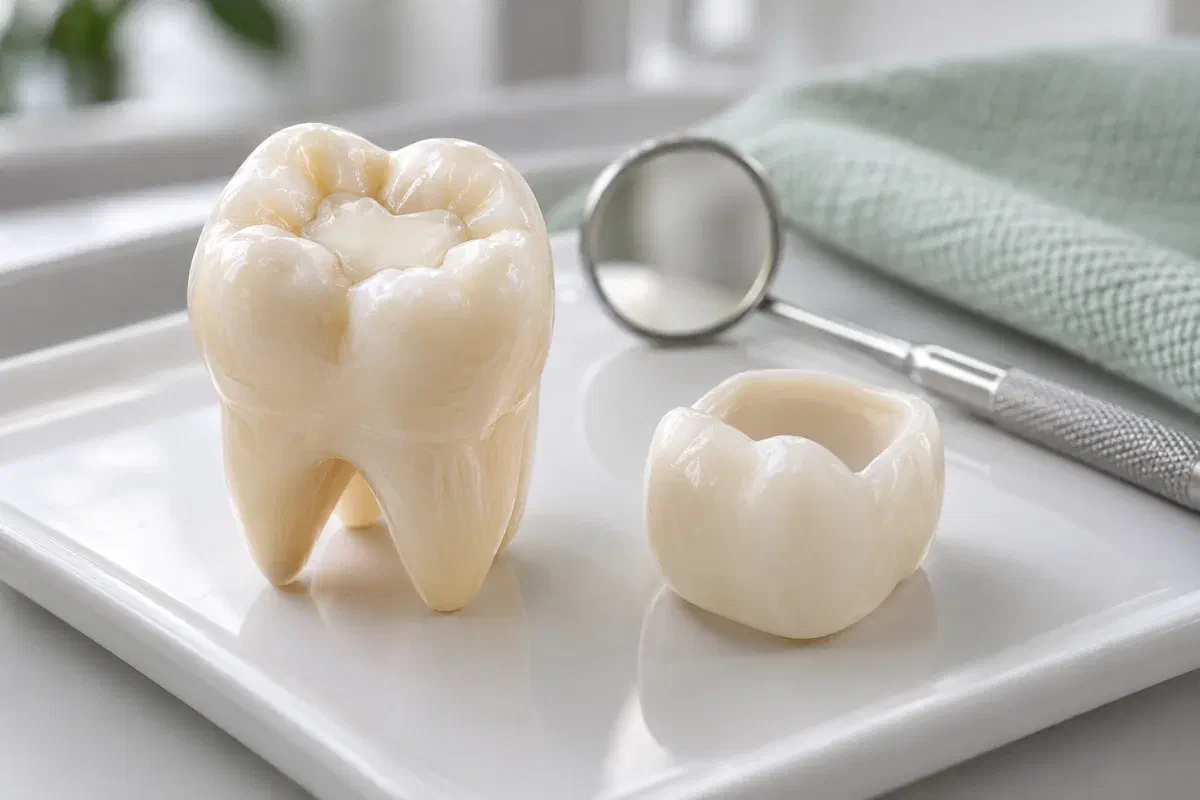
Illustrative molar model with a temporary filling beside a separate temporary crown
Questions to settle early

Comfort now, completion later

Temporary covers can be part of very different treatment stories. Tell us what has been done so far and what you were told to expect.

An emergency cover

If the interim repair went on during an urgent appointment for a broken or painful tooth, it may have been a first response rather than a plan. Ask whether a diagnosis or definitive restoration is still needed. Pain settling down is not proof that the tooth is finished.

A crown or bridge still at the lab

Provisional crowns and bridges protect prepared teeth while the final work is made. Keep the fitting date in view and follow the eating and cleaning instructions. If a business trip or family event clashes with that date, let us know early.

A tooth partway through root canal care

When treatment inside the tooth spans more than one visit, a temporary filling often seals it between appointments. Ask whether canal treatment is ongoing or complete. Knowing this tells you who to contact and what the next visit is meant to accomplish.

A repair can look and feel permanent and still be interim. If you are unsure, the clinic that placed it can confirm what it is.

Why a provisional is worth having

It keeps the plan moving and the tooth covered.

Staged treatment needs something to hold the tooth between steps, and a planned provisional does that. It might protect prepared surfaces, close an access opening or offer a temporary form for eating and appearance. Which of those roles it plays shapes how you should treat it.

Wearing a provisional for a few weeks can be useful in another way. Your experience of the bite, the ease of cleaning and the look of the tooth may give the dentist information for the final crown where relevant. Some features of the finished crown will still differ, since a provisional is not always meant to imitate them.

Patient information: Leeds Teaching Hospitals — temporary protection during crown treatment

Know where its strength ends

Ask which foods or habits to avoid and how long the provisional is planned to stay. Interim materials can wear or loosen if the wait stretches on without a plan. Knowing the boundaries lets you use the tooth confidently until fitting day.

Clarity about the fitting visit

Find out whether the next appointment is a check, a continuation of treatment or the placement of the final crown. Each one is different. You should be able to describe what remains without needing to decode clinical language.

A contact for surprises

If the provisional loosens or a symptom returns, you should already know who to call, especially when another office or specialist is involved. Keep that number with your appointment details. A prompt call makes it easier to sort things out before the next stage.

From preparation to provisional

What happens at the interim appointment

Every tooth and treatment stage is a little different. Ask to see where the provisional fits in the full plan, along with any further visits or estimates.

  1. Assess the reason for a cover

    The dentist reviews the tooth, any symptoms and the work already done. Mention an earlier temporary and whether it changed. This step shows what needs protecting, or investigating, before the crown or other restoration can proceed.

  2. Describe the provisional and its limits

    You will hear about the material or design, how to use it, what it cannot handle and how long it should last. Ask whether its main purpose is comfort, protecting prepared tooth structure or sealing an opening, and what treatment is still ahead.

  3. Fit and fine-tune it

    The provisional crown, temporary filling or other interim piece is placed to suit the situation, then its shape, contacts and bite are checked. Tell the clinician about a high point or a sharp margin before you get up from the chair.

  4. Confirm fitting day and the interim rules

    Agree on when the final restoration will be placed or the tooth reviewed. Ask for eating, cleaning and contact advice for this provisional. If a laboratory or specialist is involved, find out how their part will be coordinated with your appointment.

Living with a provisional

Treat it kindly until the real crown arrives

Follow the advice given for the restoration you have. A provisional crown may need different handling from a temporary filling.

Go easy on that side

Let the numbness fade before eating, and follow the food guidance you were given. Steer clear of sticky or very hard foods that could pull or crack the provisional. If normal chewing feels off, tell the clinic rather than repeatedly testing it.

Floss with a gentle exit

Brush as usual and clean the provisional area the way you were shown. With many provisional crowns, sliding floss out to the side is gentler than snapping it upward. If floss snags or the crown shifts, stop and call for advice.

Protect the fitting appointment

If the date must move, call so the provisional’s limits can be weighed when rebooking. A comfortable provisional should not simply be left in place indefinitely. Ask whether a review is needed if the interval becomes longer than planned.

Patient information: CDA — stages of root canal care and restoration

After the interim stage

Each path from here has its own reason

The right step depends on how the tooth is doing now. You may be ready for completion, or a review or revised plan may make more sense.

When the wait is not over

Keep the provisional a little longer

The provisional may still be the right cover until the next step, or it may need adjusting or replacing. Confirm why and set a review date. Staying with a provisional should be a choice made deliberately, not because it has stopped bothering you.

When everything is ready

Fit the definitive crown or filling

A crown, bridge, filling or another agreed restoration may complete the stage. Ask what tells the dentist the tooth is ready and what will be checked first. The final choice depends on the remaining structure and the work already done.

When a symptom or finding raises questions

Investigate a change first

Ongoing discomfort, a crack or something unexpected may call for more assessment before the final piece is placed. The clinician can explain what changed and how the tooth will be protected meanwhile. Replacing the provisional alone does not solve every underlying problem.

Provisional crown questions

What people ask while they wait for a crown

If the appointment felt rushed or you were nervous, ask us to go over the instructions again. We are happy to explain the stage you are in.

(905) 876-4488
Why can a prepared tooth not just wait uncovered until the crown is ready?
A shaped tooth can be more exposed, and the space it occupies needs to be maintained so the final crown fits as planned. A provisional helps with both. Ask your dentist what risks apply to your particular tooth.
Is some sensitivity under a provisional crown normal?
Mild sensitivity to temperature can occur while a prepared tooth is covered by a provisional. Pain that is worsening, throbbing or keeping you awake, or any swelling, should be reported promptly so the tooth can be checked.
Can I brush a provisional crown like my other teeth?
Generally yes, with a soft brush and normal technique, unless you were told otherwise. The area between teeth usually needs the most care. Follow the method demonstrated at your appointment.
What if the provisional feels higher than my other teeth when I bite?
Call the clinic. A high spot can make chewing uncomfortable and place extra force on the tooth. It is often a quick adjustment, and it is better handled than tolerated until fitting day.
Could my final crown look different from the provisional?
Yes, and that is common. Provisional materials have appearance limits. Share any preferences or concerns, and ask how the shade and shape of the final crown will be chosen before it is made.
How should I plan my visits if I am coming from Oakville?
Ask for the fitting date and a contact number before you leave, and book the completion visit at a time you can reliably keep. If the provisional comes loose, call first so we can advise whether you need to come in.
Provisional care for Oakville

We will get you from provisional to finished.

Our Bronte Street practice can check a provisional crown or temporary filling and plan the appointment that completes your care. Bring any records you have so we can assess the tooth and explain what is protecting it now.

Phone if a provisional comes off or the tooth starts to hurt. Online requests are for non-urgent appointments.

Visit Milton Dental Clinic
Unit 1, 342 Bronte St. S, Milton, ON L9T 5B7
Get directions Clinic hours
Monday–Thursday
11am–7pm
Friday–Sunday
By appointment only

Areas we serve

  • Milton
  • Oakville
  • Mississauga
  • Georgetown
  • Halton Hills
  • Acton
  • Campbellville
  • Brampton
  • Burlington
  • Puslinch
  • Rockwood
  • Erin
  • Caledon
  • Etobicoke
  • Old Milton
  • Bronte Meadows
  • Timberlea
  • Dorset Park
  • Dempsey
  • Clarke
  • Beaty
  • Coates
  • Harrison
  • Scott
  • Willmott
  • Ford
  • Bowes
  • Cobden
  • Walker
  • Mountain View
  • Milton Heights
  • Hawthorne Village
  • Valley View
  • Fallingbrook
  • Nassagaweya
  • Trafalgar
  • Esquesing
  • Nelson
  • Brookville
  • Moffat
  • Glen Williams
  • Norval
  • Limehouse
  • Stewarttown
  • Ashgrove
  • Hornby
  • Silver Creek
  • Speyside
  • Scotch Block
  • North Oakville
  • River Oaks
  • Glen Abbey
  • West Oak Trails
  • Palermo
  • Bronte Creek
  • College Park
  • Joshua Creek
  • Uptown Core
  • Preserve
  • Iroquois Ridge
  • Lisgar
  • Meadowvale
  • Meadowvale Village
  • Churchill Meadows
  • Erin Mills
  • Central Erin Mills
  • Streetsville
  • East Credit
  • Creditview
  • Heartland
  • Sheridan
  • Mount Pleasant
  • Credit Valley
  • Huttonville
  • Churchville
  • Springbrook
  • Northwest Brampton
  • Bram West
  • Fletcher's Meadow
  • Fletcher's Creek South
  • Alton Village
  • Orchard
  • Millcroft
  • Headon Forest
  • Tansley
  • Brant Hills
  • Tyandaga
  • Kilbride
  • Lowville
  • Aberfoyle
  • Morriston
  • Arkell
  • Hillsburgh
  • Freelton
  • Carlisle
  • Waterdown
  • Flamborough
  • Mountsberg

How can we help?

Milton Dental Clinic

Have a question about your smile? Choose the option that works best for you.

For urgent dental concerns, please call.
Messages are reviewed during clinic hours.