

Illustrative consultation about a temporary replacement for missing teeth
Restorative Dentistry

Temporary Partial Dentures in Campbellville

The first evening at home with a new partial is when questions come up. For households in Campbellville, we make sure you can handle the appliance confidently and group visits sensibly before you leave.

Confidence at home

In, out and looked after

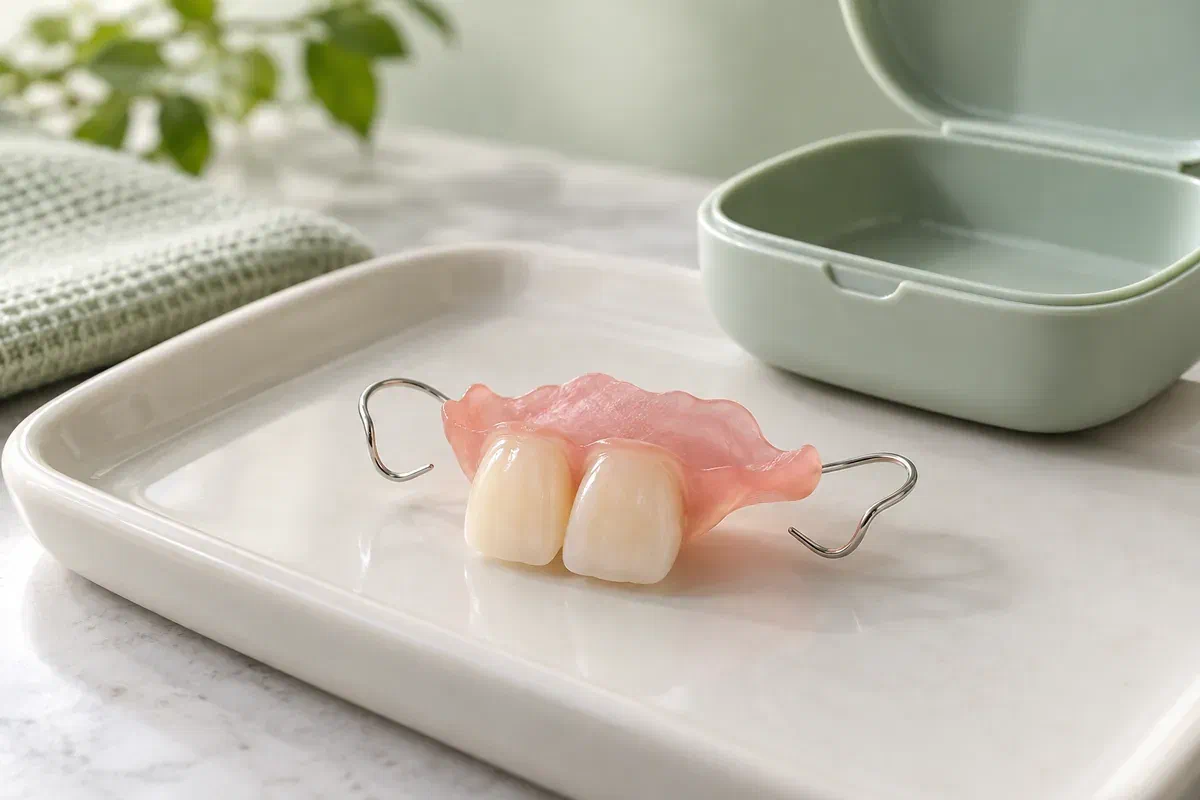
Picture the first night after fitting. The appliance needs to come out, be cleaned and go somewhere safe, then go back in the next morning without a struggle. Small skills like these shape how you feel about a temporary partial denture: a removable piece that carries one or more replacement teeth for a limited time while healing or other care is completed. Lightweight acrylic designs are often called flippers.

Confident handling begins with knowing what the appliance is for. Do you need it mostly when you are out, all day at work, or for meals too? Your answer guides the design, along with the health of your remaining teeth, the gum ridge where the tooth was and any treatment that has yet to happen.

Rural households often prefer fewer, well-grouped visits, and from Campbellville that can help with farm, family or commuting schedules. Whatever the timing, a temporary appliance still comes with clear limits and a review date. If a specialist or another dentist has been part of your care, bring their notes so the partial suits the existing plan.

Ask about fitting and handling a partial
Illustrative removable acrylic partial appliance with two replacement front teeth
When people ask about one

What brings the question up?

A clinical assessment shows whether a temporary partial is a good fit, how soon it might go in and which changes to expect. Active disease and the care of the teeth you keep still need to be addressed separately.

There is an extraction ahead

For a tooth that shows, ask about a replacement before the removal date. An immediate partial is made from records taken beforehand and inserted after the extraction if suitable. It depends on early coordination, so it cannot be assumed just because removal is booked.

The full plan has several stages

Waiting on healing, gum care or an implant review may stretch things out. Ask whether wearing an appliance is safe for you in that time, and whether a surgical site needs to be left without pressure while it recovers.

The final choice can wait

Some people would like the gap covered while they think over fixed, removable and implant-based choices. Bring up budget and priorities at the beginning. An interim appliance does not commit you to a particular final option.

The partial hides the gap but leaves the cause alone. Ongoing pain, infection, gum disease or vulnerable neighbouring teeth require their own diagnosis and management.

Benefits and boundaries

Worth having, within its limits

A temporary partial can make the gap much less obvious while you heal and plan. The shade and form of its tooth are chosen to suit your smile. How it feels day to day depends on more: the thickness of the base, its grip, its effect on speech and how it meets your opposing teeth.

Interim appliances are usually not designed for every texture of food or for the firmness of a completed long-term tooth. It is worth asking what yours can do and what signs mean it needs a check. A sound plan gives an honest account of both the present benefits and the remaining work.

Easy to clean once you know how

You take it out as instructed for cleaning and to rest the tissues. There is a particular angle and pressure to it, so practise in the chair with someone watching until it feels natural.

A smoother change

Knowing a planned replacement will fill a front-tooth gap can make the change less daunting. Mention dates that matter early, leaving time for assessment, making the appliance and adapting to it.

A planned check-in

The interim period includes a natural point to revisit comfort and your long-term choice as healing continues. Confirm who books that visit and whether it can be grouped with other appointments.

Visit by visit

Handling is taught, not left to chance

Share planned extraction dates, specialist visits and busy seasons at home or work. We can then explain what is realistic, which appointments might be grouped and where timing should remain flexible.

  1. Look at the whole mouth

    We examine the space or the tooth due for extraction, the gums and bone beneath and the teeth alongside. Your health history and daily routine are part of the conversation. If more records or X-rays would help, they may be suggested before the appliance is designed.

  2. Capture records and settle the plan

    Impressions or another suitable method record the shape of your mouth. We explain the proposed design, an itemized estimate and the order of visits. Ask whether adjustments, relines or a later replacement appear as separate charges.

  3. Fit, then practise until it is easy

    The appliance is tried in, its contact with teeth and gums is checked and pressure points are relieved. Then you take it in and out several times while we guide you. After an extraction, you also receive care instructions for the healing socket.

  4. Check back as you heal

    A follow-up reviews comfort, stability and how cleaning at home is going. As the gums settle, the fit may change and need attention. We also look ahead to the next stage, so the interim appliance is reassessed rather than left in place indefinitely.

Everyday handling

Simple habits for the appliance and your mouth

Follow the instructions written for your partial. In the early days after an extraction, the routine may differ from later on, so call if anything you were told seems unclear.

Remove it over something soft

Handle the appliance over a folded towel or a basin of water so a slip does not crack it. Clean it as advised for its material, then clean your own teeth, paying attention around the clasps, where plaque can gather.

Eat with caution at first

Check whether the partial should stay in for meals. If so, start with soft foods in small pieces. Avoid biting hard foods with the replacement front teeth, and do not test it on anything tough.

Keep it safe, keep repairs professional

Store the appliance in its case, away from pets and children. If it rubs, rocks, cracks or will not seat, call us. Do not bend clasps, sand it or glue it; bring it and any broken pieces in.

Patient information: American Dental Association — removable partial denture care

Beyond the temporary partial

Lasting replacements to talk about

The interim appliance is a stage, not a prediction of the final result. Revisit your preferences as you heal, considering your remaining teeth, the number of visits involved and the care each option needs.

Removable, built for longer wear

A definitive partial

When the tissues are stable, a long-term partial can be planned. Its design may differ from the interim one. Ask how it would stay in, which teeth would support it, what parts might show and how it is cleaned.

When nearby teeth can carry it

A fixed bridge

A bridge does not come out and relies on suitable support. The health of the teeth beside the gap, its width and your bite decide whether it is an option. Ask how those teeth would be prepared and how you would clean around them.

When an assessment favours it

An implant-supported tooth

Implant care calls for a separate look at your health, bone, gum tissue and space, plus a frank discussion of surgery, healing, fees and maintenance. Wearing a temporary partial does not show you are suitable, and you can still choose another route.

Patient information: Leeds Teaching Hospitals — partial dentures and alternatives

Questions from Campbellville

Handling, storage and the next visit

Ask about daily wear, a planned extraction or what happens when the interim stage ends. The more specific your question is to your own appliance and plan, the more useful our answer can be.

(905) 876-4488
What if I cannot get the partial back in at home?
Do not force it. Check that you are holding it the right way round and guiding it along the path you practised. If it still will not seat, or the area is sore or swollen, call the clinic for advice before trying again.
Is it normal for the clasps to feel tight at first?
A new appliance can feel snug, and some pressure may ease over the first days. Pain, sore spots or difficulty removing it are reasons to book a check. Do not bend the clasps yourself, as that can affect the fit or damage them.
Can my visits be grouped with other family appointments?
Often we can try. Let us know who else in your household needs care and which days suit you. Some steps need time in between, such as healing or lab work, so not every appointment can be combined.
Can pets really damage a partial?
Yes. Dogs in particular may chew a denture left within reach. Keep the appliance in a closed case, up high, whenever it is out of your mouth. If it is damaged, bring it in rather than trying to repair it.
Should I take the partial out for sports or strenuous activity?
Ask the dentist about your activities. A removable appliance may need to come out for contact sports, and a suitable mouthguard arrangement may be discussed. Do not wrap it in a tissue or put it in a pocket, where it is easily lost or broken.
When might a temporary partial need relining?
After an extraction, the gums and bone reshape as they heal, so a partial made for the earlier shape can loosen. A reline, an adjustment or a new appliance may be suggested depending on its condition and your next treatment stage.
From Campbellville

Leave your fitting knowing exactly how to manage it.

Book an appointment at our Bronte Street clinic about an expected extraction or a gap that is already there. Bring any specialist notes, and tell us which days work best for your household. We will explain interim options and the steps that follow.

Pain, swelling or a problem at a recent extraction site needs a phone call. Online requests are for non-urgent appointments.

Visit Milton Dental Clinic
Unit 1, 342 Bronte St. S, Milton, ON L9T 5B7
Get directions Clinic hours
Monday–Thursday
11am–7pm
Friday–Sunday
By appointment only

Areas we serve

  • Milton
  • Oakville
  • Mississauga
  • Georgetown
  • Halton Hills
  • Acton
  • Campbellville
  • Brampton
  • Burlington
  • Puslinch
  • Rockwood
  • Erin
  • Caledon
  • Etobicoke
  • Old Milton
  • Bronte Meadows
  • Timberlea
  • Dorset Park
  • Dempsey
  • Clarke
  • Beaty
  • Coates
  • Harrison
  • Scott
  • Willmott
  • Ford
  • Bowes
  • Cobden
  • Walker
  • Mountain View
  • Milton Heights
  • Hawthorne Village
  • Valley View
  • Fallingbrook
  • Nassagaweya
  • Trafalgar
  • Esquesing
  • Nelson
  • Brookville
  • Moffat
  • Glen Williams
  • Norval
  • Limehouse
  • Stewarttown
  • Ashgrove
  • Hornby
  • Silver Creek
  • Speyside
  • Scotch Block
  • North Oakville
  • River Oaks
  • Glen Abbey
  • West Oak Trails
  • Palermo
  • Bronte Creek
  • College Park
  • Joshua Creek
  • Uptown Core
  • Preserve
  • Iroquois Ridge
  • Lisgar
  • Meadowvale
  • Meadowvale Village
  • Churchill Meadows
  • Erin Mills
  • Central Erin Mills
  • Streetsville
  • East Credit
  • Creditview
  • Heartland
  • Sheridan
  • Mount Pleasant
  • Credit Valley
  • Huttonville
  • Churchville
  • Springbrook
  • Northwest Brampton
  • Bram West
  • Fletcher's Meadow
  • Fletcher's Creek South
  • Alton Village
  • Orchard
  • Millcroft
  • Headon Forest
  • Tansley
  • Brant Hills
  • Tyandaga
  • Kilbride
  • Lowville
  • Aberfoyle
  • Morriston
  • Arkell
  • Hillsburgh
  • Freelton
  • Carlisle
  • Waterdown
  • Flamborough
  • Mountsberg

How can we help?

Milton Dental Clinic

Have a question about your smile? Choose the option that works best for you.

For urgent dental concerns, please call.
Messages are reviewed during clinic hours.