

Illustrative consultation about a temporary replacement for missing teeth
Restorative Dentistry

Temporary Partial Dentures in Oakville

A front-tooth gap can feel most obvious in meetings, on calls and when you are speaking to a room. For people coming from Oakville, we plan an interim partial with realistic timing and a clear path to the final tooth.

Speaking, smiling, presenting

A gap at the front, and a calendar full of meetings

For many working adults, the first worry about losing a visible tooth is not chewing. It is the next presentation, client call or interview. A temporary partial denture is a removable appliance holding one or more replacement teeth for a limited period, typically while an extraction heals or while other treatment is completed. Small acrylic versions are sometimes called flippers, a nickname that says nothing about fit or function.

So we begin with your days. How much do you speak? Do you eat lunch with colleagues? Is a natural look the main goal, or is comfort over long hours more pressing? Your answers matter as much as the clinical picture: how healthy the neighbouring teeth are, what the ridge under the space looks like, and whether more surgery is coming.

If you are travelling from Oakville, it also helps to know early how many visits are involved and which ones cannot be skipped. An interim replacement comes with limits and a review appointment, even when life is busy. Bring along notes from any specialist or other dentist involved, so the partial fits neatly into the sequence already under way.

Plan a partial around your schedule
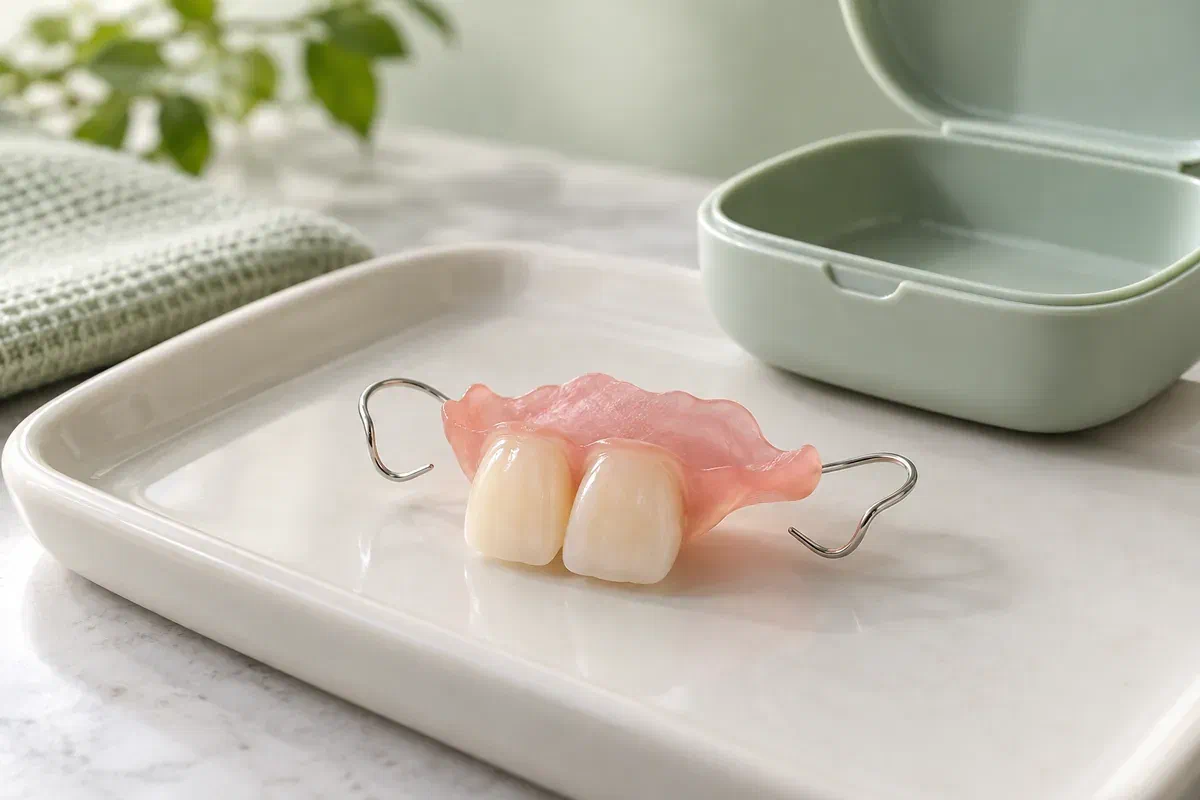
Illustrative removable acrylic partial appliance with two replacement front teeth
Moments that prompt the question

When is an interim partial worth discussing?

An assessment helps decide whether a temporary partial suits your mouth, when it could be fitted and what to expect as healing progresses. It does not take the place of treating active disease or planning for the teeth you still have.

A visible tooth is scheduled to come out

Bring up replacement well ahead of the extraction appointment. An immediate partial is fabricated in advance and placed after the tooth is removed when the clinical situation allows. It needs lead time, so a booked extraction alone does not mean an appliance will be ready.

The final tooth is months away

Socket healing, gum therapy or an implant consultation can leave a gap of weeks or months. Ask whether an appliance can be worn safely during that time, especially over a surgical site that may need to be kept free of pressure.

You need time to weigh the options

Covering the space can give you room to compare a bridge, a long-term partial or an implant without pressure. Mention your budget and priorities early. An interim appliance is not a commitment to any particular final procedure.

An interim partial hides a space but does not address why the tooth was lost. Pain, infection, gum disease or compromised supporting teeth each need proper assessment and treatment.

What a temporary partial offers

Confidence in the short term, clarity about the long term

In the months before a final replacement, an interim partial can make a missing front tooth much less noticeable at work and in photos. The shade and form of the replacement tooth are chosen to blend with your smile. Looks are only part of it, though. Bulk, retention, the effect on certain sounds and the way the appliance meets your opposing teeth shape how it feels across a long day.

A temporary design is often not meant to handle every food or to match the steadiness of a finished long-term restoration. Ask what yours is designed for and which changes would mean it needs a look. The plan should spell out what you gain now and what still requires attention later.

Removable by design

You take it out as instructed for cleaning and to rest the gums. Handling becomes easier with practice, and secure seating and removal should be shown to you in the chair rather than left to trial and error.

Fewer surprises at work

Knowing a replacement is planned for a front-tooth gap can make the change feel more manageable. Mention important presentations or travel early, leaving time for assessment, fabrication and a few days of adjustment.

A natural review point

The interim stage builds in a moment to revisit comfort and the long-term plan as your mouth changes. Confirm who will book the follow-up and which details are needed before the next decision.

What the visits involve

A sequence you can put in your calendar

Tell us about planned extractions, specialist dates and any commitments you would like to work around. That makes it easier to explain what is realistic and where the timing may need to stay flexible.

  1. Review your mouth and your priorities

    The dentist checks the space or the tooth planned for extraction, the gums and bone, and the neighbouring teeth. We talk through your health history, how you use your smile day to day and what you prefer. Extra records or X-rays may help settle the plan before anything is ordered.

  2. Take records and go over the estimate

    Impressions or other suitable records let the appliance be made to fit your mouth. We discuss the design, the estimated fees and the expected order of appointments. Ask whether adjustments, relines or a future replacement appear as separate items.

  3. Fitting and hands-on practice

    When the partial is fitted, it is checked against your teeth and gums and any pressure spots are addressed. You practise placing and removing it with someone guiding you. If it goes in straight after an extraction, you leave with instructions covering the wound and the appliance together.

  4. Return for a fit and comfort check

    A follow-up visit looks at comfort, stability and how home care is going. Healing changes the shape of the gums, so an appliance that felt right may need attention later. This visit is also the time to review the next stage of treatment instead of letting a temporary solution carry on indefinitely.

Wearing it through the workweek

Small habits that protect your partial and your gums

Follow the instructions given for your own design. The schedule right after an extraction can be different from the routine once you have healed, so ask the team if anything is unclear.

Lunch with a new appliance

Find out whether you should eat with it in and what to avoid. If eating with it is advised, choose softer foods and cut them small. Avoid biting into an apple or a crusty roll with the new front teeth to test them.

Clean around it, not just the appliance

Remove the partial and clean it using the method recommended for its material. Keep brushing and cleaning between your natural teeth, especially near the clasps. An appliance does nothing to keep plaque or decay off the teeth beside it.

Let the clinic handle fixes

Call about rubbing, rocking, a crack or trouble getting it to sit properly. Avoid bending wires, filing acrylic or using any household glue. Bring the appliance and any broken parts so the team can work out what happened.

Patient information: American Dental Association — removable partial denture care

The longer-term decision

Which final replacement suits your mouth and your routine?

The temporary partial is one step, not a forecast of the end result. Revisit your preferences as healing progresses, taking into account your remaining teeth and the upkeep each choice involves.

For a removable approach that lasts

A long-term removable partial

A definitive partial may be planned once the supporting tissues are more stable. Its design can be quite different from the interim one. Discuss retention, which teeth support it, any visible parts and cleaning, rather than expecting a copy of the temporary.

When neighbouring teeth can support it

A fixed bridge

A bridge stays in place and needs an appropriate supporting arrangement. The condition of adjacent teeth, the width of the gap and your bite affect suitability. Ask how it would affect those teeth and how you would clean underneath it.

When an evaluation supports implants

Replacement on an implant

Implant treatment needs a separate review of your health, bone, gums and available space. Surgery, healing time, costs and maintenance should all be discussed. Wearing a temporary partial neither confirms suitability nor means an implant has to be your final choice.

Patient information: Leeds Teaching Hospitals — partial dentures and alternatives

Questions we hear from Oakville

Practical answers for busy weeks

Ask about daily wear, an upcoming extraction or the switch to your final replacement. Answers help most when they relate to the specific appliance and plan being proposed for you.

(905) 876-4488
How long does it usually take to get used to a temporary partial?
It varies. Many people notice the appliance less after the first several days, though speech and eating may take a little longer to feel natural. Sore spots or persistent awkwardness are reasons to book a check rather than wait it out.
Will colleagues be able to tell I am wearing a partial?
The replacement tooth is chosen to blend in, but how noticeable an appliance is depends on its design, where clasps sit and how you speak at first. Ask to discuss what will be visible before it is made, so your expectations are realistic.
Can I book the extraction and partial around a busy work period?
Often there is some flexibility. Share your key dates early, because an immediate partial has to be made before the extraction and healing needs time afterward. The team can explain which appointments are fixed and where there is room to move.
The partial was snug at first. Why is it moving now?
As the gums and bone heal after an extraction, they change shape, and the appliance can loosen. Book a fit check rather than relying on adhesive. It may need adjusting, relining or replacing, depending on its condition and the next step in your plan.
Am I supposed to take my partial out at night?
Follow the schedule you were given at fitting. Right after an extraction, you may be asked to keep it in for an initial period. After that, removing it overnight to rest the tissues is commonly advised. Confirm how to store it safely while it is out.
What should I do if my partial cracks before an important meeting?
Call the clinic and describe what happened. Avoid gluing or reshaping it yourself, as that can make a proper repair harder and may irritate your gums. Bring the appliance and any pieces in so the team can assess whether it can be repaired or needs replacing.
Planning from Oakville

Map out the in-between stage before it starts.

Book a consultation at our Bronte Street clinic to talk about an extraction that is coming up or a space you already have. Bring details of any specialist care and tell us which work or social situations concern you. We will explain the interim options and the decisions still to make.

If you have pain, swelling or problems at a recent extraction site, please call. Online requests are intended for non-urgent appointments.

Visit Milton Dental Clinic
Unit 1, 342 Bronte St. S, Milton, ON L9T 5B7
Get directions Clinic hours
Monday–Thursday
11am–7pm
Friday–Sunday
By appointment only

Areas we serve

  • Milton
  • Oakville
  • Mississauga
  • Georgetown
  • Halton Hills
  • Acton
  • Campbellville
  • Brampton
  • Burlington
  • Puslinch
  • Rockwood
  • Erin
  • Caledon
  • Etobicoke
  • Old Milton
  • Bronte Meadows
  • Timberlea
  • Dorset Park
  • Dempsey
  • Clarke
  • Beaty
  • Coates
  • Harrison
  • Scott
  • Willmott
  • Ford
  • Bowes
  • Cobden
  • Walker
  • Mountain View
  • Milton Heights
  • Hawthorne Village
  • Valley View
  • Fallingbrook
  • Nassagaweya
  • Trafalgar
  • Esquesing
  • Nelson
  • Brookville
  • Moffat
  • Glen Williams
  • Norval
  • Limehouse
  • Stewarttown
  • Ashgrove
  • Hornby
  • Silver Creek
  • Speyside
  • Scotch Block
  • North Oakville
  • River Oaks
  • Glen Abbey
  • West Oak Trails
  • Palermo
  • Bronte Creek
  • College Park
  • Joshua Creek
  • Uptown Core
  • Preserve
  • Iroquois Ridge
  • Lisgar
  • Meadowvale
  • Meadowvale Village
  • Churchill Meadows
  • Erin Mills
  • Central Erin Mills
  • Streetsville
  • East Credit
  • Creditview
  • Heartland
  • Sheridan
  • Mount Pleasant
  • Credit Valley
  • Huttonville
  • Churchville
  • Springbrook
  • Northwest Brampton
  • Bram West
  • Fletcher's Meadow
  • Fletcher's Creek South
  • Alton Village
  • Orchard
  • Millcroft
  • Headon Forest
  • Tansley
  • Brant Hills
  • Tyandaga
  • Kilbride
  • Lowville
  • Aberfoyle
  • Morriston
  • Arkell
  • Hillsburgh
  • Freelton
  • Carlisle
  • Waterdown
  • Flamborough
  • Mountsberg

How can we help?

Milton Dental Clinic

Have a question about your smile? Choose the option that works best for you.

For urgent dental concerns, please call.
Messages are reviewed during clinic hours.