

Illustrative consultation about a temporary replacement for missing teeth
Restorative Dentistry

Temporary Partial Dentures in Rockwood

A partial that fits well on day one may feel different by week six, because gums keep changing after an extraction. From Rockwood, we plan the appliance, the reviews and the relines around that healing timeline.

Fit over the healing months

Day one, week three, month two

On the day it is fitted, a partial is shaped around your mouth as it is then. Over the following weeks, an extraction socket fills in and the ridge beneath it gradually reshapes, so the appliance that felt snug may start to rock or trap food. That is normal healing, and it is one reason a temporary partial denture is reviewed rather than simply handed over. The appliance itself is removable and carries one or more replacement teeth for a defined period.

Small acrylic designs are often called flippers, but the label does not predict how one will behave as your tissues change. We begin by asking what you need from it during healing, whether that is appearance, clear speech or careful eating, and we consider the health of your remaining teeth, the gums and bone and any surgery planned.

Rockwood households sometimes plan visits around work and family commitments further afield, so we set out expected review points from the start and explain what may prompt an extra visit. Bring notes from a specialist or previous dentist if they exist. That keeps the interim step in line with the order of treatment already agreed.

Plan your partial around healing
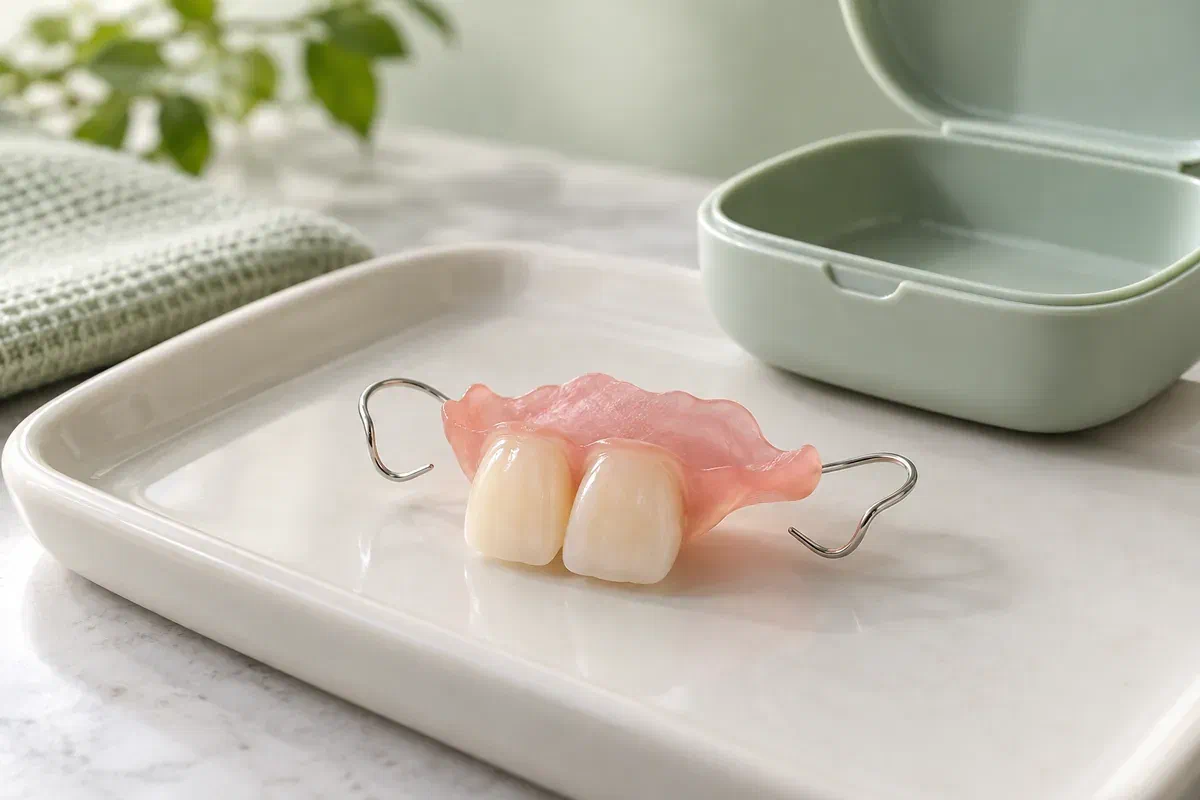
Illustrative removable acrylic partial appliance with two replacement front teeth
Situations we often see

When an interim tooth makes sense

An assessment helps establish whether a temporary partial suits you, how soon it might be fitted and how it may need to adapt as you heal. Active disease and planning for the teeth you keep are separate tasks that still need attention.

The tooth has not come out yet

Now is the time to ask about replacement. An immediate partial relies on records taken before the extraction and is placed once the tooth is removed, if appropriate. Because it needs advance planning, an extraction booking alone does not secure one.

Healing will take a while

Socket healing, gum care or an implant evaluation may mean months before the final tooth. Ask whether wearing an appliance throughout is safe in your case, and whether pressure on a surgical site needs to be avoided.

You would like time to compare

An interim partial can cover the space while you look at fixed, removable and implant-based choices. Tell us about cost and priorities at the start. The temporary appliance is not a commitment to any final procedure.

Hiding the gap leaves the underlying cause untreated. Pain, infection, gum disease or weakened neighbouring teeth each need their own assessment and management.

What the interim stage offers

Coverage now, adjustments as you heal

While the extraction site settles, a temporary partial can make the missing tooth much less noticeable. Its colour and shape are chosen to blend with your smile. Day-to-day comfort, though, depends on bulk, retention, its effect on speech and how it meets the opposing teeth, all of which can shift slightly as the tissues change.

Many interim appliances are not built for every food or for the stability of a completed restoration. Ask what yours is designed for and which changes, such as rocking or new sore spots, mean it should be looked at. A clear plan describes the present benefits and the attention it may need later.

Out for cleaning and rest

You remove the appliance as advised to clean it and let the gums recover. Handling takes practice, so have the team show you the right way to seat and remove it before you go home.

A smile that keeps pace

Knowing a replacement is ready can make losing a visible tooth feel less abrupt. Mention important dates early, allowing time to assess, fabricate and adapt, and possibly to adjust after healing.

Reviews timed to healing

As your mouth changes, scheduled checks give you and the dentist a chance to look again at fit and at the long-term plan. Agree who will book them and what is needed beforehand.

The timeline

Fitting is the middle of the process, not the end

Let us know about extraction dates, specialist appointments and events you have planned. With that, we can explain what is realistic and where healing may require some flexibility.

  1. Before anything is made

    The dentist examines the space or tooth to be removed, the supporting gums and bone and the nearby teeth. We review your health history and daily needs. If additional records or X-rays would help clarify the plan, they may be recommended at this stage.

  2. Records and expectations

    We take impressions, or another appropriate record, so the partial can be shaped for your mouth. You will see the proposed design, an itemized estimate and the likely fitting order. Ask whether relines or adjustments during healing are included or billed separately.

  3. Fitting day

    The appliance is tried in, checked against your teeth and gums, and eased where it presses. You practise seating and removing it with guidance. If it goes in right after an extraction, you receive instructions for both the healing socket and the partial.

  4. Reviews as the ridge reshapes

    Follow-up visits check comfort, stability and home care. As healing continues, the fit may loosen, and an adjustment or reline may be considered. Each review also looks at the next treatment stage, so the interim arrangement does not simply carry on.

Through the healing weeks

Notice changes early and report them

Your instructions are specific to your appliance and stage of healing. The routine immediately after an extraction may differ from later advice, so ask whenever you are unsure.

Go easy at meals

Check whether to wear the partial while eating. If yes, start with soft foods in small pieces and avoid biting hard foods with the front replacement teeth, especially as the fit changes.

Daily cleaning, inside and out

Lift the appliance out and clean it as recommended for its material. Your own teeth need their normal brushing and flossing too, with care around the clasps, where plaque collects easily.

Watch for rocking or rubbing

New movement, sore spots, a crack or trouble seating the partial are all reasons to call. Avoid bending wires, filing acrylic, home reline kits or glue. Keep any broken pieces for your appointment.

Patient information: American Dental Association — removable partial denture care

Once healing settles

Choose the final tooth when the tissues are ready

The interim appliance is one stage, not a forecast. Revisit your options as healing progresses, with the remaining teeth and the upkeep of each choice in mind.

Removable, made for stable tissues

A long-term partial

When the gums and bone have settled, a definitive partial may be designed for the healed shape. It may differ from the interim one. Ask about retention, supporting teeth, visible parts and cleaning.

Where adjacent teeth are suitable

A fixed bridge

A bridge stays in and needs suitable supporting teeth. Their condition, the width of the space and your bite determine whether it is appropriate. Ask how those teeth would be affected and how to clean beneath the bridge.

Where an evaluation supports it

An implant restoration

An implant needs its own review of your health, bone, gums and room available. Surgery, healing time, fees and maintenance should all be discussed. An interim partial does not establish that an implant will suit you, nor does it require you to choose one.

Patient information: Leeds Teaching Hospitals — partial dentures and alternatives

Rockwood healing questions

Why does my partial feel different now?

Bring what you have noticed since fitting, along with any questions about the extraction or how the fit may change. The most useful answers relate to your actual appliance and stage of healing.

(905) 876-4488
What changes in the first weeks after an extraction?
The socket gradually fills in and the gum and bone reshape. Swelling also goes down. These changes can alter how a partial sits, which is why follow-up visits are part of the plan. Report rocking, food trapping or new sore spots.
Is a reline the same as getting a new partial?
No. A reline adds material to the fitting surface so it matches the changed shape of your gums. A new partial is made from fresh records. Which one is suitable depends on the appliance’s condition and your next treatment stage.
Why does the replacement tooth look longer as I heal?
As the gum shrinks after an extraction, a small space can appear between the appliance and the tissue, which may change how the tooth looks. Mention it at your review. An adjustment, reline or new appliance may be considered.
My partial has started clicking. Can I keep wearing it?
Clicking or rocking often means the fit has changed. Call the clinic for advice and book a check. Continuing to wear a loose appliance can cause sore spots and may strain the teeth that clasps rest on.
Can I use a store-bought reline kit?
It is best not to. Home reline materials can change the fit and bite in ways that are hard to correct and may irritate the gums. Let the team assess the appliance and recommend an appropriate adjustment or reline.
When should I stop wearing my partial overnight after the extraction?
Follow the schedule from your fitting. An initial stretch of continuous wear is sometimes advised, followed by taking it out at night to rest the tissues. Ask when to switch, and how to store it safely while it is out.
Visiting from Rockwood

Start with a plan that expects your mouth to change.

Arrange an appointment at our Bronte Street clinic about an extraction you are expecting or an existing space, and bring any specialist notes and tell us which situations matter most to you. Together we can map out the review points ahead and the choices in between.

Phone the clinic about pain, swelling or problems at a recent extraction site. Online requests are for non-urgent bookings only.

Visit Milton Dental Clinic
Unit 1, 342 Bronte St. S, Milton, ON L9T 5B7
Get directions Clinic hours
Monday–Thursday
11am–7pm
Friday–Sunday
By appointment only

Areas we serve

  • Milton
  • Oakville
  • Mississauga
  • Georgetown
  • Halton Hills
  • Acton
  • Campbellville
  • Brampton
  • Burlington
  • Puslinch
  • Rockwood
  • Erin
  • Caledon
  • Etobicoke
  • Old Milton
  • Bronte Meadows
  • Timberlea
  • Dorset Park
  • Dempsey
  • Clarke
  • Beaty
  • Coates
  • Harrison
  • Scott
  • Willmott
  • Ford
  • Bowes
  • Cobden
  • Walker
  • Mountain View
  • Milton Heights
  • Hawthorne Village
  • Valley View
  • Fallingbrook
  • Nassagaweya
  • Trafalgar
  • Esquesing
  • Nelson
  • Brookville
  • Moffat
  • Glen Williams
  • Norval
  • Limehouse
  • Stewarttown
  • Ashgrove
  • Hornby
  • Silver Creek
  • Speyside
  • Scotch Block
  • North Oakville
  • River Oaks
  • Glen Abbey
  • West Oak Trails
  • Palermo
  • Bronte Creek
  • College Park
  • Joshua Creek
  • Uptown Core
  • Preserve
  • Iroquois Ridge
  • Lisgar
  • Meadowvale
  • Meadowvale Village
  • Churchill Meadows
  • Erin Mills
  • Central Erin Mills
  • Streetsville
  • East Credit
  • Creditview
  • Heartland
  • Sheridan
  • Mount Pleasant
  • Credit Valley
  • Huttonville
  • Churchville
  • Springbrook
  • Northwest Brampton
  • Bram West
  • Fletcher's Meadow
  • Fletcher's Creek South
  • Alton Village
  • Orchard
  • Millcroft
  • Headon Forest
  • Tansley
  • Brant Hills
  • Tyandaga
  • Kilbride
  • Lowville
  • Aberfoyle
  • Morriston
  • Arkell
  • Hillsburgh
  • Freelton
  • Carlisle
  • Waterdown
  • Flamborough
  • Mountsberg

How can we help?

Milton Dental Clinic

Have a question about your smile? Choose the option that works best for you.

For urgent dental concerns, please call.
Messages are reviewed during clinic hours.