

Illustrative conversation about the appearance of a tooth-coloured repair
Restorative Dentistry

Tooth-Coloured Dental Fillings in Acton

Composite, glass ionomer, an onlay: the names can blur together. From Acton, book a visit where the dentist explains which tooth-coloured material suits your repair and the reasons behind it.

Making sense of materials

Same colour, different job

“White filling” sounds like one product, but it is really a family of materials. Composite resin is the best known. Glass ionomer and related materials turn up in particular situations, and porcelain or other materials are used for restorations made outside the mouth. Each is tooth-coloured; each behaves a little differently.

So the useful question is less “which looks best?” and more “which suits this tooth?” Location matters, as do the size and depth of the damage, how dry the area can be kept, and how hard you bite. Appearance still counts, but it is weighed alongside strength and how the repair will be cleaned and maintained.

When you come down from Acton, ask the dentist to name the material being suggested and say what it is meant to accomplish. You should come away understanding what a direct filling can realistically do for that tooth, when a different restoration makes more sense, and what the finished result will look like.

Ask which material suits your tooth
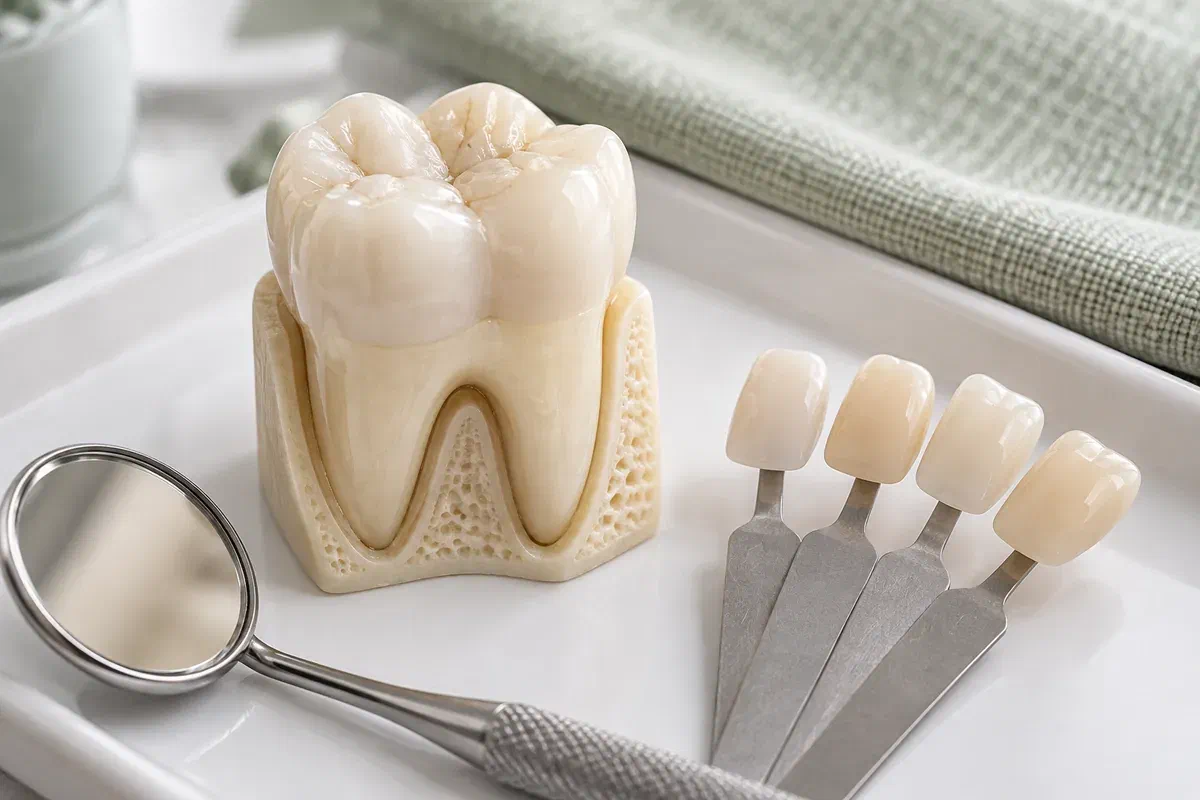
Illustrative molar model beside dental shade samples and a mirror
Why people come in

A change, then a choice

Before any material is chosen, the problem needs a name. Tell us when you noticed the change and whether it gets in the way of eating, brushing, flossing or smiling.

Decay that needs filling

Once a cavity has formed, the dentist measures how far it extends and whether the tooth can be rebuilt reliably, and only then talks materials. Early demineralization with intact enamel is another matter; it may respond to prevention and closer follow-up.

A chipped piece of enamel

Bonding is a common fix for a modest chip, though the reason for it shapes the plan. Bring up any fall, a pattern of chips, or a habit like biting fishing line or zip ties. More extensive breakage may need a sturdier approach.

A restoration that has aged

Old fillings can stain on the surface, darken through the material, or open up at the margin. Telling these apart is the examination's job, and the outcome could be watching, polishing, patching or replacing. Colour alone says little about failure.

Pain that arrives without a trigger, lingers after cold or heat, or comes with swelling is not a materials question. Call us, because the tooth may need a different kind of treatment.

What composite brings

Why composite is so often the starting point

Composite can be tinted across many shades and sculpted on the tooth itself, which lets the dentist shape a repair in one appointment. That makes it a natural fit for moderate repairs where appearance is a concern, and it is used on some back teeth after the dentist judges the chewing load and remaining structure.

It is not the answer to every tooth. Bonding is sensitive to moisture, a deep cavity or one near the gumline can complicate placement, and a large repair on a hard-working molar may call for a stronger design. Other materials exist precisely because composite has these limits.

Patient information: American Dental Association — tooth-coloured fillings

Room to fine-tune colour

Composite comes in a range of shades and translucencies, which helps with teeth that are not one even colour. Discuss which surfaces are on show and what blend is realistic for the size of the repair.

A shape built by hand

Because the dentist sculpts composite directly, the contour and contact with the next tooth can be shaped in the chair. Mention any food trapping beforehand so that contact gets particular attention.

Conservative where it fits

Composite bonds to the tooth, so a suitable repair can often be limited to the damaged area. The amount of tooth prepared follows the defect and the material, not a wish for identical teeth.

The appointment itself

Where the material decision fits in

Mention dental worries, past sensitivity, any material you have reacted to, and whitening you might be considering. Each of these can influence which material is proposed and when.

  1. Diagnose first

    The dentist looks at the tooth, its existing fillings and the surrounding gum and teeth. An X-ray may be suggested if it would answer a specific question. With the findings in hand, you can talk over whether a filling is warranted, what the alternatives are, and the fee.

  2. Agree on the material

    If composite is the right fit, a shade is selected; if another material is better, the reason is explained. Local anaesthetic may be used, and the tooth is prepared and kept free of saliva for the chosen technique.

  3. Place it properly

    Composite is built in layers, each hardened with a curing light. Glass ionomer and other materials have their own handling and setting steps. The dentist shapes the filling to the tooth and its neighbour.

  4. Finish and check

    The surface is refined and polished, and your bite is tested. Say if anything feels uneven. You will hear how to eat and clean in the coming days, and what to report if symptoms carry on or intensify.

Living with the new filling

Care depends partly on the material

Whatever was used, the tooth around it still needs daily brushing and cleaning between teeth. Ask whether your material has any particular instructions, and call if discomfort does not fade.

While you are still numb

Wait to chew until feeling comes back, and keep hot drinks for later. Some materials come with extra short-term eating advice, so ask what applies. Do not try to judge your bite until the freezing has fully worn off.

If the tooth is sensitive

Short-lived sensitivity can follow a filling. Keep track of what triggers it, such as cold or chewing, and how fast it settles. Have the tooth checked if it feels high, the pain builds, or symptoms are slow to ease.

Looking after the edges

Brush twice daily with fluoride toothpaste and floss as advised. Exams give the dentist a chance to look at the filling margins. Tell us about clenching, grinding, chips or wear, because a filling replaced without addressing heavy forces may run into the same trouble.

Side by side

Three tooth-coloured paths

Have the dentist name each option and explain its role. Weigh how long it is expected to serve, its limits, its upkeep and its cost for this tooth, not only how it looks.

Bonded, sculpted in one visit

Composite resin

Suitable for many small and moderate repairs, composite gives a natural-looking surface when the cavity size, moisture control and bite allow. It is versatile, but that does not mean every damaged tooth can be restored with it.

For selected situations

Glass ionomer

Sometimes chosen near the gumline, in areas hard to keep dry, or as a temporary measure, glass ionomer differs from composite in strength and finish. Ask whether it is planned as interim care or a definitive repair.

Inlays, onlays and crowns

Indirect restorations

When a filling placed directly cannot properly handle the damage or protect what remains, a restoration made outside the mouth may be considered. It has a different design, timeline and fee, and the tooth's condition should justify it.

Patient information: FDA — treatment options and restorative materials

Material questions

Weighing one white material against another

Shade, material and the condition of the tooth all play into each answer. Whether your earlier fillings were placed in Acton or elsewhere, share any experience with earlier fillings, good or bad, so the recommendation can be explained against it.

(905) 876-4488
What is the difference between composite and glass ionomer?
Composite is a resin-based material that bonds to the tooth and can be closely shade-matched. Glass ionomer handles differently, can be useful where moisture control is hard, and is sometimes chosen for temporary or low-load areas. The dentist explains which suits your situation.
Why might a dentist suggest a less cosmetic material for one tooth?
Sometimes the conditions favour a different material, for example near the gumline, in a hard-to-dry area, or as an interim step. The goal is a repair that works well for that tooth. Ask what is driving the recommendation.
Can a temporary tooth-coloured filling be replaced later?
Yes. Interim fillings are designed to protect a tooth for a period, and a longer-term restoration may be planned afterwards. Ask how long it is expected to serve and what signs would mean it needs attention sooner.
Is a porcelain inlay better than a white filling?
Neither is better in every case. An inlay or onlay may suit a larger defect where a direct filling would be weak, but it involves a different process and fee. The tooth’s condition should guide that decision.
If my amalgam is intact, is there a reason to change materials?
Usually not without a clinical reason. Taking out sound amalgam removes healthy tooth, and the FDA does not recommend routinely removing intact amalgam with no decay unless medically necessary. Explain your concern and the trade-offs can be discussed.
Will the material I choose change what my insurance pays?
It can. Some plans reimburse tooth-coloured fillings on back teeth differently from front teeth, and each plan has its own limits. Request an estimate, confirm with your benefits provider, and ask us to clarify the planned surfaces.

Patient information: FDA — decisions about existing amalgam fillings

Planning from Acton

Ask us to name the material

Make an appointment at our Bronte Street practice in Milton for a cavity, chip or older filling. Describe what you see and feel, and ask any material questions you have. You will hear what the dentist found and which repair suits the tooth's needs and your smile.

For significant pain, swelling, or a filling that has broken and hurts, phone us. Online requests are for non-urgent appointments.

Visit Milton Dental Clinic
Unit 1, 342 Bronte St. S, Milton, ON L9T 5B7
Get directions Clinic hours
Monday–Thursday
11am–7pm
Friday–Sunday
By appointment only

Areas we serve

  • Milton
  • Oakville
  • Mississauga
  • Georgetown
  • Halton Hills
  • Acton
  • Campbellville
  • Brampton
  • Burlington
  • Puslinch
  • Rockwood
  • Erin
  • Caledon
  • Etobicoke
  • Old Milton
  • Bronte Meadows
  • Timberlea
  • Dorset Park
  • Dempsey
  • Clarke
  • Beaty
  • Coates
  • Harrison
  • Scott
  • Willmott
  • Ford
  • Bowes
  • Cobden
  • Walker
  • Mountain View
  • Milton Heights
  • Hawthorne Village
  • Valley View
  • Fallingbrook
  • Nassagaweya
  • Trafalgar
  • Esquesing
  • Nelson
  • Brookville
  • Moffat
  • Glen Williams
  • Norval
  • Limehouse
  • Stewarttown
  • Ashgrove
  • Hornby
  • Silver Creek
  • Speyside
  • Scotch Block
  • North Oakville
  • River Oaks
  • Glen Abbey
  • West Oak Trails
  • Palermo
  • Bronte Creek
  • College Park
  • Joshua Creek
  • Uptown Core
  • Preserve
  • Iroquois Ridge
  • Lisgar
  • Meadowvale
  • Meadowvale Village
  • Churchill Meadows
  • Erin Mills
  • Central Erin Mills
  • Streetsville
  • East Credit
  • Creditview
  • Heartland
  • Sheridan
  • Mount Pleasant
  • Credit Valley
  • Huttonville
  • Churchville
  • Springbrook
  • Northwest Brampton
  • Bram West
  • Fletcher's Meadow
  • Fletcher's Creek South
  • Alton Village
  • Orchard
  • Millcroft
  • Headon Forest
  • Tansley
  • Brant Hills
  • Tyandaga
  • Kilbride
  • Lowville
  • Aberfoyle
  • Morriston
  • Arkell
  • Hillsburgh
  • Freelton
  • Carlisle
  • Waterdown
  • Flamborough
  • Mountsberg

How can we help?

Milton Dental Clinic

Have a question about your smile? Choose the option that works best for you.

For urgent dental concerns, please call.
Messages are reviewed during clinic hours.