

Illustrative dental discussion about daily habits and enamel protection
Restorative Dentistry

Tooth Erosion Treatment in Mississauga

A drink that lasts all morning can do more to enamel than a single glass at lunch. For people in Mississauga with sensitive or wearing teeth, we look at how often acid reaches them and what to protect.

Mississauga · the slow-sip problem

It is not how much you drink. It is how often.

Picture a bottle of iced tea that sits beside the keyboard from nine until noon, or an energy drink nursed through a long commute. Every sip briefly lowers the pH around the teeth. Saliva needs time to bring it back up, and constant top-ups leave little room for that recovery. Over time, this repeated contact can contribute to erosion.

Erosion means tooth structure lost to acids that bacteria did not make. It is a different process from a cavity, though one mouth can have both. It also shares features with other kinds of wear, from clenching during a stressful day to scrubbing hard with a stiff brush. Sorting out which forces are involved comes before any talk of fillings.

When you come to us from Mississauga, the first visit is a careful look and an honest chat. We ask about drinks, snacks, work patterns, exercise, reflux and medicines, and we explain why each detail matters. Anything sensitive can be discussed in private. From there, we agree on whether a tooth needs protection, closer watching or repair.

Book an erosion check
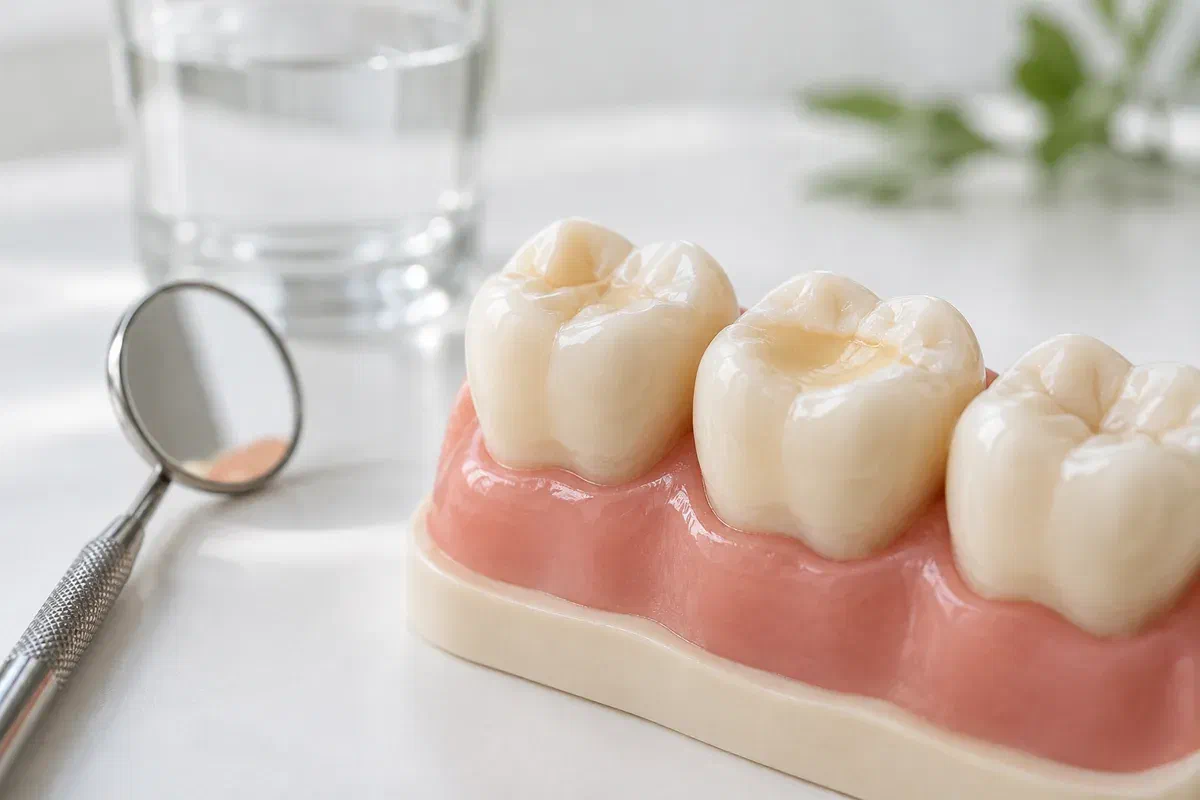
Illustrative dental teaching model with a shallow depression on a molar surface
What you might be noticing

Three common signals.

Try to remember when a change first appeared and if it appears to be speeding up. Older photos or dental records may help fill in the timeline, though an examination is needed to read them correctly.

Surfaces look polished or dished

Teeth can take on a smooth, almost polished sheen, and chewing surfaces may form small cups. Front edges might look thinner. The dentist maps the pattern and relates it to other findings. A surface’s appearance does not show by itself how long the change took or if it is still going on.

Cold drinks have become a chore

Discomfort with chilled, sweet or tart items can come from several sources. Keep track of the trigger, how long the feeling lasts and where it is. The intensity of sensitivity is not a measure of lost enamel, and a single tooth that aches badly may have another problem.

Acidic drinks fill the gaps in your day

Frequent sipping of soft drinks, energy drinks, juice or flavoured water, along with reflux or repeated vomiting, may be relevant. Tell us what you can. We look at ways to protect your teeth and whether medical advice would help with an exposure dentistry cannot control.

Avoid stopping prescribed medicine or making drastic diet changes without guidance. Bring your list of medications and any relevant health information so dental suggestions can be coordinated with your doctor.

Where treatment is heading

Give enamel time to recover between exposures.

Once enamel has worn away, it stays gone, and a repair laid over it does not change the drinking pattern behind the wear. Most plans therefore begin by spacing out or reducing acid contact. Often that means changing when and how you drink, not giving up what you enjoy, with sensitivity managed along the way.

Restoration is not automatic. The depth of wear, your comfort, the way teeth meet, appearance and any sign of progress all feed into the decision. Ask what the dentist will be watching and what would tip the advice toward treatment. Agreed markers make each review a genuine comparison.

Patient information: American Dental Association — dental erosion

Seeing the pattern clearly

The surfaces involved can point toward likely contributors, and linking them with your routine makes the explanation stronger. More than one factor is common, and we say so rather than blaming a single drink.

Changes that survive a busy week

Long shifts, school runs and meetings all shape what is realistic. Tell us which suggestions feel unworkable, so we can find options that suit your schedule instead of an ideal routine.

Treatment with a purpose

If a repair is proposed, ask what it is meant to do: cover a sensitive spot, restore a worn edge, rebuild shape or help the bite. Every restoration should have a reason beyond making teeth look identical.

Step by step

A clear process from first chat to follow-up.

There is no need to solve the puzzle before you arrive. If we ask for a note of symptoms or a typical day of eating and drinking, a rough, truthful version is far more useful than a polished one.

  1. Tell us about your day and your health

    We ask what you have noticed, when and how you drink, and about medical conditions and medicines. Reflux, vomiting and dry mouth may be discussed. Let us know if any part of this is something you would prefer to talk about privately.

  2. Look closely and record

    The dentist checks your teeth, fillings and bite. Notes and photographs, or other suitable records, capture where things stand now. Additional tests come into it only if there is something definite they could clarify, never as a routine add-on.

  3. Choose what comes first

    We discuss which habits can change, how sensitivity will be managed and whether any surface needs repair. If your doctor is involved, advice can be coordinated. Before agreeing to restorative work, ask for the planned stages and an estimate of costs.

  4. Check in and adjust

    At follow-up we review symptoms, how the changes have worked in real life and whether the teeth have changed. Timing depends on what was found. If wear seems to continue or your concerns remain, we may investigate further or revise the plan.

Habits for a busy schedule

Fewer acid breaks, more recovery time.

Use the advice designed around your own exposures. Looking after enamel should fit a balanced diet and a full calendar, not make every coffee break a cause for concern.

Finish acidic drinks rather than nursing them

If a particular drink seems to play a part, consider having it less often and with a meal instead of sipping it over hours. Avoid swishing it around your mouth. Keep a bottle of plain water handy for the rest of the day.

Go easy with the toothbrush

Brush with a fluoride toothpaste that suits you, and avoid gritty pastes or heavy pressure. Ask which brush and technique you should use. A specialised toothpaste may support your care but cannot make up for frequent acid exposure.

Raise health concerns with your doctor

Seek medical advice for regular heartburn, reflux or vomiting, and mention a persistently dry mouth. Never change a medication on your own. After vomiting, rinsing with plain water may help; ask us about oral care if it keeps happening.

Patient information: UK oral health guidance — managing and monitoring tooth wear

How care can be matched to wear

One plan, several possible layers.

Prevention stays in place no matter what else is decided. Ask how each step relates to the overall picture and which choices can be reviewed before anything more extensive goes ahead.

When restoration is not yet indicated

Change habits and monitor

A worn spot may be observed while you reduce exposures and manage sensitivity. Ask what will be recorded at each visit and which changes would justify treatment. Monitoring is a deliberate plan with follow-up dates, never a way of overlooking your concern.

For one well-defined area

Repair a worn patch

Bonded composite or another suitable material may be used to rebuild a specific worn surface. We go over the expected benefit, care and limits. Your bite and any ongoing sipping habits matter too, because the repair has to hold up in those same conditions.

When several teeth are affected

Map out a staged plan

Wear across many teeth may need detailed planning, treatment in phases or a specialist’s input. Ask how natural tooth structure will be preserved, which alternatives exist and what each option involves. Crowning many teeth should not be assumed to be the first answer.

Everyday erosion questions

Answers for busy days and long commutes.

Questions about erosion often centre on routines, drinks and quick fixes. We answer with your actual wear pattern and health in mind rather than general rules.

(905) 876-4488
Is one drink sipped over an hour worse than the same drink finished quickly?
Often, yes. Long, slow sipping keeps acid in contact with teeth for longer and gives saliva less chance to recover. Having the same drink in one sitting, ideally with food, generally means fewer acid exposures. We can look at your own routine together.
Are energy drinks especially hard on enamel?
Many energy and sports drinks are acidic, and some are sipped over long periods, which can add to erosive wear. Ingredients vary between products. If they are part of your day, mention how often and how you drink them so advice can be specific.
Can chewing sugar-free gum help after an acidic drink?
Chewing sugar-free gum can stimulate saliva, which helps the mouth recover from acid. It is a useful extra for some people, though not a substitute for reducing exposure. If you have jaw problems or grind your teeth, ask whether gum suits you.
Can erosion and a cavity affect the same tooth?
They can. Erosion is caused by acids that do not come from bacteria, while decay is a bacterial process. Both may appear in one tooth or one mouth, so the examination looks for each. A worn surface is not automatically a cavity, and a sore tooth is not automatically erosion.
Can I rely on a sensitivity toothpaste instead of having an assessment?
A sensitivity toothpaste may ease symptoms, but it cannot show whether wear is progressing or reveal its cause. An assessment records a baseline and looks for contributors. Comfort alone is not a reliable sign that the underlying problem is under control.
Do worn teeth always end up needing crowns?
No. Many areas are protected and monitored, some suit a small bonded repair, and only more extensive or complex wear calls for broader planning. Ask the dentist to explain the purpose of any treatment proposed for each tooth.
From Mississauga to Bronte Street

Let’s work out what your daily routine is doing to your enamel.

Book an assessment at our Bronte Street practice for teeth that feel sensitive, look smoother or seem to be changing shape. Bring a rough idea of what you drink through the day and any relevant health history. We will explain our findings and the best next steps to protect, and where needed restore, your teeth.

For serious pain or swelling, please phone us. The online booking form is for non-urgent visits.

Visit Milton Dental Clinic
Unit 1, 342 Bronte St. S, Milton, ON L9T 5B7
Get directions Clinic hours
Monday–Thursday
11am–7pm
Friday–Sunday
By appointment only

Areas we serve

  • Milton
  • Oakville
  • Mississauga
  • Georgetown
  • Halton Hills
  • Acton
  • Campbellville
  • Brampton
  • Burlington
  • Puslinch
  • Rockwood
  • Erin
  • Caledon
  • Etobicoke
  • Old Milton
  • Bronte Meadows
  • Timberlea
  • Dorset Park
  • Dempsey
  • Clarke
  • Beaty
  • Coates
  • Harrison
  • Scott
  • Willmott
  • Ford
  • Bowes
  • Cobden
  • Walker
  • Mountain View
  • Milton Heights
  • Hawthorne Village
  • Valley View
  • Fallingbrook
  • Nassagaweya
  • Trafalgar
  • Esquesing
  • Nelson
  • Brookville
  • Moffat
  • Glen Williams
  • Norval
  • Limehouse
  • Stewarttown
  • Ashgrove
  • Hornby
  • Silver Creek
  • Speyside
  • Scotch Block
  • North Oakville
  • River Oaks
  • Glen Abbey
  • West Oak Trails
  • Palermo
  • Bronte Creek
  • College Park
  • Joshua Creek
  • Uptown Core
  • Preserve
  • Iroquois Ridge
  • Lisgar
  • Meadowvale
  • Meadowvale Village
  • Churchill Meadows
  • Erin Mills
  • Central Erin Mills
  • Streetsville
  • East Credit
  • Creditview
  • Heartland
  • Sheridan
  • Mount Pleasant
  • Credit Valley
  • Huttonville
  • Churchville
  • Springbrook
  • Northwest Brampton
  • Bram West
  • Fletcher's Meadow
  • Fletcher's Creek South
  • Alton Village
  • Orchard
  • Millcroft
  • Headon Forest
  • Tansley
  • Brant Hills
  • Tyandaga
  • Kilbride
  • Lowville
  • Aberfoyle
  • Morriston
  • Arkell
  • Hillsburgh
  • Freelton
  • Carlisle
  • Waterdown
  • Flamborough
  • Mountsberg

How can we help?

Milton Dental Clinic

Have a question about your smile? Choose the option that works best for you.

For urgent dental concerns, please call.
Messages are reviewed during clinic hours.