

Illustrative consultation about restoring the shape and function of worn teeth
Restorative Dentistry

Worn Tooth Restoration in Caledon

When wear has shortened many teeth, rebuilding them means planning the whole bite. For adults in Caledon, we explain the records, trial stages, and possible specialist input involved before any larger restoration begins.

Extensive wear, careful planning

Wear across the whole bite

Some people arrive with one worn tooth. Others find that nearly every tooth has lost height, the smile has shortened, and the upper and lower teeth meet differently than they once did. In that situation, restoring one area at a time without a wider plan can create new problems. The teeth have to be considered together, along with how the jaw moves.

Extensive wear usually reflects several causes acting over years: acid from food, drink, or reflux; grinding and clenching; and abrasive habits. A larger restoration replaces lost structure but cannot switch those causes off. Identifying and reducing them is part of planning, and protection after treatment, such as a guard, is often discussed early.

From Bolton or the villages and farms across Caledon, bring records from previous dentists, photos of your smile over the years, and your medication list. After a thorough examination, we can explain whether the wear can be handled with targeted repairs or whether a staged rehabilitation, possibly involving a specialist, would be appropriate.

Discuss extensive tooth wear
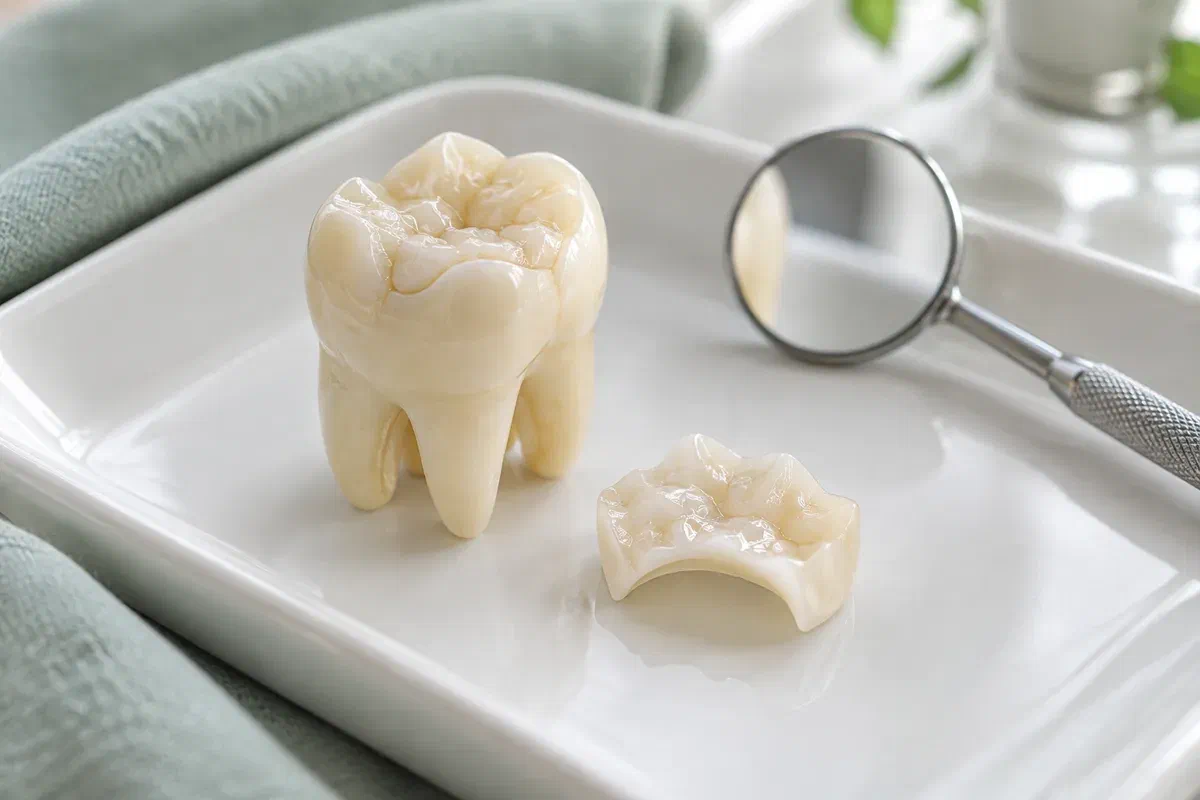
Illustrative molar teaching model and a separate partial-coverage restoration
When wear is widespread

Signs the bite needs a broader look

Even with extensive wear, not every tooth needs treatment immediately. An examination and records help decide where to focus. Older photos or dental notes can show how fast the bite has been changing.

Sensitivity in several places

Widespread wear can leave many teeth sensitive, though decay, cracks, and recession can contribute. Note which teeth react, to what, and for how long. The dentist confirms the sources before recommending that any area be rebuilt.

Teeth that have lost noticeable height

Short teeth may make chewing less efficient and change how the face and smile look. Tell us what has become harder. Whether there is space to rebuild, or whether the bite would need to be changed to create it, shapes the whole plan.

A plan involving most of the mouth

When many teeth are involved, ask how the restorations would work as a system, how the bite would change, and how the work could be staged. A plan of that size deserves records, time to consider, and a thorough explanation.

If a worn tooth suddenly cracks, hurts when you bite, or the gum swells, call before driving in so we can advise how soon you need to be seen.

What careful rehabilitation can offer

A bite rebuilt with a plan behind it

In suitable cases, worn teeth across the mouth can be rebuilt with bonded composite, adding material with little removal of healthy tooth. Other situations call for onlays, crowns, or a mix. Either way, the shape of each tooth is planned in relation to the others. A conservative approach still needs detailed diagnosis and realistic expectations about maintenance.

Clarify what success means for you. It might be comfortable chewing, a smile that shows more tooth, or protecting teeth that are at risk of breaking. Ask what the plan cannot promise. Extensive restorations need ongoing care, and some will need repair or replacement over the years.

Patient information: Leeds Teaching Hospitals — restorative dentistry services

As little drilling as is reasonable

Options differ in how much natural tooth they remove, which matters more when many teeth are involved. Ask what each approach would take away and why. Covering more tooth is not automatically the better choice.

Testing the design before committing

For substantial changes, a trial shape or provisional stage may let you try the new bite and appearance before definitive treatment. Ask whether this applies and how it would be assessed.

Long-term upkeep planned from the start

Larger plans bring more surfaces that may need polishing, adjustment, repair, or replacement. Understanding the review schedule and what to report helps you judge the full commitment.

How a larger plan is built

Records, trial, treatment, review

Restoring many worn teeth involves more planning than repairing one. We explain the records, appointments, and decisions involved, and whether specialist input would help, before treatment is scheduled.

  1. Gather a full picture

    We review symptoms, medical history, diet, grinding, and changes over time, then examine the teeth, gums, existing restorations, bite, and jaw. Photographs, X-rays, scans, or models are often needed to plan a case of this scope.

  2. Discuss options and referral

    We compare monitoring, prevention, targeted repairs, and fuller rehabilitation, and explain when a prosthodontist’s opinion may be useful. Ask which teeth are involved, in what order, and why. Fees, stages, and possible changes are reviewed before you decide.

  3. Trial, then treat in stages

    A trial shape or provisional restorations may come first so you can assess the new bite and look. Definitive work may be bonded at the chair or made by a lab. Freezing is used when needed, and treatment is usually phased.

  4. Check the bite and protect it

    At each stage we test how the teeth meet in different movements and explain care. Follow-up reviews comfort, function, and appearance. A protective guard is commonly discussed once the final shapes are in place.

Living with a rebuilt bite

Protection is part of the treatment

Restoring many teeth does not stop the causes of wear. Continue the agreed advice on grinding, acid, and cleaning, wear any recommended guard, and tell us if any part of the routine is hard to manage.

Adjusting to the new bite

It can take a little time to get used to a changed bite. Follow guidance about eating and any provisional restorations, and wait until numbness fades before chewing. Call if the bite feels uneven or uncomfortable after the first days.

Cleaning many restored surfaces

Brush twice a day with fluoride toothpaste and clean between every tooth daily. Restorations can still develop decay or gum problems at their edges. Ask the hygienist to show you tools suited to your new contours.

Reporting problems early

Let us know about a chip, roughness, or a change in comfort, and keep any broken piece. Bring your guard to reviews. Recurring problems may call for reassessing the design or forces rather than repeating the same repair.

Patient information: UK oral health guidance — monitoring and managing tooth wear

Levels of treatment

Matching the plan to the extent of wear

Even with widespread wear, more than one approach can be sensible, and some teeth may need no restoration at all. Compare preparation, benefit, maintenance, and cost for the plan as a whole.

When the wear is stable

Prevent and monitor

If wear is not progressing and teeth are comfortable and sound, causes can be managed and the bite reviewed with records over time. Ask what would prompt treatment and how often reviews will happen.

Adding material across suitable teeth

Bonded composite rehabilitation

Composite can rebuild many worn teeth with minimal preparation when the structure and bite allow, sometimes in planned stages. It can usually be repaired later. Ask about its limits under heavy grinding.

When structural loss is extensive

Onlays, crowns, or a combined plan

Severe wear may lead to lab-made restorations on some or all teeth, sometimes with specialist involvement. These involve more preparation and maintenance. You should understand why coverage is advised and what a less extensive plan would mean.

Questions about extensive wear

Understanding a larger rebuild

Ask about purpose, appearance, staging, and long-term care. These questions matter most when a plan involves many teeth.

(905) 876-4488
What does it mean to restore the height of my bite?
When teeth wear, the upper and lower jaws may close slightly further together. Rebuilding sometimes involves adding height to create space for restorations. This is a significant change, so it is usually planned with records and tested before definitive treatment.
When would I be referred to a prosthodontist?
A specialist opinion may help when wear is severe, the bite needs major changes, or several complex restorations are involved. The dentist will explain if a referral would add value and what the specialist would assess. Your general dentist often stays involved, so ask how care would be shared between the two offices.
How long can a full-mouth wear plan take?
It varies widely, from a few visits for bonded work to many months for staged lab-made restorations. Records, trial stages, and healing time all play a part. Ask for an outline once the planning records have been reviewed, including which stages need to be close together and where natural pauses could fall.
Will my jaw feel different after a large rebuild?
Some people notice a changed bite for a while as they adapt. Ongoing jaw pain, clicking, or difficulty closing should be reported so the bite can be checked. Trial stages help reduce surprises.
Do I need to have every worn tooth treated at once?
Not usually. Teeth may be treated in groups, and some may only need monitoring. The order depends on how the teeth relate in the bite. Ask how a staged approach would protect the teeth waiting for treatment.
Should I call before driving in from Caledon if a restored tooth breaks?
Yes. A quick call lets the team judge whether the problem can wait for a planned visit or needs earlier care. Keep any broken piece and avoid chewing on that side. Seek urgent care for significant pain or swelling.
Caledon worn tooth planning

Start with a thorough assessment

Arrange a visit to our Bronte Street practice to review widespread wear, shortened teeth, or a plan you would like explained. Bring previous records, photos, and any guard you wear. We will explain what we find and which teeth need protection, repair, or monitoring.

Call the clinic for severe pain, swelling, or a newly broken tooth. Online requests are for routine visits.

Visit Milton Dental Clinic
Unit 1, 342 Bronte St. S, Milton, ON L9T 5B7
Get directions Clinic hours
Monday–Thursday
11am–7pm
Friday–Sunday
By appointment only

Areas we serve

  • Milton
  • Oakville
  • Mississauga
  • Georgetown
  • Halton Hills
  • Acton
  • Campbellville
  • Brampton
  • Burlington
  • Puslinch
  • Rockwood
  • Erin
  • Caledon
  • Etobicoke
  • Old Milton
  • Bronte Meadows
  • Timberlea
  • Dorset Park
  • Dempsey
  • Clarke
  • Beaty
  • Coates
  • Harrison
  • Scott
  • Willmott
  • Ford
  • Bowes
  • Cobden
  • Walker
  • Mountain View
  • Milton Heights
  • Hawthorne Village
  • Valley View
  • Fallingbrook
  • Nassagaweya
  • Trafalgar
  • Esquesing
  • Nelson
  • Brookville
  • Moffat
  • Glen Williams
  • Norval
  • Limehouse
  • Stewarttown
  • Ashgrove
  • Hornby
  • Silver Creek
  • Speyside
  • Scotch Block
  • North Oakville
  • River Oaks
  • Glen Abbey
  • West Oak Trails
  • Palermo
  • Bronte Creek
  • College Park
  • Joshua Creek
  • Uptown Core
  • Preserve
  • Iroquois Ridge
  • Lisgar
  • Meadowvale
  • Meadowvale Village
  • Churchill Meadows
  • Erin Mills
  • Central Erin Mills
  • Streetsville
  • East Credit
  • Creditview
  • Heartland
  • Sheridan
  • Mount Pleasant
  • Credit Valley
  • Huttonville
  • Churchville
  • Springbrook
  • Northwest Brampton
  • Bram West
  • Fletcher's Meadow
  • Fletcher's Creek South
  • Alton Village
  • Orchard
  • Millcroft
  • Headon Forest
  • Tansley
  • Brant Hills
  • Tyandaga
  • Kilbride
  • Lowville
  • Aberfoyle
  • Morriston
  • Arkell
  • Hillsburgh
  • Freelton
  • Carlisle
  • Waterdown
  • Flamborough
  • Mountsberg

How can we help?

Milton Dental Clinic

Have a question about your smile? Choose the option that works best for you.

For urgent dental concerns, please call.
Messages are reviewed during clinic hours.