
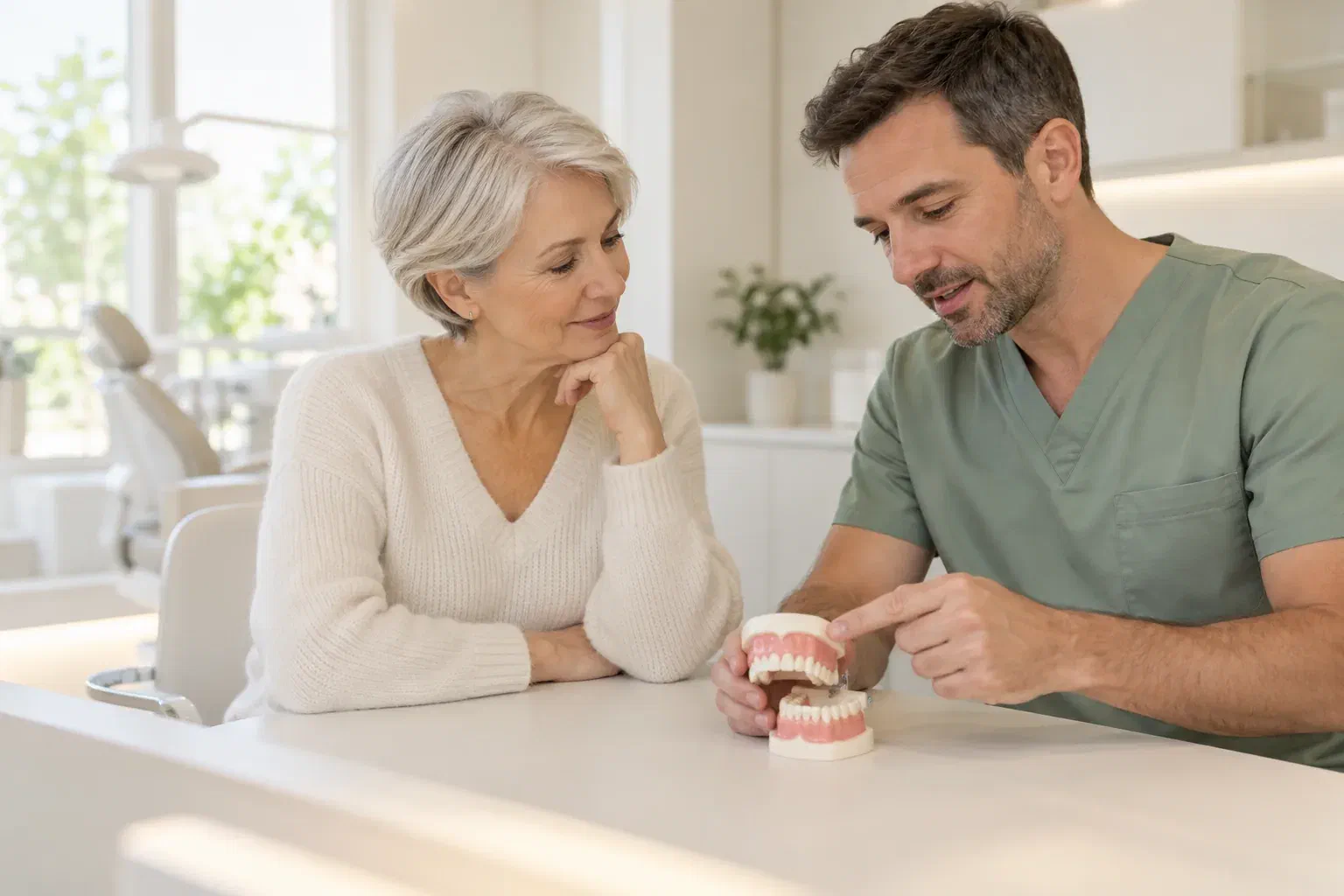
Illustrative patient and clinician discussing upper and lower tooth contacts using a dental model
Specialized Care

Bite and Occlusion Assessment in Mississauga

The same filling has broken twice, or a front tooth keeps chipping at the edge. Before another repair, it may be worth asking how your teeth meet. From Mississauga, you can have the contacts, wear and past work reviewed so the next decision rests on what the examination shows.

Repairs that do not seem to last

Why does that one tooth keep breaking?

A repeated repair is frustrating, and it raises a fair question about forces on that tooth. Occlusion describes how the upper and lower teeth come into contact as you close and chew. Looking at those contacts, together with the tooth, the material used and your habits, can help explain why a restoration has struggled and whether the same fix is likely to hold.

Breakage can have several sources at once. A large old filling may leave thin walls of tooth, a crack may already be present, grinding at night may add stress, or one contact may take more load than its neighbours. Each points toward a different response, and sometimes the honest answer is that the tooth itself has reached its limits.

Bring what you know about the earlier repairs: roughly when they were done, what broke and what it felt like. Mention guards, retainers and any knock to the mouth. Our team will explain the findings, say what remains uncertain and talk through next steps, without assuming that your teeth must be reshaped to solve the problem.

Ask about a tooth that keeps breaking
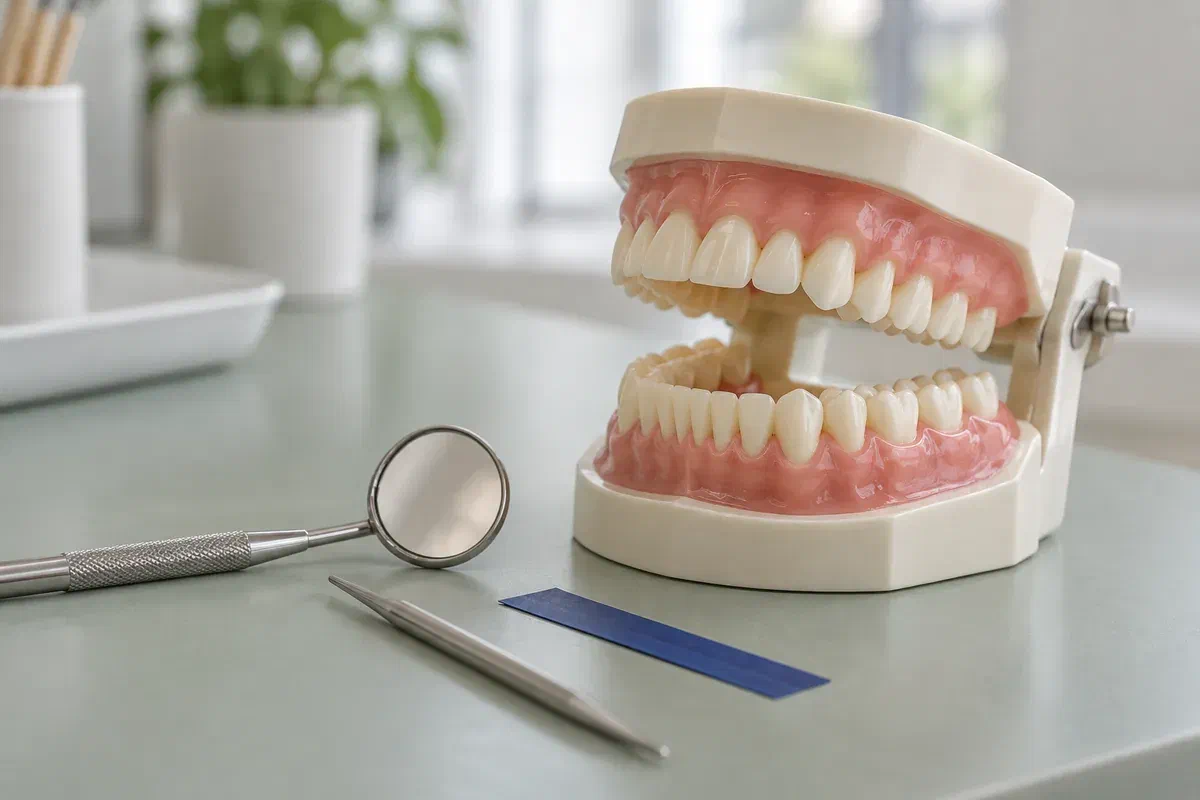
Illustrative hinged dental model beside a mirror and blue bite-marking paper on a pale surface
Patterns people from Mississauga describe

Each break leaves a clue.

Think about when things tend to fail, such as biting something firm, waking with sore teeth or nothing obvious at all. You do not need to test a damaged tooth before coming in; avoiding hard foods on that side is sensible.

A restoration that feels high or keeps failing

Tell us which filling, crown or bridge is involved and how it has behaved. Does it meet first, hurt on chewing or simply keep coming loose? Recent work should go back to the practice that placed it for review, rather than being left in the hope it beds in.

Chipped edges and flattened surfaces

Small chips along biting edges, smooth flat spots and fine cracks are worth pointing out. Bring any night guard or retainer, even an old one. We can consider whether the way your teeth meet fits the damage, and what else could be contributing. Wear records past contact rather than proving a present cause.

Discomfort in the jaw while eating

If chewing tires your jaw, if it aches, catches or locks, or if you have started avoiding certain foods, mention it. Muscles and joints may be part of the picture. Jaw symptoms should not be turned into a reason to grind down teeth.

Studies do not back the idea that a poor bite is a dependable cause of temporomandibular disorders. If your jaw hurts as well, ask how that diagnosis is being reached and why any treatment proposed is the right fit.

Breaking the cycle of repair

Fix the tooth with the cause in mind.

An assessment gives the next repair some context. By tying what you have noticed to what can be seen, it can show whether a particular contact is heavy, whether the tooth has a crack or thin walls, or whether there is not yet a clear explanation. Understanding why something failed is useful even when the advice is simply to replace it carefully.

Scope is the other thing to consider. Re-doing one restoration is a contained job; changing how many teeth meet is a far bigger step. Get each proposal explained in terms of its purpose, its alternatives and what it cannot do, so you can tell whether it really addresses the breakage that brought you in.

Knowing if the trouble is one tooth

Findings might centre on a single restoration, a tooth needing further tests, or a broader pattern of wear. Sorting that out keeps a focused repair from becoming a large plan without a clear reason. If there are several issues, ask how they are ranked.

A record before anything changes

Discuss which notes, photos or other records would be worth having first and how success will be measured. For many people, it means a repair that lasts and chewing without worry. Follow-up visits make more sense once that goal is shared.

A pause before irreversible work

If a bite adjustment is suggested, ask how much would be removed and whether it comes from enamel or a restoration. Put the possible benefit beside the uncertainty and the other choices. Taking time to decide, or getting a second opinion, is entirely reasonable.

How we approach it

From your account to a plan, in four stages.

No set formula applies. The records needed differ with the concern, and sitting for an examination is not the same as consenting to adjustments of teeth or restorations.

  1. Map out the history of the problem

    We ask when things began, which tooth or area is involved, and whether discomfort comes with closing, chewing or rest. Earlier repairs and previous attempts to fix it are part of that story. Jaw symptoms get their own discussion so they are not overshadowed.

  2. Look at the teeth, materials and contacts

    The clinician checks the teeth and restorations in question and may use marking paper to see where they meet. Let us know what you feel as you bite. Marks are interpreted along with the history and examination, never as the only explanation.

  3. Consider extra information

    A crack test, an x-ray, study models or another dentist’s view may be helpful in some situations and unnecessary in others. That judgment follows the findings and the question in front of us. Nobody needs a particular machine simply because it exists.

  4. Choose care that fits

    Options range from monitoring and a careful repair to protective or conservative care, or referral. An adjustment, if suggested, is a separate decision with its own review. Where the cause stays unclear, the plan should be further investigation rather than guesswork.

Between visits

Protect the tooth and keep notes.

There may be nothing to recover from after an examination. Guidance will reflect whether a repair was done, a guard was checked or more tests are being planned.

Leave reshaping to the clinician

Do not try to smooth a rough edge, file a tooth or cut down a guard yourself. If something still catches or feels wrong, call and describe it. Keep the appliance ready to bring in so it can be examined directly.

Watch how the repair copes

Notice whether eating is more comfortable, no different or worse, and whether any new sensitivity or soreness appears. Jot down the food and the side if something happens, rather than biting hard to test it. Ask how long to wait before a recurring problem is rechecked.

Keep repair details handy

Hold on to treatment summaries, referral letters and guard instructions. Mention any repairs done at another office since your visit. A clear history helps the next appointment focus on what has changed.

Possible directions

Strong repairs start with the right diagnosis.

For every option, ask which problem it aims to solve and what supports it. A heavy contact, a cracked tooth and a painful jaw are seldom solved the same way.

When one tooth explains the concern

Monitoring or reworking a single restoration

A particular filling or crown may need to be redone or adjusted, while other findings can be watched. Find out what the change is meant to accomplish, which material is involved and when it will be reviewed. The decision should come from the examination, not from the sensation alone.

When grinding or heavy forces play a part

Protective or conservative care

If night-time grinding or clenching may be adding stress, an appliance and your habits can be assessed, and the aim of any new care explained. Guards protect teeth but are not a cure for every jaw complaint. Clarify fit, wearing routine, limits and review.

When restoration or jaw questions are complex

Further dental or specialist evaluation

Repeated failures, a heavily restored mouth or ongoing jaw symptoms may justify another opinion. Ask what the referral should answer and how to manage until then. Permanent bite changes should not be put forward as a routine fix for jaw joint pain.

Patient information: NIDCR — bruxism assessment, symptoms, and protection of teeth

Questions from Mississauga

Before the next repair, a few answers.

Symptoms, dental history and examination findings are weighed together. The appointment can clarify your options even if the right step is simply a careful repair.

(905) 876-4488
Could the way my teeth meet explain why a filling keeps breaking?
It can be one factor. Heavy contact on a tooth, grinding, a large existing filling or a crack may all contribute. The assessment looks at these together rather than blaming the bite alone, and the explanation will shape what kind of repair makes most sense.
Is a crown always better than replacing a broken filling?
Not always. The choice depends on how much healthy tooth remains, where the break is and what forces the tooth handles. Ask the clinician to explain the reasoning for each option and what the alternatives would involve.
Can a cracked tooth feel like a bite problem?
Yes, a crack can cause sharp pain on biting or on release that may seem like an uneven bite. Describe exactly when the pain happens and on which side. The tooth itself is examined, not just the contacts.
Does finding a heavy contact mean my teeth will be ground down?
No. Identifying a contact is one thing; deciding to alter it is a separate choice that needs a clear purpose. Ask what would be removed, from where and what else could be done, and make sure the reasons are clear before agreeing.
Should I avoid chewing on the damaged side until my appointment?
Chewing on the other side and avoiding very hard foods is a sensible precaution. Do not test the tooth repeatedly to see if it still hurts. If pain becomes severe or swelling appears, call rather than waiting for the booked visit.
What if the cause of the breakage cannot be pinned down?
Ask what has been excluded, what remains uncertain and whether a review or further tests would help. Sometimes the picture becomes clearer over time. Repeated permanent adjustments without a defined goal should not replace a thoughtful investigation.

Patient information: NIDCR — painless joint sounds and caution about permanent bite changes for TMD

Bite assessments for Mississauga

Tell us what broke, and when.

Contact our Bronte Street practice about repeated breakages, chipped edges or work that no longer feels right. We can look at the contacts and the teeth involved and explain whether a repair, protection or further investigation fits best.

The examination, records, treatment scope, referral needs and fees all depend on the findings. Bite adjustment is not automatic, and no assessment can promise a specific explanation or a lasting repair in advance.

Visit Milton Dental Clinic
Unit 1, 342 Bronte St. S, Milton, ON L9T 5B7
Get directions Clinic hours
Monday–Thursday
11am–7pm
Friday–Sunday
By appointment only

Areas we serve

  • Milton
  • Oakville
  • Mississauga
  • Georgetown
  • Halton Hills
  • Acton
  • Campbellville
  • Brampton
  • Burlington
  • Puslinch
  • Rockwood
  • Erin
  • Caledon
  • Etobicoke
  • Old Milton
  • Bronte Meadows
  • Timberlea
  • Dorset Park
  • Dempsey
  • Clarke
  • Beaty
  • Coates
  • Harrison
  • Scott
  • Willmott
  • Ford
  • Bowes
  • Cobden
  • Walker
  • Mountain View
  • Milton Heights
  • Hawthorne Village
  • Valley View
  • Fallingbrook
  • Nassagaweya
  • Trafalgar
  • Esquesing
  • Nelson
  • Brookville
  • Moffat
  • Glen Williams
  • Norval
  • Limehouse
  • Stewarttown
  • Ashgrove
  • Hornby
  • Silver Creek
  • Speyside
  • Scotch Block
  • North Oakville
  • River Oaks
  • Glen Abbey
  • West Oak Trails
  • Palermo
  • Bronte Creek
  • College Park
  • Joshua Creek
  • Uptown Core
  • Preserve
  • Iroquois Ridge
  • Lisgar
  • Meadowvale
  • Meadowvale Village
  • Churchill Meadows
  • Erin Mills
  • Central Erin Mills
  • Streetsville
  • East Credit
  • Creditview
  • Heartland
  • Sheridan
  • Mount Pleasant
  • Credit Valley
  • Huttonville
  • Churchville
  • Springbrook
  • Northwest Brampton
  • Bram West
  • Fletcher's Meadow
  • Fletcher's Creek South
  • Alton Village
  • Orchard
  • Millcroft
  • Headon Forest
  • Tansley
  • Brant Hills
  • Tyandaga
  • Kilbride
  • Lowville
  • Aberfoyle
  • Morriston
  • Arkell
  • Hillsburgh
  • Freelton
  • Carlisle
  • Waterdown
  • Flamborough
  • Mountsberg

How can we help?

Milton Dental Clinic

Have a question about your smile? Choose the option that works best for you.

For urgent dental concerns, please call.
Messages are reviewed during clinic hours.