
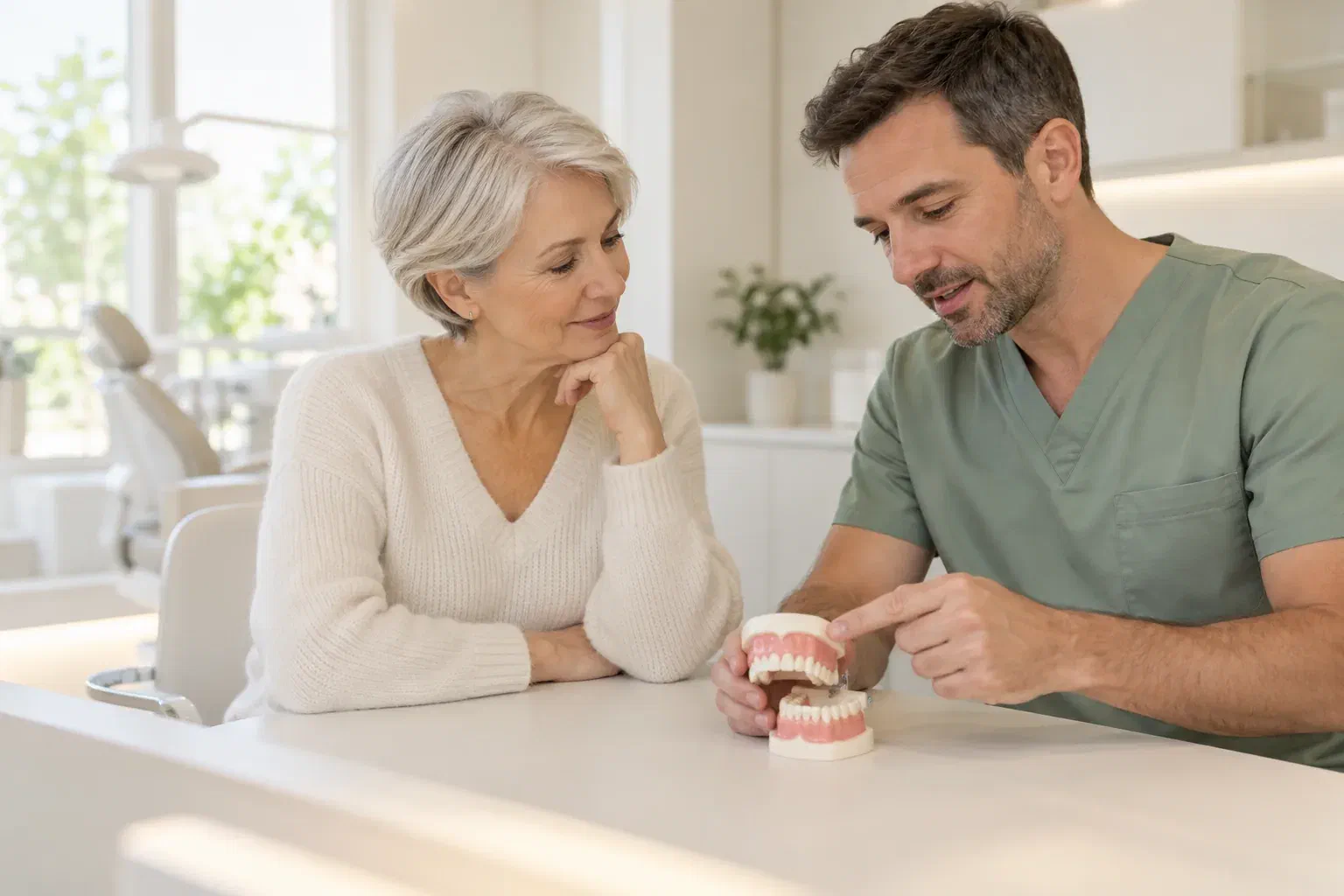
Illustrative patient and clinician discussing upper and lower tooth contacts using a dental model
Specialized Care

Bite and Occlusion Assessment in Puslinch

The feeling comes and goes, so by the time you sit in the chair it is hard to describe. A week of simple notes can change that. For households in Puslinch, a bite assessment pairs your observations with an examination of contacts, teeth and dental work, so the next decision is well grounded.

When symptoms come and go

Write it down for a week.

An uneven bite that bothers you at supper and disappears by morning is easy to forget once you are at the clinic. Occlusion refers to the way the top and bottom teeth touch, and assessing it means combining a close examination with your account of when and where things feel wrong. The better that account, the more useful the visit.

Notes also help separate problems that feel alike. A restoration that sits proud tends to bother you every time you close; a cracked tooth may sting only on certain foods; tired jaw muscles may be worst after a stressful day or on waking. Seeing the pattern on paper often points to which explanation deserves the closest look.

Nothing elaborate is needed. Jot down the date, the side, what you were eating or doing and how it felt, plus anything relevant such as recent dental work, a knock to the mouth or a change to a guard. Bring that page with you. We will explain what the examination shows, be honest about what is still uncertain and discuss next steps without assuming your teeth need reshaping.

Book with your notes in hand
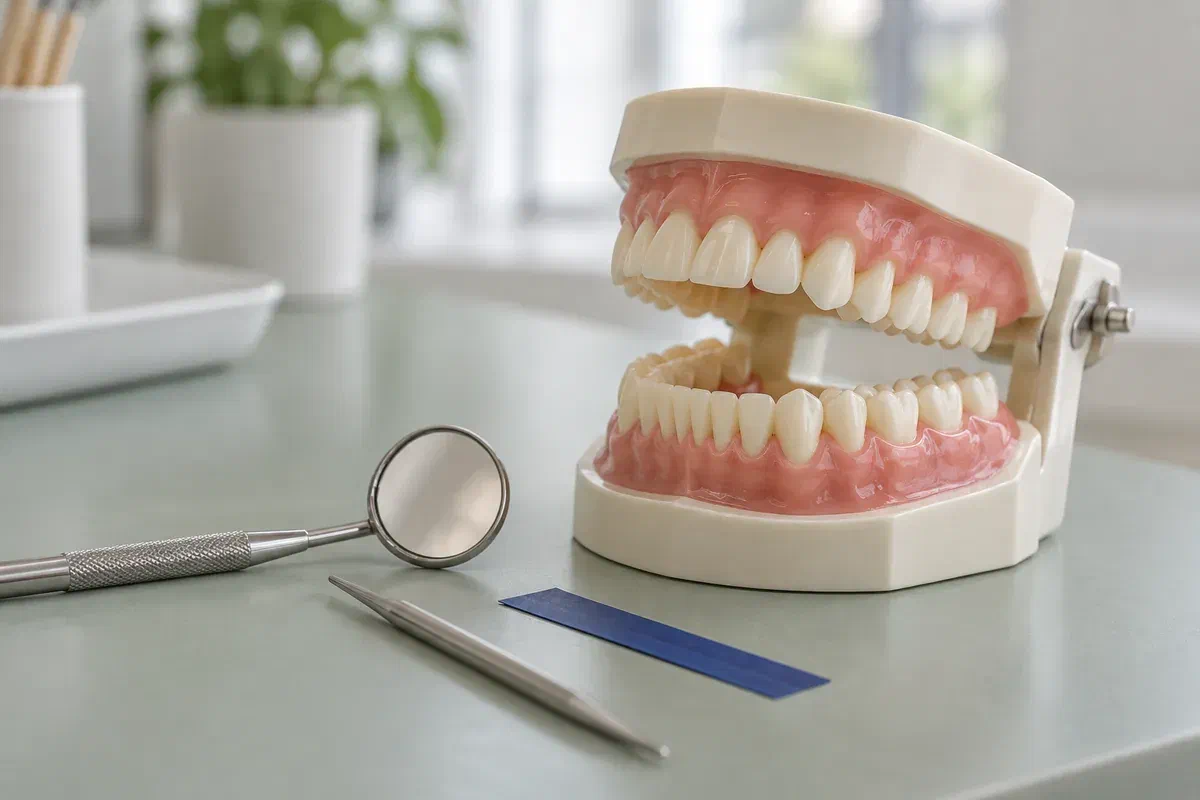
Illustrative hinged dental model beside a mirror and blue bite-marking paper on a pale surface
What to look for in your notes

Three patterns that often show up.

Record what happens in everyday eating and resting rather than testing your teeth on purpose. If a tooth is painful, avoid chewing on it while you wait for your appointment.

Every closure feels off on one tooth

A tooth that lands first each time you close, especially after a new filling, crown or bridge, tends to show up on every line of the log. Note the tooth and whether it aches. If another office placed the work, they should usually be the first to review it.

Damage that keeps recurring

If your notes include chips, a rough edge that returns or a repair that loosens, list the dates. Bring any guard or retainer. We look at whether the contacts and tooth condition match what you have recorded and consider other explanations too. A worn surface shows contact, not a full cause.

Jaw discomfort that follows a pattern

Soreness on waking, aching after long meals, catching or limited opening each tell a slightly different story. The jaw muscles and joints may need their own assessment. A sore jaw by itself is not a reason to begin grinding teeth down.

Studies have not established that an imperfect bite is a dependable cause of temporomandibular disorders. If your log mostly describes jaw pain, ask how the diagnosis will be confirmed and why any treatment offered is appropriate.

Turning notes into answers

Your observations, checked against the findings.

An assessment is most useful when your experience and the examination can be compared directly. With notes in hand, the clinician can see whether a contact on one tooth matches the times you felt it, whether the pattern suggests a tooth problem or a muscle problem, and what more would help. Even a conclusion of ‘watch and record’ is easier to accept when it is clearly explained.

The comparison also helps you size up any proposal. Rechecking one new filling is a modest step; changing many contacts is a major one. Ask what each suggestion is designed to do, what the alternatives are and what it cannot change, and whether it fits the pattern in your log.

Whether one spot explains everything

The findings may point to a single tooth or restoration, a tooth that needs further testing or a broader issue. Matching that to your notes keeps a contained problem from turning into an unexplained wide plan. If more than one thing needs care, ask about order.

A log that continues after the visit

Your notes become a baseline. Agree on what you will keep tracking and what would count as better, such as a week without that sharp twinge. Follow-up visits can then compare like with like.

Time before any permanent decision

If an irreversible adjustment comes up, ask what would be removed and whether it is enamel or a restoration. Consider uncertainty and alternatives along with the likely benefit. You can go home and think, or seek another opinion, before agreeing.

How the appointment works

Your notes first, then the examination.

Each assessment is tailored to the concern. Records vary from one person to another, and being examined does not mean you have consented to having teeth or restorations changed.

  1. Go through the log together

    We read your notes and ask about anything unclear: when it began, which side, and whether it happens on closing, chewing or at rest. Recent treatment and past attempts to fix it are added. Jaw symptoms are discussed as their own topic.

  2. Examine and compare

    The clinician checks the relevant teeth and restorations and may use marking paper to show where they meet. Describe what you feel while closing. The marks are compared with your notes and the rest of the examination, not taken as proof on their own.

  3. Consider what else would help

    If the pattern is still unclear, tooth tests, x-rays, models or another clinician’s view may be suggested. Ask whether anything can be done during the same visit to limit extra trips. No single device is required for every patient.

  4. Decide on a sensible step

    That may be monitoring with continued notes, focused care, conservative symptom relief or a referral. An adjustment, if any, is agreed as its own step and rechecked later. If nothing explains the log, the next step is investigation, not trial and error.

Keeping track afterward

Keep the notebook going for a while.

An assessment may need no recovery at all. Any instructions reflect whether treatment was given, an appliance was reviewed or further tests are being arranged.

Record, do not repair

If something still feels off, write it down and call; please do not file a tooth, smooth a filling or cut a guard at home. Bring the appliance to your next appointment so it can be looked at directly.

Compare with your earlier notes

Every few days, note whether chewing is better, the same or worse and whether anything new has started. Avoid clenching to test the bite. Agree at the visit on how many weeks of unchanged notes should lead to a recheck.

Bring the whole picture back

Store your log with any treatment summary, referral letter and guard instructions. Mention care received elsewhere since the visit. With everything together, the follow-up can go straight to what has changed.

Options the findings may support

Let the pattern guide the plan.

Ask what each option targets and what evidence supports it. A contact that bothers you at every meal, a tooth that stings on certain foods and a jaw that aches on waking may need different answers.

When the log and the findings agree

Monitoring or a single restoration review

If notes and examination both point to one filling or crown, that may be the focus while everything else is watched. Ask what a change would achieve, which material it involves and when it will be rechecked. The examination should lead the decision, with your notes as support.

When clenching or grinding fits the pattern

Conservative care or appliance assessment

Morning soreness and worn edges may suggest night-time grinding. An existing guard can be reviewed, and the aim of any new one explained. A guard protects teeth but does not resolve every jaw problem. Ask about fit, routine, limits and how benefit will be judged.

When the pattern is complex or persistent

Further dental or specialist review

Symptoms that continue despite care, complicated restorative questions or a possible joint condition may justify a referral. Ask what it should clarify and how to manage meanwhile. Permanent reshaping of the bite is not a routine answer to jaw joint pain.

Patient information: NIDCR — bruxism assessment, symptoms, and protection of teeth

Puslinch questions

About logs, timing and next steps.

Your notes, history and examination findings are considered together. The visit can make your choices clearer even if no change is recommended yet.

(905) 876-4488
What should a bite symptom log include?
Keep it simple: the date, which side, what you were eating or doing, and what it felt like. Add notes about recent dental work, guards or anything unusual. A week or two of entries is usually enough to show a pattern.
Does it matter what time of day the discomfort happens?
It can. Discomfort on waking may point toward clenching or grinding, while pain only on certain foods may suggest a tooth problem. Timing is one clue the clinician weighs with the examination.
Should I try different foods to see what triggers it?
No need to experiment. Simply note what happens during normal meals. Deliberately biting hard on a tender tooth can make it worse and does not add much useful information.
If a high contact matches my notes, will it be adjusted that day?
Not automatically. A match makes the finding clearer, but any change is still a separate decision. Ask what would be removed, from which surface and what alternatives exist before agreeing.
Can I plan the visit from Puslinch alongside other errands or appointments?
Ask when booking roughly how long the assessment may take and whether further records are likely. The team can help you schedule sensibly, though what is needed depends on the findings.
What if my notes and the examination do not line up?
That is useful information too. Ask what has been excluded, what remains uncertain and whether continued notes, a review or further tests would help. Repeated permanent changes without a clear purpose are not a substitute for investigation.

Patient information: NIDCR — painless joint sounds and caution about permanent bite changes for TMD

Booking from Puslinch

Bring the notebook. We will bring the questions.

Reach out to our Bronte Street practice about a bite that comes and goes, a restoration that feels different or discomfort when chewing. We can review your notes, examine the concern and explain whether monitoring, care or further investigation fits.

The examination, records, treatment, referral needs and fees depend on the findings. No bite adjustment is made by default, and a particular explanation or result cannot be promised ahead of time.

Visit Milton Dental Clinic
Unit 1, 342 Bronte St. S, Milton, ON L9T 5B7
Get directions Clinic hours
Monday–Thursday
11am–7pm
Friday–Sunday
By appointment only

Areas we serve

  • Milton
  • Oakville
  • Mississauga
  • Georgetown
  • Halton Hills
  • Acton
  • Campbellville
  • Brampton
  • Burlington
  • Puslinch
  • Rockwood
  • Erin
  • Caledon
  • Etobicoke
  • Old Milton
  • Bronte Meadows
  • Timberlea
  • Dorset Park
  • Dempsey
  • Clarke
  • Beaty
  • Coates
  • Harrison
  • Scott
  • Willmott
  • Ford
  • Bowes
  • Cobden
  • Walker
  • Mountain View
  • Milton Heights
  • Hawthorne Village
  • Valley View
  • Fallingbrook
  • Nassagaweya
  • Trafalgar
  • Esquesing
  • Nelson
  • Brookville
  • Moffat
  • Glen Williams
  • Norval
  • Limehouse
  • Stewarttown
  • Ashgrove
  • Hornby
  • Silver Creek
  • Speyside
  • Scotch Block
  • North Oakville
  • River Oaks
  • Glen Abbey
  • West Oak Trails
  • Palermo
  • Bronte Creek
  • College Park
  • Joshua Creek
  • Uptown Core
  • Preserve
  • Iroquois Ridge
  • Lisgar
  • Meadowvale
  • Meadowvale Village
  • Churchill Meadows
  • Erin Mills
  • Central Erin Mills
  • Streetsville
  • East Credit
  • Creditview
  • Heartland
  • Sheridan
  • Mount Pleasant
  • Credit Valley
  • Huttonville
  • Churchville
  • Springbrook
  • Northwest Brampton
  • Bram West
  • Fletcher's Meadow
  • Fletcher's Creek South
  • Alton Village
  • Orchard
  • Millcroft
  • Headon Forest
  • Tansley
  • Brant Hills
  • Tyandaga
  • Kilbride
  • Lowville
  • Aberfoyle
  • Morriston
  • Arkell
  • Hillsburgh
  • Freelton
  • Carlisle
  • Waterdown
  • Flamborough
  • Mountsberg

How can we help?

Milton Dental Clinic

Have a question about your smile? Choose the option that works best for you.

For urgent dental concerns, please call.
Messages are reviewed during clinic hours.