

Illustrative clinician discussing tooth support with a patient using a physical teaching model
Specialized Care

Bone-Loss Assessment

If a dental image or examination has raised questions about bone support, ask what the findings mean for your teeth. A bone-loss assessment in Milton brings gum measurements, relevant images, and your treatment history together to guide the next stage of care.

A closer look at bone-loss assessment

Understand the support around your teeth before deciding what comes next.

A bone-loss assessment reviews the supporting structures around your teeth and considers whether there is evidence of reduced support. It combines clinical findings with relevant dental images and history. The phrase bone loss can sound alarming, but it does not provide the location, extent, cause, or treatment implications on its own.

You may have been told about a finding on an X-ray, noticed a loose tooth, or want a clearer explanation of previous gum treatment. These are reasons to ask questions, not reasons to assume that every affected tooth must be removed. The outlook depends on the individual tooth and the wider clinical picture.

At Milton Dental Clinic, bring any previous images, periodontal records, or treatment summaries you can access. Tell us what you were advised and what remains unclear. We can review the findings, explain the information needed, and discuss care aimed at managing the condition and supporting the teeth that can reasonably be maintained.

Discuss a bone-support concern
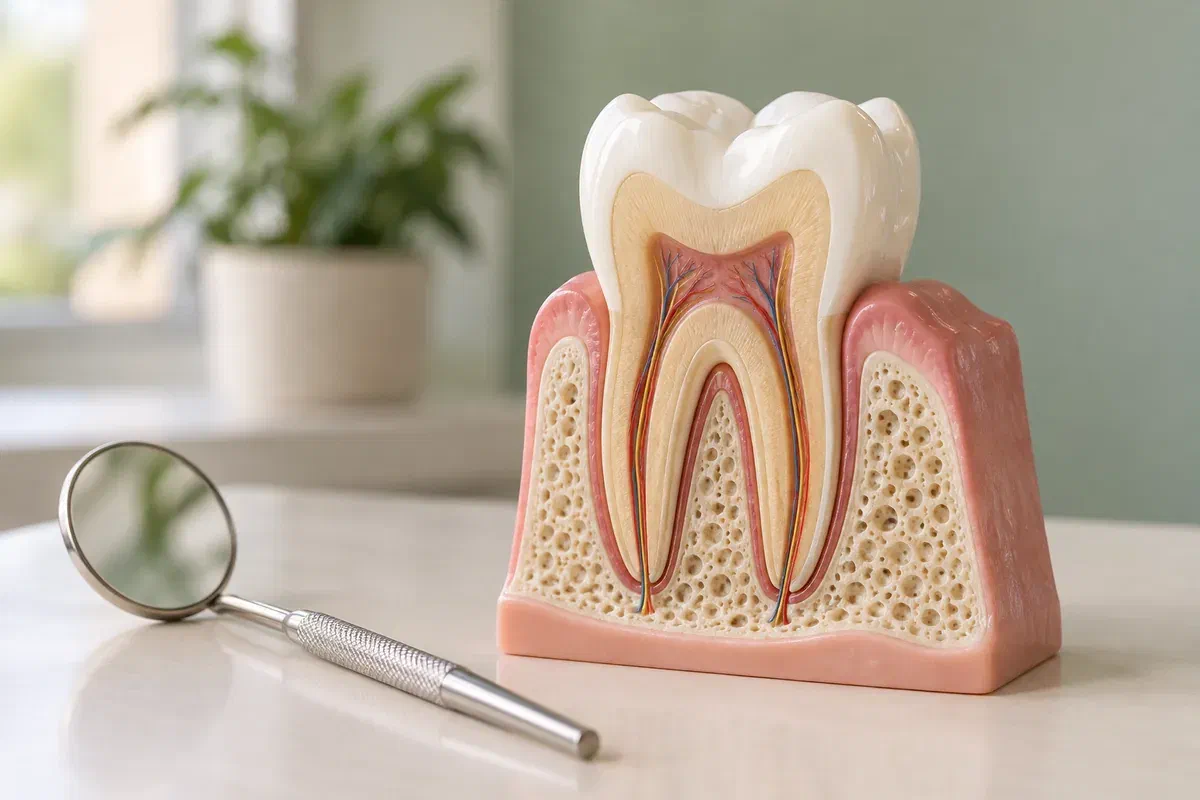
Illustrative cross-section tooth model showing roots within supporting gum and bone beside a dental mirror
What prompted the question?

A past record and a current symptom offer different information.

Explain whether your concern comes from a recent examination, an older diagnosis, or a change you have noticed. The assessment should connect that history with what is found today.

A finding on a dental image

Ask which area is involved and how the image relates to the clinical examination. A screenshot or isolated description cannot replace assessment of the teeth and gums. Previous comparable records may help the clinician discuss change over time and the limits of that comparison.

A tooth that feels loose or has shifted

Mention when you noticed the change, whether there is pain, and if it followed an injury or another event. Tooth movement needs assessment rather than a home test of how far it can move. The examination can help determine what requires prompt attention.

A history of gum disease or interrupted care

Bring details of earlier treatment and maintenance visits, including care received at another practice. Explain any barriers that made continuing difficult. The purpose is to understand the present needs and establish a workable plan, not to judge the gap in your appointment history.

Bone levels, gum measurements, and symptoms need to be interpreted together. The absence of pain does not prove that support is healthy, and a finding of reduced support does not by itself establish that every tooth has the same outlook.

What a detailed review can explain

Replace a worrying label with a plan you can understand.

The assessment can help identify which areas need treatment, which require closer observation, and what information is still missing. Ask the clinician to show you the findings in a way you can follow. Understanding the location and significance of a problem is more useful than hearing only a broad label.

It also provides a starting point for future comparison. A maintenance plan should explain what is being monitored and why the recommended interval fits your needs. You can then understand the purpose of returning even when your mouth feels comfortable and no new symptom has appeared.

Patient information: American Academy of Periodontology — combining clinical and radiographic findings

A tooth-by-tooth discussion where needed

Ask whether the concern is localized or more widespread and how that affects the options. If one tooth has a less favourable outlook, request an explanation specific to it. A recommendation for that tooth should not be assumed to apply equally to the rest of the mouth.

A distinction between present findings and progression

Ask what can be concluded from the available records and what would require follow-up. The clinician can explain whether older measurements or images help and what makes a comparison meaningful. A single assessment should not be presented as a precise prediction of future change.

An order for care and later decisions

Discuss which concerns need attention first and which restorative or appearance decisions should wait. If several treatments are proposed, ask how they relate to controlling the underlying condition. A staged plan can make the responsibilities, appointments, and fees easier to evaluate.

How the assessment is put together

Review the history, record the findings, and discuss their meaning.

The records needed depend on the question being investigated. Ask why a particular examination or image is recommended and how it will help determine the next step.

  1. Gather the dental and health history

    Discuss previous gum treatment, tooth loss, current symptoms, and any earlier explanation of bone support. Review relevant medical conditions, medicines, and tobacco use. If older records are available, ask whether they can be obtained before deciding what new information is necessary.

  2. Examine the gums and individual teeth

    The clinician evaluates the tissues and may record pocket measurements, recession, bleeding, and tooth stability. Ask which findings are most relevant to your concern. The examination should consider the teeth as part of the supporting system rather than rely only on a visible gumline.

  3. Review appropriate images with the examination

    Dental images may help assess bone levels and other tooth-related findings. The clinician decides what is indicated and interprets it alongside the clinical records. Ask about any limitations and avoid assuming that a three-dimensional scan is necessary for every bone-support question.

  4. Explain the care options and review interval

    Discuss the diagnosis, areas of concern, and the proposed sequence of care. Ask whether specialist assessment would add useful information and what should happen while waiting. Confirm how the response will be reviewed before committing to later stages of a larger treatment plan.

Following through after the assessment

Turn the findings into care you can maintain.

An assessment is the beginning of a plan, not a procedure that restores bone. Follow the advice for your diagnosis and ask for help with any part that is difficult to carry out.

Make the cleaning plan specific

Ask for a demonstration around the affected teeth and any spaces or restorations that are difficult to clean. Confirm the recommended tools and technique. If a tooth is uncomfortable or a brush catches, report it so the approach can be reviewed rather than forcing the area.

Keep the treatment and maintenance appointments connected

Clarify which visits provide active treatment and which check stability afterward. Ask who is coordinating care if a specialist is involved and where follow-up should occur. Bring any outside reports so recommendations can be considered together rather than as unrelated plans.

Report changes even between planned reviews

Contact the clinic about new looseness, swelling, discomfort, or a change in chewing. Tell the team about relevant health or medication changes as well. Do not wait for the next routine visit solely because the previous assessment established a maintenance schedule.

Deciding what follows a bone-loss assessment

Managing the condition and rebuilding tissue are different discussions.

Ask what each option is intended to achieve, what evidence makes it suitable, and what continuing care it requires. Treatment should be individualized to the findings rather than selected from the phrase bone loss alone.

When controlling the condition is the priority

Periodontal care and supportive maintenance

A plan may include appropriate cleaning, gum treatment, home-care support, and regular reassessment. Ask how stability will be evaluated and what remains uncertain. Improved gum health does not automatically mean that all previously lost support has returned.

When more detailed periodontal options need consideration

Specialist review of a suitable defect

A periodontist may assess whether additional treatment, including a regenerative approach in a suitable case, is reasonable. Ask about the specific defect, expected benefit, limitations, and maintenance. Grafting is not a universal response to every pattern of bone loss.

When a tooth's prognosis affects the overall plan

A wider tooth-retention or replacement discussion

If a tooth cannot reasonably be maintained, ask why and compare the available next steps. Retention and replacement decisions should include the condition of the surrounding mouth. Neither extraction nor implant treatment should be assumed simply because reduced support was found.

Patient information: American Academy of Periodontology — selected regenerative and surgical procedures

Questions about dental bone support

Ask where the concern is and what the evidence can show.

The assessment can explain a previous finding or establish a clearer starting point for care. Bring earlier records and the questions you were left with after another appointment.

(905) 876-4488
Does being told I have bone loss mean my teeth will all need removing?
No. The location, extent, tooth condition, and response to care affect the discussion. Ask for an explanation of each tooth that has a questionable outlook. A general label does not provide enough information to determine which teeth can reasonably be maintained.
Can an old X-ray help with a new bone-loss assessment?
It may provide useful background or allow comparison when the records are suitable. Bring the image or tell the clinic where it was taken. The clinician still needs current examination findings and will explain whether additional records are indicated.
Why are gum measurements needed if bone loss is already visible on an image?
Images and clinical measurements contribute different information. The clinician considers the supporting tissues, inflammation, and teeth alongside the radiographic findings. Ask how those records fit together and what they show about the care needed rather than relying on one image alone.
Will improved brushing rebuild all the bone that has been lost?
Better daily care supports gum health and is an important part of management, but it should not be presented as rebuilding all lost bone. Ask what the treatment aims to stabilize and whether any additional procedure is suitable for your specific findings.
Does a bone-loss assessment automatically include a grafting procedure?
No. Assessment comes before any treatment decision. Some situations call for periodontal care and maintenance, while selected defects may merit specialist discussion. If grafting is considered, ask why the site is suitable and what result and limitations are realistic.
Can I request an explanation of bone loss even if my teeth feel firm?
Yes. A comfortable, apparently firm tooth does not answer every question about its support. Bring the previous finding or concern and ask what examination is appropriate. The visit can clarify whether treatment, monitoring, or further information is needed.
Bone-loss assessment in Milton

Bring the records and get a clearer picture of your next step.

Contact our Bronte Street practice to discuss reduced bone support, a previous periodontal finding, or uncertainty about a treatment recommendation. We can assess the concern and explain an appropriate plan for care or further evaluation.

Diagnosis, tooth prognosis, imaging needs, treatment suitability, referral, and fees depend on assessment. Neither tooth retention nor regeneration of lost support can be guaranteed in advance.

Visit Milton Dental Clinic
Unit 1, 342 Bronte St. S, Milton, ON L9T 5B7
Get directions Clinic hours
Monday–Thursday
11am–7pm
Friday–Sunday
By appointment only

How can we help?

Milton Dental Clinic

Have a question about your smile? Choose the option that works best for you.

For urgent dental concerns, please call.
Messages are reviewed during clinic hours.