

Illustrative clinician discussing tooth support with a patient using a physical teaching model
Specialized Care

Bone-Loss Assessment in Caledon

Rows of numbers on a gum chart, phrases like “generalized moderate” on a report, and an X-ray you were shown for ten seconds. Coming from Bolton or elsewhere in Caledon, a bone-loss assessment translates those records into plain language and explains what they mean for your next steps.

Reading your own records

What do all those numbers actually mean?

During a gum check you may hear a hygienist call out “three, two, three, five” while someone types. Those are measurements, in millimetres, of the space between gum and tooth. Together with X-rays, they form the core of a bone-loss assessment: a review of the support around each tooth, interpreted alongside your dental and medical history.

The words on a report can be just as confusing as the numbers. “Bone loss” on its own does not explain where the change is, how much support is affected, what caused it, or what treatment is appropriate. Terms describing extent or pattern add some detail, but they still need someone to explain how they apply to your teeth.

For households in Caledon, it can help to request copies of previous charts and images before the visit, so you can bring them along. Note the terms that puzzled you. We will examine your gums, go through the records line by line if you want, and discuss care meant to preserve teeth that can realistically be maintained.

Have your gum chart explained
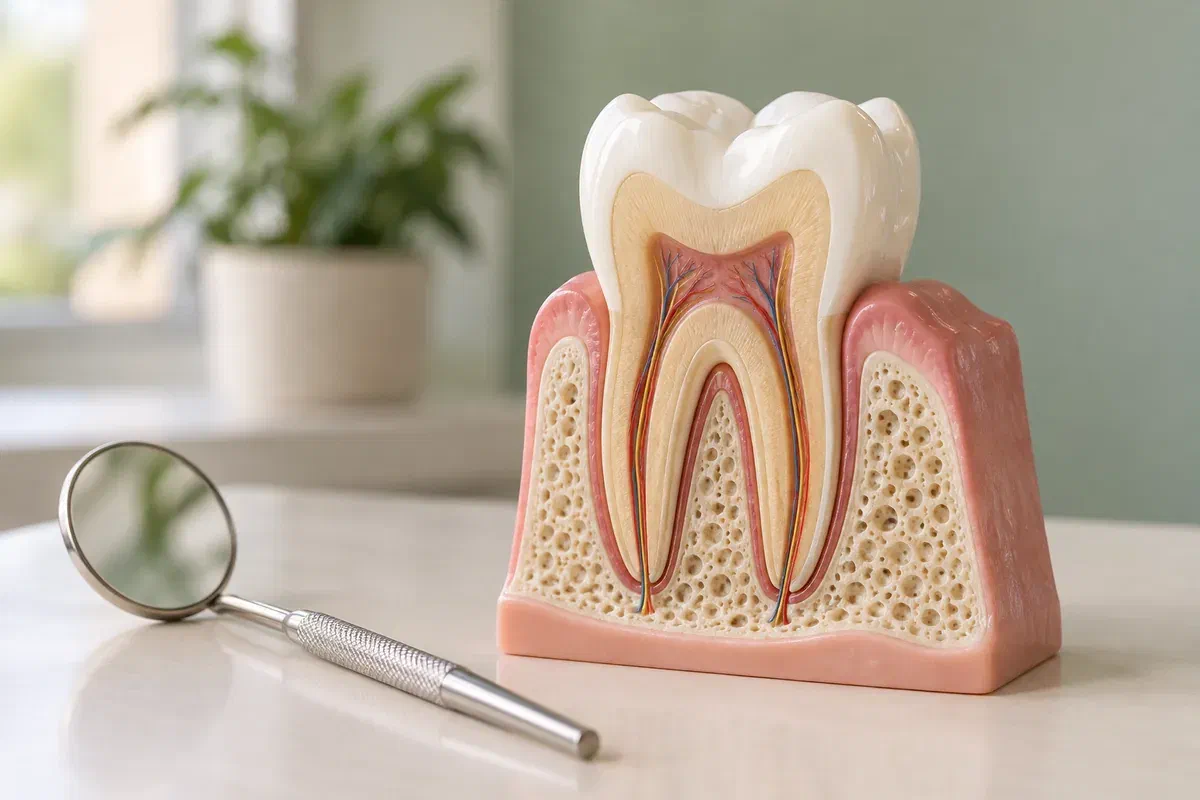
Illustrative cross-section tooth model showing roots within supporting gum and bone beside a dental mirror
Making sense of what you were told

Chart, symptom or history: each needs translating.

Tell us which record or experience left you with questions. The assessment will link it to what we find on examination today.

An X-ray you didn’t fully understand

Ask which part of the image shows bone and which teeth the comment referred to. An image is one view and needs to be paired with the gum examination. If you have older radiographs, the clinician can explain whether they help show change over time.

Movement recorded as a grade

Charts often score mobility with a number from zero upward, which means little without context. If you have felt a tooth shift yourself, tell us roughly when it began, whether chewing is sore and whether a knock or fall came first. Leave the wiggling to the clinician, who can judge how soon it should be dealt with.

A diagnosis on paper from years ago

Old letters or treatment summaries may use terms that have since changed. Bring whatever you have and tell us what treatment followed. If maintenance stopped at some point, mention why. We are interested in where things stand now, not in assigning blame.

Numbers, images and symptoms only make sense together. A low-number chart doesn’t guarantee every site is healthy, a painless mouth can still have reduced support, and one deep reading doesn’t predict the rest.

Why the translation matters

Records you can read are records you can use.

Once the numbers and terms make sense, you can take part in decisions about your care. The assessment helps show which areas need treatment, which need monitoring and what remains uncertain. Ask the clinician to point to specific readings and images, and to say why they matter.

Today’s chart also becomes your reference point. At later visits, you can ask how the numbers compare and what any change suggests. Understanding what is being tracked, and why your review interval was chosen, makes those appointments feel worthwhile rather than routine.

Patient information: American Academy of Periodontology — combining clinical and radiographic findings

Readings explained site by site

Ask whether higher numbers are clustered in one area or spread around, and how that affects the options. If one tooth has noticeably deeper readings, ask what that means for it in particular rather than for the whole mouth.

A clear sense of what numbers can’t show

Ask what today’s measurements confirm and what would need a later comparison. Older charts and images help when they are comparable. A single set of numbers is not a forecast of future change.

Care arranged by priority

When a report lists several treatments at once, ask which is most pressing and whether crowns or cosmetic work could sensibly be postponed. Ask how each depends on gum stability. A staged plan makes appointments, responsibilities and fees easier to compare.

How the records are made

Behind every number on the chart.

We choose records that answer your question. If something is recommended, ask what it will show and how it will be explained to you.

  1. Review history and earlier records

    We look at old charts and images, past gum treatment, missing teeth, symptoms and earlier explanations. Medical conditions, medications and tobacco use matter as well. If records are at another office, ask whether to request them first.

  2. Record pocket depths and other signs

    Several readings are taken around each tooth, along with notes on bleeding, recession and mobility. Ask the clinician to explain a few numbers as they go, or afterward. Together these describe the attachment below the gumline.

  3. Interpret images with the chart

    Dental X-rays can show bone height and other features along the roots. Image choice is a clinical decision, and the results are read alongside the measurements. Ask about limitations; a 3D scan is not needed for every bone-support question.

  4. Summarize in plain language

    You hear what the readings add up to, which sites matter most and the sequence of care we would propose. Ask for a copy of your chart if it helps, and whether a specialist opinion would add anything. Confirm how early results will be reviewed before later stages.

Using what you learned

Let the numbers guide the routine.

The assessment explains what is happening but doesn’t rebuild bone. Follow the care that suits your findings, and let us know if any part is difficult.

Focus cleaning on the deeper sites

Ask the team to mark where your higher readings sit and to show you how to reach those spots, including under bridges or around crowns. Find out which brushes or aids are worth buying. If one catches or leaves the gum sore, say so and we can suggest something else.

Track the chart over time

Some visits deliver treatment; others exist mainly to measure again and compare. Ask which is which. When a periodontist shares your care, find out whose office keeps the chart up to date and who you should call first. Pass along outside reports so nothing is read in isolation.

Don’t wait on a new symptom

Get in touch if a tooth moves more, a gum swells, chewing changes or discomfort appears. Tell us about new health conditions or medicines too. The next scheduled review is not a reason to delay.

Turning findings into choices

Different readings, different routes.

Ask what each option aims to do, which findings make it suitable and what ongoing care it involves. Treatment should reflect your records rather than one phrase on a report.

When steadying the readings is the aim

Periodontal care with re-measurement

This may include professional cleaning, gum therapy, home-care guidance and scheduled reviews where pockets are measured again. Ask what improvement would look like and what remains uncertain. Better readings do not mean lost bone has returned.

When one area might suit further periodontal treatment

Specialist review of a deeper site

Where one site reads much deeper than its neighbours, a periodontist may look at whether extra treatment, occasionally a regenerative technique if the defect’s shape suits it, is worthwhile. Ask what that site would gain, what the limits are and what upkeep follows. Grafting is not a fit for every pattern of bone loss.

When one tooth’s prognosis shapes the plan

Considering a tooth with very limited support

If the numbers and images suggest a tooth can’t realistically be held, ask what led to that view and lay the alternatives side by side. Its neighbours and your bite belong in that decision. A low reading by itself is no automatic case for removal or an implant.

Patient information: American Academy of Periodontology — selected regenerative and surgical procedures

Caledon chart questions

Decoding the language of gum health.

Dental records use shorthand that is rarely explained. Bring copies of yours and any questions, and we will go through them with you.

(905) 876-4488
What do the pocket depth numbers on my chart mean?
They measure, in millimetres, how far a thin probe slides between the gum and tooth. Lower readings are generally associated with healthier attachment, while deeper readings may indicate gum disease. The clinician interprets them alongside bleeding, images and other findings.
What is the difference between localized and generalized bone loss?
Localized usually means the change affects a limited number of sites, while generalized means it is seen more widely. The terms describe distribution, not outlook, so ask how they apply to specific teeth in your mouth.
Can I get a copy of my gum chart and X-rays?
You can ask for copies of your records. Having them can help you follow changes over time and share information with other providers. Ask the team how to request them.
Why does bleeding on probing matter?
Bleeding when the gum is measured can indicate inflammation at that site. The clinician considers it together with pocket depths and images to judge whether the gums are stable or need treatment.
Do deeper numbers mean a tooth has to be removed?
Not automatically. The amount of support, the tooth’s condition and how the site responds to care all matter. Ask for an explanation of any tooth with readings or images that concern you.
Is there a scan that shows bone more clearly than a regular X-ray?
Three-dimensional imaging exists, but it is not needed for most bone-support questions. The clinician decides whether it would add useful information in your situation and explains why before recommending it.
Caledon bone-loss assessment

Bring the chart. We’ll explain every line you want explained.

Call our Bronte Street practice to go over gum measurements, an X-ray report about bone, or a diagnosis you never fully understood. After examining you, we will put the findings in plain terms and suggest what should happen next, whether that is treatment, monitoring or a further opinion.

What your records mean, how each tooth is likely to fare, which images are needed, what treatment fits, whether to refer and what it costs are all settled at assessment. Keeping teeth or regaining support cannot be promised in advance.

Visit Milton Dental Clinic
Unit 1, 342 Bronte St. S, Milton, ON L9T 5B7
Get directions Clinic hours
Monday–Thursday
11am–7pm
Friday–Sunday
By appointment only

Areas we serve

  • Milton
  • Oakville
  • Mississauga
  • Georgetown
  • Halton Hills
  • Acton
  • Campbellville
  • Brampton
  • Burlington
  • Puslinch
  • Rockwood
  • Erin
  • Caledon
  • Etobicoke
  • Old Milton
  • Bronte Meadows
  • Timberlea
  • Dorset Park
  • Dempsey
  • Clarke
  • Beaty
  • Coates
  • Harrison
  • Scott
  • Willmott
  • Ford
  • Bowes
  • Cobden
  • Walker
  • Mountain View
  • Milton Heights
  • Hawthorne Village
  • Valley View
  • Fallingbrook
  • Nassagaweya
  • Trafalgar
  • Esquesing
  • Nelson
  • Brookville
  • Moffat
  • Glen Williams
  • Norval
  • Limehouse
  • Stewarttown
  • Ashgrove
  • Hornby
  • Silver Creek
  • Speyside
  • Scotch Block
  • North Oakville
  • River Oaks
  • Glen Abbey
  • West Oak Trails
  • Palermo
  • Bronte Creek
  • College Park
  • Joshua Creek
  • Uptown Core
  • Preserve
  • Iroquois Ridge
  • Lisgar
  • Meadowvale
  • Meadowvale Village
  • Churchill Meadows
  • Erin Mills
  • Central Erin Mills
  • Streetsville
  • East Credit
  • Creditview
  • Heartland
  • Sheridan
  • Mount Pleasant
  • Credit Valley
  • Huttonville
  • Churchville
  • Springbrook
  • Northwest Brampton
  • Bram West
  • Fletcher's Meadow
  • Fletcher's Creek South
  • Alton Village
  • Orchard
  • Millcroft
  • Headon Forest
  • Tansley
  • Brant Hills
  • Tyandaga
  • Kilbride
  • Lowville
  • Aberfoyle
  • Morriston
  • Arkell
  • Hillsburgh
  • Freelton
  • Carlisle
  • Waterdown
  • Flamborough
  • Mountsberg

How can we help?

Milton Dental Clinic

Have a question about your smile? Choose the option that works best for you.

For urgent dental concerns, please call.
Messages are reviewed during clinic hours.