

Illustrative clinician discussing tooth support with a patient using a physical teaching model
Specialized Care

Bone-Loss Assessment in Georgetown

Someone has raised the idea of removing a tooth, maybe replacing it with an implant, and bone support is at the centre of that conversation. From Georgetown, a bone-loss assessment examines the tooth and its neighbours, reviews suitable images and history, and helps you weigh keeping it against the alternatives.

Keep it or replace it?

Before the tooth comes out, understand what holds it in.

Talk of extraction tends to move quickly to the replacement: an implant, a bridge, a partial denture. Yet the first question is whether the tooth itself can reasonably be maintained, and that depends heavily on the gum and bone around it. A bone-loss assessment evaluates that support through a clinical examination, relevant images and your dental history.

Reduced bone around a tooth is a finding, not a verdict. It does not tell you on its own how much support remains, whether the cause can be controlled, or how the tooth compares with its neighbours. The same assessment also gives useful context if replacement is eventually chosen, since the condition of the surrounding bone and gums matters for any option.

When you come in from Georgetown, bring any plan or estimate you have been given, plus X-rays and the name of the office that took them. Explain what was recommended and what you are hesitant about. We can examine the tooth, explain its outlook as clearly as the findings allow, and discuss whether managing the condition or another route makes more sense.

Review a tooth before deciding
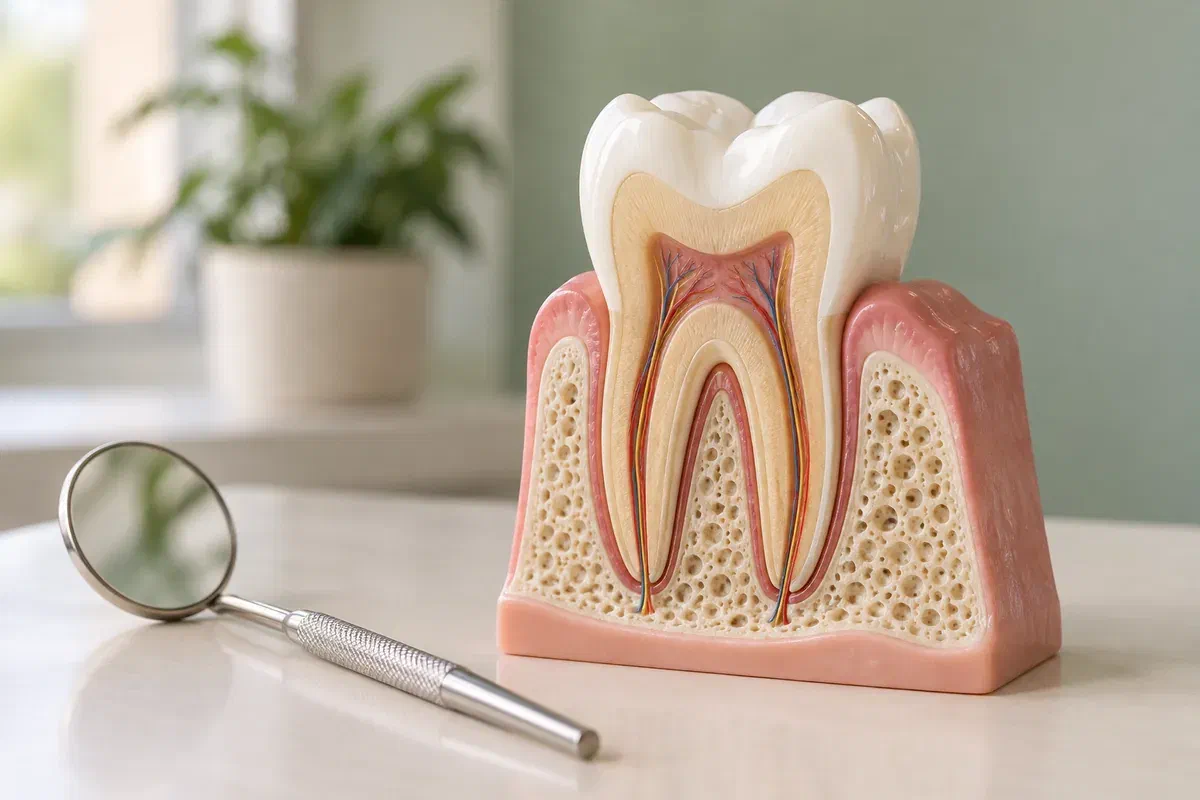
Illustrative cross-section tooth model showing roots within supporting gum and bone beside a dental mirror
How the question arose

Why is this tooth under discussion?

The reason a tooth has been flagged affects what the clinician looks for first. Share what you were told, and we will compare it with what we see today.

An X-ray showing bone around one root

Ask how much of the root appears supported and how the image relates to the gum examination. A single image is one angle on a three-dimensional structure. If older images exist, the clinician can say whether they help show whether the bone level is changing.

A tooth that moves when you chew

Note when the movement began, whether there is pain and whether anything preceded it, such as a cracked filling or a blow. Mobility can come from more than one cause. Leave the testing to the examination so the tooth is not stressed further.

Repeated gum problems in one area

Recurring swelling, tenderness or past treatment around the same tooth is valuable information. Share what was done and where, and mention if follow-up stopped. That helps us understand whether the area might stabilize with care.

Images, gum measurements and symptoms must be read together. A pain-free tooth may still have reduced support, and a poor outlook for one tooth does not mean its neighbours share it.

Why assess before removing

A decision this permanent deserves good information.

Once a tooth is gone, it is gone. A careful assessment helps you understand whether the tooth is likely to respond to treatment, whether it should be watched, or whether its support is too limited to maintain. Ask to see the images and measurements and have them explained until the reasoning is clear to you.

The same findings inform whatever comes next. If you keep the tooth, they become the baseline for monitoring, and your recall interval should be explained. If you replace it, the condition of the surrounding gum and bone is still part of planning, and of looking after the neighbouring teeth.

Patient information: American Academy of Periodontology — combining clinical and radiographic findings

Specific reasons for this tooth

Ask whether the bone change is limited to the tooth in question or affects others, and how that changes your choices. Request an explanation that applies to this tooth, rather than a general view of your mouth.

Clarity on what we can confirm today

Ask what the current records establish and what would need a follow-up to judge. Older images may help if they are comparable. Predicting exactly how long a compromised tooth will last is not possible from one visit.

An order that protects your options

Ask whether gum treatment should come before any decision about extraction, implants or bridges. Find out how each option depends on controlling the underlying condition. Taking care in stages makes the commitment, appointments and fees easier to compare.

Working through the evidence

History. Examination. Images. Options.

We choose records to answer your specific question. If an image or test is recommended, ask how it will help determine whether the tooth can stay.

  1. Hear the tooth’s history

    We ask about past fillings, crowns or root canal treatment on the tooth, earlier gum care, symptoms and what was recommended before. Health conditions, medicines and tobacco use are part of the review. Existing records may spare you a repeat image.

  2. Examine the tooth and its surroundings

    The clinician checks the gum around the tooth and its neighbours, probing pocket depth and noting recession, bleeding and movement. Ask which findings weigh most heavily in the decision. Support is judged around the full root, not only at the gumline.

  3. Read the images alongside

    X-rays can help show the bone level along the root and other findings, such as infection or a crack. The clinician decides what is needed and interprets it with the examination. Ask about the limitations; a 3D scan is not required for every case.

  4. Lay out the paths forward

    We explain the diagnosis and compare keeping the tooth with other options. Ask whether a periodontist’s or another specialist’s opinion would help. Confirm how the response to any initial treatment will be assessed before deciding on removal.

If you decide to keep it

A compromised tooth needs a dependable routine.

Assessment helps you choose; it does not restore bone. Follow the advice tailored to your diagnosis, and tell us if any part is difficult.

Learn to clean around the weak spot

Ask for a demonstration focused on the tooth in question and any nearby spaces or dental work. Confirm the tools and technique to use. If a brush catches or the area is sore, mention it so we can adjust rather than having you push through.

Track the tooth over time

Ask which appointments are active treatment and which are reviews to see whether the tooth is stabilizing. If another provider is involved, confirm who is coordinating. Share outside reports so everyone works from the same information.

Speak up if it changes

Call about increased movement, swelling, pain or a change in your bite, and let us know about new medications or health conditions. A planned review is not a reason to wait on a tooth that is getting worse.

The choices on the table

Maintain, refer or replace, each for a different reason.

Ask what each option aims to achieve, why it fits your findings and what it requires over time. The decision should come from your examination, not from the phrase bone loss.

When the tooth may hold with proper care

Treating the gums and watching the tooth

This can include professional cleaning, gum therapy, home-care support and regular reviews. Ask how you will know whether the tooth is stable and what is still uncertain. Healthier gums do not mean lost support has come back.

When more advanced periodontal care could be considered

A periodontist’s view of the defect

A specialist can assess whether additional treatment, such as a regenerative procedure for a suitable defect, might be reasonable. Ask about the specific site, the expected benefit, its limits and the aftercare. Grafting is not right for every bone-loss pattern.

When maintaining the tooth is not realistic

Replacement after careful comparison

If the tooth cannot reasonably be saved, ask why and compare implants, bridges and other alternatives. The choice should consider the condition of your whole mouth. Reduced support alone does not make extraction or an implant automatic.

Patient information: American Academy of Periodontology — selected regenerative and surgical procedures

Georgetown questions about keeping teeth

Save, treat or replace: what to ask.

Tooth removal is hard to undo, so it is worth having your questions answered first. Bring the plan you were given and any records.

(905) 876-4488
How do you decide whether a tooth with bone loss can be saved?
The clinician considers how much support remains, the cause and whether it can be controlled, the condition of the tooth itself and its role in your bite. Ask how each factor applies to your tooth so you can understand the recommendation.
Does bone loss around a tooth affect whether I can have an implant later?
The amount and quality of bone in the area is part of implant planning, and gum health matters too. If replacement is being considered, ask how the current findings would influence the options and whether any extra assessment would be needed.
Should gum treatment come before deciding to remove a tooth?
Often it is reasonable to see how the gums respond to initial care before making a final decision, but that depends on the tooth and your symptoms. Ask whether waiting is sensible in your case and what signs would change the plan.
Will a deep cleaning regrow the bone around my tooth?
Periodontal cleaning aims to reduce inflammation and support healthier gums, but it is not expected to rebuild lost bone. Ask what the treatment aims to stabilize and whether additional procedures are suitable for your situation.
Is grafting a standard part of a bone-loss assessment?
No. The assessment comes first, and treatment is decided afterward. Some defects may be suitable for a specialist discussion about regeneration, while many situations are managed with periodontal care and maintenance.
Can old X-rays show whether the bone around my tooth is getting worse?
They may help if they show the same area clearly and in a comparable way. Bring them or tell us where they were taken. The clinician will also need a current examination to judge the present situation.
Georgetown tooth-support assessment

Have the tooth looked at before you decide.

Reach our Bronte Street practice to discuss a tooth with reduced bone support, an extraction or implant recommendation, or an earlier periodontal finding. We can examine the area and explain sensible options for care or further evaluation.

Diagnosis, prognosis, imaging, suitable treatment, referral and fees depend on assessment. We cannot guarantee in advance that a tooth will be kept or that lost support will regenerate.

Visit Milton Dental Clinic
Unit 1, 342 Bronte St. S, Milton, ON L9T 5B7
Get directions Clinic hours
Monday–Thursday
11am–7pm
Friday–Sunday
By appointment only

Areas we serve

  • Milton
  • Oakville
  • Mississauga
  • Georgetown
  • Halton Hills
  • Acton
  • Campbellville
  • Brampton
  • Burlington
  • Puslinch
  • Rockwood
  • Erin
  • Caledon
  • Etobicoke
  • Old Milton
  • Bronte Meadows
  • Timberlea
  • Dorset Park
  • Dempsey
  • Clarke
  • Beaty
  • Coates
  • Harrison
  • Scott
  • Willmott
  • Ford
  • Bowes
  • Cobden
  • Walker
  • Mountain View
  • Milton Heights
  • Hawthorne Village
  • Valley View
  • Fallingbrook
  • Nassagaweya
  • Trafalgar
  • Esquesing
  • Nelson
  • Brookville
  • Moffat
  • Glen Williams
  • Norval
  • Limehouse
  • Stewarttown
  • Ashgrove
  • Hornby
  • Silver Creek
  • Speyside
  • Scotch Block
  • North Oakville
  • River Oaks
  • Glen Abbey
  • West Oak Trails
  • Palermo
  • Bronte Creek
  • College Park
  • Joshua Creek
  • Uptown Core
  • Preserve
  • Iroquois Ridge
  • Lisgar
  • Meadowvale
  • Meadowvale Village
  • Churchill Meadows
  • Erin Mills
  • Central Erin Mills
  • Streetsville
  • East Credit
  • Creditview
  • Heartland
  • Sheridan
  • Mount Pleasant
  • Credit Valley
  • Huttonville
  • Churchville
  • Springbrook
  • Northwest Brampton
  • Bram West
  • Fletcher's Meadow
  • Fletcher's Creek South
  • Alton Village
  • Orchard
  • Millcroft
  • Headon Forest
  • Tansley
  • Brant Hills
  • Tyandaga
  • Kilbride
  • Lowville
  • Aberfoyle
  • Morriston
  • Arkell
  • Hillsburgh
  • Freelton
  • Carlisle
  • Waterdown
  • Flamborough
  • Mountsberg

How can we help?

Milton Dental Clinic

Have a question about your smile? Choose the option that works best for you.

For urgent dental concerns, please call.
Messages are reviewed during clinic hours.