

Illustrative clinician discussing tooth support with a patient using a physical teaching model
Specialized Care

Bone-Loss Assessment in Milton

Someone mentioned bone loss at your last cleaning, and you left with more questions than answers. Here in Milton, our team can sit down with your gum measurements, dental images and history, explain what the finding actually describes, and help you decide on the next stage of care.

After the checkup comment

Two words in the chair, a dozen questions on the drive home.

It often happens mid-appointment. The hygienist pauses at an X-ray, says there is some bone loss, and the cleaning carries on before you can ask what that means. A bone-loss assessment slows that moment down. It looks at the gum and bone holding your teeth, together with images and your history, to judge whether support has actually been reduced and where.

On its own, the phrase tells you very little. It does not say which teeth are involved, how much support has changed, why it happened, or what should be done. Some people hear it and picture losing every tooth. That conclusion is rarely supported by a single remark, and each tooth needs to be considered on its own terms.

For a Milton visit, gather what you can before booking: earlier X-rays, gum charts from another office, or a note about past deep cleanings. Then tell us exactly what you were told and what still worries you. We can go through the findings with you, explain what further information may help, and talk about care that aims to keep the teeth that can reasonably be kept.

Ask about a bone-support finding
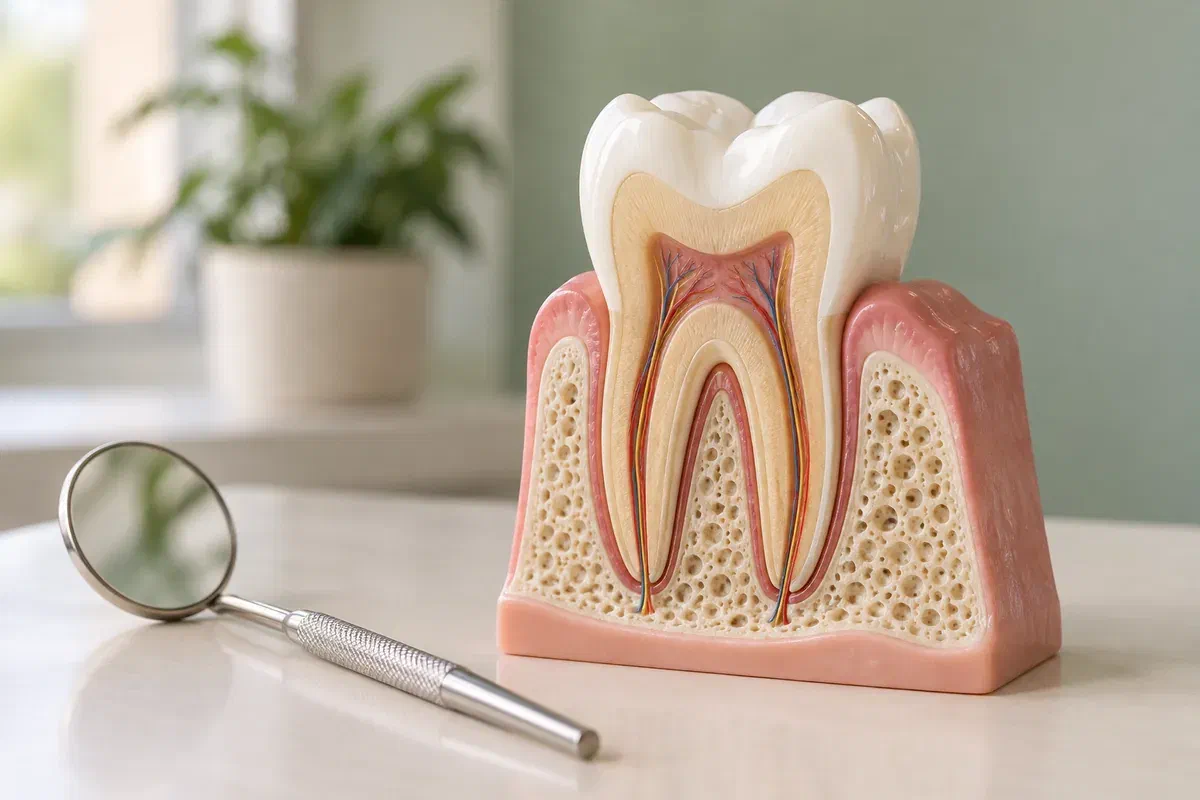
Illustrative cross-section tooth model showing roots within supporting gum and bone beside a dental mirror
Where the worry started

Is this about an image, a feeling, or an old diagnosis?

Each starting point gives the clinician something different to work with. Say which one brought you in, and the assessment can link that background to what the examination shows now.

Something spotted on an X-ray

Find out which tooth or area was flagged and how that image fits with an examination of your gums. A photo of the screen or a one-line summary is not a substitute for looking at the mouth itself. Older images of the same area, if they exist, may help show change, within limits the clinician can explain.

A tooth that moves or has drifted

Note roughly when you first noticed it, whether it hurts, and whether anything happened beforehand, such as a knock to the face. Please don't keep wiggling it to see how bad it is. An examination can sort out what needs attention soon and what can be planned more gradually.

Past gum treatment that tapered off

Life gets busy, and maintenance visits sometimes slip. Bring whatever you know about previous treatment, even if it was years ago or at a different clinic, and mention what made follow-up hard. The goal is a realistic plan from here, not a lecture about missed appointments.

An image, a set of gum measurements and your symptoms each tell part of the story, and they only make sense together. Comfortable teeth are not proof of healthy support, and reduced support in one area does not mean every tooth shares the same outlook.

What you can take away

A map of your mouth instead of a vague warning.

A careful review can separate the areas that need treatment from those that simply need watching, and point out what is still unknown. Ask to see the findings in a form that makes sense to you, whether that is the image, a chart or a model. Knowing where a problem sits, and how much it matters, is far more useful than carrying around a general label.

The assessment also sets a baseline. Future visits can be compared against it, and a maintenance schedule should come with a reason for its timing. That makes it easier to see why returning matters during the months when your mouth feels fine and nothing new seems to be happening.

Patient information: American Academy of Periodontology — combining clinical and radiographic findings

Specific answers for specific teeth

Ask whether the concern is limited to one spot or spread across several areas, and how that changes your choices. Where one tooth looks less secure than the others, ask for reasons that apply to that tooth alone. Advice about one site should not be stretched to cover the whole mouth.

Clarity on what is known today

A single visit can describe current findings, but it cannot predict exactly how things will change. Ask what the existing records allow the clinician to say and what would need a follow-up comparison. Older images or measurements help only when they are suitable for that purpose.

A sensible sequence for treatment

If more than one kind of care is suggested, ask which comes first and which can wait, such as cosmetic or restorative work. Ask how each step relates to bringing the gum condition under control. Laying the plan out in stages makes visits, responsibilities and fees easier to weigh.

What happens at the appointment

History first, then the gums, then the images.

Not every question calls for the same records. If a test or image is suggested, ask what it will add and how it will shape the decision about what comes next.

  1. Talk through your history

    Expect questions about earlier gum care, any teeth already lost, current symptoms and what you were told before. Your health matters here as well, including conditions, medicines and tobacco use. If another office holds older records, ask whether requesting them first would avoid repeating anything unnecessarily.

  2. Check the gums tooth by tooth

    The clinician looks at the gum tissue and may measure pocket depths, recession, bleeding and how firmly each tooth sits. Ask which of these readings matter most for your question. The point is to judge the whole supporting system, not just what can be seen at the gumline.

  3. Look at the images alongside the exam

    Dental X-rays can help show bone levels and other findings around the roots. The clinician chooses what is appropriate and reads it together with the measurements. Ask what the images can and cannot show, and don't assume a 3D scan is needed for every bone-support concern.

  4. Agree on the plan and the next review

    You should leave knowing the diagnosis, the areas that need care and the order things will happen in. Ask whether a specialist opinion would help and what to do in the meantime. Before committing to later stages, confirm how your response to early treatment will be checked.

Living with the findings

The real work happens between visits.

An assessment explains the situation; it does not restore bone. Follow the advice that fits your diagnosis, and say so if part of it is hard to manage day to day.

Get shown, not just told

Ask the team to demonstrate cleaning around the affected teeth, along with any gaps, bridges or crowns that are awkward to reach. Confirm which brushes or aids suit you and how to use them. If something catches or feels sore, mention it so the method can be adjusted instead of pushing through.

Know which visit is which

Some appointments are active treatment and others are check-ins to confirm things are stable. Ask which is which, and if a specialist joins your care, who is coordinating and where follow-up will take place. Share any outside reports so all the advice can be read together.

Speak up between reviews

Call if a tooth becomes looser, a gum swells, chewing changes or discomfort appears. Let the team know about new health conditions or medicines too. A scheduled maintenance date is not a reason to sit on a new problem until then.

Choices after the assessment

Controlling the problem is not the same as regrowing bone.

For each option, ask what it is meant to achieve, why your findings make it appropriate, and what ongoing care it involves. The plan should follow your results, not the label alone.

When the aim is to keep things stable

Gum treatment with regular upkeep

This may involve thorough cleaning, gum therapy, help with home care and regular reassessment. Ask how stability will be judged and what remains uncertain. Healthier gums are a good sign, but they do not mean that support already lost has come back.

When a site may warrant more advanced periodontal care

A periodontist’s look at one site

A periodontist can consider whether further treatment, sometimes including a regenerative technique in a well-suited case, makes sense. Ask about the particular defect, the likely benefit, its limits and the upkeep afterward. Grafting is not the answer to every pattern of bone loss.

When one tooth's outlook shapes the whole plan

Weighing whether to keep or replace a tooth

If a tooth cannot reasonably be kept, ask for the reasons and compare what could follow. Decisions about keeping or replacing a tooth should account for the rest of the mouth. Finding reduced support does not automatically lead to extraction or an implant.

Patient information: American Academy of Periodontology — selected regenerative and surgical procedures

Milton bone-support questions

What people ask once the word “bone” comes up.

Many questions only surface after you have left the chair. Write them down, bring any earlier records, and we can go through them one at a time.

(905) 876-4488
My hygienist mentioned bone loss in passing. Should I book a separate visit about it?
It is reasonable to ask for a dedicated conversation if the comment left you unsure. A focused appointment gives time to review the images, gum measurements and history together, and to explain which areas are involved and whether treatment, monitoring or more information is needed.
Is some bone loss just a normal part of getting older?
Support around the teeth can change over a lifetime, but age alone does not explain a finding or decide what should happen next. The clinician looks at the pattern, the gums and your history. Ask whether what was seen needs treatment or simply careful monitoring.
Does a bone-loss finding mean I could lose all my teeth?
Not necessarily. The location and extent of the change, the condition of each tooth and how the gums respond to care all shape the outlook. Ask for an explanation of any tooth with a doubtful prognosis rather than relying on a general label.
Do I have to stop flossing if my gums bleed during cleaning?
Bleeding is worth mentioning at the assessment rather than a reason to quietly stop. The team can check the gums, show you a technique and suggest tools that suit your teeth. If an area is sore or a floss keeps snagging, say so and the approach can be adjusted.
Can better brushing make the lost bone come back?
Good daily care supports healthier gums and is central to managing the condition, but it should not be described as regrowing lost bone. Ask what your treatment is aiming to keep stable and whether any further procedure might suit your particular findings.
Will I need a referral to a gum specialist?
Some people do and many do not. It depends on the findings and on how the gums respond to initial care. If a periodontist’s opinion could add useful information, we can explain why, what to expect, and how care will be coordinated afterward.
Book your Milton assessment

Bring the X-rays and the questions you didn’t get to ask.

Reach our Bronte Street practice to talk about a bone-support finding, earlier gum treatment, or a recommendation you are unsure about. We can examine the area, explain what the records show and outline sensible next steps for care or further evaluation.

Diagnosis, prognosis for any tooth, imaging, treatment suitability, referral and fees are all decided after assessment. Keeping a tooth or regaining lost support cannot be promised beforehand.

Visit Milton Dental Clinic
Unit 1, 342 Bronte St. S, Milton, ON L9T 5B7
Get directions Clinic hours
Monday–Thursday
11am–7pm
Friday–Sunday
By appointment only

Areas we serve

  • Milton
  • Oakville
  • Mississauga
  • Georgetown
  • Halton Hills
  • Acton
  • Campbellville
  • Brampton
  • Burlington
  • Puslinch
  • Rockwood
  • Erin
  • Caledon
  • Etobicoke
  • Old Milton
  • Bronte Meadows
  • Timberlea
  • Dorset Park
  • Dempsey
  • Clarke
  • Beaty
  • Coates
  • Harrison
  • Scott
  • Willmott
  • Ford
  • Bowes
  • Cobden
  • Walker
  • Mountain View
  • Milton Heights
  • Hawthorne Village
  • Valley View
  • Fallingbrook
  • Nassagaweya
  • Trafalgar
  • Esquesing
  • Nelson
  • Brookville
  • Moffat
  • Glen Williams
  • Norval
  • Limehouse
  • Stewarttown
  • Ashgrove
  • Hornby
  • Silver Creek
  • Speyside
  • Scotch Block
  • North Oakville
  • River Oaks
  • Glen Abbey
  • West Oak Trails
  • Palermo
  • Bronte Creek
  • College Park
  • Joshua Creek
  • Uptown Core
  • Preserve
  • Iroquois Ridge
  • Lisgar
  • Meadowvale
  • Meadowvale Village
  • Churchill Meadows
  • Erin Mills
  • Central Erin Mills
  • Streetsville
  • East Credit
  • Creditview
  • Heartland
  • Sheridan
  • Mount Pleasant
  • Credit Valley
  • Huttonville
  • Churchville
  • Springbrook
  • Northwest Brampton
  • Bram West
  • Fletcher's Meadow
  • Fletcher's Creek South
  • Alton Village
  • Orchard
  • Millcroft
  • Headon Forest
  • Tansley
  • Brant Hills
  • Tyandaga
  • Kilbride
  • Lowville
  • Aberfoyle
  • Morriston
  • Arkell
  • Hillsburgh
  • Freelton
  • Carlisle
  • Waterdown
  • Flamborough
  • Mountsberg

How can we help?

Milton Dental Clinic

Have a question about your smile? Choose the option that works best for you.

For urgent dental concerns, please call.
Messages are reviewed during clinic hours.