

Illustrative clinician discussing tooth support with a patient using a physical teaching model
Specialized Care

Bone-Loss Assessment in Mississauga

It has been a while since your last dental visit, and you suspect the gums have not been getting the attention they need. From Mississauga, a bone-loss assessment gives you an honest, unhurried look at the support around your teeth and a sensible place to start again.

Coming back after time away

Years have passed. Your gums deserve a fresh look.

Work, children, a move or simple worry can push dental visits aside for longer than planned. When you finally return, one of the first questions is often about the gums. A bone-loss assessment evaluates the tissue and bone supporting your teeth, using a careful examination, appropriate images and whatever history you can share, to see where support stands.

If the term bone loss comes up, try not to fill in the blanks with the worst case. On its own it does not say which teeth are affected, how much support has changed, what is behind it or what treatment is appropriate. Plenty of teeth with some reduced support can be looked after well with the right plan and follow-through.

When you book from Mississauga, mention roughly how long it has been and anything you have noticed, such as bleeding, tenderness or a tooth that seems different. Bring old records if you have them, but don’t let missing paperwork delay you. We can examine your mouth, explain what we find and discuss care aimed at keeping the teeth that can reasonably be kept.

Restart care with a bone-support review
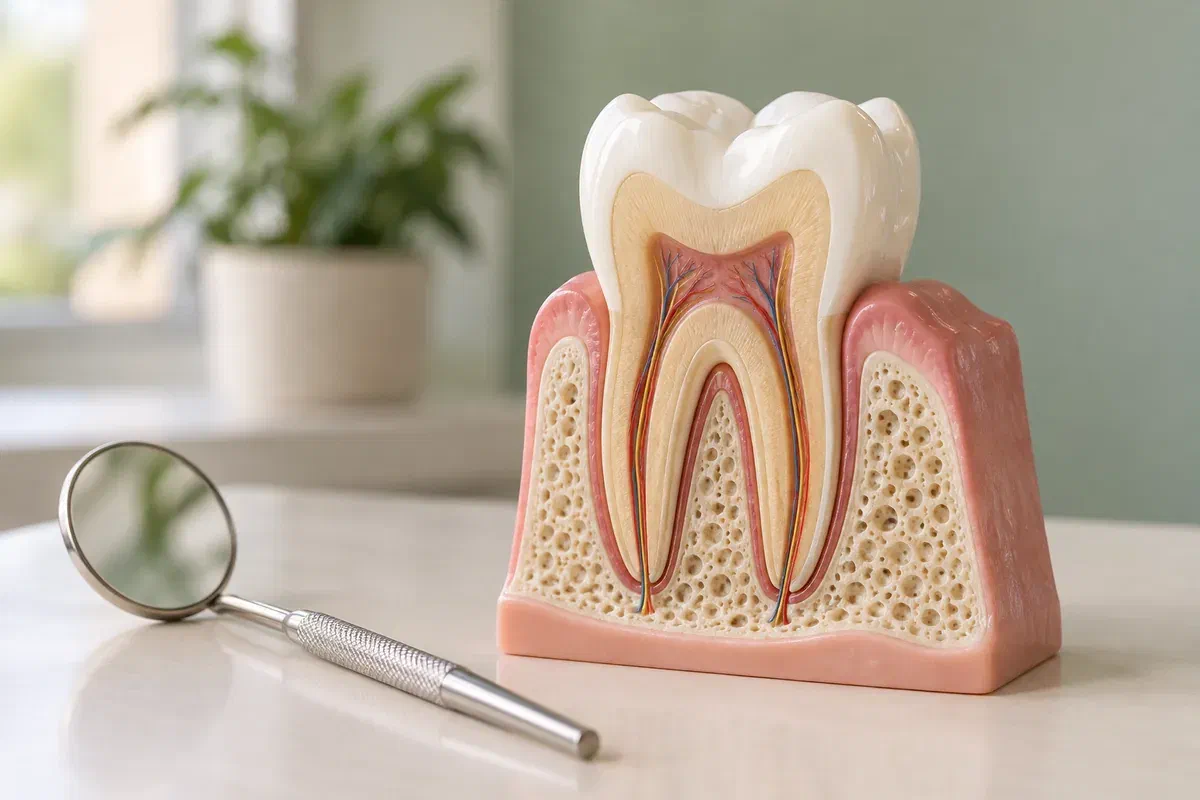
Illustrative cross-section tooth model showing roots within supporting gum and bone beside a dental mirror
What you might be wondering

Three questions people bring after a gap.

Your reason for booking shapes what the clinician focuses on. Share whatever led you here, and we will relate it to what the examination shows now.

“Was there something on my last X-ray?”

If a previous dentist mentioned bone levels, try to recall which area and request copies of the images. An old description is a starting point, not a diagnosis for today. The clinician will compare it with a current examination and explain whether the older image is useful for comparison.

“Why does this tooth feel different?”

A tooth that seems to have moved or feels less firm deserves attention. Note when you noticed it, whether it hurts and whether anything happened to your mouth. Avoid checking it yourself; the examination will show whether it needs prompt care.

“How far behind am I?”

Missed cleanings or unfinished gum treatment are common, and there is no need to apologize for them. Tell us what was done before and what made it hard to continue. Knowing that helps us build a plan that fits your life, rather than one that looks good on paper only.

Images, measurements and symptoms are interpreted together. Teeth that feel fine may still have reduced support, and reduced support in one place does not mean the same outlook everywhere.

Why start with an assessment

Know where you stand, then decide.

After a long gap, it helps to replace guesswork with facts. The assessment can identify the areas needing treatment, those that can be monitored and any information still to be gathered. Ask us to show the findings in a way you can follow, whether on the screen, on a chart or with a model.

It also creates a fresh baseline. From here, each maintenance visit can be measured against today’s records, and the timing of those visits should be explained in terms of what is being watched. That understanding makes it easier to stay on track, even when life gets busy again.

Patient information: American Academy of Periodontology — combining clinical and radiographic findings

A clear sense of which teeth need care

Ask whether any changes are confined to a few teeth or more widespread, and how that shapes your options. If one tooth stands out, ask for an explanation specific to it. Its outlook should not be assumed for the rest of your mouth.

A line between today and the future

Ask what the current findings tell us and what only time and follow-up can reveal. If older records surface, the clinician can say whether they allow a meaningful comparison. A single visit should not be treated as a precise prediction.

A manageable order of treatment

When several things need attention, ask which come first and which can wait, such as restorative or cosmetic work. Ask how each step supports controlling the gum condition. Splitting care into stages helps you plan around time, effort and fees.

What the visit involves

No rush, no assumptions.

We choose records based on what we need to understand. If we suggest an image or test, you are welcome to ask why and how it will guide the next step.

  1. Catch up on your history

    We ask about past gum care, any teeth removed, symptoms and what you remember being told. Health conditions, medicines and tobacco use are part of the picture. If older records exist, ask whether requesting them might avoid repeating something.

  2. Look carefully at the gums

    The clinician examines the tissue and may measure pocket depths, recession, bleeding and tooth stability. Ask which findings relate most closely to your concerns. What lies below the gumline matters as much as what can be seen.

  3. Take and read suitable images

    Dental X-rays can help assess bone levels and other features around the roots. The clinician decides which are indicated and interprets them with the examination. Ask about their limits, and don’t assume a 3D scan is needed for every bone question.

  4. Map out care and follow-up

    We explain the diagnosis, the areas of concern and a reasonable sequence of treatment. Ask whether a specialist’s view would add anything and what to do in the meantime. Confirm how your response will be reviewed before starting later stages.

Staying on track

Build a routine you can actually keep.

The assessment shows the way forward but does not restore bone. Follow the advice that fits your diagnosis, and be honest with us about what is hard to manage.

Learn a routine that fits your day

Ask for a demonstration around the teeth that need the most attention, including gaps or dental work that are hard to reach. Confirm which tools to use and how. If something is uncomfortable or keeps catching, tell us so we can adapt it.

Book the next visit before you leave

Ask which appointments are treatment and which are stability checks, and schedule them while you are here if that helps. If a specialist is involved, confirm who coordinates and where follow-up happens. Share outside reports so all advice is considered together.

Call between visits when things change

Contact us about new looseness, swelling, discomfort or a change in chewing, and let us know about changes in health or medication. A maintenance appointment on the calendar should not keep you from calling about something new.

After the findings

Your options depend on what we find, not on the label.

For each path, ask what it aims to achieve, why it suits your results and what ongoing care it involves. Care should be tailored rather than chosen from the phrase bone loss.

When the goal is getting the gums under control

Periodontal therapy and steady follow-up

This can include professional cleaning, gum treatment, home-care support and routine reassessment. Ask how stability will be checked and what remains uncertain. Healthier gums are progress, but they do not mean lost support has returned.

When a defect may benefit from specialist periodontal care

Referral for a particular site

A periodontist can assess whether additional treatment, possibly regenerative care for a suitable defect, is reasonable. Ask about the specific site, the expected benefit, the limits and the maintenance involved. Grafting does not suit every pattern of bone loss.

When one tooth affects the overall plan

Talking through a tooth with a poor outlook

If a tooth cannot reasonably be kept, ask why and compare the available next steps. The decision should consider your whole mouth. Reduced support alone does not mean extraction or an implant is inevitable.

Patient information: American Academy of Periodontology — selected regenerative and surgical procedures

Mississauga questions

Starting again, one question at a time.

Returning after a gap often comes with worries you might not say out loud. Bring them, along with any records, and we will answer as clearly as we can.

(905) 876-4488
My last cleaning was years ago. Is a bone-loss assessment the right first step?
It can be a useful starting point, especially if you have noticed bleeding, tenderness or a tooth that feels different. The examination helps the clinician understand your gum and bone support and decide what care should come first.
Will I be lectured about how long I stayed away?
No. Our focus is on your mouth as it is today and on a plan you can realistically follow. Telling us what made visits difficult helps us suggest appointments and home care that fit your situation.
Can bleeding gums be connected to bone loss?
Bleeding often signals gum inflammation, which may or may not involve changes in bone support. The examination and images help the clinician tell the difference. Mention any bleeding when you book so it can be checked carefully.
Does smoking affect the bone around my teeth?
Tobacco use is a recognized risk factor for gum disease and can affect how the gums respond to treatment. Let the clinician know about any smoking or vaping so it can be considered in your assessment and plan.
If some bone is gone, will my teeth need to come out?
Not necessarily. The amount and location of the change, the condition of each tooth and how your gums respond all matter. Ask about any tooth with an uncertain outlook so you understand its specific situation.
Do I need my old X-rays before I can book?
No. Older images can help with comparison, so bring them if they are easy to get. Without them, the clinician will rely on a current examination and explain whether new images are needed.
Mississauga bone-support assessment

Whenever you are ready, we can start from today.

Contact our Bronte Street practice to arrange a review of gum and bone support, an old finding you never had explained, or a plan you want to understand. We will examine the concern and set out sensible next steps for care or further evaluation.

Diagnosis, the prognosis for each tooth, imaging, suitable treatment, referral and fees depend on assessment. We cannot guarantee keeping a tooth or regenerating lost support in advance.

Visit Milton Dental Clinic
Unit 1, 342 Bronte St. S, Milton, ON L9T 5B7
Get directions Clinic hours
Monday–Thursday
11am–7pm
Friday–Sunday
By appointment only

Areas we serve

  • Milton
  • Oakville
  • Mississauga
  • Georgetown
  • Halton Hills
  • Acton
  • Campbellville
  • Brampton
  • Burlington
  • Puslinch
  • Rockwood
  • Erin
  • Caledon
  • Etobicoke
  • Old Milton
  • Bronte Meadows
  • Timberlea
  • Dorset Park
  • Dempsey
  • Clarke
  • Beaty
  • Coates
  • Harrison
  • Scott
  • Willmott
  • Ford
  • Bowes
  • Cobden
  • Walker
  • Mountain View
  • Milton Heights
  • Hawthorne Village
  • Valley View
  • Fallingbrook
  • Nassagaweya
  • Trafalgar
  • Esquesing
  • Nelson
  • Brookville
  • Moffat
  • Glen Williams
  • Norval
  • Limehouse
  • Stewarttown
  • Ashgrove
  • Hornby
  • Silver Creek
  • Speyside
  • Scotch Block
  • North Oakville
  • River Oaks
  • Glen Abbey
  • West Oak Trails
  • Palermo
  • Bronte Creek
  • College Park
  • Joshua Creek
  • Uptown Core
  • Preserve
  • Iroquois Ridge
  • Lisgar
  • Meadowvale
  • Meadowvale Village
  • Churchill Meadows
  • Erin Mills
  • Central Erin Mills
  • Streetsville
  • East Credit
  • Creditview
  • Heartland
  • Sheridan
  • Mount Pleasant
  • Credit Valley
  • Huttonville
  • Churchville
  • Springbrook
  • Northwest Brampton
  • Bram West
  • Fletcher's Meadow
  • Fletcher's Creek South
  • Alton Village
  • Orchard
  • Millcroft
  • Headon Forest
  • Tansley
  • Brant Hills
  • Tyandaga
  • Kilbride
  • Lowville
  • Aberfoyle
  • Morriston
  • Arkell
  • Hillsburgh
  • Freelton
  • Carlisle
  • Waterdown
  • Flamborough
  • Mountsberg

How can we help?

Milton Dental Clinic

Have a question about your smile? Choose the option that works best for you.

For urgent dental concerns, please call.
Messages are reviewed during clinic hours.