

Illustrative clinician explaining a tooth-and-gum model to a patient during a consultation
Specialized Care

Crown Lengthening

Crown lengthening may be considered when more healthy tooth needs to be exposed for a restoration or a carefully assessed gumline change. Discuss crown lengthening in Milton to understand the reason, the tissue changes involved, and how healing fits the overall plan.

A closer look at crown lengthening

Expose the tooth that is needed, with the surrounding tissues in mind.

Crown lengthening is a procedure that changes the gum level, and sometimes the underlying bone, to expose more of a natural tooth. The name refers to the part of the tooth visible above the gum. It does not mean simply adding a taller artificial crown.

The reason may be restorative, such as a damaged area that extends below the gumline, or an elective concern about how much tooth is visible. Those goals require different conversations. In either case, the remaining tooth, root support, neighbouring tissues, and intended final result need to be assessed together.

At Milton Dental Clinic, tell us why crown lengthening was suggested and bring any treatment plan or records you have. We can review how it relates to your dental care, explain what needs further assessment, and discuss coordination with a periodontist where appropriate. You should understand the whole plan before agreeing to a surgical stage.

Discuss a crown-lengthening recommendation
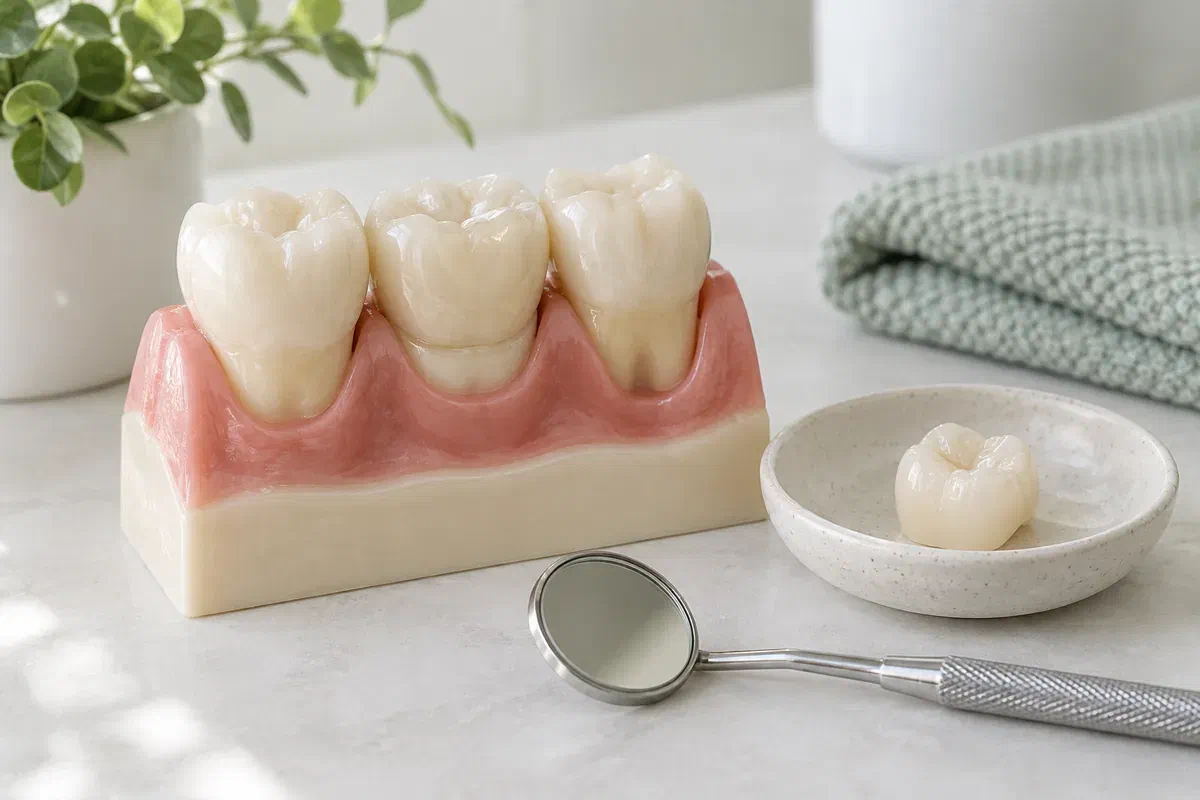
Illustrative tooth-and-gum teaching model beside a ceramic crown sample and dental mirror
Why the procedure may be considered

The purpose should be clear before the gumline changes.

Ask which tooth or area is involved and what problem the proposed procedure is intended to solve. A request for a crown and a request to change a smile's appearance are not the same starting point.

A damaged tooth with limited accessible structure

A fracture, wear, or decay may leave a restoration difficult to place appropriately. Ask whether exposing additional sound tooth would make restoration reasonable and what the tooth's overall outlook would be. The procedure cannot make every damaged root or heavily compromised tooth suitable for retention.

A restoration that needs a considered tissue relationship

The position of a planned filling or crown matters in relation to the surrounding gum and bone. Ask why the current arrangement is unsuitable and how the proposed change would help. The restoration and periodontal plan should be discussed together rather than as unrelated appointments.

An appearance concern about short-looking teeth

Explain what you notice when smiling and the features you want to preserve. The cause of visible gum display needs assessment before choosing surgery. A photograph of another smile does not establish that removing tissue is appropriate for your tooth proportions or anatomy.

Crown lengthening may involve gum tissue, bone, or both. Ask what would be changed in your case, whether adjacent areas are involved, and how those changes affect support, appearance, and later restoration.

What careful planning can clarify

Judge the surgical step as part of the complete tooth plan.

A useful consultation explains what crown lengthening is expected to make possible and whether that benefit justifies the procedure. Ask about the remaining tooth and supporting tissues after the proposed change. Exposing more structure is one part of planning a restoration; it is not a guarantee that the tooth will last indefinitely.

You should also understand the appointment sequence and the time needed to assess healing. If more than one clinician is involved, ask who is responsible for each stage. Coordinated planning helps ensure that surgery, any temporary restoration, and the final work are working toward the same agreed goal.

An explanation of the proposed tissue change

Ask the clinician to describe the area in plain language and show where the final gumline or restoration margin is intended to sit. Review how neighbouring teeth may be affected. This discussion is especially useful when the treated area is visible when you smile.

A realistic view of the benefits and tradeoffs

Discuss the intended improvement alongside healing, sensitivity, appearance changes, and maintenance. Ask which risks are most relevant to your situation rather than relying on a generic description. You can request further assessment before deciding whether the proposed result is worthwhile.

A complete estimate and treatment sequence

Ask whether the estimate includes the assessment, surgical stage, reviews, temporary care, and final restoration or whether those are separate. Confirm what could change the plan or fee. Understanding the full sequence is more useful than considering only the cost of exposing the tooth.

Planning and carrying out crown lengthening

Assess the tooth first, then coordinate surgery, healing, and restoration.

The technique and timing depend on the tissues, the tooth, and the treatment goal. The clinician performing the procedure will explain the details and obtain consent for the proposed care.

  1. Assess restorability and the surrounding tissues

    The tooth, roots, gum condition, supporting bone, and adjacent areas are reviewed with relevant records. Ask whether the tooth can reasonably benefit from the procedure. If more information is needed, discuss it before committing to a sequence that assumes the tooth is suitable.

  2. Agree on the scope and alternatives

    Review the proposed tissue changes, comfort measures, risks, healing expectations, and other suitable approaches. Confirm any referral and the roles of the treating clinicians. Ask how unexpected findings would be handled and whether they could change the restorative recommendation.

  3. Carry out the planned surgical stage

    Crown lengthening is commonly performed with local anaesthetic. The clinician manages the gum and, where indicated, bone to expose the planned structure; stitches may be used. Your individual instructions should explain the procedure, immediate care, and how to seek help afterward.

  4. Review healing before completing later treatment

    Attend the planned checks and confirm when any stitches or temporary restoration need attention. The final restorative stage is timed according to tissue healing and the clinical goal. Ask what milestones matter rather than assuming the tooth is ready as soon as the early soreness settles.

Healing and the next restorative stage

Protect the surgical area and keep the follow-up plan connected.

Follow the written instructions from the clinician who performs the procedure. Advice about cleaning, eating, activity, medicines, and review should be specific to the area and treatment you received.

Use the cleaning and eating instructions for the site

Ask how to care for the treated area while keeping the rest of your mouth clean. Confirm when normal brushing and interdental care should resume there. Do not pull at stitches, repeatedly lift the lip to inspect healing, or improvise a rinse without checking the instructions.

Report symptoms outside the expected recovery

Some postoperative discomfort or sensitivity may occur, but ask what is expected and when to contact the team. Keep the aftercare number accessible. Worsening pain, persistent bleeding, increasing swelling, or another worrying change should be discussed rather than managed by waiting for the next scheduled visit.

Attend reviews before the final restoration is arranged

The gum position can change during healing, which affects later restorative planning. Confirm who will decide when the area is ready and how any temporary is maintained. Do not treat a comfortable temporary or an improved appearance as a reason to skip the agreed review.

Patient information: Cambridge University Hospitals — crown-lengthening risks and healing before final restoration

Comparing a crown-lengthening plan

Exposing more tooth is useful only when it fits the wider findings.

Ask about the alternatives that are relevant to your tooth and treatment goal. Their suitability depends on structure, support, appearance, and the practical demands of the full plan.

When the tooth and supporting tissues make it reasonable

Crown lengthening with coordinated restoration

Discuss the proposed exposure, tissue changes, and final restorative design together. Ask how the approach balances access to sound tooth with remaining support and appearance. Surgery is a stage in the plan, not a substitute for evaluating whether the completed restoration is appropriate.

When a different approach may preserve the desired tissues

Another way to manage the tooth or its position

Selected cases may merit discussion of another restorative strategy or orthodontic extrusion, which moves a tooth to expose additional structure. These are not interchangeable options for every patient. Ask about their suitability, timing, and the clinicians needed before choosing between approaches.

When the expected benefit does not justify the proposed surgery

Observation or a different overall treatment decision

For an elective appearance concern, leaving healthy tissues unchanged may be reasonable. A tooth with a poor prognosis may require a separate retention or replacement discussion. Ask what happens if you decline the proposed procedure and which alternatives address any remaining health needs.

Patient information: European Federation of Periodontology — selection of surgical and orthodontic approaches

Crown-lengthening questions

Ask about the reason, the tissue changes, and the later appointments.

Understanding the complete sequence helps you evaluate a recommendation. Bring the original treatment plan and ask which decisions can be made now and which depend on further assessment.

(905) 876-4488
Does crown lengthening mean the dentist is making my artificial crown taller?
No. The procedure exposes more of the natural tooth by changing the surrounding tissue level. It may be considered before a restoration or for a selected appearance concern. Ask which purpose applies to your case and how it connects with any planned artificial crown.
Is bone always removed during crown lengthening?
Not in every case. The technique depends on the relationship between the tooth, gum, and bone and the intended result. Ask exactly what tissue would be changed and why. A gum-only procedure and one involving bone require different planning considerations.
Why might the final crown need to wait after crown-lengthening surgery?
The tissues need review as they heal and the gum position settles. That can affect where a final restoration should finish. Ask about the expected stages, any temporary protection, and who will decide when the site is ready rather than using a universal waiting period.
Can crown lengthening guarantee that a badly broken tooth can be saved?
No. The remaining tooth and root, supporting tissues, and other findings determine whether restoration is reasonable. Sometimes additional information changes the plan. Ask about the tooth’s prognosis and alternatives before accepting surgery as a guaranteed route to keeping it.
Could crown lengthening change the appearance of neighbouring teeth?
The surrounding tissue arrangement may need consideration, particularly in a visible area. Ask whether adjacent sites are part of the proposed treatment and how the gumline may look afterward. The scope should be explained before consent rather than assumed from the name of one tooth.
Can I ask about orthodontic extrusion before agreeing to crown lengthening?
Yes. In selected situations, moving a tooth may be an alternative or part of a combined plan. Ask whether it is appropriate for the specific defect and what time, support, and restorative stages it involves. It is not suitable for every tooth.
Crown lengthening in Milton

Understand the proposed stage before planning the final tooth.

Contact our Bronte Street practice to discuss a crown-lengthening recommendation, a difficult-to-restore tooth, or a gumline concern. We can review the goal, explain the assessment needed, and discuss suitable care or specialist coordination.

Suitability, tissue changes, provider or referral arrangements, healing, restoration timing, and fees depend on assessment. The procedure cannot guarantee tooth retention or a particular cosmetic result.

Visit Milton Dental Clinic
Unit 1, 342 Bronte St. S, Milton, ON L9T 5B7
Get directions Clinic hours
Monday–Thursday
11am–7pm
Friday–Sunday
By appointment only

How can we help?

Milton Dental Clinic

Have a question about your smile? Choose the option that works best for you.

For urgent dental concerns, please call.
Messages are reviewed during clinic hours.