

Illustrative clinician explaining a tooth-and-gum model to a patient during a consultation
Specialized Care

Crown Lengthening in Halton Hills

Keep the tooth with crown lengthening, try another approach, or rethink the tooth entirely? From anywhere in Halton Hills, you can talk through that choice with us: what the gum change would involve, what it could make possible, and how healing fits around it.

A decision, not just a procedure

Three questions: can it be saved, should it be, and how?

A tooth broken close to the gum often sits at a crossroads. One route is crown lengthening, in which the gum, and where needed the bone, is reshaped to bring more natural tooth into the open so a restoration has something firm to hold. Other routes exist, and the choice deserves care.

It also helps to clear up the name. The word refers to the part of your own tooth above the gum, not to making a cap taller. For a smaller group of people, the motive is appearance, such as teeth that look short. Restorative or cosmetic, the deciding factors are the same: remaining tooth, root and support.

For households across Halton Hills, from Georgetown and Acton to the smaller hamlets, a good first step is a single, unhurried conversation. Bring the plan and any records you have. We can explain how each option relates to your care, what still needs checking and whether a periodontist should weigh in.

Compare your options for a difficult tooth
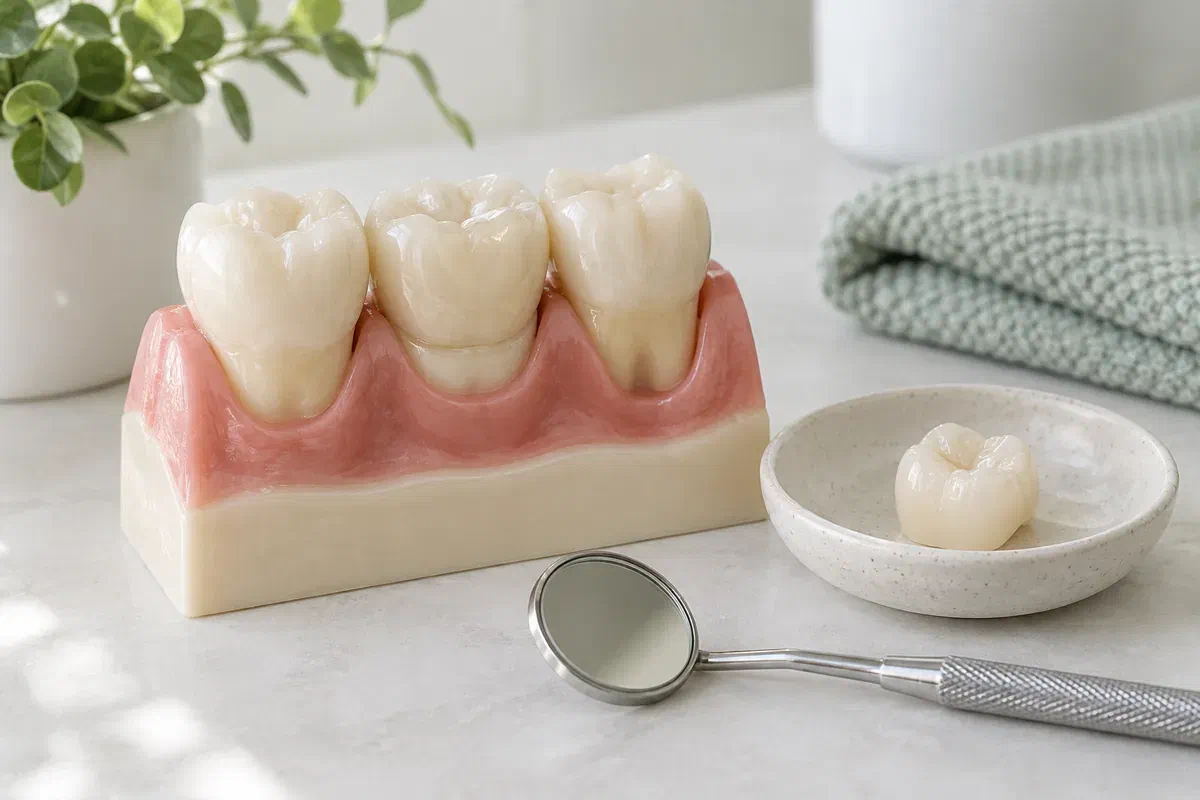
Illustrative tooth-and-gum teaching model beside a ceramic crown sample and dental mirror
How the decision usually arises

Different problems point toward different answers.

Start with the tooth in question and the problem it presents. A restoration that won’t fit and a smile you’d like to change call for separate lines of thought.

A tooth with very little left to build on

Fracture, wear or decay that goes under the gum may leave a crown without a solid base. Ask whether uncovering more sound tooth would really allow a durable repair, and how the tooth compares with the alternatives. Some roots are simply too weakened to be worth the surgery.

A margin too deep for comfortable tissue

A restoration ending too near the bone can leave the gum irritated or hard to clean. Ask why the current position is a concern and whether moving the gumline is the best fix. The gum and restorative stages need to be planned as one.

A smile with more gum than you’d like

Tell us what you notice and which features you want to keep. Visible gum can stem from several causes, and the right option depends on which one is present. A photograph of a different smile is not evidence that surgery suits yours.

This procedure may change gum, bone or both. Find out which applies, whether nearby teeth are part of the plan, and how the change would affect support, appearance and the eventual restoration.

What comparing options reveals

The right choice depends on the whole tooth, not just the gum.

Looking at options side by side shows what each could make possible and what it asks of you. Ask how much tooth and support would remain with each approach. Crown lengthening can make a restoration feasible, yet it does not guarantee a tooth that lasts for decades.

Each option also comes with its own number of visits and healing time. Ask how long each would take and who would provide it. If more than one clinician is involved, a shared plan helps make sure the surgery, any temporary and the final work aim at one result.

A side-by-side view of the approaches

Ask to see where the gum and restoration edge would end up with crown lengthening, and how an alternative would differ. Images or a model help. Front teeth deserve special attention because changes there are easy to see.

Honest pros and cons for each

Compare benefit, healing time, sensitivity, appearance change and maintenance across the options. Ask which risks really apply to your tooth. You can ask for further assessment before choosing.

Estimates for more than one path

Where it helps, ask for a breakdown of what each option would include, from assessment and surgery through reviews and final restoration. Ask what could change the plan. Comparing full sequences is more meaningful than comparing one line item.

If crown lengthening is chosen

From the first assessment to the finished restoration

Method and timing depend on the tooth, the tissues and what treatment should achieve. The treating clinician will explain the specifics and seek your consent.

  1. Judge whether the tooth is a good candidate

    X-rays and an exam look at the roots, gum, bone and teeth on either side. Ask frankly whether crown lengthening is likely to help this tooth more than another option. Fill any gaps in information before choosing a path.

  2. Confirm scope, comfort and backup plans

    Agree on which tissue changes, how comfort will be managed, the main risks and the expected healing. Confirm any referral and who does what. Ask what would happen if the tooth turned out to be less restorable than expected.

  3. Carry out the gum and bone work

    Local anaesthetic is usual. The gum and, when indicated, bone are reshaped to reveal the planned tooth structure, and stitches may be placed. Written instructions should explain what was done and how to get help.

  4. Heal, review, then restore

    Attend each check and ask when stitches or a temporary need attention. The restoration is timed to tissue healing and the treatment aim. A tooth that feels comfortable may still need more time, so ask what the clinician is waiting to see.

During recovery

Small habits that help the site heal

The clinician who treated you will give written instructions. Use them for cleaning, eating, activity, medicines and follow-up, since they reflect your particular site.

Treat the area gently at home

Your guidance should say how to keep the site clean and when brushing and flossing there can return to normal. Let stitches be. Lifting your lip to check, or swapping in a rinse you read about, is not a good idea without advice.

Don’t sit on a worsening symptom

Some soreness or sensitivity can be expected. Ask what is normal and when you should call, and keep the number somewhere obvious. Increasing pain, bleeding that won’t ease, swelling that grows or another change that worries you deserves a call the same day.

Wait for the all-clear before the crown

Healing can shift the gumline, which changes where the restoration should sit. Ask who decides the site is ready and how the temporary should be looked after. Feeling fine is good news, but it doesn’t replace the review.

Patient information: Cambridge University Hospitals — crown-lengthening risks and healing before final restoration

The choices in front of you

Surgery, movement, or a different plan for the tooth

Only some alternatives will be realistic for your tooth and goal. Which one fits depends on structure, support, appearance and how demanding each plan would be for you.

When the tooth and supporting tissue make it sensible

Crown lengthening paired with a restoration

Plan the exposure, the tissue change and the final restoration as one design. Ask how it balances access to healthy tooth with keeping support and a natural look. The surgery earns its place only if the finished restoration is the right one.

When another method may preserve tissue you value

Orthodontic extrusion or a changed restorative design

Extrusion gently pulls a tooth further out of the bone to expose more structure, usually over a longer period. A different restoration approach may also fit some cases. Neither suits every tooth, so ask about suitability, time and who would provide care.

When surgery wouldn’t deliver enough benefit

Leaving the gum alone, or replacing the tooth

For a cosmetic concern, keeping healthy gum as it is may be best. A tooth with a weak outlook may be better discussed in terms of replacement. Ask how each choice would meet your health needs and what you would give up by saying no.

Patient information: European Federation of Periodontology — selection of surgical and orthodontic approaches

Deciding what to do

Questions that help you choose a path

Seeing the full sequence for each option makes the decision clearer. Bring your treatment plan and ask what can be settled now and what depends on more assessment.

(905) 876-4488
How do I know if my tooth is worth saving?
It depends on the remaining structure, the root, the supporting bone and gum, and your wider dental health. Ask your dentist to explain the tooth’s outlook with and without treatment, and what each alternative would involve.
What is orthodontic extrusion, and how is it different?
Extrusion uses gentle orthodontic force to move a tooth so more of it sits above the gum, rather than lowering the gum around it. It takes time and isn’t suitable for every tooth. Ask whether it fits your situation.
Would an implant be simpler than crown lengthening?
Not necessarily. Replacing a tooth has its own steps, healing and considerations. Whether keeping or replacing makes more sense depends on your findings, so ask for both to be explained if the tooth’s outlook is uncertain.
Can a severely broken tooth always be rescued with crown lengthening?
No. The procedure can give access to more tooth, but if the root or support is too compromised, restoration may not be reasonable. Ask about the prognosis before treating surgery as a guaranteed solution.
What happens if I decide to wait?
That depends on the tooth. A purely cosmetic concern can often wait safely, while a broken or decayed tooth may worsen. Ask what monitoring would involve and what signs would mean you should come back sooner.
Is one consultation enough for Halton Hills households to make this decision?
Sometimes, if records are available and the picture is clear. Other times further assessment is needed first. Ask what information is missing and whether it can be gathered at the same visit to reduce extra trips.
Halton Hills consultations

Choose with every option on the table.

Call our Bronte Street practice to talk about a crown-lengthening recommendation, a tooth you aren’t sure can be saved, or a gumline concern. We can explain each path, the assessment needed, and suitable care or referral to a specialist.

Suitability, tissue changes, the provider or referral, healing, restoration timing and fees depend on assessment. No treatment can guarantee that a tooth will be kept or that a particular look will result.

Visit Milton Dental Clinic
Unit 1, 342 Bronte St. S, Milton, ON L9T 5B7
Get directions Clinic hours
Monday–Thursday
11am–7pm
Friday–Sunday
By appointment only

Areas we serve

  • Milton
  • Oakville
  • Mississauga
  • Georgetown
  • Halton Hills
  • Acton
  • Campbellville
  • Brampton
  • Burlington
  • Puslinch
  • Rockwood
  • Erin
  • Caledon
  • Etobicoke
  • Old Milton
  • Bronte Meadows
  • Timberlea
  • Dorset Park
  • Dempsey
  • Clarke
  • Beaty
  • Coates
  • Harrison
  • Scott
  • Willmott
  • Ford
  • Bowes
  • Cobden
  • Walker
  • Mountain View
  • Milton Heights
  • Hawthorne Village
  • Valley View
  • Fallingbrook
  • Nassagaweya
  • Trafalgar
  • Esquesing
  • Nelson
  • Brookville
  • Moffat
  • Glen Williams
  • Norval
  • Limehouse
  • Stewarttown
  • Ashgrove
  • Hornby
  • Silver Creek
  • Speyside
  • Scotch Block
  • North Oakville
  • River Oaks
  • Glen Abbey
  • West Oak Trails
  • Palermo
  • Bronte Creek
  • College Park
  • Joshua Creek
  • Uptown Core
  • Preserve
  • Iroquois Ridge
  • Lisgar
  • Meadowvale
  • Meadowvale Village
  • Churchill Meadows
  • Erin Mills
  • Central Erin Mills
  • Streetsville
  • East Credit
  • Creditview
  • Heartland
  • Sheridan
  • Mount Pleasant
  • Credit Valley
  • Huttonville
  • Churchville
  • Springbrook
  • Northwest Brampton
  • Bram West
  • Fletcher's Meadow
  • Fletcher's Creek South
  • Alton Village
  • Orchard
  • Millcroft
  • Headon Forest
  • Tansley
  • Brant Hills
  • Tyandaga
  • Kilbride
  • Lowville
  • Aberfoyle
  • Morriston
  • Arkell
  • Hillsburgh
  • Freelton
  • Carlisle
  • Waterdown
  • Flamborough
  • Mountsberg

How can we help?

Milton Dental Clinic

Have a question about your smile? Choose the option that works best for you.

For urgent dental concerns, please call.
Messages are reviewed during clinic hours.