

Illustrative clinician explaining a tooth-and-gum model to a patient during a consultation
Specialized Care

Crown Lengthening in Puslinch

Between the gum procedure and the permanent crown there is often a stretch with a temporary in place. From Puslinch, you can talk with us about why crown lengthening might be needed, what tissue changes, and how to live with that in-between stage while the gum heals.

The stage in the middle

Surgery is done. The real crown isn’t on yet.

People tend to picture crown lengthening as a single event, yet a good part of the process is waiting. The gum, and sometimes bone, is reshaped so more of your natural tooth is exposed. Then the tissue needs time to settle, often with a temporary protecting the tooth, before the final restoration is made.

The procedure is named for the visible part of the tooth itself, not for any artificial crown being lengthened. Most of the time it gives a broken or decayed tooth enough healthy surface to restore. Occasionally the aim is cosmetic. Either way, the remaining tooth, its root and its support guide the plan.

Coming from Puslinch, it helps to understand the in-between stage before you start. Bring your treatment plan and X-rays. We can explain how crown lengthening relates to your care, what needs further assessment, whether a periodontist would be involved, and how to look after a temporary until the tooth is ready.

Learn about the healing and temporary stage
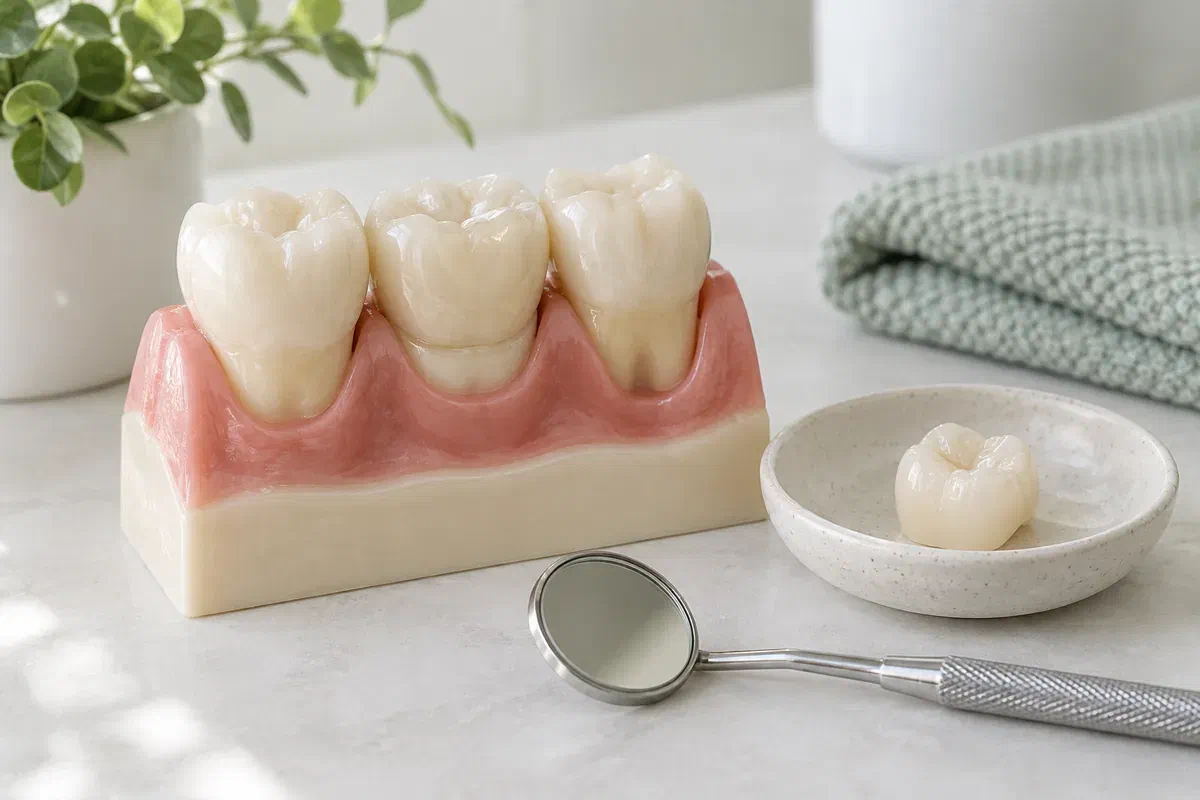
Illustrative tooth-and-gum teaching model beside a ceramic crown sample and dental mirror
When it is usually suggested

Most cases start with a tooth that needs rebuilding.

Find out which tooth is involved and what the procedure is meant to accomplish. Preparing a tooth for a crown and changing how a smile looks are distinct goals, and only some involve a temporary.

Damage that leaves too little tooth exposed

Breaks, wear or decay that reach under the gum can leave a crown with little to hold. Ask whether exposing more sound tooth would allow a reliable restoration and how the tooth is expected to do. A severely weakened root may be better managed another way.

A restoration margin too close to bone

Gum tissue needs room between the restoration’s edge and the bone. Ask whether that room is missing and how the procedure would create it. The gum work, the temporary and the final crown should all be part of one connected plan.

A wish to see more of your teeth

Explain what you’d like to change and what you’d keep. Several causes can make teeth look short, so the reason needs identifying before surgery is weighed. Someone else’s smile can’t show what suits your own proportions.

Gum, bone or both may be reshaped. Ask what applies to you, whether nearby teeth are included, and how it will affect support, appearance and the restoration that follows.

What a clear plan prevents

No guessing about the temporary, the timing or who to call

Your consultation should set out what the surgery is supposed to make possible and whether that benefit is worth it. Ask how much tooth and support you’ll have afterward. Exposing more structure helps the final crown fit; it doesn’t guarantee the tooth will last forever.

Knowing the sequence also tells you how long the temporary may need to serve. Ask how many reviews are planned and who will check the temporary between them. If a periodontist and your dentist share the care, confirm who handles which part so the temporary and the final crown are planned together.

Where the final crown edge will finish

Ask to be shown where the gum is expected to settle and where the permanent crown should end. Check whether nearby teeth would change. Seeing this ahead of time explains why waiting for healing matters.

The tradeoffs, including the waiting period

Weigh the intended gain against healing time, sensitivity, appearance changes, temporary care and maintenance. Ask which risks apply to you specifically. Further assessment is always an option before deciding.

Every stage priced and listed

Check whether the estimate includes assessment, surgery, the temporary, its adjustments, the reviews and the final crown. Ask what could change the plan. A complete list avoids surprises if the temporary needs attention partway through.

The four stages

Examine, plan, operate, protect while healing

Approach and timing depend on the tooth, the tissues and the goal. The clinician performing the procedure will explain the specifics and obtain your consent.

  1. Examine the tooth and its foundations

    X-rays and an exam assess the root, bone, gum and adjacent teeth. Ask whether the tooth is a realistic candidate. If something is uncertain, address it before accepting a sequence that depends on the answer being yes.

  2. Plan the surgery and the temporary together

    Agree on the tissue change, comfort, risks, healing and alternatives, and ask how the tooth will be protected afterward. Confirm referrals and roles. Ask what would happen if findings during the procedure changed the plan.

  3. Complete the procedure

    Local anaesthetic is usually used. Gum and, where needed, bone are reshaped to expose the planned structure, and stitches may be placed. A temporary may be fitted or adjusted. You should leave with written care instructions.

  4. Protect the tooth while the gum settles

    Attend each review so the clinician can check the tissue and the temporary. The final crown is timed to healing and the clinical goal, not simply to when the area feels comfortable. Ask what milestones need to be reached first.

Living with a temporary

Treat the temporary kindly; it is there to buy healing time.

Use the written instructions from the clinician who treated you. They should cover cleaning, eating, activity, medicines and follow-up, as well as care of any temporary.

Clean and chew with the temporary in mind

Ask how to clean around the temporary and the healing gum, and when normal flossing can resume there. Sticky or hard foods may dislodge a temporary, so ask what to avoid. Don’t pull at stitches or try rinses that weren’t recommended.

Call about worrying changes

Some soreness or sensitivity is common during healing. Ask what is expected and when to phone, and keep the number close. Increasing pain, bleeding that continues, swelling that grows or a temporary that comes off should all prompt a call rather than a wait.

Keep the reviews until the final crown

The gum can shift as it heals, changing where the permanent crown should end. Ask who decides readiness. A temporary that feels perfectly fine still isn’t meant to be permanent, so keep the appointments that lead to the final restoration.

Patient information: Cambridge University Hospitals — crown-lengthening risks and healing before final restoration

Other routes

Before you commit to the surgical path

Ask which alternatives realistically suit your tooth and goal. Each depends on how much tooth remains, the support around it, the appearance you want and how long each plan would run.

When the tooth and tissue support it

Crown lengthening, a temporary, then the crown

Plan the exposure, tissue change, temporary and final crown together. Ask how the plan balances reaching healthy tooth with preserving support. Surgery only earns its place if the final crown is the right choice.

When another approach may preserve tissue

Orthodontic extrusion or a different restoration

Extrusion gradually moves a tooth to reveal more structure and often takes longer. A different restorative approach may also suit some situations. Neither is right for every tooth, so ask about fit, timing and who would be involved.

When surgery wouldn’t provide enough benefit

Not proceeding, or replacing the tooth

For an elective cosmetic concern, leaving healthy gum alone may be reasonable. A tooth with a poor outlook may need a separate discussion about replacement. Ask what declining would involve and how your health needs would still be met.

Patient information: European Federation of Periodontology — selection of surgical and orthodontic approaches

In-between questions

The temporary, the wait and the final crown

Seeing every stage makes a recommendation easier to judge. Bring the original plan with you, and ask what can be agreed today and what has to wait for further assessment.

(905) 876-4488
Will I have a temporary crown after crown lengthening?
Often, if the tooth needs protection while the gum heals, but not always. Ask whether a temporary is part of your plan, when it will be placed, and whether it may be adjusted as the gum settles.
What should I do if my temporary falls off?
Call the clinic for advice. Keep the temporary if you can, keep the area clean, and avoid chewing on that side. Don’t use household glue. Ask at your appointment what to do if this happens out of hours.
Can I eat normally with a temporary in place?
Temporaries are not as strong as final crowns. Avoiding very sticky or hard foods on that side is commonly advised. Ask your clinician what is sensible for your particular tooth.
How will I know when the gum is ready for the final crown?
Your clinician decides at a review, based on how the tissue has healed and settled. There isn’t one universal waiting period. Ask what they will be checking for and roughly when that review will happen.
Does the temporary affect how the gum heals?
A well-fitting temporary that is kept clean supports healthy healing, while a rough or loose one can irritate the tissue. Ask how to clean around it and report any problems promptly.
Can my Puslinch visits for the temporary and the review be combined?
In many cases they can be, provided the timing works clinically. Ask when booking which appointments can be merged, so you can cut down on trips while still keeping the checks the plan needs.
Puslinch planning

Understand the whole path from surgery to final crown.

Speak with our Bronte Street practice about a recommended crown lengthening, a tooth that is hard to rebuild, or a gumline concern. We can explain the goal, the assessment involved, the temporary stage, and suitable care or specialist coordination.

Suitability, tissue changes, the treating provider, temporary care, healing, final crown timing and fees are all set after assessment. The procedure can’t guarantee the tooth will be kept or a certain look achieved.

Visit Milton Dental Clinic
Unit 1, 342 Bronte St. S, Milton, ON L9T 5B7
Get directions Clinic hours
Monday–Thursday
11am–7pm
Friday–Sunday
By appointment only

Areas we serve

  • Milton
  • Oakville
  • Mississauga
  • Georgetown
  • Halton Hills
  • Acton
  • Campbellville
  • Brampton
  • Burlington
  • Puslinch
  • Rockwood
  • Erin
  • Caledon
  • Etobicoke
  • Old Milton
  • Bronte Meadows
  • Timberlea
  • Dorset Park
  • Dempsey
  • Clarke
  • Beaty
  • Coates
  • Harrison
  • Scott
  • Willmott
  • Ford
  • Bowes
  • Cobden
  • Walker
  • Mountain View
  • Milton Heights
  • Hawthorne Village
  • Valley View
  • Fallingbrook
  • Nassagaweya
  • Trafalgar
  • Esquesing
  • Nelson
  • Brookville
  • Moffat
  • Glen Williams
  • Norval
  • Limehouse
  • Stewarttown
  • Ashgrove
  • Hornby
  • Silver Creek
  • Speyside
  • Scotch Block
  • North Oakville
  • River Oaks
  • Glen Abbey
  • West Oak Trails
  • Palermo
  • Bronte Creek
  • College Park
  • Joshua Creek
  • Uptown Core
  • Preserve
  • Iroquois Ridge
  • Lisgar
  • Meadowvale
  • Meadowvale Village
  • Churchill Meadows
  • Erin Mills
  • Central Erin Mills
  • Streetsville
  • East Credit
  • Creditview
  • Heartland
  • Sheridan
  • Mount Pleasant
  • Credit Valley
  • Huttonville
  • Churchville
  • Springbrook
  • Northwest Brampton
  • Bram West
  • Fletcher's Meadow
  • Fletcher's Creek South
  • Alton Village
  • Orchard
  • Millcroft
  • Headon Forest
  • Tansley
  • Brant Hills
  • Tyandaga
  • Kilbride
  • Lowville
  • Aberfoyle
  • Morriston
  • Arkell
  • Hillsburgh
  • Freelton
  • Carlisle
  • Waterdown
  • Flamborough
  • Mountsberg

How can we help?

Milton Dental Clinic

Have a question about your smile? Choose the option that works best for you.

For urgent dental concerns, please call.
Messages are reviewed during clinic hours.