

Illustrative patient discussing an oral appliance and care coordination with a dental clinician
Specialized Care

Custom Sleep Apnea Appliances in Campbellville

In rural Campbellville, much of the day depends on driving, which makes daytime sleepiness more than an inconvenience. Learn where a custom sleep apnea appliance fits after medical diagnosis, and how it is fitted, adjusted and tested.

Tired behind the wheel

When sleepiness follows you into the day, treatment has to be real.

Rural life tends to mean early starts and plenty of time in the car. If untreated or poorly controlled sleep apnea leaves you heavy-eyed by mid-morning, that matters for safety as much as comfort. It is also why any treatment, including a dental appliance, needs to be confirmed as effective rather than assumed.

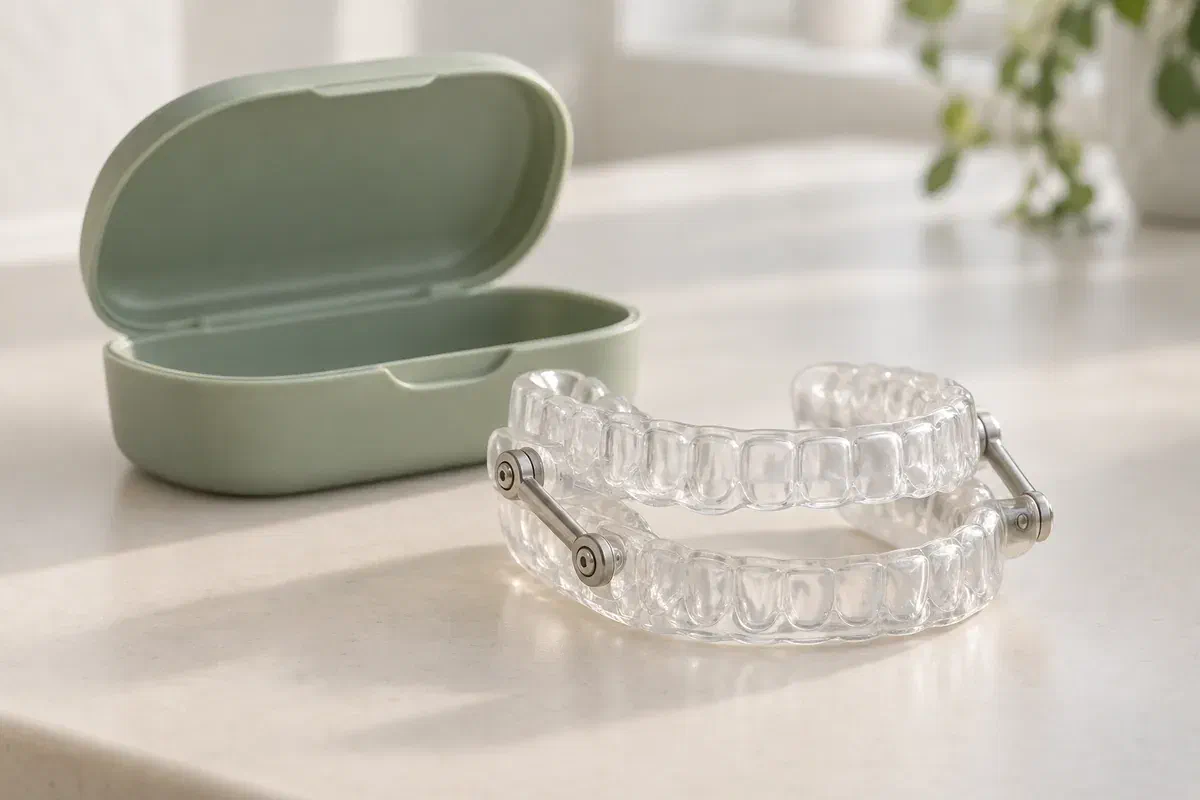
A custom oral appliance is one prescribed option when obstructive sleep apnea has been diagnosed in an adult. The usual type rests on both sets of teeth and draws the lower jaw slightly forward during sleep, which can help the airway stay open. Your sleep physician decides whether it suits your diagnosis, and a dental examination decides whether your mouth can support it.

Households around Campbellville often prefer to group appointments. Bring your sleep results, your physician's recommendations and a description of what you currently use. We will explain dental suitability, the records likely to be needed and how we stay in touch with your sleep-care provider, while your present treatment carries on.

Talk about a sleep appliance
Illustrative connected upper and lower oral-appliance trays beside a pale sage storage case
Getting the order right

Is this a medical question, a treatment problem or a dental one?

Let us know what your physician has assessed and advised. A dental team can help with appliance planning but does not diagnose sleep apnea.

Sleepy and snoring, never tested

Struggling to stay alert while driving, waking unrefreshed, or a partner noticing breathing pauses are reasons to see your family doctor soon. Snoring can be part of sleep apnea, and assessment establishes cause and severity. Quieter sleep does not mean the risk has gone.

Prescribed treatment that isn't being used much

Be frank about how often you actually use what was prescribed and why. Your sleep-care team can address those barriers and advise whether an appliance could be an alternative or addition. Stopping treatment on your own leaves the condition unmanaged.

Teeth or jaw that may limit options

Loose or heavily restored teeth, gum treatment, dentures or jaw pain can influence suitability. Mention them at the start. Ask whether dental care should happen first and how your teeth and bite would be watched while using an appliance.

Under Canadian Dental Association guidance, snoring or suspected sleep apnea is assessed by a physician first, and the dentist works in collaboration with that physician before an oral appliance is supplied.

Safety through coordination

Treatment you can rely on, confirmed by the people who prescribe it

A coordinated discussion gives you a decision built on evidence. You can ask your physician why an appliance might suit your diagnosis, how it compares with the treatment you have, and what it cannot do. An appliance may be simpler to use every night, which matters, but its value depends on whether it controls your sleep apnea.

Roles are spelled out too. We fit and adjust the appliance and keep an eye on your teeth; your sleep-care provider arranges retesting and interprets it. When those jobs are clear before fabrication, fewer trips are wasted and nothing is overlooked.

Patient information: AASM and AADSM — custom appliances, dental oversight, and follow-up sleep testing

Guided by your medical results

Your sleep report and your physician's advice form the basis; ask what else would be useful. The appliance should be selected because your physician agrees it suits the findings, not for convenience alone.

Dental support confirmed first

Ask how the device would be retained and whether your gums and jaw could handle it. Mention planned dental treatment and other appliances. Problems found now can change the timing or the design, or lead to a referral.

Proof before you relax

Ask when your response will be checked and how. Feeling more alert is important to report, but it does not confirm control. The plan should cover what happens if testing shows an incomplete response.

Planning visits from Campbellville

Four stages, grouped where it is safe to do so

The sequence depends on your physician's advice and what the examination shows. Ask about every stage and its fees early, including assessment, fabrication, adjustments, dental reviews and sleep follow-up.

  1. Talk through diagnosis and daily impact

    We go over your sleep results, medical background and recommended treatment, along with how sleepiness affects your day. We agree how we will update your physician and which therapy to keep using during assessment.

  2. Dental assessment and records

    Teeth, gums, restorations and jaw function are examined. If an appliance seems appropriate and your mouth is ready, records can sometimes be taken at the same visit. Ask whether a suitably trained dentist or a referral is part of the plan.

  3. Fitting and a clear adjustment schedule

    When the appliance is delivered, the clinician confirms it sits comfortably and you practise placing and removing it, plus cleaning and storage. Book adjustment visits together where you can. Never advance it on your own between appointments.

  4. Effectiveness checked, reviews continued

    Your physician decides how to assess the result, which may include a follow-up sleep study. Dental reviews watch the appliance, your teeth and bite. Ask who passes results between the two offices, and what the next move is if control proves inadequate.

Day-to-day use

Keep the routine simple and the follow-up steady.

Your instructions reflect the device and the shared plan. Keep both teams' phone numbers handy, and call before driving in if something has changed, since some questions can be answered by phone.

Wear, clean and store it properly

Follow the advice on wear, adjustment, cleaning and storage. Keep the appliance in its case and away from pets, and have it with you at dental reviews. If it breaks or no longer fits, call us for interim guidance instead of attempting a repair.

Report what you notice

Sore teeth, gum irritation, jaw aching that persists, or a bite that seems changed should be mentioned. Ask which signs mean stopping and booking a prompt visit. Do not force the appliance in or keep adjusting it when something feels wrong.

Stay connected with your physician

Tell your sleep-care team if symptoms return, if the device is hard to wear or if your health changes. Keep testing appointments even when you feel well. If you cannot continue with it, ask promptly what to use instead.

Patient information: American Academy of Dental Sleep Medicine — appliance discomfort and dental effects · NHLBI — sleep deficiency and its effects on driving and daily function

Treatment choices

Weigh every option with your physician, not just the convenient one.

The best approach reflects your type of sleep apnea and its severity, your health, how you have responded to treatment and your dental condition. A custom appliance is one possible choice.

When your physician recommends it

Positive airway pressure, made workable

Ask your sleep-care team about comfort, mask or routine problems before stopping. Support or adjustments may help, and they can discuss alternatives. A dental opinion alone should not override that medical advice.

If physician and dentist both see a fit

A custom appliance with confirmed results

Review the design, its limits, the adjustment plan and the testing that will confirm effect. Ask how changes to your teeth will be monitored. A precise fit is important but cannot guarantee control of sleep apnea for everyone.

When something different or additional is needed

Other measures or specialist care

Your physician may suggest other steps or a referral, depending on your diagnosis and response. Ask how these fit with prescribed therapy and when to reassess. Lifestyle and position changes should not take the place of effective treatment without medical review.

Patient information: NHLBI — sleep-apnea treatment options and individualized medical care

Questions about alertness and safety

Sleepiness, driving and appliance treatment

Bring your sleep-care records and an honest picture of how tired you feel during the day. We will tie the dental side to your physician's plan.

(905) 876-4488
Will an oral appliance make me safe to drive again?
No appliance can promise that. Your physician assesses whether your sleep apnea is controlled and whether daytime sleepiness has improved enough. Follow their advice about driving, and do not drive when you feel too drowsy.
I feel sleepy even with treatment. Should I tell the dentist or my physician?
Your physician needs to hear about it first, and soon, as persistent sleepiness may need medical review. Let the dental team know too if the appliance fit or comfort has changed, but do not wait for a dental visit to raise it.
Can I group my dental appointments to save trips?
Often some steps can be combined, depending on your dental findings and the appliance. Ask for an outline at the first visit so you can plan around work and family.
Does caffeine or a nap fix the problem while I wait for the appliance?
They do not treat sleep apnea. Follow the treatment your physician has prescribed in the meantime, and ask them how to manage daytime sleepiness safely until the new plan is confirmed.
What if the appliance is uncomfortable and I start skipping nights?
Tell both teams soon. Comfort problems can sometimes be addressed, and your physician needs to know if treatment is not being used. Ask what to do in the meantime so sleep apnea is not left untreated.
Should I bring my CPAP data or sleep diary to the consultation?
Yes, if you have them. Information about how often you use treatment and how you sleep can help the discussion with both your physician and the dental team.
Sleep appliances for Campbellville

Start with your diagnosis. We will take care of the dental details.

When your diagnosis and recommendations are in hand, phone our Bronte Street practice. We can review dental suitability, explain the records involved and describe how we keep your physician informed or arrange a referral.

Diagnosis, dental suitability, provider roles, follow-up testing and fees require individual review. An appliance is not certain to control sleep apnea and should only replace prescribed treatment with coordinated advice.

Visit Milton Dental Clinic
Unit 1, 342 Bronte St. S, Milton, ON L9T 5B7
Get directions Clinic hours
Monday–Thursday
11am–7pm
Friday–Sunday
By appointment only

Areas we serve

  • Milton
  • Oakville
  • Mississauga
  • Georgetown
  • Halton Hills
  • Acton
  • Campbellville
  • Brampton
  • Burlington
  • Puslinch
  • Rockwood
  • Erin
  • Caledon
  • Etobicoke
  • Old Milton
  • Bronte Meadows
  • Timberlea
  • Dorset Park
  • Dempsey
  • Clarke
  • Beaty
  • Coates
  • Harrison
  • Scott
  • Willmott
  • Ford
  • Bowes
  • Cobden
  • Walker
  • Mountain View
  • Milton Heights
  • Hawthorne Village
  • Valley View
  • Fallingbrook
  • Nassagaweya
  • Trafalgar
  • Esquesing
  • Nelson
  • Brookville
  • Moffat
  • Glen Williams
  • Norval
  • Limehouse
  • Stewarttown
  • Ashgrove
  • Hornby
  • Silver Creek
  • Speyside
  • Scotch Block
  • North Oakville
  • River Oaks
  • Glen Abbey
  • West Oak Trails
  • Palermo
  • Bronte Creek
  • College Park
  • Joshua Creek
  • Uptown Core
  • Preserve
  • Iroquois Ridge
  • Lisgar
  • Meadowvale
  • Meadowvale Village
  • Churchill Meadows
  • Erin Mills
  • Central Erin Mills
  • Streetsville
  • East Credit
  • Creditview
  • Heartland
  • Sheridan
  • Mount Pleasant
  • Credit Valley
  • Huttonville
  • Churchville
  • Springbrook
  • Northwest Brampton
  • Bram West
  • Fletcher's Meadow
  • Fletcher's Creek South
  • Alton Village
  • Orchard
  • Millcroft
  • Headon Forest
  • Tansley
  • Brant Hills
  • Tyandaga
  • Kilbride
  • Lowville
  • Aberfoyle
  • Morriston
  • Arkell
  • Hillsburgh
  • Freelton
  • Carlisle
  • Waterdown
  • Flamborough
  • Mountsberg

How can we help?

Milton Dental Clinic

Have a question about your smile? Choose the option that works best for you.

For urgent dental concerns, please call.
Messages are reviewed during clinic hours.