

Illustrative patient discussing an oral appliance and care coordination with a dental clinician
Specialized Care

Custom Sleep Apnea Appliances in Erin

Choosing between CPAP and an oral appliance is a real decision with trade-offs. For adults in Erin and Hillsburgh, we explain what to weigh, what the dental assessment adds and how your physician confirms the treatment is working.

Making the choice

Machine or mouthpiece? Start by asking what each would need from you.

Once obstructive sleep apnea is diagnosed, the conversation often turns to options. Positive airway pressure is commonly prescribed. For some adults, a custom oral appliance is another possibility. Each has its own demands, and the best treatment is the one that both suits your diagnosis and gets used, night after night.

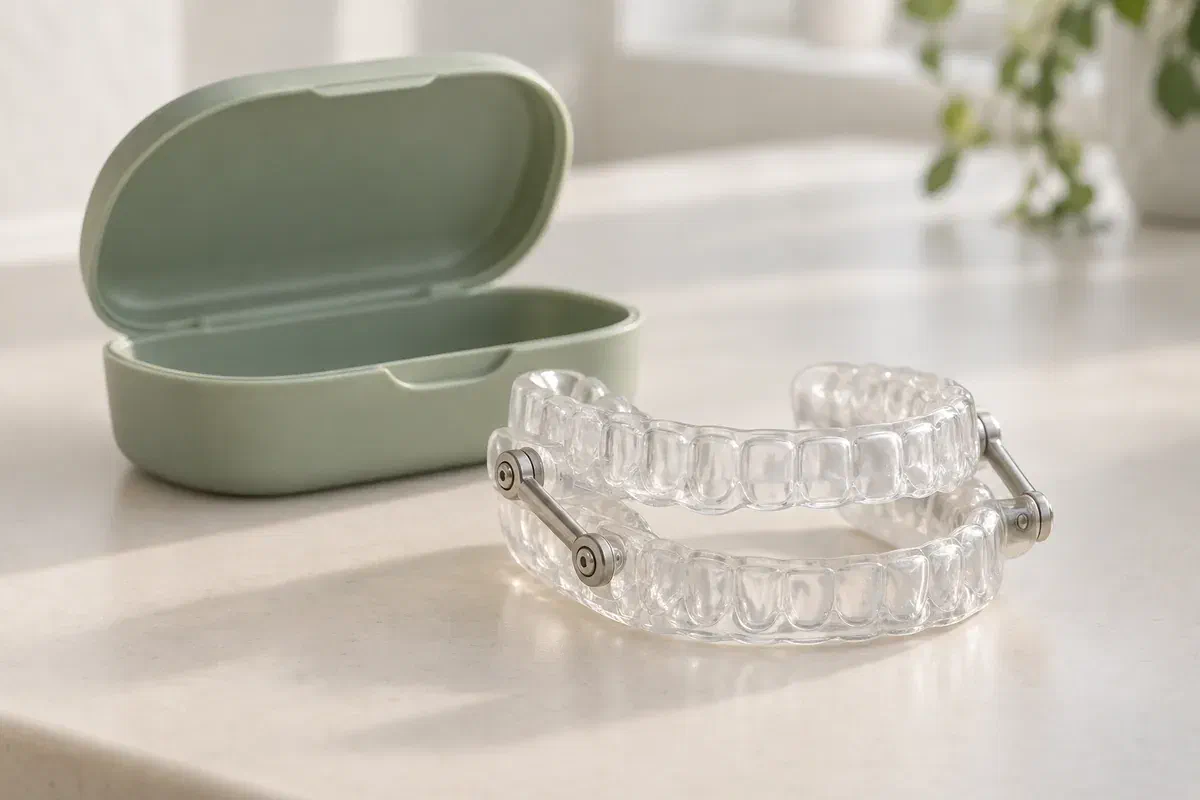
An oral appliance usually covers the upper and lower teeth and holds the lower jaw slightly forward during sleep so the airway is less likely to narrow. Your sleep physician decides whether it is a reasonable choice for you. A dental assessment checks your teeth, gums and jaw. Afterwards, testing shows whether it is controlling the condition, since feeling better is not enough.

Households in Erin often weigh appointments against farm, commute and family schedules. Bring your sleep report, the options your physician has discussed and your honest experience with any treatment so far. We will talk about dental suitability, records and coordination, while you continue what you have been prescribed.

Weigh an appliance with us
Illustrative connected upper and lower oral-appliance trays beside a pale sage storage case
What decision are you facing?

Your situation decides who you should talk to first.

Share what a physician has assessed and recommended. Dental input is part of the decision about an appliance, but it does not diagnose sleep apnea.

Deciding whether to get tested at all

Witnessed breathing pauses, sleep that never refreshes and daytime drowsiness are reasons to see your family doctor. Snoring may come with sleep apnea or may not, and the difference changes everything about treatment. A device is not the place to start.

Weighing a switch from current treatment

Describe what you use and what is hard about it. Your sleep-care team can help with fixes and tell you whether an appliance is a suitable alternative or addition. Until that decision is made with them, keep up your prescribed treatment.

Wondering if your mouth is up to it

Loose teeth, gum treatment, dentures, implants, recent restorations or jaw problems affect whether an appliance is realistic. Raise them early. Ask whether dental care should come first and how the device's effects on your teeth would be reviewed.

Canadian Dental Association policy calls for snoring or suspected sleep apnea to be medically assessed, and for dentists to collaborate with the attending physician, before an oral appliance is offered.

Deciding with all the facts

Compare effectiveness, practicality and dental fit side by side.

A good decision weighs more than size. With your physician, you can talk about how well each option is likely to work for your diagnosis and what follow-up each needs. With us, you can learn what your teeth and jaw allow and what living with an appliance involves. Convenience matters, but control of the condition matters most.

You also leave knowing who handles what. The dental team fits, adjusts and watches your teeth. Your sleep-care provider decides when breathing is retested and interprets it. Agreeing on those roles first keeps the plan simple to follow.

Patient information: AASM and AADSM — custom appliances, dental oversight, and follow-up sleep testing

Effectiveness for your diagnosis

Your sleep report and recommendations frame the choice; ask what other information would help. The decision should reflect the medical findings and your treatment history, with your physician involved, rather than a preference for something smaller.

Practicality in your life

Ask how the appliance would be held in place, whether your gums and jaw could tolerate it and how many visits it needs. Mention planned dental work. These details can change timing or design, or involve another provider.

A plan to confirm the choice

Ask when your response will be measured and how. More energy and less snoring are welcome but not proof. Ask what the fallback is if testing shows the appliance is not enough.

If you decide to go ahead

What follows a yes

Timing follows your physician's recommendations and our dental findings. Ask for a full outline of stages and fees, covering the assessment, fabrication, each adjustment, later dental check-ups and the medical follow-up arranged separately.

  1. Confirm the decision with your physician

    We review your sleep findings, health background and the recommendation for an appliance, and you share any struggles with current treatment. We agree how your physician will be kept informed and what therapy continues meanwhile.

  2. Dental examination and records

    The clinician looks at each tooth's support, your gum health, existing fillings and crowns, and how your jaw opens and moves. When an appliance makes sense, you hear which design is proposed and which impressions or scans it needs. You can also ask about the dentist's training in dental sleep care, or whether a referral fits better.

  3. Fitting and adjustment

    At delivery the clinician checks comfort and fit and shows you how to wear, remove, clean and store the appliance. Adjust it only as instructed. Advancing it on your own to silence snoring sooner can lead to jaw or bite trouble.

  4. Testing and continued reviews

    Your physician arranges how effectiveness is checked, possibly with a sleep study. Dental reviews keep watch on the appliance and your teeth and bite. Ask how results are shared and what changes if the appliance does not control the condition.

Living with your decision

The choice only works if the routine does.

Instructions depend on the device and plan. Keep both teams' details handy so that fit and comfort questions reach us, and symptom questions reach your physician.

Nightly wear and simple care

Follow your wear, adjustment, cleaning and storage instructions. Keep it in its case and bring it to reviews. If it breaks or loosens, call us for interim advice instead of repairing it with anything from the kitchen drawer.

Changes in your mouth

Let us know about tender teeth, sore gums, jaw ache that does not ease, or teeth meeting differently. Ask at fitting which signs mean stopping and being seen promptly. Never force it into place or keep adjusting it when it feels wrong.

Honest reports to your physician

Tell your sleep-care team if symptoms return, if you are skipping nights or if a new health issue appears. A comfortable appliance is no reason to miss a test. If you cannot carry on with the appliance, ask quickly what to use instead.

Patient information: American Academy of Dental Sleep Medicine — appliance discomfort and dental effects · NHLBI — sleep deficiency and its effects on driving and daily function

Erin treatment options side by side

Three approaches, each with its own demands

Your physician considers what form of sleep apnea you have and how marked it is, your overall health, how you have responded so far and your dental findings. An oral appliance is one option in that comparison.

When it is the prescribed medical approach

Positive airway pressure

Equipment, mask and routine issues can often be worked on with your sleep-care team, so speak to them before stopping. They can also discuss alternatives. Our view of your teeth informs that choice but does not overrule it.

When medical and dental assessments both support it

A custom oral appliance

Review the design, its limitations, the number of visits, the adjustment plan and the testing that will confirm it works. Ask how dental changes will be monitored. Fit matters, but nothing guarantees control of sleep apnea for every person.

When neither of the above is enough on its own

Other measures or a specialist

If findings or progress call for it, your physician may raise other measures or a referral. Ask how these fit with prescribed treatment and when reassessment is due. Lifestyle or position changes should not replace effective treatment without medical review.

Patient information: NHLBI — sleep-apnea treatment options and individualized medical care

Questions people weigh

Helping you decide between treatments

Bring your sleep-care information and your own priorities. We will help you see where an appliance could fit in your physician's plan.

(905) 876-4488
Is an oral appliance as effective as CPAP?
It depends on the person and the diagnosis, and your sleep physician is best placed to compare them for you. How consistently each option is actually used can matter too, so be candid about your habits. Whatever is chosen, effectiveness should be confirmed with follow-up rather than assumed.
What if I simply prefer the idea of an appliance?
Preference is worth telling your physician, because a treatment you will use matters. They will weigh it against your diagnosis and health. The dental assessment then checks whether an appliance is practical for your mouth.
Can I try CPAP again if the appliance does not work out?
Talk to your sleep-care provider. They can advise on returning to positive airway pressure or another approach, and on what to use in the meantime so treatment does not lapse.
Is an appliance something I would wear for life?
Sleep apnea is often a long-term condition, so treatment may be ongoing. Your physician will advise on that. Appliances may need adjustment, repair or replacement over time, with regular dental reviews.
Does the dental assessment commit me to getting an appliance?
No. The assessment helps you and your physician decide. You can ask questions, take time to consider the findings and talk them over with your sleep-care provider before agreeing to records or fabrication. Ask for the fees in writing at this stage too.
Will planning around rural travel from Erin change the treatment?
The treatment itself is the same, but we can try to group steps where it is safe and help you plan visits. Ask for an outline at the first appointment and call ahead if something changes.
Appliance decisions for Erin households

Bring the options your physician has given you.

Call our Bronte Street practice once you have a diagnosis and a recommendation to consider. We will review dental suitability, explain any records needed and describe how we coordinate with your physician or refer.

Diagnosis, oral health, the roles of each clinician, retesting and fees all need individual review. No appliance is guaranteed to control sleep apnea, and changing prescribed treatment requires coordinated advice.

Visit Milton Dental Clinic
Unit 1, 342 Bronte St. S, Milton, ON L9T 5B7
Get directions Clinic hours
Monday–Thursday
11am–7pm
Friday–Sunday
By appointment only

Areas we serve

  • Milton
  • Oakville
  • Mississauga
  • Georgetown
  • Halton Hills
  • Acton
  • Campbellville
  • Brampton
  • Burlington
  • Puslinch
  • Rockwood
  • Erin
  • Caledon
  • Etobicoke
  • Old Milton
  • Bronte Meadows
  • Timberlea
  • Dorset Park
  • Dempsey
  • Clarke
  • Beaty
  • Coates
  • Harrison
  • Scott
  • Willmott
  • Ford
  • Bowes
  • Cobden
  • Walker
  • Mountain View
  • Milton Heights
  • Hawthorne Village
  • Valley View
  • Fallingbrook
  • Nassagaweya
  • Trafalgar
  • Esquesing
  • Nelson
  • Brookville
  • Moffat
  • Glen Williams
  • Norval
  • Limehouse
  • Stewarttown
  • Ashgrove
  • Hornby
  • Silver Creek
  • Speyside
  • Scotch Block
  • North Oakville
  • River Oaks
  • Glen Abbey
  • West Oak Trails
  • Palermo
  • Bronte Creek
  • College Park
  • Joshua Creek
  • Uptown Core
  • Preserve
  • Iroquois Ridge
  • Lisgar
  • Meadowvale
  • Meadowvale Village
  • Churchill Meadows
  • Erin Mills
  • Central Erin Mills
  • Streetsville
  • East Credit
  • Creditview
  • Heartland
  • Sheridan
  • Mount Pleasant
  • Credit Valley
  • Huttonville
  • Churchville
  • Springbrook
  • Northwest Brampton
  • Bram West
  • Fletcher's Meadow
  • Fletcher's Creek South
  • Alton Village
  • Orchard
  • Millcroft
  • Headon Forest
  • Tansley
  • Brant Hills
  • Tyandaga
  • Kilbride
  • Lowville
  • Aberfoyle
  • Morriston
  • Arkell
  • Hillsburgh
  • Freelton
  • Carlisle
  • Waterdown
  • Flamborough
  • Mountsberg

How can we help?

Milton Dental Clinic

Have a question about your smile? Choose the option that works best for you.

For urgent dental concerns, please call.
Messages are reviewed during clinic hours.