

Illustrative patient discussing an oral appliance and care coordination with a dental clinician
Specialized Care

Custom Sleep Apnea Appliances in Milton

A sleep study result often leaves people asking what comes next. In Milton, we can talk through whether a custom oral appliance suits your diagnosis and your mouth, and how fitting and follow-up would link with your sleep-care team.

After the sleep report arrives

You have a diagnosis. Now the dental question can be asked properly.

A sleep apnea result can feel like the end of a long stretch of tired mornings, yet it usually opens new choices. For some adults with obstructive sleep apnea, a custom oral appliance is one of them. The most familiar type gently positions the lower jaw forward during sleep so the airway is less likely to narrow.

That device is prescribed treatment, not an over-the-counter snoring gadget. Your sleep physician decides how the condition should be managed, and a dental examination looks at whether your teeth, gums and jaw could hold and tolerate an appliance. Neither step replaces the other, and the result is measured later, not judged by how rested you feel.

For people here in Milton, the first visit is a conversation. Bring the report and recommendations you were given, and tell us about any treatment you are using now. We will talk about dental suitability, what records may be needed, and how coordination or referral would work, while your current prescribed care carries on.

Ask about an oral appliance
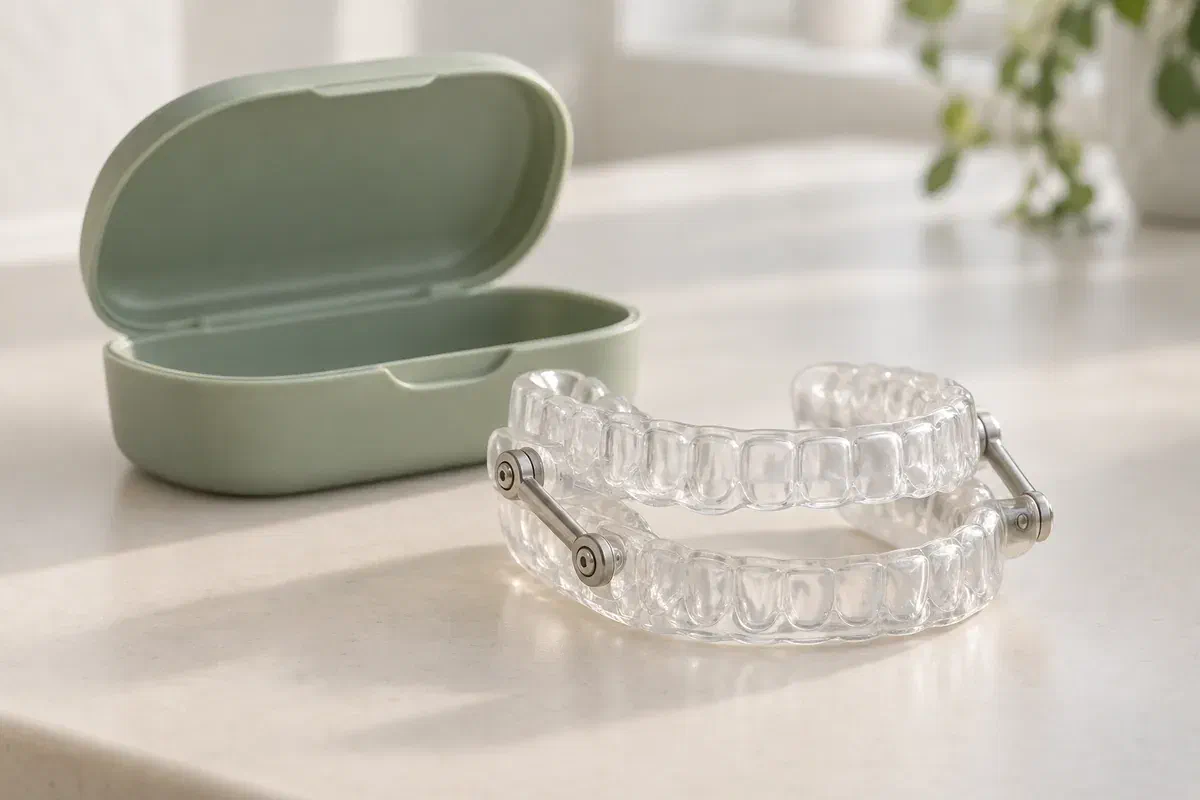
Illustrative connected upper and lower oral-appliance trays beside a pale sage storage case
Where are you starting from?

Three common starting points, each with a different first call

Many Milton households first hear about sleep apnea from a partner. Tell us whether a physician has assessed your sleep; a dental visit cannot confirm or rule it out.

Loud snoring, no assessment yet

If someone has noticed you stop breathing, or you wake unrefreshed and fight sleepiness during the day, raise it with your family doctor first. Snoring can travel with sleep apnea, and only a medical assessment can sort out the cause and severity. A quieter night is not evidence that breathing is fine.

Struggling with the treatment you were given

Tell us what you have been prescribed and where it goes wrong, whether that is the mask, the pressure or simply getting used to it. Raise those problems with your sleep-care team and ask whether an appliance could be an alternative or an addition. Keep using the current treatment until they advise otherwise.

Worries about your teeth or jaw

Let us know about crowns, bridges, recent gum care, loose teeth, dentures or a jaw that clicks or aches. These details shape whether an appliance can be planned and what it would need to look like. Ask whether any dental work should come first and how changes to your bite would be watched.

Canada's national dental association advises that troublesome snoring or possible sleep apnea be assessed by a physician first, with the dentist working alongside that physician before any appliance is provided.

Why a joined-up discussion matters

A clear decision, made with your physician and your dentist on the same page

When your sleep physician thinks an oral appliance is worth considering, a dental consultation lets you see the option in detail. Ask why it might suit your diagnosis and how it stacks up against what you already use. A smaller device may be easier to live with, but ease alone does not show that it is controlling the condition.

The visit is also the time to settle who does what. Someone fits and adjusts the appliance, someone checks your teeth and bite over the following months, and someone arranges the sleep testing. Knowing those roles before anything is made keeps the plan easy to follow.

Patient information: AASM and AADSM — custom appliances, dental oversight, and follow-up sleep testing

Grounded in your sleep findings

Bring whatever sleep report and recommendations you have, and ask what else would be useful. The choice should rest on your diagnosis and treatment history, not on a general wish for something less bulky. Check that your sleep physician is part of the decision.

Your mouth checked before anything is made

Ask how the device would grip your teeth and whether your gums and jaw could cope with the design being proposed. Mention dental work you are planning and any other appliance you wear. Issues found now may change the timing, rule a design out, or mean another provider is involved.

A way to tell whether it is working

Find out when your response will be assessed and what testing is planned. Keep reporting how you feel, while knowing that better energy or less snoring cannot confirm control on its own. The plan should also say what happens if the result falls short.

How the steps usually run

Four stages, from first conversation to measured result

The order and timing depend on your physician's recommendations and what we find in your mouth. Ask about each stage and its fees up front, including assessment, fabrication, adjustment visits, dental reviews and separate sleep follow-up.

  1. Review the diagnosis together

    Share your sleep assessment, health history and recommendations, plus anything that has made current treatment hard. We confirm how we will reach your sleep-care provider and which treatment to keep using meanwhile.

  2. Examine your mouth and take records

    The clinician looks at your teeth, gums, existing restorations, jaw movement and other findings that matter. If an appliance looks appropriate, the design and the records needed are explained. Ask whether a dentist with suitable training in this area, or a referral elsewhere, is part of the plan.

  3. Deliver the appliance and set up adjustments

    At the fitting, comfort and fit are checked, and you learn how to put the device in, take it out, clean it and wear it. Adjust it only as the treating clinician directs. Moving it further on your own to quiet snoring sooner can cause problems.

  4. Measure the response and keep reviewing

    Your sleep-care provider decides how to check effectiveness, often with a follow-up sleep test. Dental reviews keep an eye on the device and on your teeth and bite. Ask how both sets of findings will be shared and what changes if treatment is not enough.

Living with the appliance

Wear it as prescribed and keep both teams in the loop.

Instructions depend on the device and the shared plan. Keep both your dental and sleep-care contacts handy so each concern reaches the right person.

Daily wear, cleaning and storage

Follow the wear schedule, adjustment steps, cleaning routine and storage advice you were given. Pack the appliance in its case when you travel and bring it along to dental reviews. If it cracks or stops fitting, call the treating team for an interim plan instead of patching it with glue or household products.

Changes in your teeth, gums or jaw

Tell us about sore teeth, irritated gums, jaw aching that lingers, or a feeling that your teeth meet differently. Ask which signs mean you should stop wearing it and book a prompt review. Never push an uncomfortable appliance into place or keep adjusting it when the bite feels off.

Updates for your sleep-care provider

Let them know if symptoms return, if you are finding the device hard to use, or if your health changes. Go to recommended testing even when the appliance feels fine. If you cannot wear it, ask quickly what to do so your sleep apnea still has an agreed treatment.

Patient information: American Academy of Dental Sleep Medicine — appliance discomfort and dental effects · NHLBI — sleep deficiency and its effects on driving and daily function

Weighing the treatment paths

Your physician leads the choice; the dental part follows from it.

For adults in Milton, as anywhere, the right approach depends on the type and severity of sleep apnea, your health, your response so far and dental suitability.

When it is the medically recommended treatment

Positive airway pressure, with support

If the mask, pressure or routine is a struggle, raise it with your sleep-care team before giving up. Ask what adjustments or support they can offer and whether an alternative would suit you. A dental opinion should not overrule a medical recommendation on its own.

When both medical and dental findings support it

A custom oral appliance, closely followed

Discuss the chosen design, its limits and how effectiveness will be tested. Ask how changes to your teeth will be tracked over time. A precise fit matters, yet it cannot promise that the appliance controls sleep apnea for everyone.

When a different or added approach is needed

Other measures your physician may suggest

Depending on your diagnosis and response, your sleep-care provider may raise other steps or a specialist referral. Ask how those fit alongside your prescribed therapy and what would prompt reassessment. Position changes or lifestyle measures should not be treated as a replacement for effective treatment without review.

Patient information: NHLBI — sleep-apnea treatment options and individualized medical care

Questions people ask us

What to know before, during and after an appliance

Come with the sleep-care details you have and the everyday problems you would like solved. A good discussion ties the dental device to your medical plan.

(905) 876-4488
My sleep study says mild sleep apnea. Does that mean an appliance is the right choice?
Not automatically. Severity is one factor your sleep physician weighs, along with your symptoms, health and preferences. Ask them whether an oral appliance is an appropriate option for your result, then bring that recommendation to the dental assessment so suitability can be reviewed.
How is a prescribed appliance different from a snoring device sold online?
A prescribed appliance is planned from an assessment of your diagnosis and your mouth, made from records of your teeth and followed with dental and sleep reviews. A product chosen without assessment may leave sleep apnea unrecognised or poorly controlled. Ask your physician before trying a substitute.
Will I need to keep seeing my sleep physician once the appliance is fitted?
Yes. The appliance is part of a medical treatment, and your sleep-care provider decides how and when its effect is checked, which may include a follow-up sleep test. Dental reviews run alongside to watch the device and your teeth.
Can I keep using CPAP until the new appliance is ready and adjusted?
Ask your sleep-care provider, and follow their advice. In general, prescribed treatment should not be stopped on your own while an appliance is being assessed, made or adjusted. Any switch should be planned once the device’s effect has been reviewed.
What dental findings might mean an appliance has to wait?
Active gum disease, loose teeth, a tooth needing treatment, or a planned crown or bridge can all affect timing and design. Jaw symptoms may need attention too. The clinician will explain what was found and whether care should come first.
Who should I call if the appliance suddenly feels wrong one morning?
Contact the dental team that fitted it and describe what changed, such as a sore tooth, jaw pain or a bite that feels different. Ask whether to stop wearing it and what your interim sleep treatment should be. Avoid adjusting it yourself.
Sleep apnea appliances in Milton

Book a conversation about the dental side of your sleep treatment.

Reach our Bronte Street practice with your diagnosis and recommendations. We can review dental suitability, the records that may be needed, and the coordination or referral that oral-appliance care calls for.

Diagnosis, dental suitability, provider arrangements, follow-up testing and fees all need individual review. An appliance cannot guarantee control of sleep apnea, and it should not replace prescribed care without coordinated advice.

Visit Milton Dental Clinic
Unit 1, 342 Bronte St. S, Milton, ON L9T 5B7
Get directions Clinic hours
Monday–Thursday
11am–7pm
Friday–Sunday
By appointment only

Areas we serve

  • Milton
  • Oakville
  • Mississauga
  • Georgetown
  • Halton Hills
  • Acton
  • Campbellville
  • Brampton
  • Burlington
  • Puslinch
  • Rockwood
  • Erin
  • Caledon
  • Etobicoke
  • Old Milton
  • Bronte Meadows
  • Timberlea
  • Dorset Park
  • Dempsey
  • Clarke
  • Beaty
  • Coates
  • Harrison
  • Scott
  • Willmott
  • Ford
  • Bowes
  • Cobden
  • Walker
  • Mountain View
  • Milton Heights
  • Hawthorne Village
  • Valley View
  • Fallingbrook
  • Nassagaweya
  • Trafalgar
  • Esquesing
  • Nelson
  • Brookville
  • Moffat
  • Glen Williams
  • Norval
  • Limehouse
  • Stewarttown
  • Ashgrove
  • Hornby
  • Silver Creek
  • Speyside
  • Scotch Block
  • North Oakville
  • River Oaks
  • Glen Abbey
  • West Oak Trails
  • Palermo
  • Bronte Creek
  • College Park
  • Joshua Creek
  • Uptown Core
  • Preserve
  • Iroquois Ridge
  • Lisgar
  • Meadowvale
  • Meadowvale Village
  • Churchill Meadows
  • Erin Mills
  • Central Erin Mills
  • Streetsville
  • East Credit
  • Creditview
  • Heartland
  • Sheridan
  • Mount Pleasant
  • Credit Valley
  • Huttonville
  • Churchville
  • Springbrook
  • Northwest Brampton
  • Bram West
  • Fletcher's Meadow
  • Fletcher's Creek South
  • Alton Village
  • Orchard
  • Millcroft
  • Headon Forest
  • Tansley
  • Brant Hills
  • Tyandaga
  • Kilbride
  • Lowville
  • Aberfoyle
  • Morriston
  • Arkell
  • Hillsburgh
  • Freelton
  • Carlisle
  • Waterdown
  • Flamborough
  • Mountsberg

How can we help?

Milton Dental Clinic

Have a question about your smile? Choose the option that works best for you.

For urgent dental concerns, please call.
Messages are reviewed during clinic hours.