

Illustrative patient discussing an oral appliance and care coordination with a dental clinician
Specialized Care

Custom Sleep Apnea Appliances in Oakville

A snoring mouthpiece from a store and a prescribed sleep apnea appliance can look alike, but they do different jobs. Coming from Oakville, you can learn how diagnosis, dental suitability, fitting and testing fit together before any device is made.

Snore guard or sleep treatment?

Two pieces of plastic, two very different purposes

Search for snoring help and you will find mouthpieces promising a quiet night. A custom sleep apnea appliance is something else. It is prescribed for selected adults diagnosed with obstructive sleep apnea, built from records of their own teeth, and followed by both a dentist and a sleep physician.

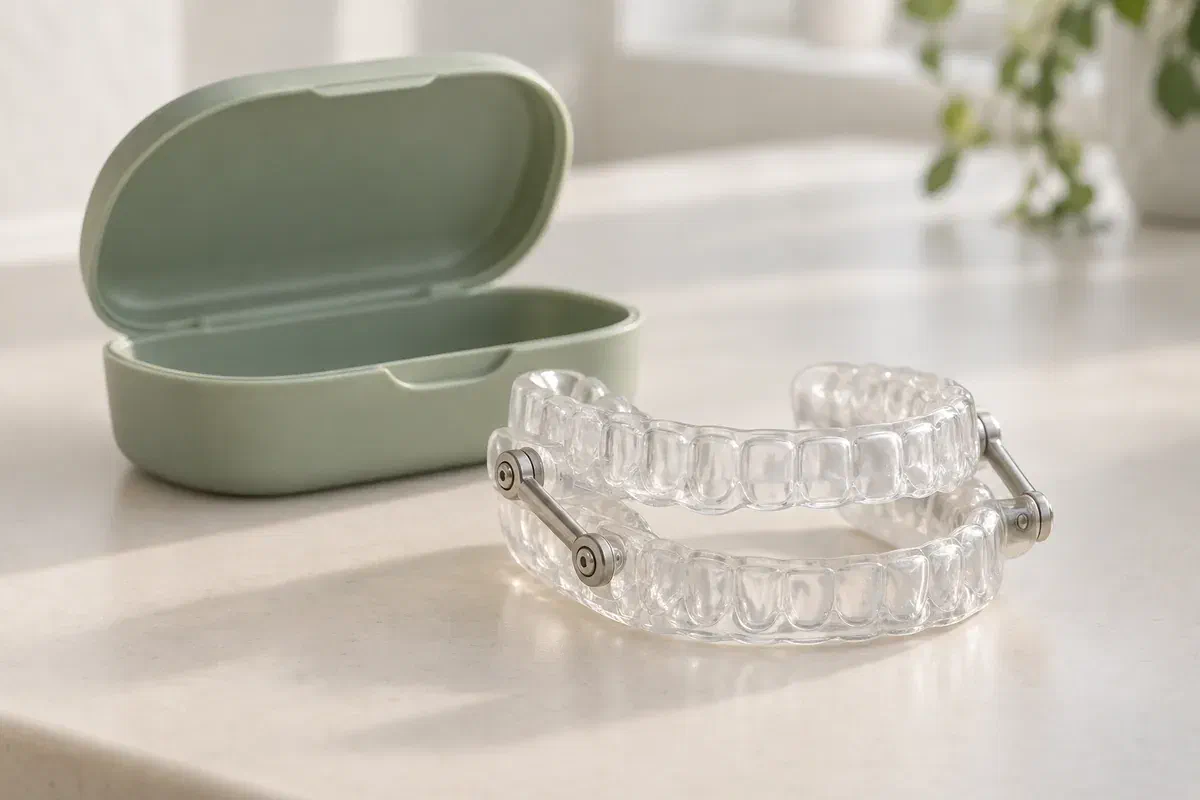
The most common design rests on the upper and lower teeth and holds the lower jaw a little forward, which can help keep the airway from narrowing during sleep. Your physician decides whether this approach suits the diagnosis. The dental examination checks whether your teeth, gums and jaw can support it. Afterwards, testing shows whether it is actually working.

For a first appointment from Oakville, bring your sleep report and treatment recommendations to the first appointment and tell us what you use now. We will discuss suitability, the records that might be needed, and how we would coordinate with your sleep-care provider or refer you on. Your current treatment continues in the meantime.

Learn about prescribed appliances
Illustrative connected upper and lower oral-appliance trays beside a pale sage storage case
Which question are you really asking?

Noise, a known diagnosis, or a struggling routine

Let us know whether you have had a medical sleep assessment and what came of it. Dental advice can help, but it cannot replace that diagnosis.

“I just want the snoring to stop”

Snoring sometimes signals obstructive sleep apnea, especially alongside breathing pauses, unrefreshing sleep or daytime drowsiness. A physician should assess those signs before any device is chosen. A gadget that quiets the room could hide a problem rather than treat it.

“My current treatment isn't working for me”

Describe what you have and what gets in the way. Your sleep-care team can look at solutions and say whether an oral appliance belongs in the plan as an alternative or a complement. Keep using your prescribed treatment until they say otherwise.

“Will my teeth handle it?”

Loose teeth, gum treatment, implants, dentures, large fillings or a jaw that aches can affect whether an appliance is suitable and how it is designed. Ask whether dental care should come first and how your teeth and bite would be monitored.

According to the Canadian Dental Association, snoring and suspected sleep apnea should be evaluated medically, and the dentist should collaborate with your physician, before an appliance is made.

The value of doing it properly

Why prescription and follow-up beat a quick fix

A properly coordinated consultation gives you a real treatment decision instead of a guess. You can ask your sleep physician and dentist whether an appliance makes sense for your diagnosis, how it compares with positive airway pressure or other measures, and what its limits are. Being small and quiet is a benefit, but the deciding question is whether it controls the condition.

It also tells you who is responsible for each part. The dentist fits, adjusts and checks your teeth. The sleep physician decides when and how your breathing is retested. Knowing that before fabrication makes the months ahead much simpler.

Patient information: AASM and AADSM — custom appliances, dental oversight, and follow-up sleep testing

Matched to your diagnosis

Your sleep report, symptoms and treatment history shape the recommendation. Ask what further information may help. A device should be chosen because it suits the medical picture, with your sleep physician involved, rather than because it looks easier.

Planned around your mouth

Ask how the appliance would grip your teeth and whether your gums and jaw can cope with it. Upcoming dental work and other appliances you wear should be part of the conversation. Findings here can change timing or design, or lead to a referral.

Checked against real results

Find out when your response will be evaluated and what testing is planned. Quieter nights and better mornings are welcome, yet they cannot confirm that sleep apnea is controlled. Ask what the next step is if the response is partial.

The appointments involved

Plan it, make it, fit it, test it

Exact steps depend on your physician's advice and our dental findings. Ask up front about every stage and fee, including assessment, fabrication, adjustment, dental checks and separate sleep-care follow-up.

  1. Start with your medical information

    We look at your sleep assessment, health details and recommendations, and describe any difficulty with present treatment. Together we confirm how communication with your sleep-care provider will work and what you should continue using during the dental assessment.

  2. Assess and record your bite

    Your teeth, gums, restorations and jaw function are examined. If an appliance seems appropriate, the design and required impressions or scans are explained. Ask whether a dentist with suitable training or a referral is needed for this care.

  3. Receive and learn the appliance

    Fit and comfort are checked at delivery, and you are shown how to place, remove, clean and store the device. Follow the adjustment schedule exactly. Pushing the setting further yourself to silence snoring sooner is not advised.

  4. Confirm the effect over time

    Your sleep physician decides how effectiveness is assessed, which may include another sleep test. Dental reviews follow the appliance and any changes to your teeth or bite. Ask how results move between the two offices and what happens if control is not good enough.

Night after night

Treat it like the prescription it is.

Care steps vary by device and plan. Keep both your dental and sleep-care contacts handy so that comfort problems and treatment questions go to the right place.

Routine use and cleaning

Wear, adjust, clean and store the appliance as instructed. Use its case when you travel and bring it to dental reviews. If it breaks or loosens, ask the treating team for a safe interim plan instead of attempting a home repair.

Signals from your teeth and jaw

Report tooth soreness, gum irritation, jaw discomfort that persists, or teeth that seem to meet differently. Ask which signs mean you should stop wearing it and book a review. Do not force an uncomfortable device into place or keep tightening it.

Regular contact with the sleep team

Tell them about returning symptoms, difficulty with the appliance or changes in your health. Attend follow-up testing even when it feels comfortable. If wearing it becomes impossible, ask promptly what to use so sleep apnea is still treated.

Patient information: American Academy of Dental Sleep Medicine — appliance discomfort and dental effects · NHLBI — sleep deficiency and its effects on driving and daily function

Options for Oakville adults

Your physician sets the direction. We handle the dental piece.

Which treatment fits depends on the type and severity of your sleep apnea, your overall health, how you have responded so far and your dental situation. An oral appliance is one choice among several.

When it is the prescribed medical treatment

Positive airway pressure with troubleshooting

Problems with the mask, comfort or routine are worth raising with your sleep-care team before giving up. They may suggest adjustments or support, or discuss alternatives. A dental opinion should not override their recommendation alone.

When medical and dental findings agree it fits

A custom appliance, reviewed regularly

Discuss the chosen design, its limits, how it is adjusted and how its effect is tested. Ask about monitoring your teeth over time. A precise fit matters, but no appliance is guaranteed to control sleep apnea for everyone.

When another approach is needed or helps

Additional measures or specialist input

Your physician may raise other measures or a specialist referral based on your findings and progress. Ask how these fit with prescribed treatment and when to reassess. Lifestyle and position changes should not stand in for effective therapy without review.

Patient information: NHLBI — sleep-apnea treatment options and individualized medical care

Before you buy anything

Questions about snoring devices, diagnosis and fit

Bring your sleep-care paperwork and a list of what bothers you most. We will link the dental side to the treatment your physician has in mind.

(905) 876-4488
Is a boil-and-bite snoring mouthpiece a reasonable stand-in while I wait?
Please check with your physician first. A product chosen without assessment may not suit your diagnosis or your teeth, and it can give a false sense that breathing is controlled. Follow the treatment your sleep-care provider has prescribed in the meantime.
Can a dentist tell me if I have sleep apnea?
No. A dentist may notice signs worth mentioning to your physician, but diagnosis requires a medical assessment. Once you have one, a dental consultation can look at whether an oral appliance is suitable.
Does my partner's report of quieter nights mean the appliance is working?
It is helpful information but not confirmation. Breathing events can continue with less noise. Your sleep-care provider decides how to check the response, which may involve follow-up testing.
How many dental visits should I expect?
Usually there is an assessment, a records appointment, a fitting and several adjustment or review visits, though the exact number varies. Ask for a clear outline at the consultation so you can plan around work and family commitments.
Why does the appliance need adjusting after it is fitted?
The jaw position is often changed gradually, guided by the treating clinician and by how you respond. Adjust only as instructed. Moving it further on your own can cause discomfort or bite problems.
What happens if my teeth feel sore on the first few mornings?
Some temporary tenderness can occur, but tell the dental team what you are feeling. Ask which symptoms mean you should stop wearing it and be seen. Persistent pain or a changed bite needs prompt review.
Sleep apnea appliance consultations

Bring your diagnosis from Oakville and let's look at the dental side.

Contact our Bronte Street practice with your sleep report and recommendations. We will discuss dental suitability, which records may be needed, and the coordination or referral that oral-appliance care involves.

Suitability, the roles of each provider, retesting and fees are decided case by case. A custom fit does not promise that sleep apnea will be controlled, and the appliance should only replace your prescribed treatment on coordinated advice.

Visit Milton Dental Clinic
Unit 1, 342 Bronte St. S, Milton, ON L9T 5B7
Get directions Clinic hours
Monday–Thursday
11am–7pm
Friday–Sunday
By appointment only

Areas we serve

  • Milton
  • Oakville
  • Mississauga
  • Georgetown
  • Halton Hills
  • Acton
  • Campbellville
  • Brampton
  • Burlington
  • Puslinch
  • Rockwood
  • Erin
  • Caledon
  • Etobicoke
  • Old Milton
  • Bronte Meadows
  • Timberlea
  • Dorset Park
  • Dempsey
  • Clarke
  • Beaty
  • Coates
  • Harrison
  • Scott
  • Willmott
  • Ford
  • Bowes
  • Cobden
  • Walker
  • Mountain View
  • Milton Heights
  • Hawthorne Village
  • Valley View
  • Fallingbrook
  • Nassagaweya
  • Trafalgar
  • Esquesing
  • Nelson
  • Brookville
  • Moffat
  • Glen Williams
  • Norval
  • Limehouse
  • Stewarttown
  • Ashgrove
  • Hornby
  • Silver Creek
  • Speyside
  • Scotch Block
  • North Oakville
  • River Oaks
  • Glen Abbey
  • West Oak Trails
  • Palermo
  • Bronte Creek
  • College Park
  • Joshua Creek
  • Uptown Core
  • Preserve
  • Iroquois Ridge
  • Lisgar
  • Meadowvale
  • Meadowvale Village
  • Churchill Meadows
  • Erin Mills
  • Central Erin Mills
  • Streetsville
  • East Credit
  • Creditview
  • Heartland
  • Sheridan
  • Mount Pleasant
  • Credit Valley
  • Huttonville
  • Churchville
  • Springbrook
  • Northwest Brampton
  • Bram West
  • Fletcher's Meadow
  • Fletcher's Creek South
  • Alton Village
  • Orchard
  • Millcroft
  • Headon Forest
  • Tansley
  • Brant Hills
  • Tyandaga
  • Kilbride
  • Lowville
  • Aberfoyle
  • Morriston
  • Arkell
  • Hillsburgh
  • Freelton
  • Carlisle
  • Waterdown
  • Flamborough
  • Mountsberg

How can we help?

Milton Dental Clinic

Have a question about your smile? Choose the option that works best for you.

For urgent dental concerns, please call.
Messages are reviewed during clinic hours.