

Illustrative patient discussing an urgent dental concern with a clinician
Specialized Care

Dental Abscess Treatment in Caledon

Some tooth infections are straightforward; others involve the gums, several teeth or a specialist. From Bolton or elsewhere in Caledon, call to describe your symptoms and we can discuss urgency, assessment and possible next steps.

Caledon · when care involves more than one provider

Not every abscess follows the simple route

Often a swollen gum turns out to be one tooth and one fix. Sometimes it is less tidy: the infection seems linked to the gum rather than the tooth, a previously treated tooth is involved, or several teeth are candidates. A dental abscess is pus that has collected around infection in a tooth or its surrounding tissues. It needs treatment, and an examination is what reveals whether the picture is simple or calls for further help, as well as ruling out problems that merely feel similar.

Urgency comes first: how soon should you be seen, and is a dental chair or a hospital the right place to start? Treatment follows the findings. It may involve drainage, care inside the tooth, extraction where the tooth has poor prospects, treatment of the gum and supporting tissue, or a referral to a specialist.

From Caledon, phone us and explain what has changed, when it started and whether you feel unwell. We can discuss availability and what the first visit may cover. For urgent symptoms, skip the email; if our line goes unanswered, find an emergency dental service that is open.

Arrange the first assessment
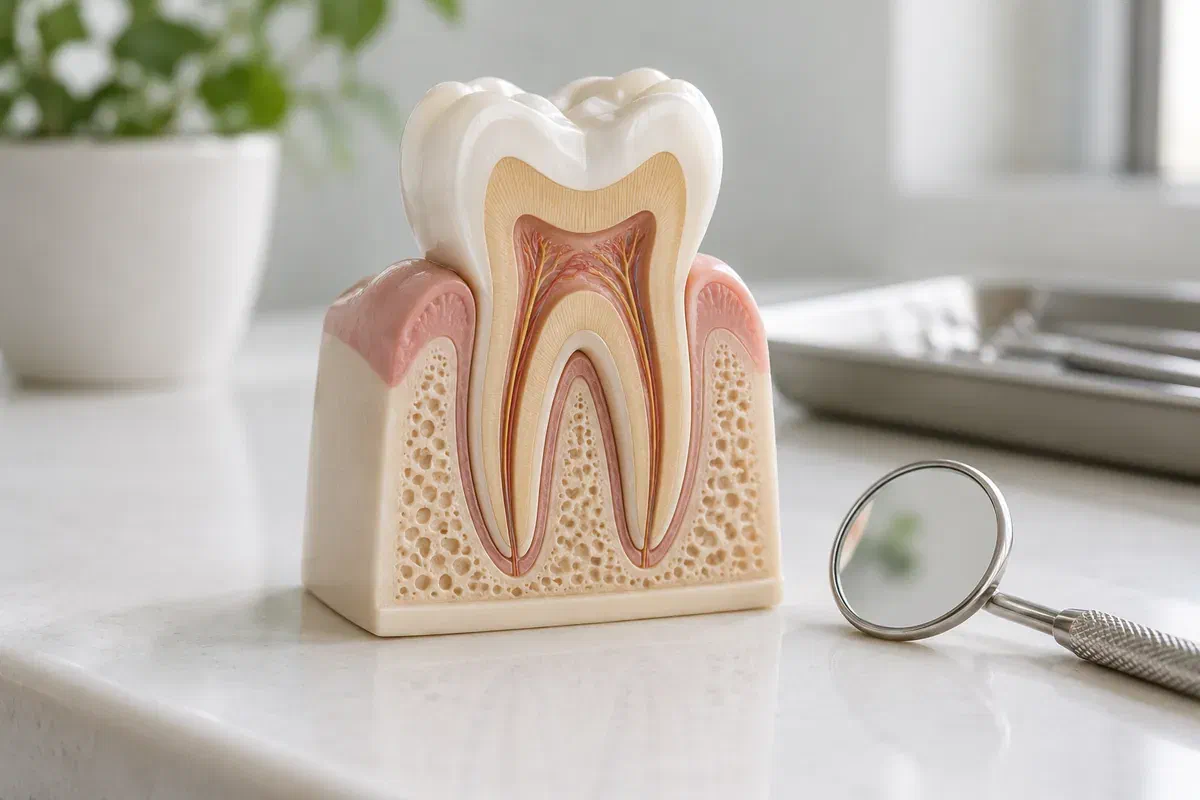
Illustrative physical model showing the inside of a tooth beside a dental mirror
Information that guides the route

The more complete the picture, the clearer the path

You are not expected to say whether it is an abscess or who should treat it. Sharing these details helps the team judge urgency and anticipate whether more than one visit or provider may be involved.

Where the problem seems to sit

Describe whether the swelling or pain is at the gum line, deeper near the root, or spread across several teeth. Mention a bump, an odd taste, looseness or pain on biting, and how things have changed. Watch the area rather than pressing on it.

Your general condition

Let us know about fever, feeling unwell or swelling moving into the face or neck. Share medical conditions, regular medicines and recent treatment. These can affect not only how quickly you are seen but whether another setting or provider should be involved.

Previous care from any provider

Tell us about earlier gum treatment, root canal work or specialist visits, plus any medicine prescribed and when. Bring allergy information. If symptoms eased and came back, or another office has already examined it, say so; that history helps more than assumptions.

Call 911 or go to hospital emergency care right away for difficulty breathing or swallowing, swelling around the eye or vision changes, or swelling of the face or mouth that is substantial or spreading rapidly. A dental booking request is not the place for these signs.

What you should understand

Who does what, and in which order

When care may involve more than one appointment or provider, the most useful outcome of the first visit is a clear map. Ask what was found, whether today’s treatment addresses the source or stabilises things while further care is arranged, and who handles each part. Easing symptoms matters; so does knowing the route.

The tooth’s condition, the health of the surrounding gum and your overall health all shape the advice. You can ask why the tooth should be kept or removed, what a specialist would add, what each option cannot do and how the sequence would run.

Patient information: American Dental Association — antibiotics and definitive dental treatment

A diagnosis that points to the source

Your history, the examination and any X-rays or tests that are warranted are considered together. Ask which findings identify whether the tooth, the gum or both are involved. Discomfort can mislead, so the obvious tooth is not always the whole story.

Medicine with a clear role

Antibiotics are not a stand-in for dental treatment that is needed. Their use depends on the diagnosis, whether infection appears to be spreading or affecting you generally, your medical history and how soon treatment can be arranged, including any specialist wait.

A coordinated plan

Confirm the next visit and the person providing it, whether here or with a specialist, and what to do if symptoms change first. Request the estimate and referral details. A written sequence helps when several appointments are involved.

Mapping the route

From first call to the right provider

The scope of the first appointment depends on what is found and what can be done that day. Ask which parts are handled here and which may need a return visit or a referral.

  1. Gather history from every source

    We cover current symptoms, previous dental and gum treatment, specialist care, medicines and allergies. Relevant health conditions are noted. If your symptoms worsen before the appointment, call again or seek another suitable provider promptly.

  2. Examine teeth and gums

    The dentist checks the teeth, gums and nearby tissue and decides whether X-rays or tests would help. Ask what is certain and what is uncertain. A working diagnosis should identify the likely source before any treatment is chosen.

  3. Decide on treatment or referral

    You discuss the proposed care, comfort measures, alternatives, limits and fees, and whether a specialist is advisable. Initial treatment may include drainage or care of the tooth or tissue involved. Ask whether this is definitive or a step toward further care.

  4. Arrange the handover clearly

    Before you leave, confirm the expected changes and the signs that need attention. If you are referred, ask what information will be sent, who books the appointment and what to do while you wait.

While the plan unfolds

Aftercare for each stage, from each provider

Recovery after drainage is different from recovery after root canal care, an extraction or gum treatment. Ask for instructions matched to the procedure you had, and follow the guidance of whichever provider treated you.

Keep track of every appointment

Note each upcoming visit, here or with a specialist, and confirm the dates. If one becomes difficult, call that office to rearrange. Improvement in symptoms does not mean every part of the plan is done.

One medicine list for all providers

Follow each prescriber’s directions, and make sure every provider knows what you are taking. Ask a pharmacist about interactions. Do not use someone else’s antibiotics or leftovers. If you cannot take a prescribed medicine, inform the prescriber.

Report changes while you wait

Contact us if pain, swelling or general illness increases while you are waiting for further care, or does not match what was explained. Mention the treatment date and the change. Do not try to drain or squeeze a swelling yourself.

Possible paths

Tooth, gum or specialist: matching care to the cause

Ask what each option aims to achieve, what follows and what waiting could mean. Suspected abscesses vary too widely for one procedure to suit all of them.

When the tooth has good prospects

Root canal care to retain the tooth

If the infection comes from inside a restorable tooth, root canal treatment may be discussed, sometimes with a specialist for complex roots or retreatment. Ask about stages and the final restoration. Remaining structure and support shape the decision.

When retention is unlikely to succeed

Extraction, with replacement planned later

Removal may be advised when the tooth cannot be reliably treated or rebuilt. Ask why and what the appointment involves, including whether an oral surgeon is recommended. Replacement can be planned separately.

When the gum is the source or the case is complex

Gum treatment or specialist care

A periodontal infection or more involved presentation may need gum-focused treatment or a specialist referral. Ask what the specialist is expected to assess and how care will be shared. The aim is the right route, not a single fix for every swelling.

Caledon referral questions

When more than one provider is involved

Urgent symptoms call for a phone call. These answers help with planning, but the diagnosis and treatment depend on your examination.

(905) 876-4488
What is the difference between a tooth abscess and a gum abscess?
One begins with infection inside the tooth, the other in the gum and supporting tissue. They can look similar, and the treatment differs. The examination helps determine which is involved.
Why might I be referred to a specialist for an infected tooth?
Complex root anatomy, retreatment of earlier work, a difficult extraction or gum-related infection can all be reasons. Ask what the referral is meant to clarify and who arranges it.
What happens while I wait for a specialist appointment?
Ask what interim care has been provided and what signs mean you should call before the referral date. Worsening symptoms need prompt attention, and warning signs need emergency care.
Will my records be sent to the specialist?
Ask what information will be shared and when. It helps to confirm the specialist has your relevant history and images before your appointment.
Can more than one tooth be involved in an abscess?
Pain or swelling can affect an area that includes several teeth, and sometimes more than one has a problem. The examination and any needed imaging help sort out which are involved.
Who do I call with questions after seeing a specialist?
Contact the provider who carried out the treatment for questions about it. Keep us informed if you are returning here for later stages so the plan stays coordinated.
Calling from Caledon

Start here, and we will map the route with you

Phone our Bronte Street practice to describe the infection and ask when we can examine it. Tell us if swelling or your general health is changing. If you need immediate help and cannot get through, find an emergency dental service that is open.

Online requests are for non-urgent questions. Diagnosis, treatment, prescriptions, referrals and fees follow the examination, and urgent or same-day appointments cannot be guaranteed.

Visit Milton Dental Clinic
Unit 1, 342 Bronte St. S, Milton, ON L9T 5B7
Get directions Clinic hours
Monday–Thursday
11am–7pm
Friday–Sunday
By appointment only

Areas we serve

  • Milton
  • Oakville
  • Mississauga
  • Georgetown
  • Halton Hills
  • Acton
  • Campbellville
  • Brampton
  • Burlington
  • Puslinch
  • Rockwood
  • Erin
  • Caledon
  • Etobicoke
  • Old Milton
  • Bronte Meadows
  • Timberlea
  • Dorset Park
  • Dempsey
  • Clarke
  • Beaty
  • Coates
  • Harrison
  • Scott
  • Willmott
  • Ford
  • Bowes
  • Cobden
  • Walker
  • Mountain View
  • Milton Heights
  • Hawthorne Village
  • Valley View
  • Fallingbrook
  • Nassagaweya
  • Trafalgar
  • Esquesing
  • Nelson
  • Brookville
  • Moffat
  • Glen Williams
  • Norval
  • Limehouse
  • Stewarttown
  • Ashgrove
  • Hornby
  • Silver Creek
  • Speyside
  • Scotch Block
  • North Oakville
  • River Oaks
  • Glen Abbey
  • West Oak Trails
  • Palermo
  • Bronte Creek
  • College Park
  • Joshua Creek
  • Uptown Core
  • Preserve
  • Iroquois Ridge
  • Lisgar
  • Meadowvale
  • Meadowvale Village
  • Churchill Meadows
  • Erin Mills
  • Central Erin Mills
  • Streetsville
  • East Credit
  • Creditview
  • Heartland
  • Sheridan
  • Mount Pleasant
  • Credit Valley
  • Huttonville
  • Churchville
  • Springbrook
  • Northwest Brampton
  • Bram West
  • Fletcher's Meadow
  • Fletcher's Creek South
  • Alton Village
  • Orchard
  • Millcroft
  • Headon Forest
  • Tansley
  • Brant Hills
  • Tyandaga
  • Kilbride
  • Lowville
  • Aberfoyle
  • Morriston
  • Arkell
  • Hillsburgh
  • Freelton
  • Carlisle
  • Waterdown
  • Flamborough
  • Mountsberg

How can we help?

Milton Dental Clinic

Have a question about your smile? Choose the option that works best for you.

For urgent dental concerns, please call.
Messages are reviewed during clinic hours.