

Illustrative patient discussing an urgent dental concern with a clinician
Specialized Care

Dental Abscess Treatment in Georgetown

Pain that seems to move between teeth, or aches up toward the ear, can make an infection hard to pin down. From Georgetown, call us to describe it so we can discuss urgency and an examination that finds the real source.

Locating a tooth infection

Which tooth is it, really?

Dental pain is notoriously poor at giving directions. It can feel like the whole side of the jaw, drift between upper and lower teeth, or settle near the ear. Sometimes the cause is a dental abscess, a collection of pus around an infection in a tooth or its supporting tissue. Sometimes it is something else entirely that happens to feel similar, which is why an examination matters before anything is treated.

There are really two puzzles. One is urgency: how soon should you be seen, and where? The other is the source: which tooth or tissue is involved and what should be done? Depending on what the dentist identifies, the answer may be drainage, care inside the tooth, removal of a tooth that cannot be reliably kept, or treatment directed at the gum and surrounding area.

When you ring from Georgetown, describe where the pain seems to be, what makes it worse and whether you feel unwell. Do not rely on a web form for urgent symptoms. If nobody answers and things are getting worse, reach an emergency dental provider who can see you.

Book an exam to find the source
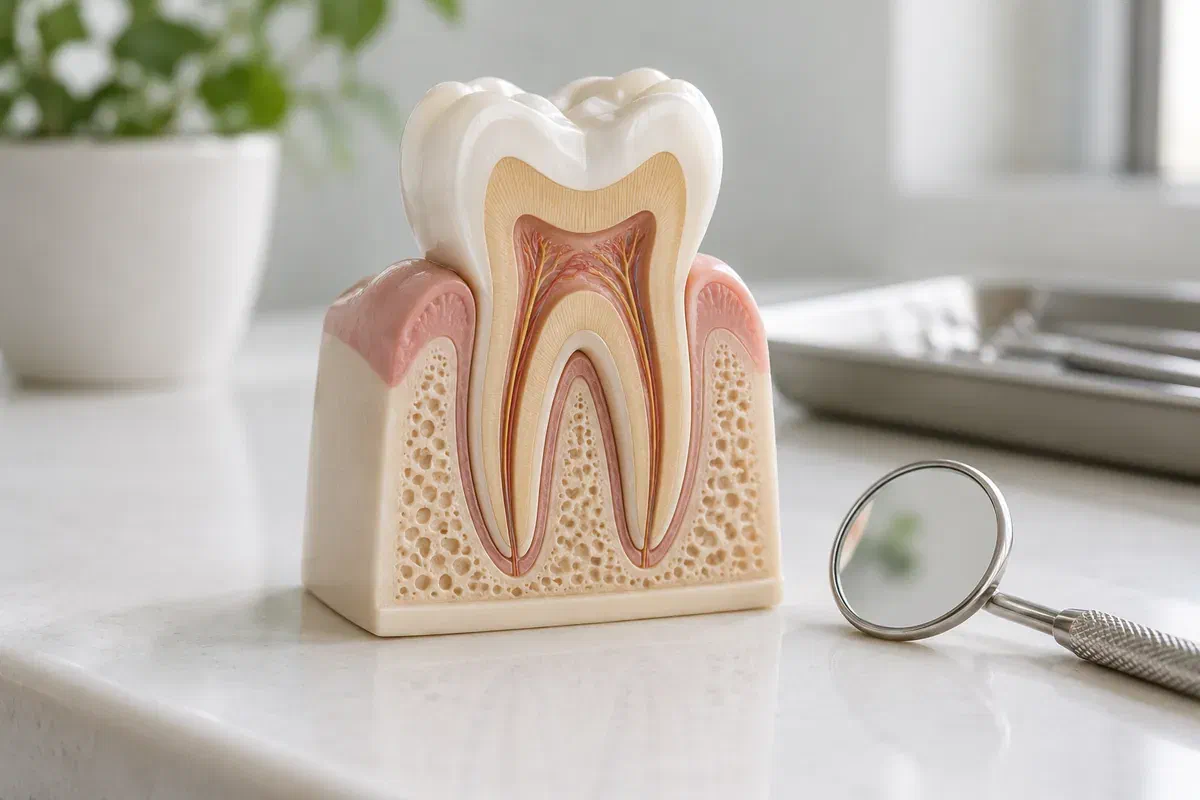
Illustrative physical model showing the inside of a tooth beside a dental mirror
Clues worth noting

Small observations help narrow down the cause

You do not have to name the tooth or the problem. Noticing a few patterns and passing them on gives the team a head start on judging urgency and planning your exam.

When and where it hurts

Note whether pain is on the upper or lower jaw, front or back, and whether it spreads. Does biting, cold, heat or lying down set it off? Mention any gum bump or unusual taste. Observing is more helpful than poking the area to test it.

Other signs in your body

A fever, feeling unwell, congestion or swelling that extends beyond the gum can all be relevant. Share health conditions, the medicines you take and any recent dental or medical care. Some of these change how urgently and where you should be seen.

Treatment and medicine so far

Tell us about recent dental work in the area and any medicine you have taken, with dates. Keep the names and your allergies to hand. If pain eased and then returned, mention it; a pattern like that is often a better clue than assuming the first episode settled.

Call 911 or go to hospital emergency care straight away for difficulty breathing or swallowing, swelling around the eye or vision changes, or swelling of the face or mouth that is marked or spreading rapidly. A dental enquiry form is not appropriate for these.

Why the diagnosis matters

Treat the right tooth, for the right reason

The most valuable thing an urgent visit can give you is a confident answer about where the problem lies. Then you can ask whether the care offered treats that source or is a first stage that still needs finishing. Easing pain is welcome; knowing it was the right tooth is what makes the relief last.

Any advice also has to account for the tooth’s condition and your overall health. Ask why keeping or removing it is suggested, what each choice cannot do and how the appointments would be ordered. When symptoms have been confusing, a clear explanation is especially reassuring.

Patient information: American Dental Association — antibiotics and definitive dental treatment

Findings matched to your symptoms

The dentist combines your account, the examination and any X-rays or other checks that are justified. Ask which findings point to the culprit. A tooth that feels painful may be reacting to a neighbour, and the true source is not always obvious.

A clear explanation of medication

An antibiotic is not a stand-in for dental treatment that is needed. Whether one makes sense depends on the diagnosis, signs of spread or general illness, your medical situation and how soon treatment can be carried out. Ask what any prescription is for.

Defined next steps

Confirm the next appointment, who will see you and what to do if symptoms shift beforehand. Ask for the estimate and referral details where needed. A written plan is useful after an anxious or confusing few days.

Tracking down the source

From scattered symptoms to a working diagnosis

The scope of the first visit rests on the findings and on what can be done that day. Ask early on which pieces can be handled at once and which need a second visit or a specialist.

  1. Map the symptoms

    We ask when it started, where it seems to be, what triggers it, earlier dental work and medicines taken so far. Allergies and conditions are noted too. If the pain or swelling increases before your visit, phone again or seek another suitable provider.

  2. Test, look and explain

    The dentist examines the suspected teeth and nearby tissue and may use X-rays or simple tests to narrow things down. Ask what has been ruled in or out. A working diagnosis should explain your symptoms before treatment is chosen.

  3. Decide on treatment together

    You go through the proposed procedure, how comfort will be managed, other options, what it cannot achieve and the cost. Treatment for an abscess may involve drainage and care of the tooth or tissue responsible. Ask whether it is complete or a first stage.

  4. Leave knowing what to watch

    Before you go, confirm what is normal over the next few days and what means you need help again. Check how remaining treatment will be done. With a referral, ask what will be sent ahead and who to contact.

In the days that follow

Instructions tailored to what was treated

Aftercare varies after drainage, root canal care, a tooth removal or gum treatment. Ask for guidance that fits your own procedure instead of following advice from a different, earlier appointment.

Return for the completion visit

Write the next step down and book it promptly. If it clashes with other plans, call to rearrange. A tooth that has stopped hurting is not a sign the whole plan has been carried out.

Follow medicine directions

Take any prescribed medicine as directed, and ask a pharmacist about side effects or other medicines you use. Do not take antibiotics prescribed for someone else or left over from before. If you cannot continue a medicine, contact the person who prescribed it.

Watch for a new or shifting pattern

Phone us if pain, swelling or feeling unwell gets worse or behaves differently from what was explained. Mention the treatment date and the change. Please do not squeeze, prick or drain a swelling on your own.

Once the source is identified

Treatment that fits the tooth that is actually involved

Ask what each option should achieve, what further care it needs and what could happen if it waits. Suspected abscesses vary too much for one procedure to suit them all.

If the source tooth can be restored

Root canal care

When infection begins inside a tooth that can be rebuilt, root canal treatment may be discussed. Ask about the stages and the restoration afterward. The decision considers the entire tooth, including remaining structure and support.

If the tooth cannot be predictably kept

Extraction

Removal may be advised when the tooth cannot be dependably treated or restored. Ask why keeping it is not suggested and what the appointment involves. Replacement choices, timing and cost can follow as a separate discussion.

If the gums or a complex picture are involved

Gum treatment, or a second opinion

When infection comes from the gum, or the situation is harder to read, different care or a specialist may be suggested. You can ask what a referral would clarify. The aim is accurate treatment, not one label for every sore spot.

Georgetown questions

When pain is hard to place

Phone us for anything urgent. These answers are for planning; your examination decides the diagnosis and treatment.

(905) 876-4488
Can a sinus problem feel like an abscessed upper tooth?
Yes, upper back teeth sit close to the sinuses, so the two can feel alike. Mention congestion or recent colds when you call. The examination helps tell dental and sinus causes apart.
Why does my ear ache when the problem seems to be a back tooth?
Pain from teeth can be felt elsewhere in the face or jaw. Describe exactly where you feel it. The dentist uses the examination and, if needed, X-rays to locate the source.
Is it possible for a tooth to be infected without any pain?
It can happen, sometimes with only a gum bump or a bad taste. Infections can also go quiet for a time. If you notice changes like these, book an assessment.
Can a cracked tooth lead to an abscess?
A crack can allow bacteria into a tooth, which may lead to infection. Pain on biting or when releasing a bite is worth mentioning. The dentist will assess the crack and the tooth’s prospects.
What if the X-ray does not show anything obvious?
Images are only one part of the picture. The dentist also relies on your history and the examination. Ask what is still uncertain and whether further tests or a review appointment make sense.
Do antibiotics help find which tooth is the problem?
No. Medicine does not locate the source and may mask symptoms. The examination is what identifies the cause, and dental treatment is usually central to dealing with it.
Georgetown to Bronte Street

Tell us where it seems to hurt, and we will look closely

Phone our Bronte Street practice to describe the pain and ask about appointment availability. Mention any change in swelling or general health. If you need care immediately and cannot reach us, contact an emergency dental provider elsewhere.

Use online requests for non-urgent questions only. The diagnosis, treatment plan, any medicine or referral, and the fee all follow from the examination, and same-day or urgent openings cannot be assured.

Visit Milton Dental Clinic
Unit 1, 342 Bronte St. S, Milton, ON L9T 5B7
Get directions Clinic hours
Monday–Thursday
11am–7pm
Friday–Sunday
By appointment only

Areas we serve

  • Milton
  • Oakville
  • Mississauga
  • Georgetown
  • Halton Hills
  • Acton
  • Campbellville
  • Brampton
  • Burlington
  • Puslinch
  • Rockwood
  • Erin
  • Caledon
  • Etobicoke
  • Old Milton
  • Bronte Meadows
  • Timberlea
  • Dorset Park
  • Dempsey
  • Clarke
  • Beaty
  • Coates
  • Harrison
  • Scott
  • Willmott
  • Ford
  • Bowes
  • Cobden
  • Walker
  • Mountain View
  • Milton Heights
  • Hawthorne Village
  • Valley View
  • Fallingbrook
  • Nassagaweya
  • Trafalgar
  • Esquesing
  • Nelson
  • Brookville
  • Moffat
  • Glen Williams
  • Norval
  • Limehouse
  • Stewarttown
  • Ashgrove
  • Hornby
  • Silver Creek
  • Speyside
  • Scotch Block
  • North Oakville
  • River Oaks
  • Glen Abbey
  • West Oak Trails
  • Palermo
  • Bronte Creek
  • College Park
  • Joshua Creek
  • Uptown Core
  • Preserve
  • Iroquois Ridge
  • Lisgar
  • Meadowvale
  • Meadowvale Village
  • Churchill Meadows
  • Erin Mills
  • Central Erin Mills
  • Streetsville
  • East Credit
  • Creditview
  • Heartland
  • Sheridan
  • Mount Pleasant
  • Credit Valley
  • Huttonville
  • Churchville
  • Springbrook
  • Northwest Brampton
  • Bram West
  • Fletcher's Meadow
  • Fletcher's Creek South
  • Alton Village
  • Orchard
  • Millcroft
  • Headon Forest
  • Tansley
  • Brant Hills
  • Tyandaga
  • Kilbride
  • Lowville
  • Aberfoyle
  • Morriston
  • Arkell
  • Hillsburgh
  • Freelton
  • Carlisle
  • Waterdown
  • Flamborough
  • Mountsberg

How can we help?

Milton Dental Clinic

Have a question about your smile? Choose the option that works best for you.

For urgent dental concerns, please call.
Messages are reviewed during clinic hours.