

Illustrative patient discussing an implant concern with a clinician and dental model
Specialized Care

Dental Implant Emergencies in Burlington

Sometimes the first sign is subtle: your back teeth no longer close the way they used to, or an implant crown feels tall after a night of clenching. For Burlington households, a call to our team is the place to start, before chewing on it or trying a fix.

Small shifts worth noticing

Your bite is often the first to know.

Not every implant problem announces itself with pain. A crown can begin to feel high, a gap can open where food suddenly catches, or the teeth on one side can meet a little earlier than the other. Those small signals can come from a crown that has loosened, a screw or abutment that has worked free, gum that has become inflamed, or a strain from grinding. Each points to different care, and an examination is the way to find out which applies.

It speeds things up to know what you have in your mouth. A lone crown on one post, a bridge spanning several implants, and a removable denture that locks onto implants each behave differently when something gives. Describe the change in your own words: a click, a tilt, tenderness, swelling or a bite that feels wrong. Brand names are not needed, but placement paperwork is useful if you still have it.

Get in touch soon after the change and ask when an assessment can be booked. Coming from Burlington with an implant that another office placed or restored? Let us know and bring copies of what you have. We will deal with the pressing concern and talk about whether the first provider or a specialist should take part.

Book an implant assessment
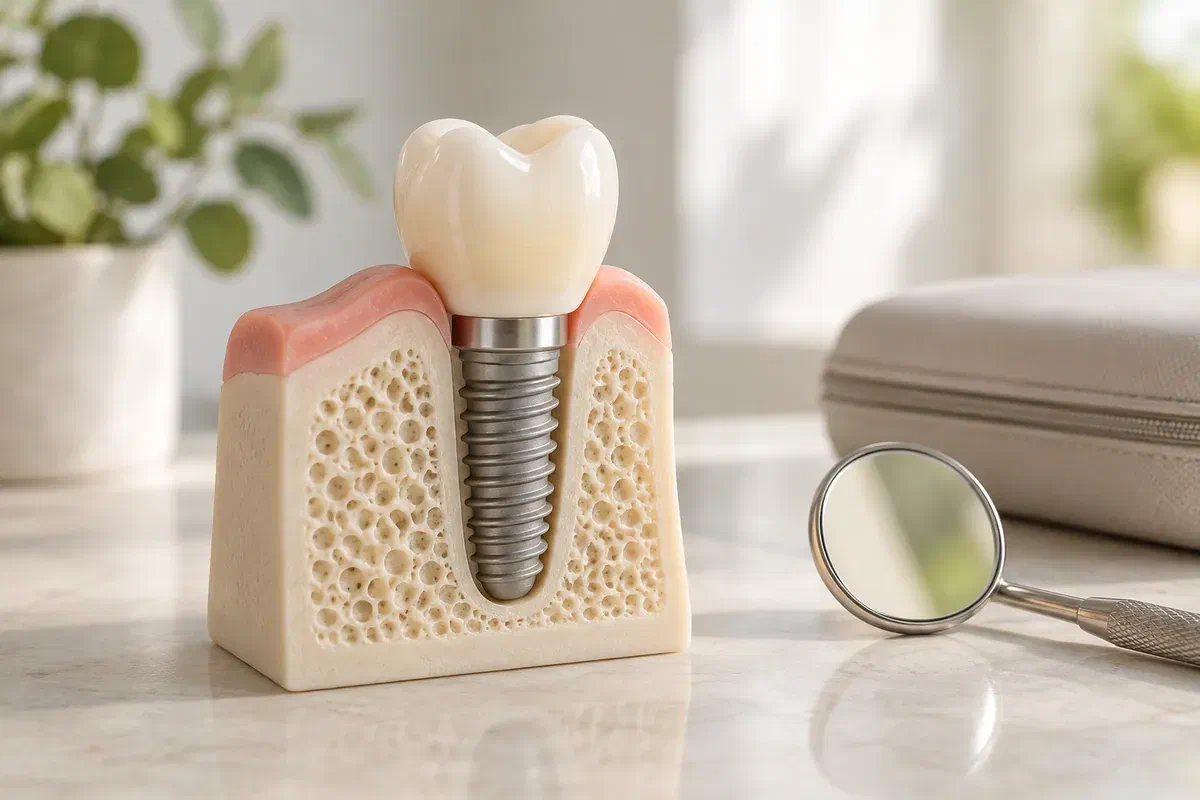
Illustrative model of a dental implant and attached crown within a bone-and-gum cross-section
What has changed?

Pay attention to the pattern, not the wiggle.

Where you feel it, when it began, and whether it is getting worse are the details we listen for. A snapshot can be handy for the record, but it says nothing reliable about the post or the bone that holds it.

A crown or bridge that has lifted or tilted

Note whether the shift came on overnight, after biting something firm, or gradually. Resist pressing it with a finger or clenching to see if it drops back. Only an examination can show whether the restoration, the connection, or the implant is responsible.

Tender, bleeding or swollen gum

Think back to when the gum first felt different and whether a bad taste or discharge appeared. The tissue that wraps around an implant can become inflamed, and that may affect its foundation. We judge that by examining the gum and, where needed, taking images, rather than by the crown’s appearance.

Something came loose, or you took a hit

Keep a piece that has fallen out in a clean, closed container and bring it to the appointment. Tell us about any knock, fall or recent dental treatment. Pushing it back, turning a screw or using a household adhesive can complicate the repair.

Cavities are not a risk for the implant itself. Disease in the gum and bone around it, and wear or loosening in the parts attached to it, can still happen at any stage, so a fresh symptom should not be brushed aside.

Why it pays to come in early

Sort the now from the later.

Coming in early means the team can identify what has to be addressed today and what depends on information not yet in hand. It is fair to ask whether the area can be steadied or soothed during the visit, and whether a lasting repair hinges on records, a specific part, lab work or a referral. Each of those deserves its own clear answer.

Once the cause is pinned down, more than one sound approach may be on the table. The plan should take the implant, the crown, the gum and your other teeth into account, along with habits such as clenching. A fast adjustment that is never explained can leave you unsure why it happened or what to watch for.

Knowing where the problem sits

Ask for the crown, abutment and implant to be described in simple terms, and which one is involved. That context makes the suggested treatment easier to weigh, and it prevents a loosened crown from being read as the end of the implant.

Records that point the way

Information such as the system used, when it went in, earlier X-rays and lab details can help the treating clinician. Ask how these can be obtained with your consent. If you have none, mention that, but still call about a symptom that seems urgent.

Coordination with other providers

Some repairs require matching parts, technical information or a specialist. Ask who will set up that step and what to do in the meantime. A clear plan for what comes next is worth more than a phone number on a card.

The usual sequence

Call, check, choose, and confirm the follow-up

What can be finished at the first visit depends on the findings and on having the right components and expertise. It is wise not to expect every implant problem to be resolved in one sitting.

  1. Your account of the change

    Describe the symptoms, when they started, and anything that may have triggered them, such as a knock or a recent procedure. Name the provider if you know it, and mention any piece that came off. Tell us about medical conditions and medicines so the visit can be planned properly.

  2. A look at the restoration and the gum

    The clinician examines the area, checks your bite, and considers whether images or older records are needed. Ask which findings explain your symptoms and whether anything is still unknown. Tissue health counts as much as how firmly the crown sits.

  3. Options for today and beyond

    Go over what can sensibly be done at the visit and any limits. Ask about the recommended repair, alternatives and estimated fees. If a part needs to be identified or ordered, find out how to protect the area until then.

  4. Next steps, agreed in writing

    Before you head out, confirm who handles the next stage and how to reach them. Ask which symptoms should bring you back sooner. Keep copies of the records so future care starts with an accurate history.

In the days that follow

Protect the site and keep us posted.

Advice is different for a loose crown, an irritated gum, a healing component, or an implant-retained denture. Ask for guidance that reflects the actual finding, not a generic list.

Let the clinic do the fixing

Do not use tools, glue or repeated biting to hold the restoration in place. Follow the advice about chewing and about wearing any removable appliance. If it loosens again after treatment, call and describe it rather than trying to repeat the repair.

Keep pieces safe and records handy

Store anything that came off in a clean container and do not put it back in your mouth. Bring it and any paperwork to the visit. Knowing when it separated can help explain the cause, even if that component cannot be used again.

Stay with the cleaning and review schedule

Brushing and flossing still matter, though the technique may need to change for a while. Find out which brush or floss suits the treated tooth or a temporary setup, and tell us if soreness gets in the way. After the urgent part is settled, agree on a recall schedule and on who keeps an eye on the implant from here.

Patient information: Guy's and St Thomas' — swallowed or inhaled dental objects

Paths after the diagnosis

Mechanical repair, tissue care, or a wider review

By the end of the assessment you should know which parts are sound, which could be mended or swapped, and which questions remain open. Weigh the implications of each route before you commit.

When the restoration or its connection is the cause

Repairing the crown, bridge or abutment

A loose or damaged restoration may be repaired, given a replacement part, or remade. The right approach depends on its design and condition. Ask whether the reason for the loosening, such as grinding, has been identified and whether lab work or extra visits are needed.

When gum or bone changes are found

Treating inflammation around the implant

Ask what the examination and images show, what treatment is advised, and how the response will be checked. Treatment may go well beyond cleaning the crown. The plan should be candid about the extent of the problem and avoid promising that every implant can be kept.

When the picture is complex or uncertain

Specialist input or a broader plan

More assessment may be needed before repair is decided. Ask what the referral should clarify and what interim care to follow. If removal is discussed, replacement options and timing should be planned around you rather than assumed.

Burlington implant FAQs

Answers for when something feels off

An unexpected change after a long stretch of comfort can be unsettling. These answers help you prepare for the appointment without predicting the result before an examination.

(905) 876-4488
Can grinding my teeth at night loosen an implant crown?
Heavy clenching or grinding can place extra stress on an implant restoration and its parts. Mention any grinding habit when you call. The clinician can check the restoration and discuss whether a night guard or bite adjustment is worth considering.
My bite suddenly feels uneven around my implant. What should I do?
Avoid chewing hard foods on that side and call to describe the change. An uneven bite can be a sign that something has shifted. An examination is needed to find out whether the crown, its connection or something else is responsible.
Is it normal to hear a click from an implant tooth?
A new click is not something to ignore. It can point to a loose crown or connecting part. Leave it alone and arrange a prompt assessment so the source can be identified.
I have a bridge on two implants and one end feels loose. Is it urgent?
It is worth a prompt call. Movement at one end can place extra load on the rest of the bridge. Avoid biting on it, and bring any records about the bridge and implants to the visit.
Can the gum around an implant get infected if the tooth cannot decay?
Yes. The gum and bone around an implant can become inflamed and diseased. Tell us about bleeding, soreness, discharge or swelling. A crown that looks normal does not confirm that the support beneath it is healthy.
How many visits does an implant repair usually take?
It varies. Some problems can be managed in one visit, while others need parts ordered, lab work or a referral first. Ask the clinician to explain each stage and roughly how it will be scheduled.
Implant care for Burlington

Before you chew on it, call.

A crown that has lifted, gum that has puffed up, or a part sitting in your palm are all reasons to ring our Bronte Street practice. We will go over timing and what paperwork helps. When care cannot wait and we are unreachable, turn to another emergency provider who is open.

Online requests are not for emergencies. Availability, component compatibility, referrals, fees and whether an implant can be kept all depend on assessment.

Visit Milton Dental Clinic
Unit 1, 342 Bronte St. S, Milton, ON L9T 5B7
Get directions Clinic hours
Monday–Thursday
11am–7pm
Friday–Sunday
By appointment only

Areas we serve

  • Milton
  • Oakville
  • Mississauga
  • Georgetown
  • Halton Hills
  • Acton
  • Campbellville
  • Brampton
  • Burlington
  • Puslinch
  • Rockwood
  • Erin
  • Caledon
  • Etobicoke
  • Old Milton
  • Bronte Meadows
  • Timberlea
  • Dorset Park
  • Dempsey
  • Clarke
  • Beaty
  • Coates
  • Harrison
  • Scott
  • Willmott
  • Ford
  • Bowes
  • Cobden
  • Walker
  • Mountain View
  • Milton Heights
  • Hawthorne Village
  • Valley View
  • Fallingbrook
  • Nassagaweya
  • Trafalgar
  • Esquesing
  • Nelson
  • Brookville
  • Moffat
  • Glen Williams
  • Norval
  • Limehouse
  • Stewarttown
  • Ashgrove
  • Hornby
  • Silver Creek
  • Speyside
  • Scotch Block
  • North Oakville
  • River Oaks
  • Glen Abbey
  • West Oak Trails
  • Palermo
  • Bronte Creek
  • College Park
  • Joshua Creek
  • Uptown Core
  • Preserve
  • Iroquois Ridge
  • Lisgar
  • Meadowvale
  • Meadowvale Village
  • Churchill Meadows
  • Erin Mills
  • Central Erin Mills
  • Streetsville
  • East Credit
  • Creditview
  • Heartland
  • Sheridan
  • Mount Pleasant
  • Credit Valley
  • Huttonville
  • Churchville
  • Springbrook
  • Northwest Brampton
  • Bram West
  • Fletcher's Meadow
  • Fletcher's Creek South
  • Alton Village
  • Orchard
  • Millcroft
  • Headon Forest
  • Tansley
  • Brant Hills
  • Tyandaga
  • Kilbride
  • Lowville
  • Aberfoyle
  • Morriston
  • Arkell
  • Hillsburgh
  • Freelton
  • Carlisle
  • Waterdown
  • Flamborough
  • Mountsberg

How can we help?

Milton Dental Clinic

Have a question about your smile? Choose the option that works best for you.

For urgent dental concerns, please call.
Messages are reviewed during clinic hours.