

Illustrative patient discussing an implant concern with a clinician and dental model
Specialized Care

Dental Implant Emergencies in Milton

When an implant crown shifts at dinner, a screw cap drops out, or the gum beside an implant turns sore and puffy, call us before you try anything at home. Our Milton team can talk through what changed, when we can see you, and which records are worth bringing.

A sudden change in a familiar tooth

A wobble at the dinner table is a reason to call, not a verdict on the implant.

Most people notice an implant problem in an ordinary moment: biting into toast, flossing, or hearing a strange click. The tooth you can see is only the top layer of a system that also includes a connecting piece and the post in bone. A loose crown, a worn connection, sore gums and an injury each need different care, and only an examination can tell which one you have.

When you phone, it helps to say what kind of restoration you have: one crown, a bridge on implants, or a denture that clips onto them. Then describe the change itself, such as movement, an ache, puffiness, or teeth that suddenly meet differently. Nobody expects you to know the implant brand, but set aside any placement paperwork.

For Milton households, the simplest step is to call our clinic as soon as you notice something new and ask how soon an assessment is possible. If a different dentist or surgeon placed or restored the implant, let us know and gather what records you can. We can settle the pressing problem first and then work out together if the clinic that did the work, or a specialist, ought to weigh in.

Ask about an implant assessment
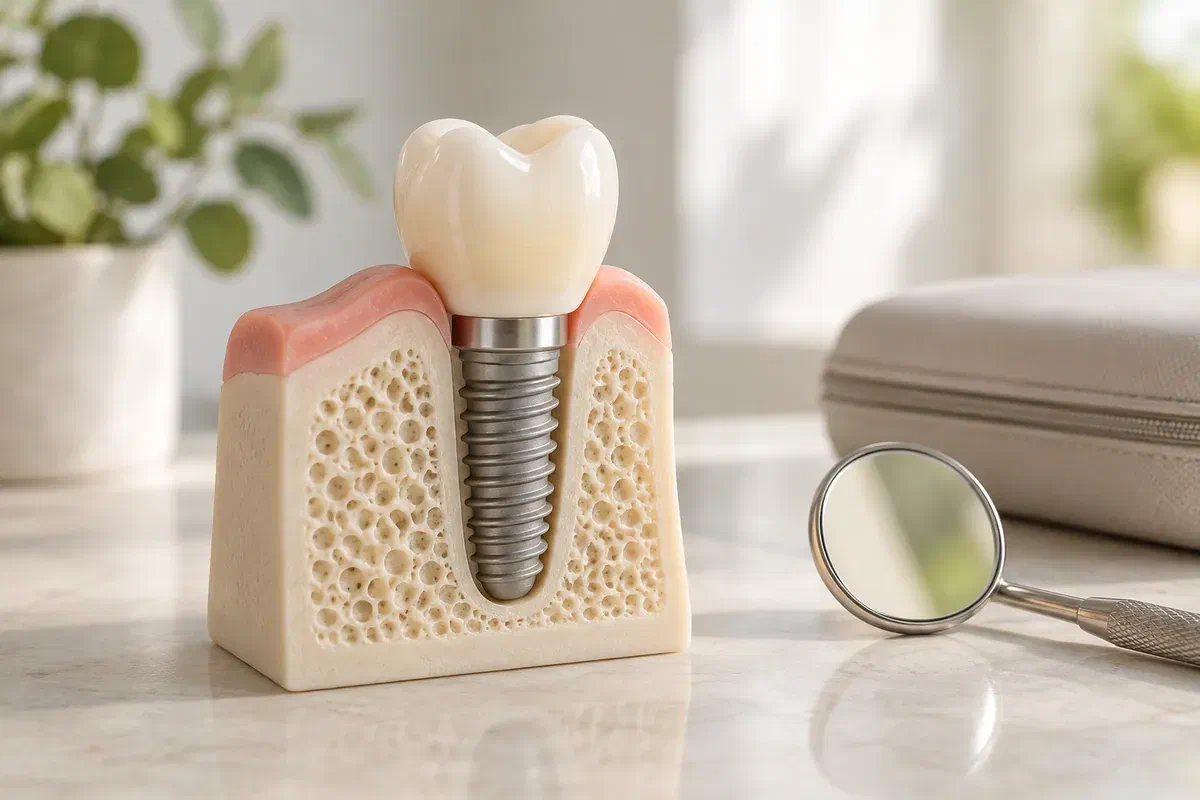
Illustrative model of a dental implant and attached crown within a bone-and-gum cross-section
What to report when you call

Tell us what you see and feel, then leave the implant alone.

Where the change is, when it started and what it feels like all shape the first conversation. A phone photo can add useful history, but it cannot show the state of the implant or the bone and gum holding it.

Movement in a crown or bridge

Say whether the shift appeared all at once, after a hard bite, or has crept up over weeks. Try not to push it with your tongue or chew on that side to see if it settles. The clinician has to work out whether the restoration, its connection, or the implant itself is moving.

Gum soreness, bleeding or puffiness

Note when the gum began to change and whether you have tasted something unpleasant or seen discharge. Tissues around an implant can become inflamed, and that can affect the support underneath. The assessment looks at the gum and any needed images, not just at how the crown appears.

A piece that came off, or a knock to the mouth

If a cap, screw or crown has already come away, place it in a clean container and bring it along. Mention any fall, sports knock, or recent dental work. Please do not press the piece back in, turn a screw yourself, or reach for household glue.

Implants do not get cavities, but the gum and bone around them can develop disease, and the parts on top can wear or loosen. A new symptom is worth reporting even if the implant has felt normal for a decade.

Why a prompt visit helps

Today’s problem and the lasting repair are two separate questions.

A good first appointment sorts out what needs attention right away and what still has to be learned before a lasting repair. Ask whether the area can be made comfortable or secure that day, and whether the final fix depends on records, specific parts, lab work or a referral. Those steps deserve their own explanation.

Once the cause is clear, there may be more than one sensible way forward. The plan should weigh the implant, the restoration, the gums and the neighbouring teeth together. A fast tweak with no explanation can leave you guessing about why it happened and what you should keep an eye on.

Knowing which part is involved

Ask the clinician to show the difference between the crown you see, the piece that connects it, and the implant beneath. That makes any proposed treatment easier to follow, and it keeps a simple loose crown from being mistaken for an implant that has been lost.

Records that guide the right care

Details such as the implant system, the year it was placed, older X-rays and restoration notes can help whoever treats it. Ask how records can be requested with your permission. If paperwork is missing, mention that on the phone, but do not let it delay a call about an urgent change.

A proper handover when someone else is needed

Some problems call for particular parts, technical details from the manufacturer, or a specialist opinion. Ask who will set up the next step and how to look after the area until then. A clear handover beats walking out with only a phone number to try.

What happens after you phone

Four steps from first call to a clear repair plan

How much can be done at the first visit depends on what is found and whether suitable parts and expertise are available. Not every implant emergency is fully resolved in one appointment.

  1. Describe the change and your restoration

    Share the symptoms, when they began, and any knock or recent dental visit. Tell us who placed the implant if you know, and mention any piece that has come out. Let us know about health conditions and medicines so the visit can be planned safely.

  2. Look closely at the crown and the gum

    The clinician examines the area and decides whether images or other records are needed. Ask which findings explain what you are feeling and whether more information is still required. Gum and bone health matter as much as how firm the visible restoration is.

  3. Talk through short-term care and lasting options

    Ask what can be sorted on the spot and what cannot. Request an outline of the suggested repair, alternatives, and a fee estimate. If a component must be tracked down, get advice on protecting the tooth until it arrives.

  4. Agree on who handles the next stage

    You should walk out knowing whose job the next step is and which number to ring. Find out what would justify calling ahead of that date. Keep copies of helpful records so any future maintenance or urgent visit starts with accurate history.

Looking after the area in between

Follow the advice for your restoration, and call if it moves again.

What you should do at home depends on the finding: a crown that worked free, sore gum, a part still settling in, or a clip-on implant denture. Ask for instructions that fit what was actually found rather than general advice for every implant.

No home fixes, no testing

Skip tools, adhesives and repeated biting meant to hold the restoration in place. Use the area and any removable appliance only as the clinician suggests. If it loosens again after treatment, call and describe what happened rather than trying to redo the repair.

Hold on to loose pieces and paperwork

Keep any detached part in a clean container and do not put it back in your mouth. Bring it with whatever records you have. Knowing when it separated can help explain what went wrong, even if that particular component cannot be reused.

Stick with the cleaning and review plan

Ask how to clean safely around the affected restoration or any temporary setup. Tell us if discomfort stops you from following the routine. Once the urgent issue is settled, confirm the maintenance schedule and who will monitor the implant and the tissue around it.

Patient information: Guy's and St Thomas' — swallowed or inhaled dental objects

Matching treatment to the cause

Is it the tooth on top or the support underneath?

Expect a frank account of what is worth keeping, what needs mending or a substitute, and what is still unclear, before you sign on to a final plan.

When the crown or its connection is the issue

Fixing or replacing a restorative part

A damaged or loose restoration may need a professional repair, a replacement part, or a new crown. The right choice depends on how it was designed and its current condition. Ask whether the reason it loosened has been found and whether extra visits or lab work are involved.

When inflammation or lost support is found

Caring for the tissue around the implant

Ask what the gum check and images show, what treatment is suggested, and how healing will be reviewed. It may take more than cleaning the visible crown. The plan should describe the extent of the problem without promising that every implant can be saved.

When the case is complex or the implant’s future is unclear

Specialist input or a wider replacement plan

More assessment may be needed before deciding whether a repair makes sense. Ask what a referral will answer and what care is suggested while you wait. If removal comes up, replacement options and timing should be planned for you individually, not assumed ahead of time.

Questions from Milton households

Common worries about a sudden implant problem

A change after years of comfortable use can be unsettling. These answers help you prepare for the visit without guessing at the outcome before anyone has examined the implant.

(905) 876-4488
My implant tooth clicks when I chew. Does that mean the post is failing?
Not always. A click can come from the crown, the connecting piece, or something else entirely. Stop chewing on that side where you can, avoid testing it, and call for an assessment. The clinician needs to find the source before discussing repair or other treatment.
Is it safe to keep eating normally until my appointment?
Favour the other side and choose softer foods if the restoration feels loose or sore. Avoid biting directly on it to check whether it has settled. Ask the team on the phone whether there is anything specific to avoid for your type of restoration.
Can I be seen for an implant that was placed somewhere else?
Yes, you can call to discuss it and ask about availability. Tell us where and roughly when it was placed, and bring any records. Care may need to be coordinated with the original clinician, especially if specific system details or parts are required.
Should I take a photo of the problem before I call?
A photo can help you describe what you noticed, and you are welcome to mention it. It cannot show what is happening under the gum or at the connection, though, so it does not replace an examination.
Why would my gum swell around an implant if it cannot get a cavity?
The tissue around an implant can still become inflamed or diseased. Report bleeding, tenderness, discharge or swelling and arrange to be seen. A crown that looks fine does not confirm that the gum and supporting bone are healthy.
Will the whole problem be fixed in one emergency visit?
Not necessarily. What is possible depends on the findings, the implant system, parts on hand, and how complex the issue is. Ask what can be done right away and what needs another visit, lab work or referral.
Implant concerns in Milton

Pick up the phone before you pick up any tools.

Whether it aches, moves, swells or has shed a piece, our Bronte Street practice would rather hear about it early. We will find you a time and suggest which records to bring. If you need immediate care and cannot reach us, go to another available emergency provider.

Online requests are not monitored for urgent needs. Timing, matching parts, any referral, cost, and the long-term future of the implant can only be judged once it has been examined.

Visit Milton Dental Clinic
Unit 1, 342 Bronte St. S, Milton, ON L9T 5B7
Get directions Clinic hours
Monday–Thursday
11am–7pm
Friday–Sunday
By appointment only

Areas we serve

  • Milton
  • Oakville
  • Mississauga
  • Georgetown
  • Halton Hills
  • Acton
  • Campbellville
  • Brampton
  • Burlington
  • Puslinch
  • Rockwood
  • Erin
  • Caledon
  • Etobicoke
  • Old Milton
  • Bronte Meadows
  • Timberlea
  • Dorset Park
  • Dempsey
  • Clarke
  • Beaty
  • Coates
  • Harrison
  • Scott
  • Willmott
  • Ford
  • Bowes
  • Cobden
  • Walker
  • Mountain View
  • Milton Heights
  • Hawthorne Village
  • Valley View
  • Fallingbrook
  • Nassagaweya
  • Trafalgar
  • Esquesing
  • Nelson
  • Brookville
  • Moffat
  • Glen Williams
  • Norval
  • Limehouse
  • Stewarttown
  • Ashgrove
  • Hornby
  • Silver Creek
  • Speyside
  • Scotch Block
  • North Oakville
  • River Oaks
  • Glen Abbey
  • West Oak Trails
  • Palermo
  • Bronte Creek
  • College Park
  • Joshua Creek
  • Uptown Core
  • Preserve
  • Iroquois Ridge
  • Lisgar
  • Meadowvale
  • Meadowvale Village
  • Churchill Meadows
  • Erin Mills
  • Central Erin Mills
  • Streetsville
  • East Credit
  • Creditview
  • Heartland
  • Sheridan
  • Mount Pleasant
  • Credit Valley
  • Huttonville
  • Churchville
  • Springbrook
  • Northwest Brampton
  • Bram West
  • Fletcher's Meadow
  • Fletcher's Creek South
  • Alton Village
  • Orchard
  • Millcroft
  • Headon Forest
  • Tansley
  • Brant Hills
  • Tyandaga
  • Kilbride
  • Lowville
  • Aberfoyle
  • Morriston
  • Arkell
  • Hillsburgh
  • Freelton
  • Carlisle
  • Waterdown
  • Flamborough
  • Mountsberg

How can we help?

Milton Dental Clinic

Have a question about your smile? Choose the option that works best for you.

For urgent dental concerns, please call.
Messages are reviewed during clinic hours.