

Illustrative patient and clinician discussing a tooth model before endodontic care
Specialized Care

Emergency Root Canal Treatment in Milton

A tooth that throbbed through the night still needs a diagnosis before anyone settles on a root canal. Our Milton team can look for the source of the pain, talk honestly about keeping the tooth, and set out each stage needed to finish and protect it.

When a tooth keeps you up at night

Find out what is behind the pain before the treatment is chosen.

A toothache that wakes you at 3 a.m. can feel like proof that something serious is wrong, yet the pain on its own does not tell anyone what that something is. Emergency root canal care comes into the picture when the examination shows trouble in the pulp, the soft tissue at the core of the tooth, and keeping that tooth looks reasonable.

Getting to that answer takes an examination, suitable tests and often an image, along with a judgement about whether the tooth can carry a lasting restoration. The treatment itself manages the affected tissue, then cleans, shapes, fills and seals the canals. An urgent visit frequently covers only the opening part, and the restoration that lets you chew on that side again is planned as well.

When you phone our Milton office, describe how the pain began and mention fillings, crowns, knocks or earlier root canal work on that tooth. That gives us enough to discuss a sensible next step, including whether care here or a referral fits better. Two sore teeth can need quite different things.

Ask about a painful-tooth assessment
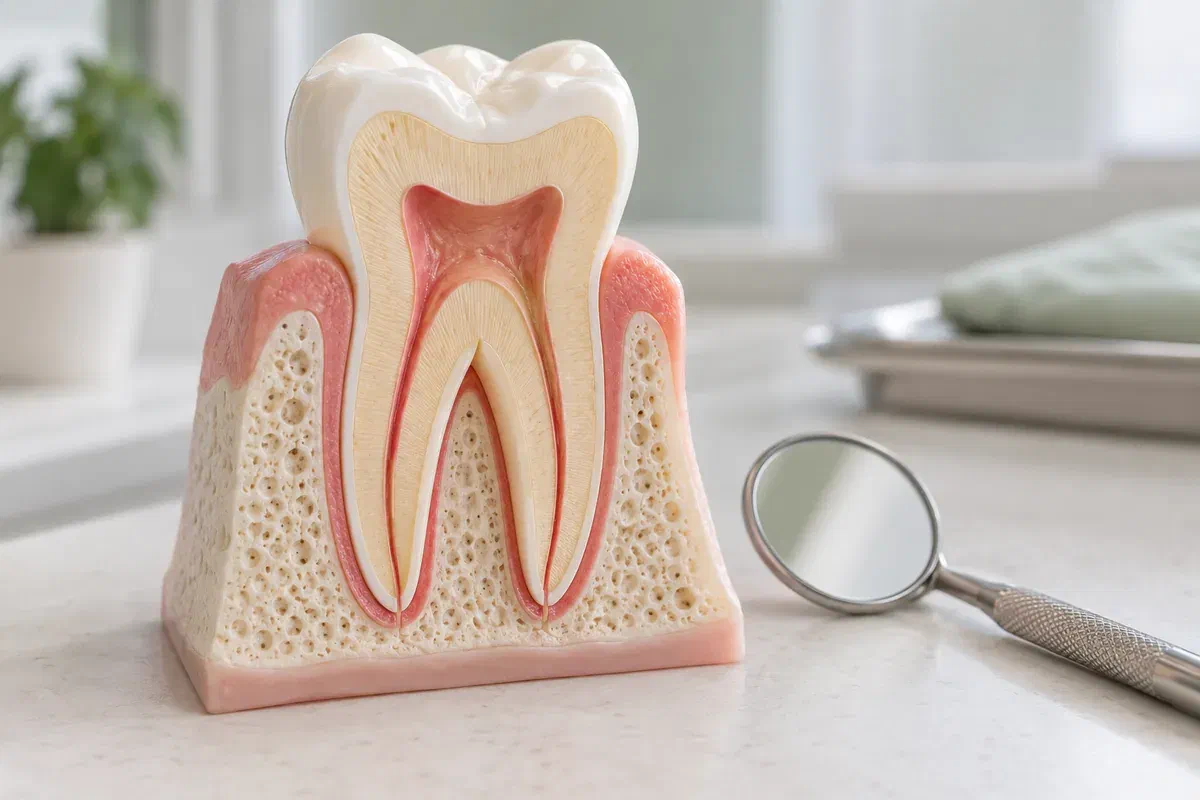
Illustrative physical molar cross-section showing the pulp chamber and root canals
Notes worth making before you call

Small details about the pain decide what gets checked first.

Write down what you notice rather than poking at the tooth to see if it still hurts. Your notes sit beside the examination findings, so they don't have to settle the question by themselves.

An ache that hangs on or arrives out of nowhere

Say whether pain lingers once a hot or cold drink is finished, starts while you are resting, or breaks your sleep. Note the day the pattern shifted and whether pain relief from the pharmacy made any difference. That timeline helps the clinician pick the right tests and judge how soon you should be seen.

Tenderness on biting, puffiness or a gum change

Mention it if your teeth meet differently on that side, or if you see swelling, a small bump on the gum or discharge. A fever or feeling run down is relevant as well. The dentist looks at the tooth together with the tissue around it instead of reading too much into one sign.

Old dental work or a past knock

List fillings, crowns and any recent chip, even one that caused no pain when it happened. If another office began or completed a root canal on this tooth, bring whatever records you have. A tooth treated before can call for a different line of questioning than one that never has been.

Phone promptly about a tooth that is painful or swollen. Trouble breathing or swallowing, swelling that is spreading quickly, or swelling that reaches the eye needs hospital emergency care right away; call 911 if you need emergency help.

What a sound urgent plan answers

Calm the cause, then spell out what is left to do.

You are looking for treatment that fits the diagnosis and a frank talk about the odds of keeping your own tooth. It is reasonable to ask how the findings lead to root canal care, and whether a crack, thin remaining walls or weakened support change the outlook. A good recommendation weighs the whole tooth, not only the inflamed tissue in its centre.

Planning should also draw a line between this week's urgent step and the work that completes it. Leave knowing who handles each stage, when you are due back and what the estimate covers. Relief after the first appointment is welcome, but it shouldn't leave you unsure whether canal work or a final restoration is still waiting.

Patient information: American Association of Endodontists — management of endodontic emergencies

A stated reason for saving the tooth

Ask what makes this tooth a fair candidate and what could stand in the way of a lasting result. The dentist can say whether more assessment should come before a firm recommendation. Keeping a tooth is a choice to weigh carefully, never an outcome anyone can promise ahead of time.

Comfort talked through first

Tell the team if freezing has been slow to work for you before, if appointments make you anxious, or if you have medical conditions. Ask how local anaesthetic and other suitable measures will be used and how to signal for a break. Raising a hand mid-procedure is expected, not an inconvenience.

A plain account of today's step

Depending on the findings, urgent care might treat part of the pulp space or all of it. Ask exactly what this visit includes and what remains for later. Any first-stage treatment should link to a clear plan for completion or review.

How the visits unfold

Diagnose, handle the urgent stage, and guard the tooth until it is finished.

The number of appointments and their length depend on the tooth, what the dentist finds and whether a specialist joins in. Ask to see the full sequence instead of assuming a single urgent booking takes care of everything.

  1. History, examination and testing

    Your symptoms are reviewed, the area is examined, and suitable tests and images are taken. Ask whether a firm diagnosis has been reached and whether the tooth can hold a final restoration. Talk through anything still unclear before deciding between keeping the tooth and the alternatives.

  2. Agreement on the plan and the setup

    You go over the procedure, other options, its limits and the estimate. Local anaesthetic and a dental dam are used as appropriate; the dam is a thin sheet that keeps the working tooth isolated. Mention any worries now so the setup and the way you'll communicate are clear before work starts.

  3. The endodontic stage

    The clinician reaches and treats the pulp space that needs attention. Cleaning, shaping and filling might be finished in this sitting or carried over, depending on the plan. Before you leave, find out what was done and whether a temporary seal or other interim measure is in place.

  4. Completion and the lasting restoration

    Confirm who will finish any remaining canal work and who will place the restoration. Ask how to protect the tooth meanwhile and how soon to book. When an endodontist shares the care, check how records move between offices and which appointment comes first.

The stretch between appointments

Look after the temporary seal and come back for the rest.

Follow the instructions given for the stage you had done. Ask which sensations are normal while things settle and which changes mean you should call rather than wait for your next booking.

Go gently on the treated side

Let the numbness wear off before eating, and avoid hard chewing on a tooth that is not yet fully restored. Ask how to brush and clean around it. A pain-free morning is not the time to try crusty bread, nuts or toffee against that temporary filling.

Call about changes in the seal, bite or symptoms

Reach the treating clinician if the temporary filling falls out, your bite feels high or uneven, swelling develops, or strong pain lingers or returns. Say which stage was done and on what date. These changes may need a look even when a follow-up is already on the calendar.

Keep each remaining appointment

Confirm the suggested timing and book the visits needed to complete the plan. Ask whether the final restoration is part of the estimate or quoted separately. Work inside the tooth and the restoration over it depend on each other, so neither should be left vague.

Patient information: American Association of Endodontists — care after treatment and reasons to call · American Dental Association — antibiotic decisions for pulpal and periapical pain

Weighing the routes for the tooth

A root canal is one possibility, not the automatic answer.

For each reasonable option, ask what it means for the tooth, the number of visits and the restoration at the end. Urgent pain calls for a quick explanation, not a rushed decision.

When keeping the tooth makes sense

Endodontic treatment followed by restoration

This route can include an urgent stage, completion of the canals, and then a crown or another suitable restoration. Ask why that order is advised and what might affect how well it works. The final restoration is chosen to suit this particular tooth rather than by a fixed rule.

When the diagnosis or the anatomy is complicated

A specialist opinion or another way to preserve the tooth

An unclear diagnosis, earlier treatment, unusual root shapes or other findings can justify a referral. Ask what question the specialist is being asked to answer and what care you need while you wait. A referral should widen your understanding, not signal that the result is already decided.

When the tooth can't reasonably be kept

Removal, with replacement discussed separately

If the tooth cannot be restored, or something else makes keeping it unwise, extraction may come up. Ask for the reasons and the alternatives. Any replacement can then be planned around the rest of your mouth, healing time, timing and your own preferences.

Questions from Milton

What people ask after a rough night with a sore tooth.

Bring your questions about why a treatment is suggested and which stages it covers. The appointment should pin down the diagnosis and lay out the path from urgent relief to a finished tooth.

(905) 876-4488
My tooth hurt all night but feels calmer this morning. Should I still call?
Yes. Pain that eases can still point to a problem inside the tooth, and a quieter spell does not mean the cause has gone. Call to describe the night and let the team decide how soon the tooth should be examined.
Does a bad toothache always end in a root canal?
No. Gum problems, a cracked tooth, a sinus issue or a worn filling can all hurt a great deal. The history, examination and appropriate tests show what is going on. Ask how the findings support whatever is recommended for your tooth.
Why take an X-ray when I can already point to the sore tooth?
Pain can be felt in a different tooth from the one causing it, and the image shows structures the eye cannot. It helps the dentist look at the roots and surrounding bone before choosing a treatment. Ask what the image showed and how it shaped the plan.
Is some tenderness normal for a few days after the first stage?
Mild soreness when biting is common for a short time, and the team will explain what to expect for the stage you had. Call if pain grows stronger, swelling appears or the bite feels uneven, rather than waiting it out.
What should I bring to an urgent root canal assessment?
Bring a list of medicines, any relevant medical conditions and details of earlier work on the tooth, especially records from another office. Note when the symptoms began and what has helped. This lets the visit focus on the tooth rather than on piecing together history.
Once the canals are sealed, is the tooth finished?
Not usually. The tooth still needs a proper seal and protection for everyday chewing, often a crown or another restoration chosen for its remaining structure. Ask who will place it, when it should be done and whether the estimate includes it.
Urgent tooth pain in Milton

Start with a call about the tooth that hurts.

Phone our Bronte Street practice to describe the pain and ask about current assessment availability. We can go over the concern, explain the realistic options, and talk through whether treatment or a referral is the better route. If you need immediate care and can't reach us, contact another available emergency provider.

Online requests are non-urgent. Diagnosis, whether the tooth is suitable, treatment stages, the restoration, referral, fees and appointment availability all depend on assessment. Keeping the tooth, or finishing care in a single visit, cannot be guaranteed.

Visit Milton Dental Clinic
Unit 1, 342 Bronte St. S, Milton, ON L9T 5B7
Get directions Clinic hours
Monday–Thursday
11am–7pm
Friday–Sunday
By appointment only

Areas we serve

  • Milton
  • Oakville
  • Mississauga
  • Georgetown
  • Halton Hills
  • Acton
  • Campbellville
  • Brampton
  • Burlington
  • Puslinch
  • Rockwood
  • Erin
  • Caledon
  • Etobicoke
  • Old Milton
  • Bronte Meadows
  • Timberlea
  • Dorset Park
  • Dempsey
  • Clarke
  • Beaty
  • Coates
  • Harrison
  • Scott
  • Willmott
  • Ford
  • Bowes
  • Cobden
  • Walker
  • Mountain View
  • Milton Heights
  • Hawthorne Village
  • Valley View
  • Fallingbrook
  • Nassagaweya
  • Trafalgar
  • Esquesing
  • Nelson
  • Brookville
  • Moffat
  • Glen Williams
  • Norval
  • Limehouse
  • Stewarttown
  • Ashgrove
  • Hornby
  • Silver Creek
  • Speyside
  • Scotch Block
  • North Oakville
  • River Oaks
  • Glen Abbey
  • West Oak Trails
  • Palermo
  • Bronte Creek
  • College Park
  • Joshua Creek
  • Uptown Core
  • Preserve
  • Iroquois Ridge
  • Lisgar
  • Meadowvale
  • Meadowvale Village
  • Churchill Meadows
  • Erin Mills
  • Central Erin Mills
  • Streetsville
  • East Credit
  • Creditview
  • Heartland
  • Sheridan
  • Mount Pleasant
  • Credit Valley
  • Huttonville
  • Churchville
  • Springbrook
  • Northwest Brampton
  • Bram West
  • Fletcher's Meadow
  • Fletcher's Creek South
  • Alton Village
  • Orchard
  • Millcroft
  • Headon Forest
  • Tansley
  • Brant Hills
  • Tyandaga
  • Kilbride
  • Lowville
  • Aberfoyle
  • Morriston
  • Arkell
  • Hillsburgh
  • Freelton
  • Carlisle
  • Waterdown
  • Flamborough
  • Mountsberg

How can we help?

Milton Dental Clinic

Have a question about your smile? Choose the option that works best for you.

For urgent dental concerns, please call.
Messages are reviewed during clinic hours.