

Illustrative patient describing facial discomfort during a consultation
Specialized Care

Facial Muscle Pain Assessment in Acton

Pain on just one side of the face raises an obvious question: is it a tooth, or the muscles around it? From Acton, a facial muscle pain assessment checks both, along with your jaw and history, before anyone settles on an answer or a treatment.

One side, one question, from Acton

Left cheek, right jaw: which part is really hurting?

When discomfort sits on one side only, people tend to reach for the simplest story. Maybe a back tooth is going bad. Maybe you sleep on that side, or chew there more. Each idea is plausible, and each can be wrong. A cheek that aches near the jaw can be dental, muscular, both at once, or neither.

So the assessment looks in more than one direction. The dentist examines the teeth and gums on the sore side and the other, watches how the jaw opens and moves, feels the chewing muscles for tenderness and takes a careful history. Nerve-related and other medical causes can produce one-sided facial pain too, and noticing those is part of the job.

Before you head over from Acton, think about when that side hurts, whether biting or temperature sets it off, and how long it lasts. Mention anything you have tried, from switching sides when chewing to medication. We will explain what the examination supports and what it leaves undecided, and point you toward the next useful question.

Have one-sided pain checked
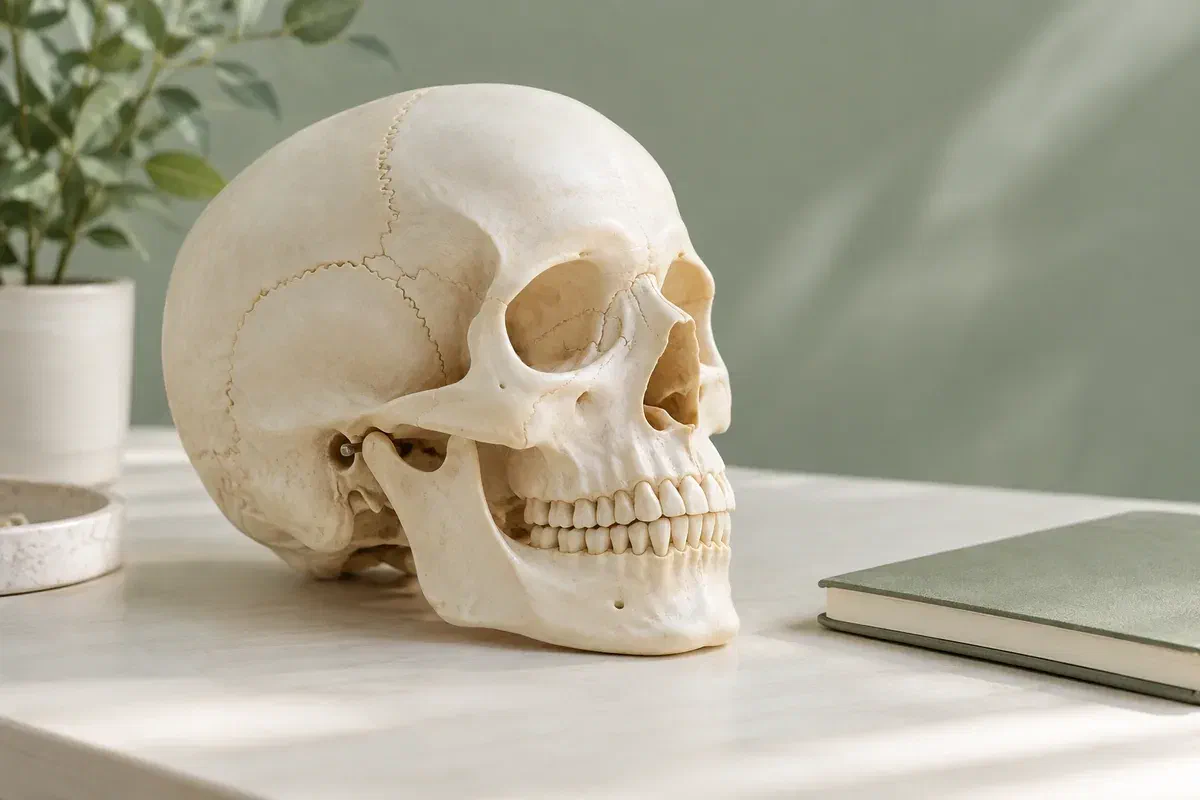
Illustrative anatomical skull teaching model with its jaw attached beside a notebook
Clues that separate tooth from muscle

Small details can tip the balance

Rather than tapping or biting on the sore side to see what happens, recall the last few times it bothered you. Everyday episodes are more telling than anything you provoke, and symptoms are often quieter during the appointment itself.

When and how often that side hurts

Does it start on waking, after meals, or later in the day? Does it ever switch sides or spread to both? Note how long a typical episode lasts. These details sharpen the questions, though no single pattern confirms which structure is responsible.

Biting, temperature and jaw movement

Say whether one tooth hurts on biting, lingers after cold or heat, or feels tall. Mention painful opening, catching, locking or a click on that side. Recent fillings, crowns or an injury are important. Together they show whether the examination should focus beyond the muscles.

What has helped, what has not

List any guard, exercises, medicines, physiotherapy or earlier assessments, plus what effect each had. If chewing on the other side or avoiding certain foods changed things, that is useful to hear. Other pain conditions and medical history may also be relevant to one-sided pain.

One-sided facial or jaw pain is not automatically a temporomandibular disorder, nor automatically a tooth problem. Other explanations may need to be looked at before a dental or muscle-focused plan is chosen.

Why checking both matters

Treat the right structure, not just the sore side

With one-sided pain, the risk is fixing whatever is closest. A careful assessment is designed to understand the problem first. Ask which findings point toward a tooth, which toward the muscles or jaw, and which toward something else. A clear explanation of what is still uncertain is better than starting treatment on a guess that the examination does not support.

It also helps to say what you want to be able to do again. Perhaps chew evenly on both sides, sleep on your preferred side, or drink something cold without wincing. Using goals like these, a follow-up can judge real change in function and pattern rather than resting on how one muscle feels under the fingers.

Patient information: NIDCR — a graduated approach to temporomandibular disorder care

Teeth and muscles examined in the same visit

The dentist can check the teeth on both sides, the gums, jaw movement and muscle tenderness together. Ask whether a dental finding actually explains the pain or is simply present on the same side. A worn filling or uneven bite is not automatically the cause.

A cautious first plan

If a jaw-muscle problem looks likely, talk through gentle, reversible steps and when they will be reviewed. Know what to try, what to put aside and when to call. Beginning with a more invasive option is not inherently wiser, especially if a tooth has not been ruled in.

The right referral when neither fits

If the pattern suggests a nerve-related or medical cause, a physician or orofacial pain professional may need to be involved. Ask what the referral should answer and what to bring. Coordinated notes help when several providers have considered the same side of the face.

What to expect

Four steps toward the likely source

There is rarely one decisive finding in facial pain, even when it sits on one side. The dentist combines your history with the examination and explains whether more testing should come before treatment.

  1. Talk about the sore side

    Tell us where it is, what it feels like, when it comes and what you are doing at the time. Mention spreading or quick, sharp flashes. A few notes are helpful, yet there is no need to wait for weeks of tracking before getting it looked at.

  2. Cover health and dental history

    We ask about medicines, health conditions, injuries and earlier investigations, as well as recent work on teeth on that side. Bring any appliance and say what it was for. Mention treatment that changed your bite or seemed to worsen things.

  3. Examine teeth, jaw and muscles

    Checks may include specific teeth, jaw opening and movement, and tenderness on each side. Say if anything is uncomfortable. X-rays may be useful to look at a particular tooth or area when they would answer a real question, rather than as a routine.

  4. Explain and plan

    The dentist tells you which explanation fits best so far, what is still unclear, and whether dental treatment, a reversible trial, more investigation or referral is sensible. Agree on a review and on changes that should prompt an earlier call.

Afterward at home

Give the plan time, and leave the sore side alone

Your instructions depend on what was found. Ask for a clear explanation of each recommendation and what to do if it seems to increase the pain.

Note changes on each side

Write down noticeable shifts in comfort, chewing, sleep or jaw movement, and whether the pain stays on one side or wanders. Record anything you try. A few brief entries are more helpful than constant checking. Bring them to your review.

No vigorous self-treatment

Avoid strong stretching, hard repeated massage on the sore side, or exercises copied from someone else’s diagnosis. Ask whether a technique is right for you and how to do it gently. If advice you were given makes it worse, stop and ask for guidance.

Report appliance or medicine issues

If a guard hurts or leaves your bite feeling different for a long stretch, set it aside and contact the clinician who made it. Use medicines as directed and do not change regular prescriptions yourself. Let us know about any practical obstacles so the plan can adapt.

Depending on what we find

Three directions after the examination

Ask why a given approach fits the working diagnosis, and what the alternatives are. Pain near a tooth does not by itself mean the tooth needs treatment.

When the evidence favours a muscle or jaw source

Conservative muscle and jaw care

You may be advised on self-care, temporary changes in chewing, or therapy arranged with another clinician, plus a plan for reviewing progress. Ask for simple, specific steps. A first plan you can actually follow is easier to evaluate than a long list of techniques.

When the source is still uncertain or another cause is possible

More investigation first

Sometimes the findings do not clearly point to a tooth or a muscle, and more dental or medical assessment comes first. Ask what is still unanswered. A referral is useful when it brings in the expertise the question needs, not when it repeats what has been done.

When a proposal would change teeth or bite irreversibly

Restraint with permanent treatment

Permanently adjusting the bite is not routine care for facial muscle pain, and treating a healthy tooth will not fix a muscle problem. Ask about the evidence, risks, alternatives and a possible second opinion before agreeing to grinding, major restorations or surgery.

One-sided pain questions

Tooth, muscle, or something else?

These general answers help you prepare. Where your own pain is coming from can only be worked out in the chair, with your history in hand.

(905) 876-4488
How can a dentist tell whether one-sided pain is a tooth or a muscle?
By combining your description with tests of specific teeth, jaw movement and muscle tenderness, and sometimes an X-ray. No single sign settles it. The dentist explains which findings point which way and whether the answer is still uncertain.
Can a tooth problem make the muscles on that side sore too?
It can happen, for example if you start chewing differently to avoid a sore tooth. Equally, muscle pain can feel like it is in the teeth. That overlap is why both are assessed rather than treating one on assumption.
Should I avoid chewing on the painful side until I am seen?
Favouring the other side for a short time is a common, sensible way to stay comfortable. Mention it when you visit, since long-term one-sided chewing can affect how things feel. Advice afterward will depend on what is found.
Is aching in one cheek a sure sign of a muscle problem?
No. The location helps, but several conditions can cause pain in the same region. With a full description and examination, the dentist can say whether a muscle cause fits or whether dental, medical or specialist review is needed.
My pain comes as quick shocks on one side. Does that need a different look?
Yes. Describe those episodes carefully, including what triggers them and how long they last. Some nerve-related conditions need medical or specialist evaluation. The description is not a diagnosis, but it deserves attention separate from muscle soreness.
If the tooth on that side is worn, is grinding the cause of my pain?
Not necessarily. Wear has to be interpreted with everything else. Ask which findings support grinding as a factor and what else remains possible. Protecting a worn tooth and managing facial pain are related but different goals.

Patient information: NIDCR — why different facial pain patterns need appropriate diagnosis

Booking from Acton

Show us which side. We will look at every possibility.

Call our Bronte Street practice to arrange a facial muscle pain assessment. Bring earlier reports, any recent dental records for that side, and a note of what you have tried, so the findings and next steps can be talked through together.

Whether the pain is dental, muscular or something else, which care suits you, any imaging or referral, and fees all depend on the assessment. We cannot guarantee a particular diagnosis or relief from any appliance or treatment.

Visit Milton Dental Clinic
Unit 1, 342 Bronte St. S, Milton, ON L9T 5B7
Get directions Clinic hours
Monday–Thursday
11am–7pm
Friday–Sunday
By appointment only

Areas we serve

  • Milton
  • Oakville
  • Mississauga
  • Georgetown
  • Halton Hills
  • Acton
  • Campbellville
  • Brampton
  • Burlington
  • Puslinch
  • Rockwood
  • Erin
  • Caledon
  • Etobicoke
  • Old Milton
  • Bronte Meadows
  • Timberlea
  • Dorset Park
  • Dempsey
  • Clarke
  • Beaty
  • Coates
  • Harrison
  • Scott
  • Willmott
  • Ford
  • Bowes
  • Cobden
  • Walker
  • Mountain View
  • Milton Heights
  • Hawthorne Village
  • Valley View
  • Fallingbrook
  • Nassagaweya
  • Trafalgar
  • Esquesing
  • Nelson
  • Brookville
  • Moffat
  • Glen Williams
  • Norval
  • Limehouse
  • Stewarttown
  • Ashgrove
  • Hornby
  • Silver Creek
  • Speyside
  • Scotch Block
  • North Oakville
  • River Oaks
  • Glen Abbey
  • West Oak Trails
  • Palermo
  • Bronte Creek
  • College Park
  • Joshua Creek
  • Uptown Core
  • Preserve
  • Iroquois Ridge
  • Lisgar
  • Meadowvale
  • Meadowvale Village
  • Churchill Meadows
  • Erin Mills
  • Central Erin Mills
  • Streetsville
  • East Credit
  • Creditview
  • Heartland
  • Sheridan
  • Mount Pleasant
  • Credit Valley
  • Huttonville
  • Churchville
  • Springbrook
  • Northwest Brampton
  • Bram West
  • Fletcher's Meadow
  • Fletcher's Creek South
  • Alton Village
  • Orchard
  • Millcroft
  • Headon Forest
  • Tansley
  • Brant Hills
  • Tyandaga
  • Kilbride
  • Lowville
  • Aberfoyle
  • Morriston
  • Arkell
  • Hillsburgh
  • Freelton
  • Carlisle
  • Waterdown
  • Flamborough
  • Mountsberg

How can we help?

Milton Dental Clinic

Have a question about your smile? Choose the option that works best for you.

For urgent dental concerns, please call.
Messages are reviewed during clinic hours.