

Illustrative patient describing facial discomfort during a consultation
Specialized Care

Facial Muscle Pain Assessment in Brampton

When your face aches near the jaw, it is hard to know whether to call a doctor or a dentist first. For people in Brampton, a facial muscle pain assessment is one practical starting point: we check teeth, jaw and muscles, then say whether others should be involved.

A starting point for Brampton

Dentist, doctor, or both?

Pain in the cheeks, temples or along the jaw sits in an awkward spot. It is near the teeth, so a dentist seems sensible. It is also near the ears, sinuses and nerves of the face, so a doctor seems sensible too. Many people put off calling anyone while they try to work out who is the right fit.

A dental assessment is a reasonable first stop when the discomfort feels connected to chewing, jaw movement or the teeth. Your dentist examines teeth and gums, watches the jaw open and close, checks the chewing muscles for tenderness and takes a careful history. If what they find points away from the mouth and jaw, they will say so and suggest who to see.

Come with a rough account of when the ache appears, what changes it, and what you have tried, including anything your family doctor has already suggested. We explain what the examination supports and where questions remain. The first visit may not end with a diagnosis, but it should end with a clear sense of direction.

Start with a dental and jaw review
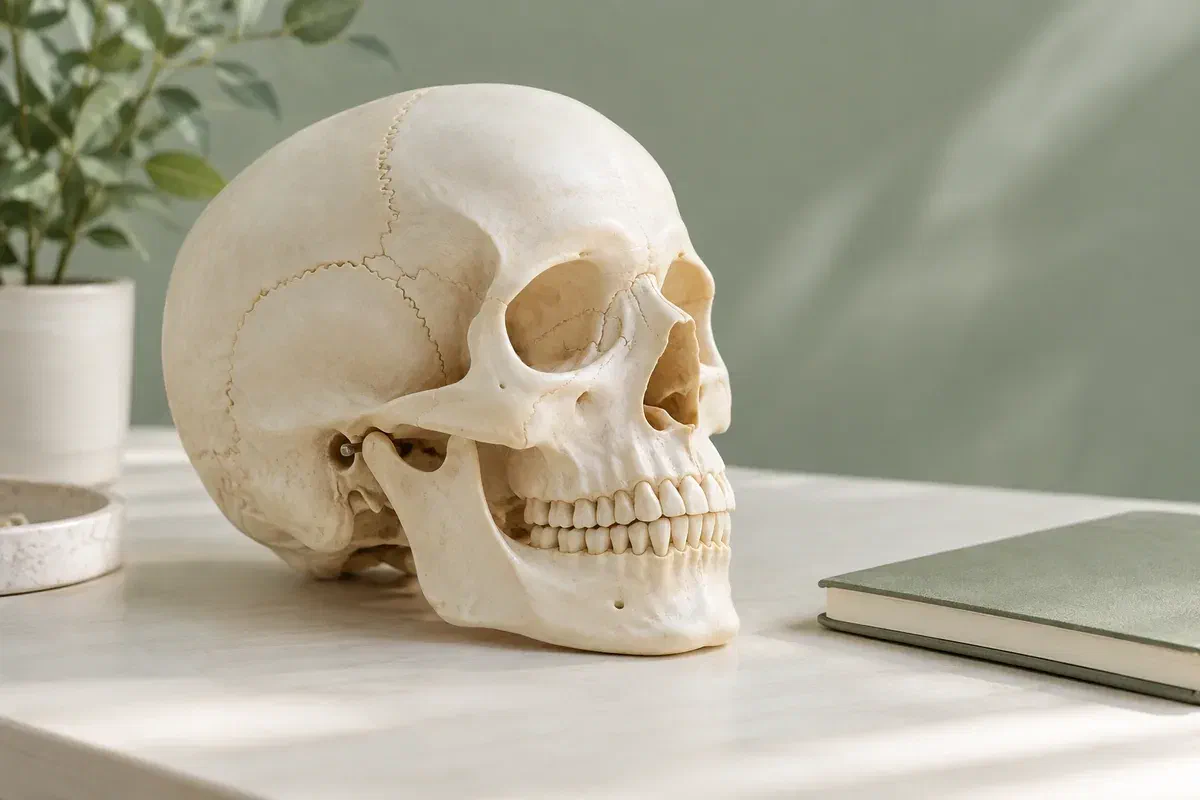
Illustrative anatomical skull teaching model with its jaw attached beside a notebook
What to tell whoever you see first

Three kinds of detail that steer the assessment

Leave the sore spot alone rather than pressing it repeatedly to prove the point. A description of what usually happens is more informative, particularly if things are calm on the day of your appointment.

The rhythm of the discomfort

Does it greet you on waking, gather through the afternoon, or flare with eating and talking? Is it one-sided or on both sides, and does it last minutes or hours? Patterns like these help shape the dentist’s questions, though a pattern alone cannot confirm a cause.

Mouth and jaw clues

Let us know about trouble opening fully, catching or locking, pain on movement, biting tenderness or a tooth that has recently become sensitive. A fall, a knock or new dental work also counts. Such clues suggest whether the examination needs to go wider than muscle tenderness.

Medical background and earlier advice

Mention appointments with your doctor, physiotherapist or other clinicians, and any medicines, appliances or exercises you were given. Describe what helped and what did not. Other pain conditions, headaches and general health matter, even if the jaw seems to be the centre of it all.

Facial and jaw pain is not automatically a temporomandibular disorder. Depending on the findings, other causes may need medical or specialist attention before any dental or muscle-directed plan is chosen.

What you get from starting here

A clearer route, whichever direction it points

The appointment is about understanding, not about finding something to fix in every tender muscle. You are entitled to ask which observations favour a muscle-related problem and which suggest another explanation. If the honest answer is that the picture is mixed, that is more useful than a neat conclusion the findings cannot really sustain.

Before you leave, decide together how improvement will be recognized. That might be eating a full meal without discomfort, talking through a long family gathering, or waking without a stiff jaw. Having that marker means later reviews look at what you can actually do, rather than leaning only on how a muscle feels under pressure.

Patient information: NIDCR — a graduated approach to temporomandibular disorder care

Teeth and jaw examined in one sitting

The dentist can review the teeth, gums, joint movement and muscle tenderness together. Ask whether any finding explains the pain or is simply present at the same time. Worn enamel or a less-than-perfect bite does not by default account for facial aching.

Gentle measures with a check-in date

If a jaw-muscle problem seems likely, talk through reversible steps and when to reassess them. Be clear on what to try, what to stop and when to phone. Jumping to a bigger intervention first rarely makes more sense than starting small.

Clear hand-offs to other professionals

Some findings point toward your family doctor, a medical specialist or an orofacial pain clinician. Ask what each referral is meant to clarify and which notes to pass along. Keeping everyone informed helps when the same symptoms have been seen by more than one person.

How we work through it

Listen, review, examine, decide

There is rarely a single finding that explains facial pain. The dentist pulls together your history and the examination, then tells you whether more information or another opinion should come before treatment.

  1. Hear the whole story

    We ask where you feel it, what it is like, when it happens and what you tend to be doing. Spreading pain and brief, sharp episodes are important to mention. A few notes on your phone are handy, but please do not hold off on booking to build a complete log.

  2. Check medical and dental history

    Medicines, conditions, past injuries and any investigations by your doctor are reviewed. An appliance you currently wear is worth bringing, along with what it was made for. Treatment that changed your bite or worsened things should be mentioned so it is taken into account.

  3. Focus the examination

    Guided by your history, the dentist may look at how the jaw opens and moves and which areas are tender. Speak up if something hurts. Imaging is reserved for situations where it would answer a meaningful question, instead of being taken for every ache.

  4. Map out what happens next

    You learn what the findings support, what is uncertain, and whether a reversible trial, further testing or a referral to another clinician makes sense. Agree when to follow up and what developments should prompt an earlier call. Each step should be purposeful and reviewable.

Afterward

Stick with the plan you agreed and give the area a rest

Your instructions depend on the assessment. Ask for clear explanations of each recommendation and what to do if a step seems to raise your discomfort rather than lower it.

Track only what matters

Make a note when comfort, chewing, sleep or jaw use changes noticeably, and when you try something new. Brief notes are easier to review than a constant tally. Bring them to your follow-up, along with anything your doctor has added, so progress can be compared with your goals.

Hold back on forceful home care

Avoid vigorous stretching, prolonged pressing, or routines intended for a different diagnosis. Check whether a technique suits you and how to perform it gently. When a recommended measure increases pain, stop and seek advice instead of forcing it.

Keep everyone informed about appliances and medicines

If a guard is painful or leaves your bite feeling changed for long, stop wearing it and talk to the clinician who provided it. Take medicines exactly as directed and leave regular prescriptions to your prescriber. Practical difficulties are worth raising so the plan can evolve.

Next directions

Different findings, different paths

Ask how each suggestion fits the working diagnosis and what alternatives you have. Being close to the teeth or jaw does not make a treatment the obvious choice.

When a muscle or jaw-related cause fits the findings

Individual conservative care

Self-management, adjustments to some daily activities, or therapy coordinated with another provider may be suggested, with a plan to review the effect. Ask for a short, workable set of instructions. The first plan should be easy to follow and specific enough to judge.

When the source is unclear or points beyond the jaw

Medical or further dental investigation

A pattern that does not fit, or an unexpected finding, may need your doctor or a specialist before any treatment. Ask what remains to be answered. A good referral sends you toward relevant expertise instead of another round of the same approach.

When a proposal would change teeth or bite irreversibly

A careful pause before permanent treatment

Permanent alterations to the bite are not routine care for facial muscle pain. Ask what evidence supports the proposal, what the risks and alternatives are, and whether a second opinion would help. One unsuccessful reversible step does not justify grinding teeth, extensive restorations or surgery.

Who-to-see questions

Answers about where to start and what comes next

These answers are general preparation. The cause of your own facial pain can only be judged after your history and examination have been reviewed.

(905) 876-4488
My family doctor suggested I see a dentist. What will the dentist look for?
The dentist examines teeth, gums, jaw movement and chewing muscles and reviews your history, including what your doctor found. The aim is to see whether dental or jaw-related factors explain the pain. If not, they will explain what further medical input might help.
Should I tell the dentist about my other medical conditions and medicines?
Yes. Other health conditions, pain elsewhere in the body and regular medicines can all be relevant to facial pain and to which options are suitable. A complete list helps the dentist interpret findings and coordinate with your doctor if needed.
Can a dentist refer me to a specialist for facial pain?
Where the findings suggest it, a dentist can recommend referral to an appropriate specialist or suggest returning to your doctor for one. Ask what the referral is meant to clarify and what records to bring, so the next appointment builds on this one.
If the pain is in my cheek, does that settle that a chewing muscle is involved?
No. Location is a helpful clue, but several different problems cause aching in similar areas. The assessment looks at the whole pattern before linking it to the muscles, or to a dental, medical or specialist cause.
Does the assessment usually end with a nightguard being made?
No. An appliance is not the standard answer to facial pain. If the dentist suggests one, ask what it is for in your case and how its effect will be judged. The diagnosis and goals come first.
What should I do if the advised jaw care is making things worse?
Stop that measure and call for guidance. Describe what you tried and how symptoms responded. The approach may change or the working diagnosis may be reconsidered. Increasing pain is not something to push through.

Patient information: NIDCR — why different facial pain patterns need appropriate diagnosis

Booking from Brampton

Not sure who to call? Start with a conversation.

Call our Bronte Street practice to set up a facial pain assessment. If your doctor or another clinician has already looked into the aching, bring their notes and a list of what you have tried, so we can build on that work together.

Whether the pain has a dental, jaw or other source, what care fits, any imaging or referral, and fees all depend on assessment. We cannot promise a muscle diagnosis or that a particular appliance or treatment will help.

Visit Milton Dental Clinic
Unit 1, 342 Bronte St. S, Milton, ON L9T 5B7
Get directions Clinic hours
Monday–Thursday
11am–7pm
Friday–Sunday
By appointment only

Areas we serve

  • Milton
  • Oakville
  • Mississauga
  • Georgetown
  • Halton Hills
  • Acton
  • Campbellville
  • Brampton
  • Burlington
  • Puslinch
  • Rockwood
  • Erin
  • Caledon
  • Etobicoke
  • Old Milton
  • Bronte Meadows
  • Timberlea
  • Dorset Park
  • Dempsey
  • Clarke
  • Beaty
  • Coates
  • Harrison
  • Scott
  • Willmott
  • Ford
  • Bowes
  • Cobden
  • Walker
  • Mountain View
  • Milton Heights
  • Hawthorne Village
  • Valley View
  • Fallingbrook
  • Nassagaweya
  • Trafalgar
  • Esquesing
  • Nelson
  • Brookville
  • Moffat
  • Glen Williams
  • Norval
  • Limehouse
  • Stewarttown
  • Ashgrove
  • Hornby
  • Silver Creek
  • Speyside
  • Scotch Block
  • North Oakville
  • River Oaks
  • Glen Abbey
  • West Oak Trails
  • Palermo
  • Bronte Creek
  • College Park
  • Joshua Creek
  • Uptown Core
  • Preserve
  • Iroquois Ridge
  • Lisgar
  • Meadowvale
  • Meadowvale Village
  • Churchill Meadows
  • Erin Mills
  • Central Erin Mills
  • Streetsville
  • East Credit
  • Creditview
  • Heartland
  • Sheridan
  • Mount Pleasant
  • Credit Valley
  • Huttonville
  • Churchville
  • Springbrook
  • Northwest Brampton
  • Bram West
  • Fletcher's Meadow
  • Fletcher's Creek South
  • Alton Village
  • Orchard
  • Millcroft
  • Headon Forest
  • Tansley
  • Brant Hills
  • Tyandaga
  • Kilbride
  • Lowville
  • Aberfoyle
  • Morriston
  • Arkell
  • Hillsburgh
  • Freelton
  • Carlisle
  • Waterdown
  • Flamborough
  • Mountsberg

How can we help?

Milton Dental Clinic

Have a question about your smile? Choose the option that works best for you.

For urgent dental concerns, please call.
Messages are reviewed during clinic hours.