

Illustrative patient describing facial discomfort during a consultation
Specialized Care

Facial Muscle Pain Assessment in Georgetown

Is it dull, throbbing, burning or sharp? The words you use for facial pain matter more than you might expect. Book a facial muscle pain assessment from Georgetown and we will help you describe it, examine your teeth and jaw, and plan from there.

Facial pain assessment for Georgetown

Finding the right words for an ache

“It just hurts” is a perfectly honest description, and also a hard one to work with. Facial pain comes in many textures. A deep, tired ache after chewing is different from a throbbing tooth, and both are different from a brief, electric jolt. Muscle discomfort tends to fall into the first group, but you cannot be sure from the feeling alone.

That is why the assessment pays close attention to your words. Alongside that conversation, the dentist examines your teeth and gums, observes jaw opening and movement, and checks the chewing muscles for tenderness. Some descriptions fit a muscle or jaw explanation well; others suggest a dental, nerve-related or medical cause that needs a different approach.

Before the visit, try describing a typical episode to yourself: where it sits, what it feels like, how long it lasts, and what seems to bring it on or ease it. Add anything you have already tried. We will explain what the findings support and what remains open, and you should leave knowing which question to tackle next.

Describe your symptoms to us
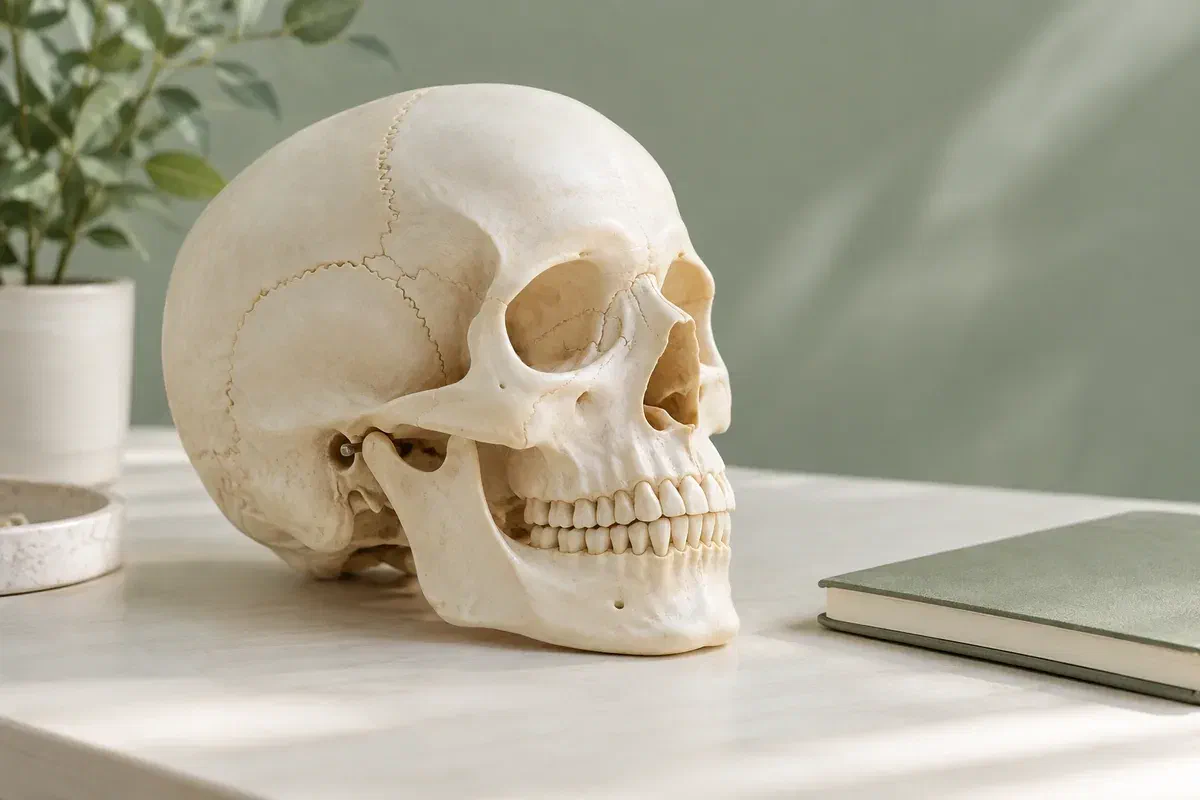
Illustrative anatomical skull teaching model with its jaw attached beside a notebook
A vocabulary for your visit

Location, quality, timing: three words to start with

You do not need to make the pain happen to describe it. Repeatedly pressing on the spot can blur things. Thinking through an ordinary episode, and the words that fit it, usually gives a truer picture than whatever you feel in the chair.

Timing, triggers and duration

Is it constant, or does it come and go? Does it arrive on waking, build over hours, or follow meals and long conversations? Say which side it favours and how long it hangs around. This guides the questions, although a pattern on its own never proves a cause.

What the jaw and teeth are doing

A jaw that will not open fully, catches, locks or hurts as it moves is worth describing, as is a tooth that is sore to bite on or newly sensitive. Mention injuries and recent dental work. These details help decide if the examination needs to go beyond muscle tenderness.

Previous care and other health issues

Tell us about guards, exercises, medicines, physiotherapy or earlier assessments, and use plain words for how each one went: helped, did nothing, made it worse. Other pain conditions and medical history can be part of the picture, even if everything seems to point at the jaw.

No matter which words fit best, aching in the face or jaw does not by default mean a temporomandibular disorder. Other explanations may need to be considered before choosing dental or muscle-based care.

What clear description makes possible

Better words, better reasoning

When the description is precise, the dentist can match it more carefully against what the examination shows. The aim is understanding, not a treatment pinned to each tender spot. Ask which of your descriptions fit a muscle-related explanation and which do not. You deserve a straightforward account of what is still uncertain, rather than a firm label resting on thin evidence.

Words also help define improvement. You might say the ache drops from constant to occasional, or that you can chew a crisp apple again, or that mornings start without tightness. Those phrases become the yardstick for later reviews, which then track function and patterns instead of relying on how a muscle reacts when pressed.

Patient information: NIDCR — a graduated approach to temporomandibular disorder care

Description and examination, side by side

The dentist can compare what you report with the teeth, tissues, jaw movement and tenderness found during the visit. Ask whether a particular finding accounts for your discomfort or just happens to be present. A worn tooth or uneven bite is not automatic proof.

A modest, reversible plan

If the evidence points to a jaw-muscle problem, discuss simple measures and when to review them. Be clear about what to try, what to set aside, and when to report difficulties. More intensive treatment is not necessarily a stronger place to begin.

Another expert when the description points elsewhere

Certain qualities of pain, such as brief shock-like episodes, may be better assessed by a physician or orofacial pain professional. Ask what the referral should clarify and what to bring. Shared notes help when several clinicians have heard the same story.

Our approach

Your words first, then the examination

One finding rarely explains facial pain. The dentist combines how you describe it with what the examination shows, then tells you whether more information is needed before treatment.

  1. Describe it in your own language

    Where, what kind, when and during what? Mention spreading and short flashes as well as steady aching. Words like dull, pressing, sharp or burning are all useful. A few notes help, but there is no need to delay booking while you perfect them.

  2. Share your health and dental background

    We cover medicines, conditions, injuries and earlier investigations. Bring any appliance you wear and explain why it was made. Tell us about treatment that altered your bite or seemed to aggravate the pain, so it is considered properly.

  3. A targeted examination

    Checks follow from your history and may include jaw opening, movement and muscle tenderness. Tell us if anything is uncomfortable. Imaging is used when it would answer a particular question rather than as a routine for every ache.

  4. Agree on direction and review

    You will hear what fits, what does not, and whether a reversible trial, further investigation or a referral is the sensible step. Settle on a review date and on changes that should bring you back sooner. Each step should have a reason you understand.

Once the plan is in place

Notice the pain less, record it briefly, and avoid overdoing it

Advice depends on the findings. Ask for clear instructions on whatever is recommended, and be sure you know what to do if something seems to make the discomfort worse.

Write a line, not an essay

Record meaningful changes in comfort, meals, sleep or jaw use, using the same words you used at the visit, and note anything you tried. A sentence or two a few times a week is usually enough. Bring it to the review to compare with your goals.

Leave out vigorous home treatment

Forceful stretching, repeated deep pressing and exercises intended for other conditions can do more harm than good. Ask whether a method suits you and how to do it gently. If something you were advised to do increases pain, stop and call.

Speak up about appliances and medicines

A guard that hurts or leaves your bite feeling changed for a long time should be put aside until you have spoken with the clinician who made it. Use medicines as prescribed and do not alter regular prescriptions on your own. Mention practical problems so the plan can change.

Choosing what comes next

Match the care to what the evidence shows

When a treatment is suggested, ask how it fits the working diagnosis and what alternatives exist. The fact that the pain is near your teeth or jaw does not decide the treatment.

Where the findings suggest a muscle or jaw source

Personal conservative management

This could involve self-care, changes to certain activities, or therapy coordinated with another provider, with a plan to review the effect. Ask for a few clear instructions rather than a long list. The first plan should be easy to follow and specific enough to judge.

Where the source is uncertain or another cause seems likely

Further investigation

A pain quality or finding that does not fit may need another dental or medical assessment first. Ask what question has not been answered. Referral is worthwhile when it reaches the relevant expertise, instead of another round of care that has not explained anything.

Where a suggestion would alter teeth or bite for good

Thinking twice about permanent changes

Irreversible bite adjustment is not standard care for facial muscle pain. Ask what supports it, what could go wrong, what else might be tried, and whether a second opinion is wise. One reversible measure that falls short does not justify grinding teeth, extensive restorations or surgery.

Describing facial pain

Questions about putting symptoms into words

These general answers can help you prepare. They cannot identify what is behind your own pain without an assessment of your history and findings.

(905) 876-4488
What is the most useful way to describe facial pain to a dentist?
Cover four things: where it is, what it feels like, when it happens, and what makes it better or worse. Ordinary words are fine. Mention whether it spreads and how long episodes last. That outline gives the dentist a solid starting point for the examination.
Does a burning feeling in my face mean the same thing as an ache?
Not necessarily. Burning, aching, throbbing and sharp sensations can point in different directions. Describe it as accurately as you can. The dentist will consider whether it fits a muscle or jaw pattern or suggests another assessment.
I cannot tell if the pain is in my teeth or my face. Is that normal?
Yes, it is common. Pain can be felt in a place that is not its source, which is one reason the examination checks both teeth and muscles. Point to where you feel it and the dentist will help work out where it may be coming from.
Can I assume aching at the temples comes from the chewing muscles?
No. Location is a useful clue, but several conditions cause discomfort in nearby areas. With a full description and examination, the dentist can say whether a muscle explanation fits or whether dental, medical or specialist review is wiser.
Should I demonstrate the pain by pressing on the spot during the visit?
Point to it, but avoid repeatedly provoking it. Describing what happens in everyday activities is more helpful. The dentist will guide any tenderness checks, and repeated self-testing can make your usual pattern harder to judge.
Will I automatically be given a nightguard for muscle pain?
No. An appliance is not the default response to facial pain. If one is suggested, ask what it is meant to do in your case and how its effect will be checked. Diagnosis and goals come before any appliance.

Patient information: NIDCR — why different facial pain patterns need appropriate diagnosis

Visiting us from Georgetown

Tell us what it feels like, in your own words

Phone our Bronte Street practice to arrange time for facial aching or suspected jaw-muscle discomfort. Bring earlier assessments and a short description of what you have tried, so we can look at the findings and possible next steps with you.

The cause of facial pain, appropriate care, any imaging or referral, and fees are worked out after assessment. A dental appointment cannot guarantee a muscle diagnosis or that a particular appliance or treatment will help.

Visit Milton Dental Clinic
Unit 1, 342 Bronte St. S, Milton, ON L9T 5B7
Get directions Clinic hours
Monday–Thursday
11am–7pm
Friday–Sunday
By appointment only

Areas we serve

  • Milton
  • Oakville
  • Mississauga
  • Georgetown
  • Halton Hills
  • Acton
  • Campbellville
  • Brampton
  • Burlington
  • Puslinch
  • Rockwood
  • Erin
  • Caledon
  • Etobicoke
  • Old Milton
  • Bronte Meadows
  • Timberlea
  • Dorset Park
  • Dempsey
  • Clarke
  • Beaty
  • Coates
  • Harrison
  • Scott
  • Willmott
  • Ford
  • Bowes
  • Cobden
  • Walker
  • Mountain View
  • Milton Heights
  • Hawthorne Village
  • Valley View
  • Fallingbrook
  • Nassagaweya
  • Trafalgar
  • Esquesing
  • Nelson
  • Brookville
  • Moffat
  • Glen Williams
  • Norval
  • Limehouse
  • Stewarttown
  • Ashgrove
  • Hornby
  • Silver Creek
  • Speyside
  • Scotch Block
  • North Oakville
  • River Oaks
  • Glen Abbey
  • West Oak Trails
  • Palermo
  • Bronte Creek
  • College Park
  • Joshua Creek
  • Uptown Core
  • Preserve
  • Iroquois Ridge
  • Lisgar
  • Meadowvale
  • Meadowvale Village
  • Churchill Meadows
  • Erin Mills
  • Central Erin Mills
  • Streetsville
  • East Credit
  • Creditview
  • Heartland
  • Sheridan
  • Mount Pleasant
  • Credit Valley
  • Huttonville
  • Churchville
  • Springbrook
  • Northwest Brampton
  • Bram West
  • Fletcher's Meadow
  • Fletcher's Creek South
  • Alton Village
  • Orchard
  • Millcroft
  • Headon Forest
  • Tansley
  • Brant Hills
  • Tyandaga
  • Kilbride
  • Lowville
  • Aberfoyle
  • Morriston
  • Arkell
  • Hillsburgh
  • Freelton
  • Carlisle
  • Waterdown
  • Flamborough
  • Mountsberg

How can we help?

Milton Dental Clinic

Have a question about your smile? Choose the option that works best for you.

For urgent dental concerns, please call.
Messages are reviewed during clinic hours.