

Illustrative adult patient discussing an oral tissue assessment with a clinician
Specialized Care

Frenectomy in Campbellville

A teen about to start braces, a parent with a gum question, a younger sibling due for a checkup: rural households in Campbellville often juggle several needs at once. We help fit a frenectomy assessment into that schedule and explain each option clearly.

Campbellville frenulum questions

Braces are booked, and now someone has mentioned the lip.

Orthodontic consultations often bring up things nobody had thought about before, and the band of tissue above the front teeth is one of them. It is called the upper labial frenulum. A matching band sits beneath the tongue. When there is a real clinical reason, a frenectomy removes the band, while a frenotomy only releases it and a frenuloplasty reshapes it.

Mentioning the tissue is not the same as recommending surgery. The examination asks whether the attachment is affecting the teeth, the gums, lip movement, or another function, and whether treatment would fit the orthodontic timeline. Calling it a tie, or noticing that it looks thick, does not answer that question.

Campbellville is a rural hamlet within Milton’s own boundaries, and many households here like to group appointments where they can. If a teenager’s orthodontic plan has raised the question, bring the notes. We can assess, coordinate with the orthodontist, and arrange referral if another provider should be involved.

Ask about the frenulum before braces
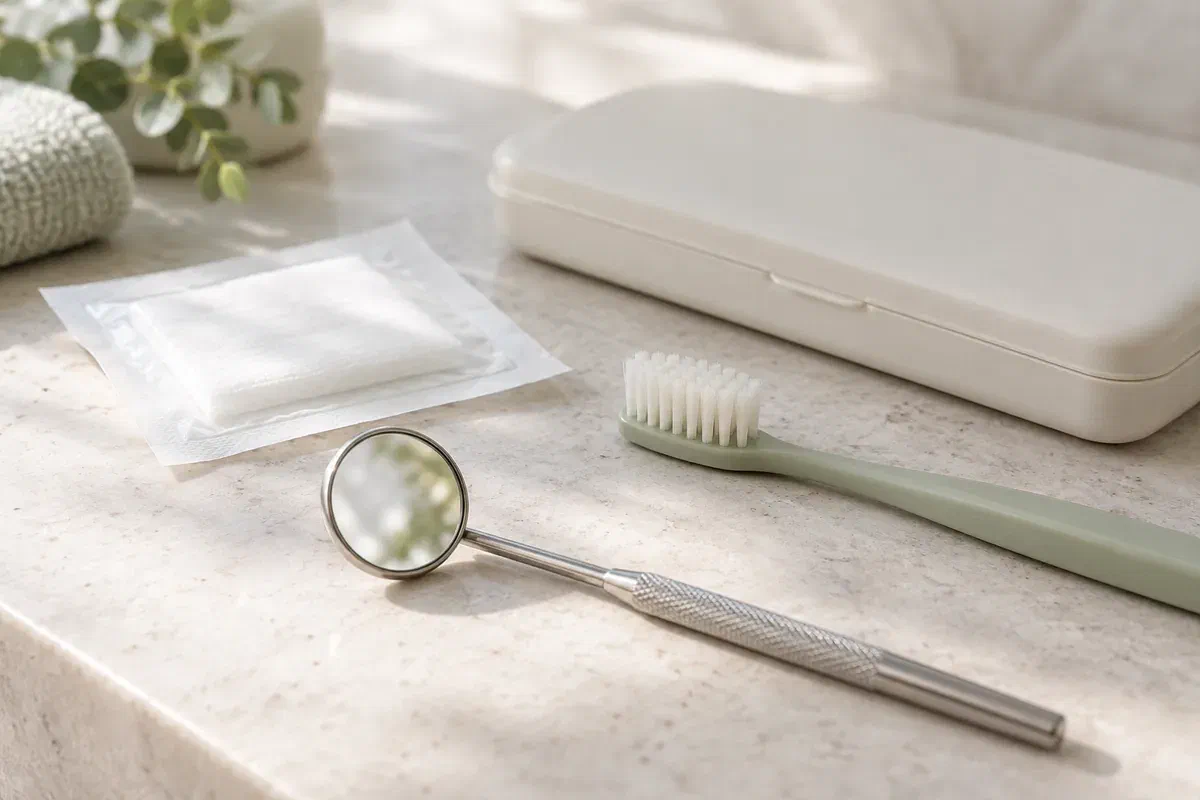
Illustrative dental mirror and gentle oral-care supplies beside a closed instrument case
What raised the question

An orthodontic note, a gum worry, or a child’s speech.

Each starting point leads to different questions. Copies of orthodontic records, hygiene notes, or therapy reports let the clinician see how the tissue fits with what others have found.

The lip or tongue doesn’t move as freely as expected

Describe what you or your teen notice, how long it has been the case, and whether it changes. Ask how movement will be checked. Real everyday examples count for more than comparing the mouth with pictures on a phone.

An orthodontist or hygienist flagged it

Ask which finding led to the comment and whether it is connected to a gap or to gum health near the attachment. Timing with braces or aligners can matter a great deal, so ask how the two treatments would be sequenced.

A younger child with feeding or speech difficulty

Bring any assessments and describe the specific struggle. A child having trouble feeding needs medical and feeding expertise, and unclear speech is properly evaluated by a speech-language pathologist. An attachment being visible does not show it is responsible.

Orthodontic, dental, speech, and feeding care sometimes overlap, and planning them together helps settle whether a procedure is needed and when. Most frenula need no treatment at all.

Good questions, good answers

What would the procedure change for the teeth, and what would it not?

If the assessment finds that the attachment is genuinely contributing to a dental or functional concern, a procedure can be one piece of the treatment plan. Ask what it is expected to accomplish and how that will be measured, whether by the orthodontist, the dental team, or both. Be cautious with promises that reach beyond the specific finding.

Orthodontic movement, not tissue surgery, is what usually closes a space. Retention, gum care, and habits also play their parts. Hearing that clearly helps your family decide whether a frenectomy adds something meaningful to the braces plan, or whether it can be left alone.

A reason linked to the exam

The clinician should be able to point to the attachment and explain the observation that supports treating it. Ask how it compares with ordinary variation. If more records or opinions are needed, ask what they would add.

Sequence and other choices

Monitoring, deferring to the orthodontic timeline, or another professional’s input may be appropriate. Ask what would happen if nothing were done for now. The right moment depends on the reason for care, growth, and where the braces plan stands.

What treatment would involve

Go over the technique, numbing, any stitches, the risks, and how long recovery usually takes. Ask who would treat and in what setting. Some techniques, ages, and anaesthetic choices may mean referral rather than treatment in our office.

Fitting it into the family calendar

One clear plan that the orthodontist and dental team share.

How many visits are needed depends on the attachment, age, and concern. An assessment is not a booking for surgery, and grouping it with other family visits is often possible.

  1. Gather the orthodontic and health details

    Share the orthodontic plan, hygiene notes, or therapy reports, along with medical history, medications, and allergies. Ask whether the orthodontist should be consulted before a decision is made.

  2. Assess the attachment in context

    The clinician checks the tissue, lip and tongue movement, and the relationship to the teeth and gums. You will hear whether the findings support the concern raised. Any uncertainty is explained before options are discussed.

  3. Agree on a decision and its timing

    This is where you hear the likely gain, the limits, the other routes, what it would cost, and how healing tends to go. Should a frenectomy be the right call, ask how much tissue is involved, whether the site would be stitched, and how anaesthetic and setting are decided. Where braces are part of the picture, the date is chosen to suit the orthodontic schedule.

  4. Line up follow-up with other visits

    Confirm aftercare and a review that checks function and healing. Where possible, the review can be coordinated with other family appointments. Ask how notes will be shared with the orthodontist.

Back home in Campbellville

A few careful days, then a proper check.

Aftercare depends on the procedure and the patient. Keep the written instructions, and do not follow a routine designed for an infant or for a different treatment.

Cleaning around braces and the treated area

Ask how to keep the area clean, how to manage any appliances during healing, and when normal brushing can resume. Follow advice about numbness and soft foods. Call the treating office if soreness makes this hard.

Know which signs need a call

Ask what is expected during healing. Bleeding that persists, swelling that worsens, fever, or trouble eating or drinking should be reported promptly. Difficulty breathing or swallowing requires emergency medical help without delay.

Return to the original reason

Once the site has healed, the question is whether the concern has improved. Keep the review appointment and share what has changed, including any feedback from the orthodontist. Ongoing difficulty should be reassessed rather than blamed on reattachment.

Patient information: American Academy of Pediatrics — infant frenotomy selection and aftercare

The possible outcomes

Leave it, coordinate around it, or treat it.

Ask which option fits the documented concern and why. Every mouth has frenula, so a recommendation to treat one needs a clear explanation of what it will address.

When no significant problem calls for surgery

Leave the tissue and monitor

The advice may be to watch the area as orthodontic treatment progresses, or to get another opinion. Ask what changes would prompt a recheck. If nothing in the exam points to a problem surgery would solve, leaving the tissue alone is a thoughtful plan, and it keeps the orthodontic schedule simple.

When spacing, gums, speech, or feeding are central

Let the orthodontic or therapy plan lead

The orthodontist, hygienist, or a therapist may handle the main concern, with dental surgery considered only if needed later. Ask who is responsible for which part of the goal. Surgery on the tissue should never take the place of the broader treatment plan or of understanding why the concern exists.

When assessment supports intervention

A frenulum procedure that fits the plan

Ask exactly which procedure is proposed and what it should achieve. Compare it with the other options and understand the risks, from soreness and bleeding to infection, scarring, or no improvement. Ask what evidence supports the technique; equipment branding is not evidence.

Questions from busy households

Practical questions about frenula and braces.

Bring orthodontic notes and any questions your teen has. These answers help you prepare without assuming that the attachment needs treatment.

(905) 876-4488
Can the frenulum assessment be booked alongside our family’s regular checkups?
Often, yes. Ask when booking whether the assessment can be scheduled near other family appointments. A procedure, if needed, would usually be planned separately so there is time to consider it.
My teenager is starting braces soon. Is now the time to ask about the lip attachment?
It is a good time to ask. Whether and when anything should be done depends on the reason and the orthodontic plan, so the orthodontist and dental team should agree on the sequence.
Would a frenectomy get in the way of wearing braces or aligners?
Healing needs to fit around appliances, which is one reason timing is coordinated. Ask both providers how the treated area and the braces or aligners would be managed during recovery.
Can an attachment make it harder to keep the gums healthy?
In some situations an attachment near the gum is raised as a concern. An examination can show whether that applies and whether monitoring, improved cleaning, gum care, or a procedure fits best.
Is local anaesthetic usually used for teenagers?
The choice depends on the procedure, the patient, and the setting. Ask what anaesthetic is planned and why. Not every anaesthetic option is offered at every office.
What questions should my teen ask for themselves?
Encourage them to ask what the procedure is for, what it will feel like afterward, how long healing takes, how it affects braces, and what happens if they choose not to have it.

Patient information: AAPD — procedure definitions and orthodontic timing considerations · Royal Cornwall — avoiding preventive tongue-tie procedures without a current functional indication

Arranging care from Campbellville

Sort out the frenulum question before the brackets go on.

Reach our Bronte Street practice to discuss a frenectomy suggestion or an attachment noticed during orthodontic planning. Bring the orthodontic notes, and we can look at the findings, timing, other options, and any care that should be shared with the orthodontist.

Whether treatment is indicated, age suitability, technique, anaesthetic, location of care, referral, fees, and expected benefit are assessed individually. Improvements in spacing, speech, feeding, or function are never guaranteed.

Visit Milton Dental Clinic
Unit 1, 342 Bronte St. S, Milton, ON L9T 5B7
Get directions Clinic hours
Monday–Thursday
11am–7pm
Friday–Sunday
By appointment only

Areas we serve

  • Milton
  • Oakville
  • Mississauga
  • Georgetown
  • Halton Hills
  • Acton
  • Campbellville
  • Brampton
  • Burlington
  • Puslinch
  • Rockwood
  • Erin
  • Caledon
  • Etobicoke
  • Old Milton
  • Bronte Meadows
  • Timberlea
  • Dorset Park
  • Dempsey
  • Clarke
  • Beaty
  • Coates
  • Harrison
  • Scott
  • Willmott
  • Ford
  • Bowes
  • Cobden
  • Walker
  • Mountain View
  • Milton Heights
  • Hawthorne Village
  • Valley View
  • Fallingbrook
  • Nassagaweya
  • Trafalgar
  • Esquesing
  • Nelson
  • Brookville
  • Moffat
  • Glen Williams
  • Norval
  • Limehouse
  • Stewarttown
  • Ashgrove
  • Hornby
  • Silver Creek
  • Speyside
  • Scotch Block
  • North Oakville
  • River Oaks
  • Glen Abbey
  • West Oak Trails
  • Palermo
  • Bronte Creek
  • College Park
  • Joshua Creek
  • Uptown Core
  • Preserve
  • Iroquois Ridge
  • Lisgar
  • Meadowvale
  • Meadowvale Village
  • Churchill Meadows
  • Erin Mills
  • Central Erin Mills
  • Streetsville
  • East Credit
  • Creditview
  • Heartland
  • Sheridan
  • Mount Pleasant
  • Credit Valley
  • Huttonville
  • Churchville
  • Springbrook
  • Northwest Brampton
  • Bram West
  • Fletcher's Meadow
  • Fletcher's Creek South
  • Alton Village
  • Orchard
  • Millcroft
  • Headon Forest
  • Tansley
  • Brant Hills
  • Tyandaga
  • Kilbride
  • Lowville
  • Aberfoyle
  • Morriston
  • Arkell
  • Hillsburgh
  • Freelton
  • Carlisle
  • Waterdown
  • Flamborough
  • Mountsberg

How can we help?

Milton Dental Clinic

Have a question about your smile? Choose the option that works best for you.

For urgent dental concerns, please call.
Messages are reviewed during clinic hours.