

Illustrative patient discussing gum health with a clinician and a small dental model
Specialized Care

Gingivitis Treatment in Halton Hills

Floss, picks, tiny brushes, water flossers: the choice can be overwhelming when your gums are bleeding. For households across Halton Hills, our gingivitis care pairs a careful gum examination with hands-on help choosing tools that suit your teeth and your hands.

Gum care for Halton Hills

A drawer full of floss picks, and gums that still bleed

Plenty of people own every cleaning gadget going and still see blood in the sink. Often the issue is not effort but fit: a pick too wide for a tight space, floss that skips past the gumline, or a brush angled away from where plaque gathers. Gingivitis, the medical word for inflamed gums, tends to linger where cleaning keeps missing.

Professional cleaning followed by a routine that genuinely reaches those areas frequently helps plaque-related gingivitis settle. Still, it would be a mistake to assume every bleeding gum just needs a better tool. An examination checks whether the inflammation is limited to the gum, whether periodontitis has affected the supporting tissue, or whether something else entirely is involved.

From Georgetown, Acton, Glen Williams or the smaller hamlets of Halton Hills, many people arrive with a bag of products and a simple question: which of these should I use? We look at your gums first, explain what we see, and then work through the options with you in hand.

Get help with your gums and tools
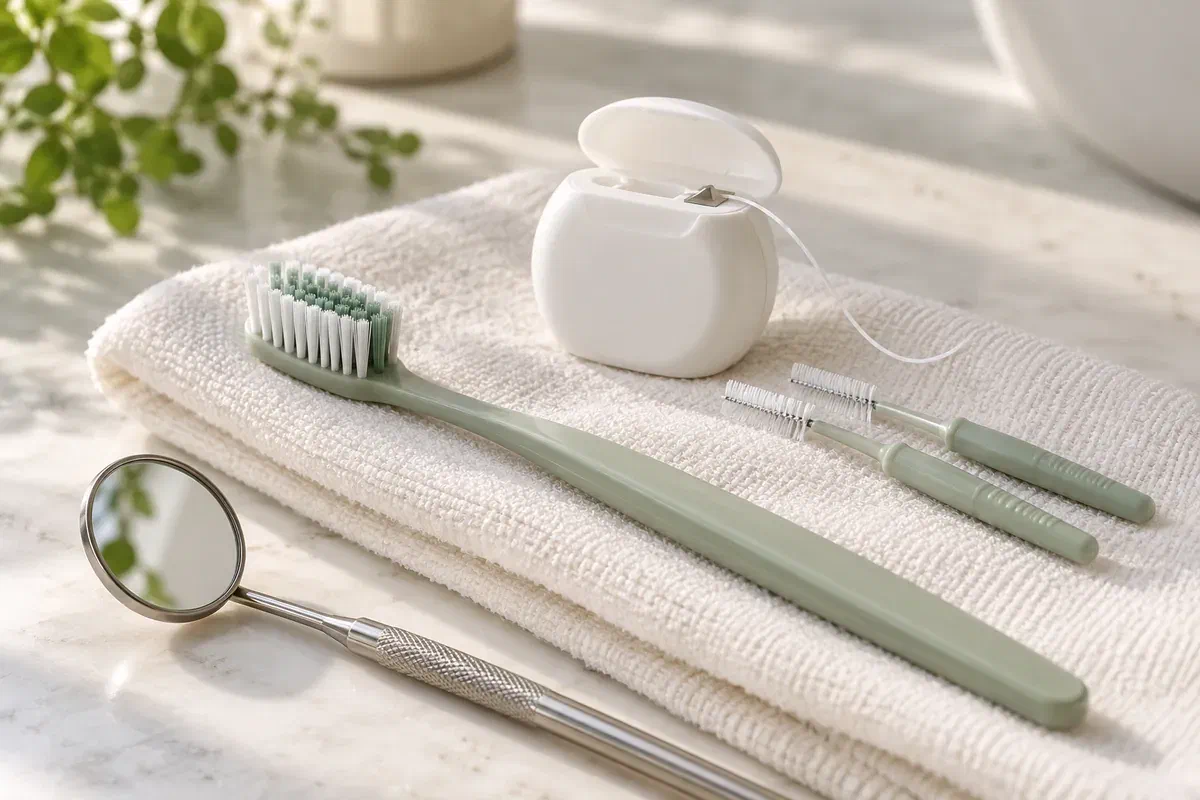
Illustrative soft toothbrush, floss, interdental brushes, and dental mirror on an ivory towel
Signals from your gums

Where your cleaning struggles, your gums will often tell you.

Share which areas feel hard to reach, when you first spotted a change and whether it is steady or occasional. Products you have switched to, dental work, medicines and health changes can all be relevant, and the examination will help decide which ones are.

Bleeding in spots you find awkward to clean

Many people find the same places tricky, such as the back molars or the inside surfaces. Tell us which areas bleed and show us the tool you use there. Steering clear of them, or forcing a tool through, can both keep the gum irritated.

Puffiness around teeth with tight contacts or dental work

Crowded teeth, bridges and crowns can create spaces that standard floss struggles with. Point out where the gum looks swollen or feels sore. That area may benefit from a different aid or a specific technique, alongside an explanation of what is driving the inflammation.

Breath that does not match your cleaning effort

If you clean carefully but your breath stays stale, mention it. Gum inflammation can contribute, yet so can dryness and other factors. Rinsing more heavily may mask it, so bring it up during the examination where the possible sources can be considered.

Bleeding that appears on its own, swelling that seems unusual, sores, or symptoms affecting your general health should be raised at the visit. Gum problems are not always the ordinary plaque-related kind.

What a good plan delivers

The right tool, used the right way, in the right place

The most practical outcome of a gingivitis visit is a routine matched to your findings. You should know which sites are inflamed, what professional cleaning is planned and how improvement will be gauged. Struggling with a tool is a fitting problem, and fitting problems have solutions.

Just as important is understanding what the diagnosis covers. Gingivitis involves the gums only; periodontitis includes loss of the tissue anchoring the teeth and shifts the conversation toward other treatment. If your findings point that way, ask what changes and whether further assessment would be helpful.

Patient information: NIDCR — plaque, gum inflammation, professional cleaning, and individualized treatment

Hardened deposits cleared away

Tools at home cannot remove tartar once it has formed. Ask where it has accumulated and what the professional cleaning will involve. The examination findings, rather than the length of time since your last visit, should determine how extensive that cleaning is.

Interdental aids sized and tested at the chair

We can try different sizes of interdental brush, floss types or holders in the spaces that bleed and see which fit comfortably. Your dexterity, any arthritis or hand stiffness, and dental work all count, because a tool you cannot hold well will not be used.

A recheck to see whether the routine is working

Arrange a time for the gums to be looked at again, and ask what would justify calling sooner. Lingering inflammation can mean the diagnosis, remaining deposits, a local factor or the routine itself needs a fresh look.

Your visit, in order

We examine first and recommend tools second.

Going in order keeps the advice grounded in what is actually happening. Whether assessment and cleaning share one appointment or are split across two depends on what we find and how comfortable you are.

  1. Bring your routine with you, literally

    Pack the brush, floss, picks or rinse you use and tell us where bleeding or redness shows up and for how long. We go over your medical history and medications. Seeing your actual tools lets us give advice that fits what you already have.

  2. Look closely at the gums

    Your clinician examines the areas you mentioned and decides whether they fit gingivitis or suggest another condition. Gum measurements and images may help where appropriate. Ask which findings were most important and why.

  3. Clean, then practise with the right aids

    Before treatment, we explain what is planned, how we will keep you comfortable, the fees and how many visits are likely. After the deposits are removed, we practise with suitable tools so the technique feels natural. Tell us if anything is tender or you need a moment.

  4. Come back to fine-tune

    At your review, tell us which tools you have kept using and which you dropped. We check the tissue response and adjust sizes or techniques. If the gums still look inflamed, ask whether further evaluation or a different plan makes sense.

Making the tools work for you

Fit and gentleness matter more than force.

Ask for directions on which tool goes where and how to use it. A short routine with a handful of well-chosen aids is easier to keep up than a long one with a drawer full of options.

Brush where the gum meets the tooth

Use the brush and fluoride toothpaste we agreed on, holding the bristles toward the gumline at the sites we pointed out. If brushing a spot hurts, note where and how. A different grip or angle may solve it, and pressing harder rarely does.

Match each space to its aid

You might use one size of interdental brush at the front and another at the back, or floss in tight contacts. Ease each one in gently. If something feels wrong, bring it in and we will help you swap or resize.

Use a rinse only for a stated reason

If a rinse is suggested, know what it is for, how many days or weeks to continue and any warnings on the label. It does not replace the tools above. Call us if symptoms carry on or grow more uncomfortable.

How we decide on care

Tools help, but the diagnosis leads.

Ask how each recommendation traces back to your own examination. Gum inflammation alone, lasting periodontal damage and a change caused by something else will each be handled in a distinct way.

When the findings fit plaque-related gingivitis

Professional cleaning and fitted home tools

Deposits are removed and your aids are chosen for the inflamed sites. Ask how progress will be measured and what maintenance looks like. The plan should be clear about the professional side and the part you play each day.

When supporting tissue has been lost

Periodontal care beyond routine cleaning

With periodontitis, the treatment discussion expands. More thorough cleaning, reassessment, ongoing periodontal maintenance or a specialist's view may be suggested. Each step should be explained using your findings, not a one-size-fits-all approach to bleeding gums.

When another explanation is likely

A further look when something does not add up

Irritation from dental work, a health factor or a different gum condition could be involved. Find out what is still unclear and whether another examination or referral is wise. Switching tools endlessly without a diagnosis is not a plan.

Tool and technique questions

Choosing and using cleaning aids

These questions can help you move from a pile of products to a short, sensible routine that suits your diagnosis, your teeth and your hands.

(905) 876-4488
Are floss picks as good as regular floss?
They can be handy, especially if reaching the back of the mouth is difficult, but they do not suit every space. Ask the clinician to watch you use one. Sometimes a different aid or a change in technique reaches the gumline better.
How do I know what size of interdental brush to buy?
Sizes vary, and the right one should pass through the space with gentle resistance but without forcing. You may need more than one size. The team can test options at your visit and tell you which to look for.
I have arthritis in my hands. What can make cleaning easier?
Options such as a powered toothbrush, a floss holder or aids with larger handles may help. Bring up any grip or dexterity problems at your appointment so the recommendations reflect what you can manage comfortably.
Do I need to clean between my teeth if they are very tightly spaced?
Tight spaces can still collect plaque. Floss or a very fine aid may work where brushes do not fit. Ask to be shown a method for your contacts, and mention if floss shreds or catches, since that can point to a restoration edge worth checking.
Could my bleeding be something other than gingivitis?
Yes. Periodontitis, a local irritant, medicines or other health factors can also cause bleeding or redness. That is why the examination comes before tool advice. Ask what the findings suggest in your case.
Is there a good order for brushing and flossing?
Either order can work. What matters most is reaching the gumline and between-teeth spaces thoroughly and gently every day. If you have been advised otherwise for a specific reason, follow that guidance and ask why.
Booking from Halton Hills

Bring your tools and your questions.

Contact our Bronte Street practice about redness, bleeding or soreness at the gumline. Let us know which products you use so we can make time to go through them with you.

What your gums need, the cleaning involved, the review schedule and the response all depend on the examination and your own situation.

Visit Milton Dental Clinic
Unit 1, 342 Bronte St. S, Milton, ON L9T 5B7
Get directions Clinic hours
Monday–Thursday
11am–7pm
Friday–Sunday
By appointment only

Areas we serve

  • Milton
  • Oakville
  • Mississauga
  • Georgetown
  • Halton Hills
  • Acton
  • Campbellville
  • Brampton
  • Burlington
  • Puslinch
  • Rockwood
  • Erin
  • Caledon
  • Etobicoke
  • Old Milton
  • Bronte Meadows
  • Timberlea
  • Dorset Park
  • Dempsey
  • Clarke
  • Beaty
  • Coates
  • Harrison
  • Scott
  • Willmott
  • Ford
  • Bowes
  • Cobden
  • Walker
  • Mountain View
  • Milton Heights
  • Hawthorne Village
  • Valley View
  • Fallingbrook
  • Nassagaweya
  • Trafalgar
  • Esquesing
  • Nelson
  • Brookville
  • Moffat
  • Glen Williams
  • Norval
  • Limehouse
  • Stewarttown
  • Ashgrove
  • Hornby
  • Silver Creek
  • Speyside
  • Scotch Block
  • North Oakville
  • River Oaks
  • Glen Abbey
  • West Oak Trails
  • Palermo
  • Bronte Creek
  • College Park
  • Joshua Creek
  • Uptown Core
  • Preserve
  • Iroquois Ridge
  • Lisgar
  • Meadowvale
  • Meadowvale Village
  • Churchill Meadows
  • Erin Mills
  • Central Erin Mills
  • Streetsville
  • East Credit
  • Creditview
  • Heartland
  • Sheridan
  • Mount Pleasant
  • Credit Valley
  • Huttonville
  • Churchville
  • Springbrook
  • Northwest Brampton
  • Bram West
  • Fletcher's Meadow
  • Fletcher's Creek South
  • Alton Village
  • Orchard
  • Millcroft
  • Headon Forest
  • Tansley
  • Brant Hills
  • Tyandaga
  • Kilbride
  • Lowville
  • Aberfoyle
  • Morriston
  • Arkell
  • Hillsburgh
  • Freelton
  • Carlisle
  • Waterdown
  • Flamborough
  • Mountsberg

How can we help?

Milton Dental Clinic

Have a question about your smile? Choose the option that works best for you.

For urgent dental concerns, please call.
Messages are reviewed during clinic hours.