

Illustrative adult describing a dental concern to a clinician in a consultation room
Specialized Care

Gum Abscess Treatment in Brampton

Dentist, walk-in clinic or emergency department? With a swollen gum, the answer depends on your symptoms. For households in Brampton, a call to our team can sort out urgency, the right first visit and the follow-up care.

Choosing where to go from Brampton

The right door depends on the symptoms.

Someone at home wakes with a puffy, painful patch of gum and the household has to decide what to do before work and school. Most of the time, a dental assessment is the place to start. A gum abscess is a contained pocket of infection in the gum or the tissue that supports a tooth, and dentistry is where its cause gets found and treated.

Location can fool you. Infection may begin in a gum pocket beside the root, or deep inside the tooth before breaking out through the gum. Each needs different handling, which is why the tooth is tested and the gum and bone are checked. Relief from drainage is real, though the cause can still be sitting there.

There are exceptions. Swelling that heads toward the eye, trouble breathing or swallowing, or feeling seriously unwell all point to emergency medical care. For everything short of that, call our team from Brampton and describe how things are changing. If we cannot fit you in soon enough, contact another emergency dental provider rather than waiting on an online reply.

Arrange an abscess check
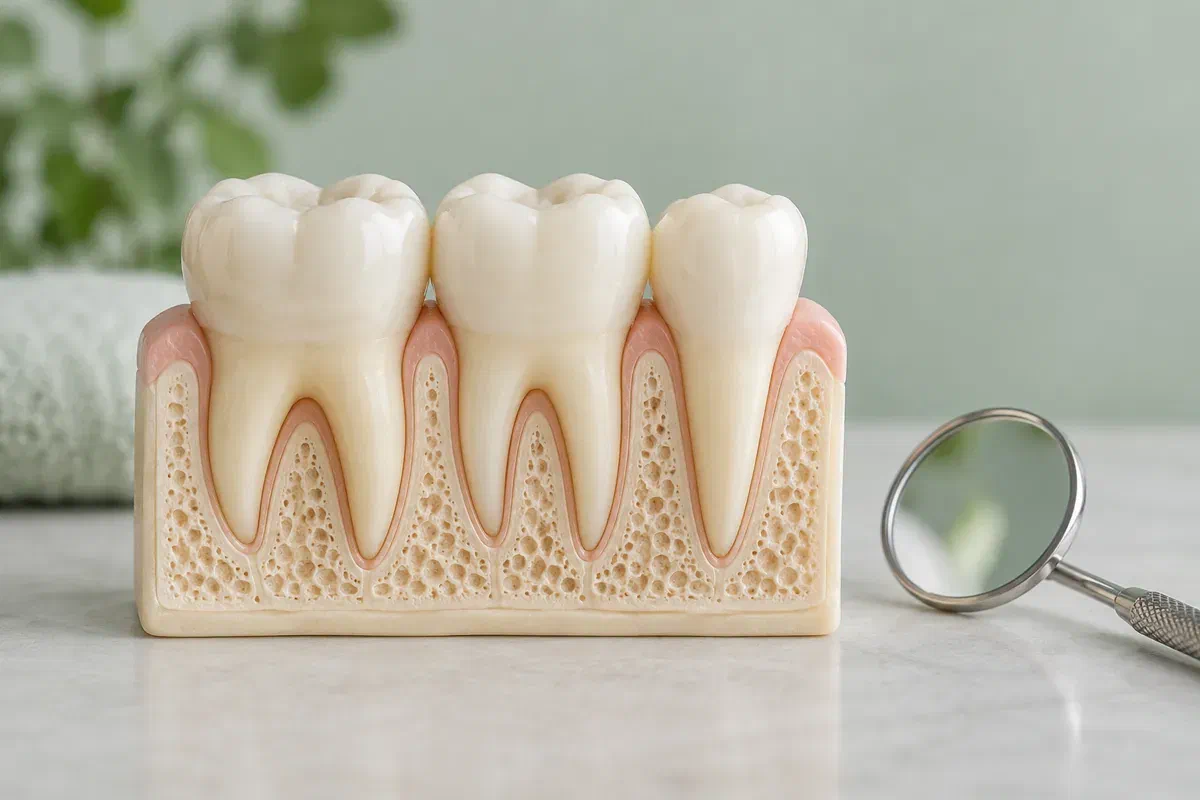
Illustrative physical model showing teeth supported by gum tissue and underlying bone
Helping us triage

Three things decide how quickly you need us.

Share where the swelling is, when it began and whether it is getting worse. Health conditions and medicines matter as well, especially any that lower resistance to infection. A family member can make the call if the person affected finds talking difficult.

A swollen, sore spot next to a tooth

Name the tooth or area and say whether chewing or touching hurts. Previous gum problems, recent fillings or crowns, and anything that might have become wedged under the gum are worth mentioning. These help us prepare, but the cause is confirmed only by examining it.

Fluid draining or the pain letting go

Drainage often brings quick relief because the pressure has gone. That does not mean treatment has happened. Tell us what you noticed, keep the appointment and leave the area alone rather than squeezing or piercing it.

Fever, facial swelling or a stiff jaw

These suggest the infection may be affecting more than the gum, and the best setting for care can shift as a result. Call promptly. If anything has changed since the appointment was made, say so instead of assuming the earlier plan still holds.

Head to emergency medical care for difficulty breathing, speaking or swallowing, swelling or pain around an eye, any change in vision, or significant swelling in the mouth with trouble opening it. Call 911 when it is an immediate emergency; do not wait for a callback.

What dental care adds

Calm the infection, then deal with why it happened.

On the urgent day, the clinician judges severity and offers suitable local treatment. Ask for a plain account of what is done now and what is left for later. With that in hand, nobody in the house mistakes a calmer gum for the end of care.

The tooth’s condition and the health of the bone and gum around it guide what comes next. It is reasonable to ask whether the findings favour keeping the tooth and whether a separate gum or root canal assessment is needed. A single swelling does not, by itself, settle the outcome for that tooth.

Patient information: SDCEP — local treatment and appropriate antibiotic use for dental abscesses · SDCEP — periodontal abscess management and review

Local treatment for the cause that was found

A gum-pocket infection might be drained and cleaned, whereas one coming from inside the tooth usually takes a separate approach. Ask which source the clinician identified and what the treatment should achieve. Identical-looking lumps can need different procedures.

Antibiotics only where they help

No prescription takes the place of treating the local source. Spread, signs of general illness, whether drainage is possible and your medical history all shape the decision. Ask for the reason behind it either way, rather than expecting the same medicine for every abscess.

A review that closes the loop

Agree on when the area will be checked and what treatment may follow once the acute stage is controlled. If a deep pocket or a weakened tooth remains, there should be a plan for it. Swelling that returns deserves another look, even when earlier bouts eased.

How the appointment runs

What to expect once you are in the chair

Every visit adapts to the findings and to how ill you feel. Severe or spreading infection can mean care in a hospital or other setting, while a localized abscess is usually managed with a dental plan built around it.

  1. A conversation about the last few days

    Onset, pain, drainage, fever and any facial swelling come first. We also go through medicines, allergies, conditions and recent dental visits. If you have started antibiotics already, bring the details: who prescribed them, the reason and whether anything changed.

  2. A careful look and the right tests

    Examination of the gum and tooth may be combined with tooth sensitivity tests, gum pocket readings or suitable X-rays. Together they point to where the infection began. Ask the clinician what is now certain and what is not; the swelling is only one clue.

  3. Urgent care, explained before it starts

    You will hear the proposed local treatment, the comfort measures, the limits of what can be done today and the fees. Treatment may centre on a gum pocket, an infected tooth or something else the tests uncovered. When a referral or hospital assessment is wiser, we tell you why and what to do next.

  4. A written route to completion

    Before leaving, check what should get better, which symptoms mean phoning straight away and when the review is. Ask whether you have finished treatment or only the acute part. Plans for further gum care, a restoration, root canal treatment or extraction should be recorded clearly.

Back home

Simple instructions, followed closely

Aftercare varies with what was done and the source of the infection. Ask for guidance meant for your treatment rather than borrowing what a relative was told after an extraction, root canal or gum surgery.

Keep it clean without disturbing it

Check how to brush and clean beside the treated spot and whether to adjust your routine briefly. Avoid pressing or squeezing the gum to see whether it is better. If the method is too painful to manage, phone the team for practical suggestions.

Medicines by the directions, every time

Tell your clinician or pharmacist about any other medicines and health conditions before picking a pain reliever. Take prescribed antibiotics as directed and mention side effects. Do not use pills left over from an earlier illness, share prescriptions within the family or increase a dose because of lingering discomfort.

Watch the trend over the next days

Swelling, comfort and chewing should improve in the way the clinician described. If they worsen, return or follow a different pattern, get in touch. Attend the review even if all seems well, so any remaining treatment can be confirmed or completed.

After the diagnosis

Care that fits the cause, not the appearance

Ask the clinician to explain how each recommendation fits the diagnosis and your tooth’s condition. Local treatment now may be followed by a different form of care when the acute episode settles.

For infection involving the pocket and supporting tissues

Gum-focused treatment

Local care may be followed by reassessment and treatment of the gum disease beneath it. Ask what is still outstanding after drainage or cleaning, how the support around the tooth affects its future and whether a periodontist might help.

For infection that began inside the tooth

Tooth-focused treatment

A suitable tooth may be considered for root canal treatment and then a durable restoration. The gum may be where the drainage shows, but that does not make it purely a gum issue. Ask about restorability, alternatives and whether an endodontist should be involved.

For a tooth that cannot be kept, or infection that is spreading

Removal or hospital-level care

A severely damaged tooth may need extraction, and an infection that is spreading may require urgent care beyond a regular dental practice. Ask why a given option suits the findings. Clinical need, alternatives and your health should drive the decision, not a rule applied to every abscess.

Questions from Brampton households

Deciding where to go and what comes next

These answers can help you prepare and choose a sensible first step. They cannot pin down the source or urgency of a specific swelling without an examination and an account of the symptoms.

(905) 876-4488
Should I go to the emergency department for a gum abscess?
For a localized swelling without serious symptoms, a prompt dental assessment is usually the right first step. Go to emergency care for swelling near the eye, vision changes, trouble breathing or swallowing, or major swelling with difficulty opening your mouth.
Can teenagers get gum abscesses too?
Gum swellings can occur at different ages, sometimes from trapped food or an erupting tooth, and sometimes from a problem inside a tooth. Any tender swelling in a young person’s mouth should be assessed. Call us to discuss the symptoms and what to do next.
Can another family member call on my behalf?
Yes. If it is hard for you to talk, someone else can phone and describe the swelling, how it has changed and any other symptoms. Have your health conditions and medicines ready so we can discuss urgency.
Does an opened abscess still need to be checked?
It does. Once it drains, pressure and pain often drop, but the source of the infection is likely still there. Keep the appointment and describe when the drainage happened so the cause can be identified and treated.
Will taking antibiotics from the walk-in clinic fix it?
Antibiotics alone are not relied on to resolve a gum abscess. The dental source needs local assessment and treatment. Tell us about any medicine you have been given, and ask what further care is needed even if symptoms improve.
Is the tooth beside the abscess going to need pulling?
Not necessarily. The choice depends on what caused the infection, the condition of the tooth and how much support it has. Some teeth can be treated and kept; others cannot. Ask what the examination shows and why the suggested option fits.
Calling from Brampton

One phone call can settle the next step.

Contact our Bronte Street practice at (905) 876-4488 to talk about an urgent gum problem and how soon we can help. Be clear about any spreading swelling or feeling unwell. Email and online requests are for non-urgent questions.

Urgent appointments are not always available. When needed, contact another emergency dental provider, or seek emergency medical care for serious symptoms.

Visit Milton Dental Clinic
Unit 1, 342 Bronte St. S, Milton, ON L9T 5B7
Get directions Clinic hours
Monday–Thursday
11am–7pm
Friday–Sunday
By appointment only

Areas we serve

  • Milton
  • Oakville
  • Mississauga
  • Georgetown
  • Halton Hills
  • Acton
  • Campbellville
  • Brampton
  • Burlington
  • Puslinch
  • Rockwood
  • Erin
  • Caledon
  • Etobicoke
  • Old Milton
  • Bronte Meadows
  • Timberlea
  • Dorset Park
  • Dempsey
  • Clarke
  • Beaty
  • Coates
  • Harrison
  • Scott
  • Willmott
  • Ford
  • Bowes
  • Cobden
  • Walker
  • Mountain View
  • Milton Heights
  • Hawthorne Village
  • Valley View
  • Fallingbrook
  • Nassagaweya
  • Trafalgar
  • Esquesing
  • Nelson
  • Brookville
  • Moffat
  • Glen Williams
  • Norval
  • Limehouse
  • Stewarttown
  • Ashgrove
  • Hornby
  • Silver Creek
  • Speyside
  • Scotch Block
  • North Oakville
  • River Oaks
  • Glen Abbey
  • West Oak Trails
  • Palermo
  • Bronte Creek
  • College Park
  • Joshua Creek
  • Uptown Core
  • Preserve
  • Iroquois Ridge
  • Lisgar
  • Meadowvale
  • Meadowvale Village
  • Churchill Meadows
  • Erin Mills
  • Central Erin Mills
  • Streetsville
  • East Credit
  • Creditview
  • Heartland
  • Sheridan
  • Mount Pleasant
  • Credit Valley
  • Huttonville
  • Churchville
  • Springbrook
  • Northwest Brampton
  • Bram West
  • Fletcher's Meadow
  • Fletcher's Creek South
  • Alton Village
  • Orchard
  • Millcroft
  • Headon Forest
  • Tansley
  • Brant Hills
  • Tyandaga
  • Kilbride
  • Lowville
  • Aberfoyle
  • Morriston
  • Arkell
  • Hillsburgh
  • Freelton
  • Carlisle
  • Waterdown
  • Flamborough
  • Mountsberg

How can we help?

Milton Dental Clinic

Have a question about your smile? Choose the option that works best for you.

For urgent dental concerns, please call.
Messages are reviewed during clinic hours.