

Illustrative patient and clinician discussing options beside a small gum model
Specialized Care

Gum Grafting in Burlington

Was a gum graft suggested before braces, aligners or new restorative work? From Burlington, you can bring that recommendation to us and talk through what the tissue concern is, how grafting fits the sequence, who would carry it out, and whether monitoring or another step deserves a look first.

Grafting as part of a bigger plan

Where does a graft sit in the order of treatment?

A note on an orthodontic consult or a crown plan that reads “consider gum graft” tends to raise more questions than it answers. Why now? Why this tooth? And would it change if you waited? Those questions deserve clear answers before anything is scheduled.

In a graft, soft tissue is added to or moved around a tooth with one main purpose. It may be to build up thin tissue, partially cover an exposed root, or create a gum margin that's easier to keep clean. Not every graft does each of these, which is why the purpose should be written into the plan.

If you're coming from Burlington with a referral or treatment summary, bring it along. We'll review the tooth, the surrounding support and what's planned next, then talk about sequencing, who coordinates which step, and whether a periodontist, monitoring or a different route makes sense.

Discuss a grafting recommendation
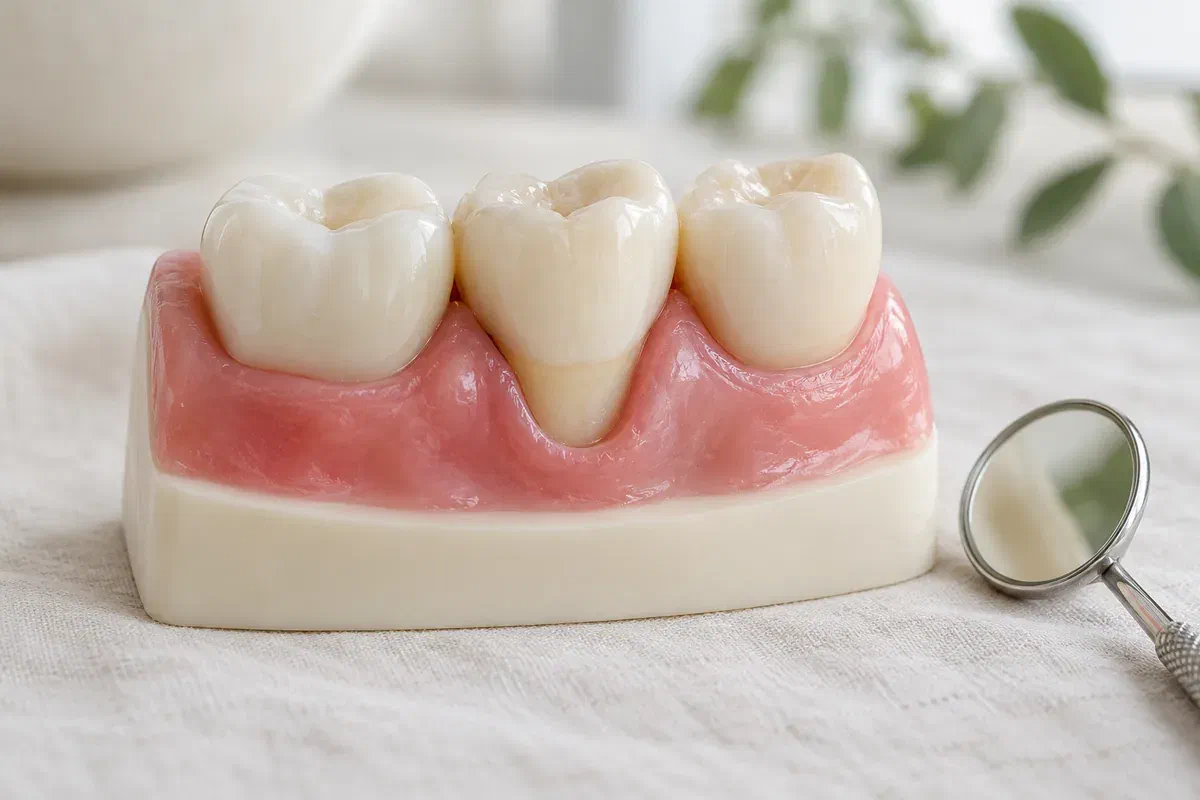
Illustrative physical tooth-and-gum model showing a localized lowered gum margin
Where the question usually starts

A plan, a symptom, or a change you spotted

Let us know whether the graft was suggested by another provider, whether a tooth feels sensitive, or whether you've simply noticed the gum shift. Your concern focuses the visit; the exam decides what's realistic.

A gum margin that has moved

Show us the tooth and estimate when it changed. Records or photos from earlier visits can help show whether things are progressing. With that, we can talk about contributors and what would need confirming before deciding between careful observation and treatment.

Tenderness or trouble keeping a site clean

Tell us whether brushing, flossing, or certain foods and drinks set it off. There's often more than one explanation for that kind of sensitivity. We can explore whether something nonsurgical would help and what grafting might contribute specifically for you.

Thin tissue flagged before tooth movement or restorations

Orthodontic and restorative plans sometimes mention grafting first. Ask what the concern is at that tooth, how the graft relates to the other work, what the timing is and who oversees the sequence. The note should explain more than the single word thin.

Grafting is soft-tissue care. It should not be presented as regrowing bone or attachment that gum disease has already removed, and complete root coverage can't be assumed.

Making the purpose explicit

Name the goal, then judge the proposal.

When grafting is tied to other treatment, the expected benefit can be easy to lose track of. Is the aim to make the tissue more robust before teeth move, to cover some root, or both? Ask for the intended change at your tooth and what is likely to remain as it is.

Contributing factors still count. Inflammation, brushing technique and other habits can keep affecting the gums during and after orthodontic or restorative care. A graft belongs within ongoing maintenance and shouldn't be treated as a reason to skip cleanings or reviews.

Patient information: Cambridge University Hospitals — soft-tissue grafting goals, procedure, and risks

An outcome described for your site

Neighbouring tissue and bone affect what can be achieved, and results may vary even between adjacent teeth. Ask for the intended improvement, the remaining uncertainty, and how the result will be assessed after healing. If teeth are going to move, ask whether that changes the expected outcome.

Where the graft tissue would come from

Some techniques take tissue from the palate; others may use different materials in suitable situations. Ask which is proposed and why, and whether a second area will need to heal. This should be discussed openly as part of consent.

Recovery that fits the treatment calendar

Go over expected soreness, eating and cleaning limits, stitches, review visits and possible complications. Ask how long healing needs before the next stage of treatment can start. No method is free of risk, and more care may be needed if healing doesn't go as planned.

Coordinating the steps

Who does what, and when?

For someone coming from Burlington, the office that assesses the gum, the office doing the graft and the one handling braces or crowns may all be different. Ask where each step happens and how records will be shared before committing.

  1. Review the referral and examine the area

    We go over the recommendation, your symptoms, past gum care, cleaning routine, medical history and medicines, and assess the recession and supporting tissues. If additional records or a periodontist's input would help, we'll explain why.

  2. Agree on purpose and timing

    We compare watching, nonsurgical measures and grafting where appropriate, and discuss where each fits around your other treatment. Ask what delay would mean and what is realistically expected. Tissue source, donor site, anaesthetic, fees and preparation should all be clear.

  3. Complete the graft if it's indicated

    The clinician performing it explains how the area will be prepared and how the tissue will be placed and held. Local anaesthetic is commonly used, with other arrangements considered individually. Technique and setting depend on the tooth, the aim and the provider.

  4. Heal, review and hand back to the next stage

    Get written instructions for the graft and any donor area covering cleaning, food, medicines and stitches. Confirm review dates and when it's safe to resume other treatment. Later reviews should check the original purpose as well as appearance.

During recovery

Protect the site so the next stage can follow.

Follow the aftercare for the procedure you actually had. Ask if graft and donor-site guidance seem different, and keep contact details for the treating office within easy reach.

No stretching, poking or testing

Pulling back the lip or cheek to look, pressing on the tissue or checking whether it's attached can all disrupt healing. Your clinician will examine it at review and can tell you how it's progressing. Leaving it alone is one of the most useful things you can do, even when you're eager to see whether it worked.

Adjust cleaning and meals as instructed

You may need to avoid normal brushing and flossing at the treated site for a period. Follow guidance on where to clean, any rinse, appropriate food and when your regular routine can return. Wait for clearance before brushing the graft as usual.

Report concerns and keep follow-ups

Ask what discomfort and swelling to expect and how to manage them safely. Contact the treating provider about continued bleeding, increasing pain, fever or anything unusual. Attend stitch removal and tissue reviews even if you feel fine.

Patient information: Guy's and St Thomas' — protecting a gum graft and following postoperative instructions

Comparing routes

Thin tissue can be handled in more than one way.

Ask which approach fits the documented concern and how it compares with alternatives. The plan should consider symptoms, stability, tissue type, support around the tooth and your goals.

When observation fits the site and the plan

Monitoring with closer attention to cleaning

The area may be documented, home care adjusted and the site checked during other treatment. Ask what change would trigger a rethink and how measurements will be compared from one visit to the next. Monitoring should come with clear checkpoints and a named person responsible for them, especially when more than one office is involved in your care.

When something simpler meets the need

Nonsurgical care for a symptom or contributor

Sensitivity care, managing inflammation or changing brushing habits may be appropriate. These don't restore lost tissue, so ask what each achieves and how long you'd try it before reviewing. Comfort and long-term tissue goals may need different parts of the plan, and one doesn't automatically settle the other.

When surgery offers a clear benefit

A soft-tissue graft timed around other work

Weigh the expected tissue change against risks and recovery, and ask how timing affects your other treatment. Ask whether a periodontist should provide the graft and how their notes will reach your other providers. A website listing doesn't establish suitability, on-site specialist care or full coverage of the root.

Questions about timing and coordination

Before braces, crowns or a graft

Bring any referral or treatment plan and ask that the recommendation be explained using your own findings. These questions can help clarify how the steps fit together.

(905) 876-4488
Why would grafting be suggested before orthodontic treatment?
Sometimes a clinician is concerned that thin tissue at a particular tooth may be vulnerable as teeth move. Ask what was observed, what the graft is meant to achieve and whether monitoring during treatment is a reasonable alternative.
How long should a graft heal before the next stage of treatment?
That depends on the procedure and the next step. The treating clinician should give a timeline. Ask how healing will be confirmed and who decides when it’s appropriate to start or resume braces or restorative work.
Can grafting be done after braces instead of before?
In some cases timing can be flexible, and in others the clinician may prefer a particular order. Ask why a specific sequence is recommended and what the trade-offs of changing it might be.
Is a graft expected to restore the bone around my tooth?
No. Gum grafting deals with soft tissue, while regenerating deeper support is a separate topic. Ask which structures the proposed procedure addresses and don’t take better gum coverage as evidence that bone has returned.
Do aligners or retainers affect a healing graft?
They might, depending on where the graft is and how the appliance fits. Mention any appliance you wear. The treating clinician can advise whether to adjust or pause wear and when it’s safe to resume.
Who keeps my orthodontist, dentist and periodontist on the same page?
Ask this at the start. One provider usually acts as the main point of contact for records and sequencing. Make sure everyone has the relevant notes and that you know whom to call with questions during each stage.
Burlington grafting consultations

A recommendation explained before the calendar fills up

Contact our Bronte Street practice with a grafting suggestion, a receding gum or a sensitive area. We can outline the assessment needed and how we'd work alongside your orthodontist, periodontist or other dentist.

Only an individual exam can confirm whether a graft is needed, how and where it would be done, the fees involved, and what healing and coverage to expect.

Visit Milton Dental Clinic
Unit 1, 342 Bronte St. S, Milton, ON L9T 5B7
Get directions Clinic hours
Monday–Thursday
11am–7pm
Friday–Sunday
By appointment only

Areas we serve

  • Milton
  • Oakville
  • Mississauga
  • Georgetown
  • Halton Hills
  • Acton
  • Campbellville
  • Brampton
  • Burlington
  • Puslinch
  • Rockwood
  • Erin
  • Caledon
  • Etobicoke
  • Old Milton
  • Bronte Meadows
  • Timberlea
  • Dorset Park
  • Dempsey
  • Clarke
  • Beaty
  • Coates
  • Harrison
  • Scott
  • Willmott
  • Ford
  • Bowes
  • Cobden
  • Walker
  • Mountain View
  • Milton Heights
  • Hawthorne Village
  • Valley View
  • Fallingbrook
  • Nassagaweya
  • Trafalgar
  • Esquesing
  • Nelson
  • Brookville
  • Moffat
  • Glen Williams
  • Norval
  • Limehouse
  • Stewarttown
  • Ashgrove
  • Hornby
  • Silver Creek
  • Speyside
  • Scotch Block
  • North Oakville
  • River Oaks
  • Glen Abbey
  • West Oak Trails
  • Palermo
  • Bronte Creek
  • College Park
  • Joshua Creek
  • Uptown Core
  • Preserve
  • Iroquois Ridge
  • Lisgar
  • Meadowvale
  • Meadowvale Village
  • Churchill Meadows
  • Erin Mills
  • Central Erin Mills
  • Streetsville
  • East Credit
  • Creditview
  • Heartland
  • Sheridan
  • Mount Pleasant
  • Credit Valley
  • Huttonville
  • Churchville
  • Springbrook
  • Northwest Brampton
  • Bram West
  • Fletcher's Meadow
  • Fletcher's Creek South
  • Alton Village
  • Orchard
  • Millcroft
  • Headon Forest
  • Tansley
  • Brant Hills
  • Tyandaga
  • Kilbride
  • Lowville
  • Aberfoyle
  • Morriston
  • Arkell
  • Hillsburgh
  • Freelton
  • Carlisle
  • Waterdown
  • Flamborough
  • Mountsberg

How can we help?

Milton Dental Clinic

Have a question about your smile? Choose the option that works best for you.

For urgent dental concerns, please call.
Messages are reviewed during clinic hours.