

Illustrative patient and clinician discussing options beside a small gum model
Specialized Care

Gum Grafting in Erin

Gum grafting often involves more than one clinician, and it helps to know who does what. From Erin or Hillsburgh, you can start with an assessment here, learn whether a periodontal specialist should be involved, and understand how records, surgery and follow-up would be shared between offices.

Assessment and referral

Who would actually do the graft?

It's a question people often forget to ask until late in the process. Your general dentist may spot the recession, a periodontist may perform the surgery, and follow-up might be split between them. Understanding that arrangement early saves confusion, repeated tests and wasted trips.

The procedure itself moves or adds soft tissue at a tooth with one main aim: sturdier tissue, partial cover for an exposed root, or a margin that's easier to look after. Those purposes differ, and the right clinician and technique often depend on which one your tooth needs.

Coming from Erin, it makes sense to start where your questions can be sorted out in one visit. We'll examine the area and the tooth's support, look at what might be contributing, and explain whether grafting is worth pursuing, whether a periodontist should see you, or whether monitoring or nonsurgical care comes first.

Start a gum assessment from Erin
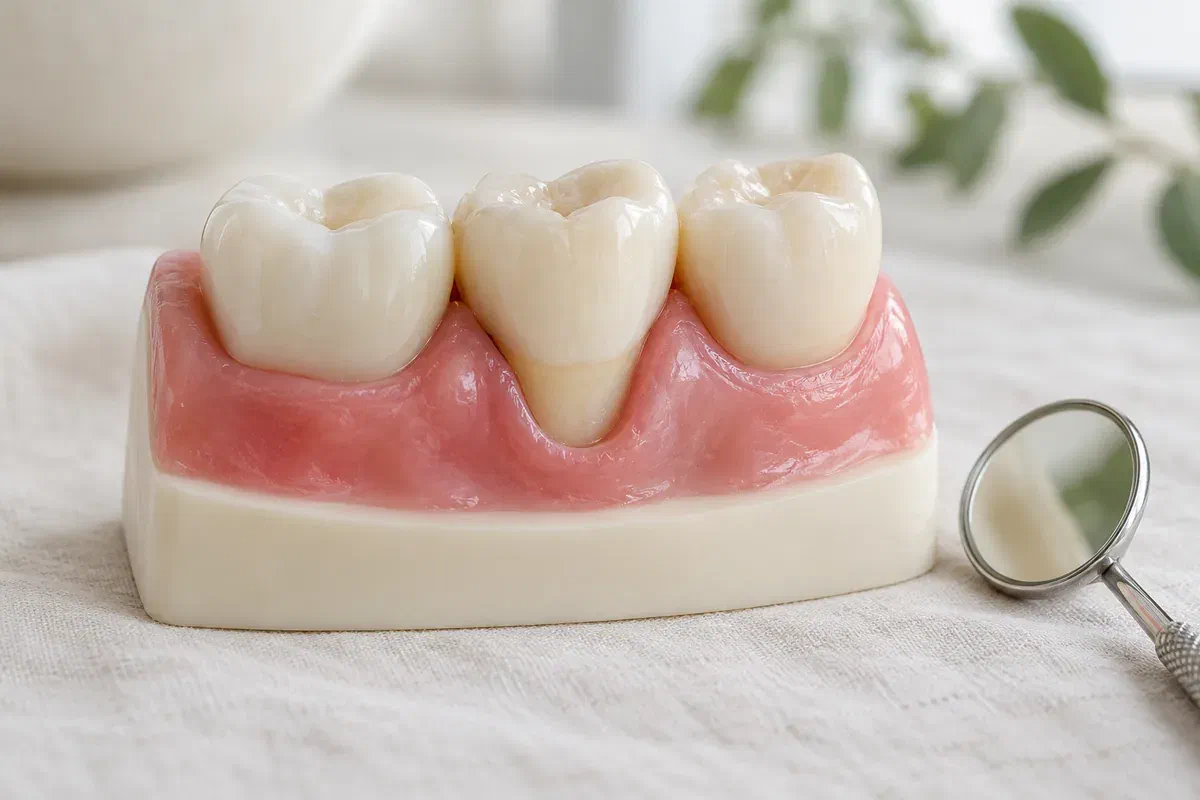
Illustrative physical tooth-and-gum model showing a localized lowered gum margin
What brings the question up

Recession, sensitivity or a referral letter

Say whether you're mostly concerned about how a tooth looks, a sensitive or awkward area, or advice from another provider. That shapes the conversation, and the examination indicates which goals are reachable.

A gumline that has pulled back

Point to the area and give a rough timeline. Earlier records or photographs, from us or another office, make it easier to tell whether it's progressing. With that context we can discuss possible causes and what's needed before choosing observation or treatment.

Tenderness or trouble cleaning at one tooth

Tell us what triggers it and how it affects your routine. Sensitivity can stem from several causes, and recession is only one. A nonsurgical step may help, so we'll weigh that against what a graft would add.

A recommendation from an orthodontist or another dentist

If grafting was proposed before other treatment, ask how the plans relate, which comes first and who's responsible for coordinating them. A clear recommendation explains what's happening at that tooth instead of resting on the word thin.

Gum grafting is soft-tissue surgery. It doesn't restore bone or attachment taken by periodontal disease, and complete root coverage is never a safe assumption.

Clarifying the goal

A clear aim makes the referral easier, too.

When the purpose of a graft is written down, every clinician involved can work toward the same target. For one tooth, that may be firmer tissue; for another, some root coverage could be reasonable. Ask what change is expected at your tooth and what's likely to remain the same.

Contributing factors don't go away with surgery. Inflammation, brushing technique and other habits need ongoing attention, often with your regular dentist or hygienist. A graft fits into continuing care rather than replacing cleanings or maintenance.

Patient information: Cambridge University Hospitals — soft-tissue grafting goals, procedure, and risks

An expectation tailored to your site

The gum and bone around neighbouring teeth affect the possible outcome, and it can differ between teeth. Ask what improvement is intended, how confident the clinician is, and who will assess the result and when.

Knowing what tissue would be used

The palate is a common source, which means a second area to heal, while some situations may allow other materials. Ask which option the treating clinician favours and why. This is part of your consent, wherever the surgery happens.

Recovery planned across offices

Ask about tenderness, food and cleaning limits, stitches, reviews and possible complications, and which office handles each. Consider work and household duties, and for rural households, who can cover chores or driving in the first day or two. Every procedure has some risk, and additional care might be needed if healing doesn't match the plan.

How shared care works

Assessment here, surgery possibly elsewhere

Your assessment, any surgery and the reviews may not all happen under one roof. Ask where each step will be, who holds your records, and whom to contact at each stage before making arrangements.

  1. Examine the area and gather the history

    We'll go over symptoms, past gum care, cleaning habits, overall health and medicines, and assess the gum and the tooth's support. If a periodontist's opinion or extra records are needed, we'll explain why and help with the referral.

  2. Agree on the goal before any referral

    We discuss monitoring, nonsurgical care and grafting where each fits. Ask what waiting would mean and what's realistically achievable. Questions about tissue source, donor site, anaesthetic and fees may be answered in more detail by the treating specialist.

  3. Have the graft with the right clinician

    On the day, the surgeon walks you through readying the receiving area and securing the new tissue in place. Local anaesthetic is commonly used, with any other arrangements assessed by that provider. Ask them to send a summary of what was done back to your regular dentist so everyone works from the same notes.

  4. Heal and return for shared follow-up

    Keep the written aftercare from the treating office, covering cleaning, food, medicines and stitches. Confirm who sees you for each review and when your normal routine can resume. Over time, the result should be checked against the original goal.

After surgery

Keep the right phone number handy.

Your instructions should come from the clinician who did the procedure and match what was done. If anything is unclear, ask that office first, and keep their contact details where you'll find them quickly.

Leave the graft undisturbed

Don't pull back your lip or cheek to look, press on the tissue or test whether it's attached. The treating clinician will check it at review. A quick look can do more harm than it seems, and the tissue is better protected by patience than by inspection.

Follow the temporary cleaning and food plan

Brushing and flossing may pause at the surgical site for a time. Stick to the treating office's advice on where to clean, rinses, suitable meals and when to resume your normal routine. Don't brush the graft until you've been cleared.

Know whom to call, and attend reviews

Ask what discomfort is expected and which pain relief is safe for you. Contact the office that did the surgery about persistent bleeding, worsening pain, fever or other concerns. For severe symptoms, seek urgent care closer to home. Keep every review.

Patient information: Guy's and St Thomas' — protecting a gum graft and following postoperative instructions

Options and who provides them

Some routes stay with your dentist; others go to a specialist.

Ask which option fits the concern documented at your tooth and who would provide it. The plan should reflect symptoms, stability, surrounding tissue and bone, and what matters to you.

When the site appears stable

Monitoring with your regular dental team

The area can be recorded and rechecked at routine visits while your cleaning is fine-tuned. Agree on what change would lead to a referral or a graft, and make sure records are kept so each check can be compared fairly.

When simpler care addresses the need

Nonsurgical care for symptoms or causes

Desensitizing approaches, managing inflammation or improving brushing technique can often be handled by your general dentist and hygienist where suitable. None of them puts back gum that has receded, so be clear about what you can expect from each. A symptom eased close to home may be enough for now, while the longer-term tissue question is reviewed at later visits.

When the exam supports surgery

A graft by an appropriate clinician

Weigh the expected change against risks and recovery, and ask who's best placed to provide the procedure. A grafting service page doesn't confirm suitability, in-house specialist availability or complete coverage of the root.

Referral and coordination questions

Understanding who does what

Ask that any recommendation be explained in light of your own exam, and clarify each clinician's role. These questions can help you navigate shared care.

(905) 876-4488
What does a periodontist do that a general dentist might not?
A periodontist is a dental specialist focused on gums and supporting structures, including surgical procedures like many grafts. Your general dentist may assess and refer, then continue routine care. Ask who’s best suited to your particular case.
Can my records be sent ahead so I don't repeat tests?
Often, yes. With your consent, X-rays, charts and notes can be shared with the treating specialist. Ask what will be sent and whether anything will need to be redone. Bringing copies of recent X-rays or a referral letter to your first visit can also help, especially if you’d rather not make an extra trip just to fill a gap in the records.
Will I still see my own dentist while grafting care is underway?
Usually, for routine checkups and cleanings, though timing around surgery may change. Ask both offices how they’ll coordinate and when it’s appropriate to resume regular hygiene visits near the treated site.
Is the goal of every graft to cover the whole exposed root?
No. Many grafts are chosen for tissue thickness rather than full coverage, and how much of a root can be covered changes from tooth to tooth. Ask the treating clinician to describe the target for your site and the local factors that could hold it back.
Does grafting replace bone that has been lost?
No. Soft-tissue grafts and treatments aimed at regenerating deeper support are distinct. Ask which structures your procedure targets, and don’t treat better gum coverage as proof that support has returned.
Can I discuss grafting even if my main worry is cleaning, not looks?
Yes. Describe where cleaning is difficult or uncomfortable. The cause can be assessed, nonsurgical steps discussed and a graft considered if it offers a real benefit. Function is a valid reason to ask.
Erin gum consultations

Start with clear answers and a coordinated plan.

Get in touch with our Bronte Street practice about a receding gum, a sensitive spot or a grafting referral. We'll explain what the assessment covers and how we coordinate with a periodontal specialist when that's the right route.

Need, technique, tissue source, specialist referral, fees, recovery and possible coverage all depend on individual assessment.

Visit Milton Dental Clinic
Unit 1, 342 Bronte St. S, Milton, ON L9T 5B7
Get directions Clinic hours
Monday–Thursday
11am–7pm
Friday–Sunday
By appointment only

Areas we serve

  • Milton
  • Oakville
  • Mississauga
  • Georgetown
  • Halton Hills
  • Acton
  • Campbellville
  • Brampton
  • Burlington
  • Puslinch
  • Rockwood
  • Erin
  • Caledon
  • Etobicoke
  • Old Milton
  • Bronte Meadows
  • Timberlea
  • Dorset Park
  • Dempsey
  • Clarke
  • Beaty
  • Coates
  • Harrison
  • Scott
  • Willmott
  • Ford
  • Bowes
  • Cobden
  • Walker
  • Mountain View
  • Milton Heights
  • Hawthorne Village
  • Valley View
  • Fallingbrook
  • Nassagaweya
  • Trafalgar
  • Esquesing
  • Nelson
  • Brookville
  • Moffat
  • Glen Williams
  • Norval
  • Limehouse
  • Stewarttown
  • Ashgrove
  • Hornby
  • Silver Creek
  • Speyside
  • Scotch Block
  • North Oakville
  • River Oaks
  • Glen Abbey
  • West Oak Trails
  • Palermo
  • Bronte Creek
  • College Park
  • Joshua Creek
  • Uptown Core
  • Preserve
  • Iroquois Ridge
  • Lisgar
  • Meadowvale
  • Meadowvale Village
  • Churchill Meadows
  • Erin Mills
  • Central Erin Mills
  • Streetsville
  • East Credit
  • Creditview
  • Heartland
  • Sheridan
  • Mount Pleasant
  • Credit Valley
  • Huttonville
  • Churchville
  • Springbrook
  • Northwest Brampton
  • Bram West
  • Fletcher's Meadow
  • Fletcher's Creek South
  • Alton Village
  • Orchard
  • Millcroft
  • Headon Forest
  • Tansley
  • Brant Hills
  • Tyandaga
  • Kilbride
  • Lowville
  • Aberfoyle
  • Morriston
  • Arkell
  • Hillsburgh
  • Freelton
  • Carlisle
  • Waterdown
  • Flamborough
  • Mountsberg

How can we help?

Milton Dental Clinic

Have a question about your smile? Choose the option that works best for you.

For urgent dental concerns, please call.
Messages are reviewed during clinic hours.