

Illustrative young adult discussing a wisdom-tooth assessment with a dental clinician
Specialized Care

Impacted Wisdom Teeth Removal in Milton

Heard the word impacted at a checkup? Sort out what it means for your own wisdom tooth in Milton: where it sits, whether it is causing trouble, what removal would involve, how recovery works, and when an oral surgeon should take over.

When a checkup turns up a wisdom tooth

A label on an X-ray is the start of the conversation, not the verdict.

Impacted simply means a wisdom tooth has not come fully into its normal place. Something has blocked or redirected it, usually limited room or an awkward angle, so it stays under the gum or bone or breaks through only part of the way at the back of the jaw. The term tells you about position. On its own, it does not say the tooth has to come out.

What decides the matter is the whole picture: any symptoms, signs of disease, what is happening to the molar next door, how likely trouble is later, and the risks the surgery itself carries. Some impacted teeth are reasonably watched over time. Others have a plain reason to be removed. Your assessment should spell out which of those describes the tooth in question.

For Milton households, the first step can be as simple as bringing earlier X-rays or a referral letter to our Bronte Street practice and describing what you have noticed. We will go through the findings, the available care, and whether an oral surgeon should be involved. Before deciding, you should know why treatment is suggested, the alternatives, the recovery, and the risks that apply to your anatomy.

Book a wisdom-tooth assessment in Milton
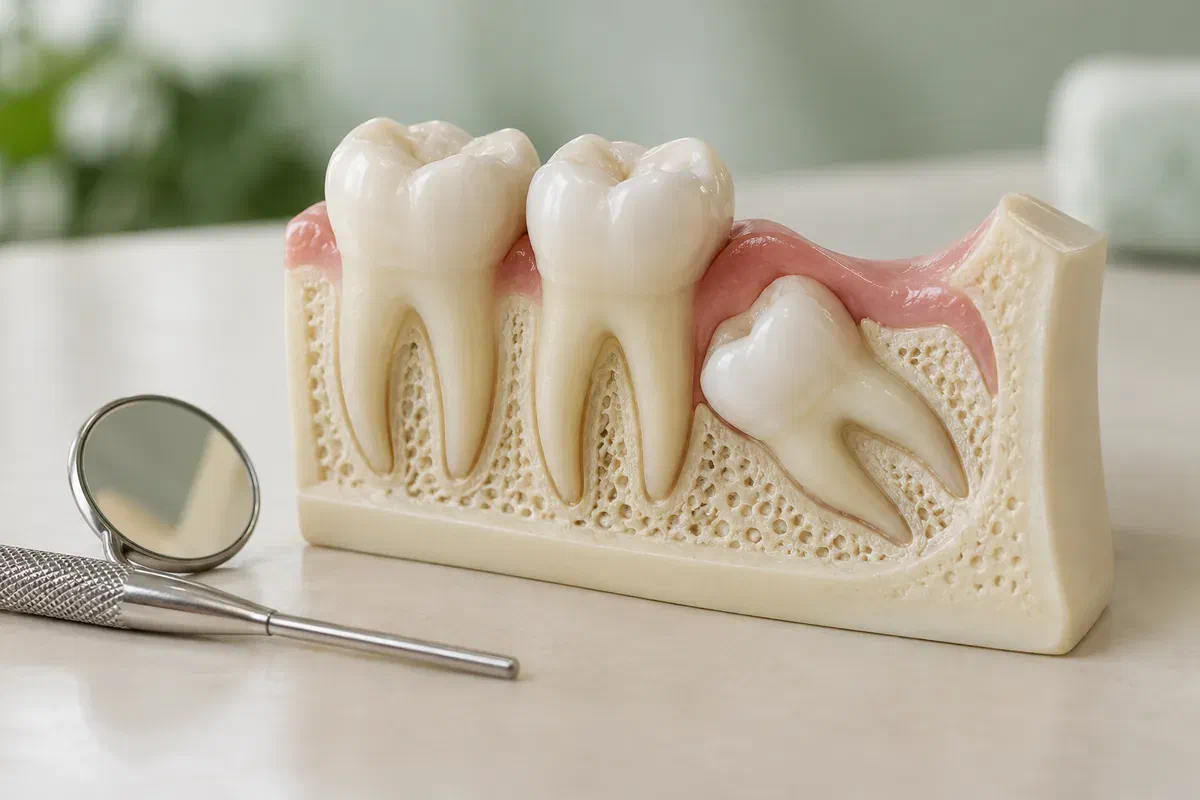
Illustrative physical jaw model with an angled wisdom tooth behind two upright molars
Why the tooth is being discussed

What matters is the problem it causes, not only how it tilts.

Let us know if the area has flared up more than once, has changed recently, or has never bothered you. That history helps separate a tooth causing trouble now from one that calls for a careful talk about watching and weighing risk.

Sore, puffy gum at the very back

Describe swelling, tenderness, a spot that is hard to brush, or food packing under the gum flap, plus earlier flare-ups and how they were treated. A sudden episode may need settling before anyone decides on surgery, and growing swelling or a jaw that is harder to open should be reported the same day, not held for a routine visit.

Trouble reaching the molar in front

The examination covers the wisdom tooth and its surroundings, including parts you cannot see. Ask whether the second molar beside it shows decay or other damage and what the images suggest. When that neighbouring tooth needs its own treatment, find out how the two pieces of care will be ordered.

Something spotted on an image, with no discomfort

Many impacted teeth appear on a routine X-ray before causing any sensation. Ask whether disease is actually present, what possible future problem is in view, and what keeping watch would look like. Feeling fine is not a reason to ignore the finding, and the word impacted is not a reason to remove the tooth automatically.

Call us promptly if swelling is increasing, you develop a fever, or opening your mouth is getting harder. Trouble breathing or swallowing, swelling that reaches the eye, or swelling that spreads quickly needs emergency medical care straight away, not a wait for a dental appointment.

What removal is meant to fix

Match the surgery to a specific reason.

When taking a wisdom tooth out makes sense, the goal is to deal with a defined source of disease or a properly weighed risk. Ask exactly which problem the procedure should solve and whether other treatment will still be needed. Extraction is not a fix for unrelated jaw pain or a general answer to crowding worries.

Careful planning matters because no two impacted teeth sit quite the same way. A lower tooth resting near a sensory nerve raises different questions than an upper tooth close to the sinus floor. Your consultation is where those differences are explained, along with how they shape the technique, where treatment takes place, and whether a specialist should provide it.

Patient information: British Association of Oral and Maxillofacial Surgeons — impacted wisdom-tooth treatment decisions and risks

Weighing keep against remove

Ask what is likely if the tooth stays and what risks come with taking it out. The answer should come from your own findings, not a rule that every wisdom tooth goes. Where watching is sensible, ask which changes would bring the question back to the table.

A plan built around your anatomy

Your clinician looks at how the tooth relates to the teeth beside it, the surrounding bone, and nearby nerves or sinus. Extra imaging may be suggested when its answer would change the plan. It is reasonable to ask what a particular view will show instead of assuming everyone needs the same scan.

Honest expectations about healing

Talk through soreness, swelling, bleeding, dry socket, infection, and any risk tied to where the tooth sits. With lower teeth, changes in sensation occasionally last. Ask how your own risk is judged and what follow-up you can count on. A common procedure still calls for a full consent discussion.

How a plan comes together

First the reason, then the setting, then the recovery.

Being assessed does not commit you to surgery that day. The plan depends on your symptoms, your anatomy and medical history, what treatment is available, and whether a specialist opinion or further tests are needed first.

  1. Share the history of the area

    Tell us about past pain, swelling, infections, and any treatment there. Bring a list of medicines and allergies, relevant health details, and earlier X-rays if you have them. Mention if dental visits make you anxious, or if anaesthetic has given you trouble before, so comfort can be planned honestly.

  2. Walk through findings and choices

    We explain why treatment is being suggested, whether watching is an option, and any alternative suited to this tooth. Ask how the position affects risk and whether a referral makes sense. Fees, the number of visits, and any open questions should be clear before you decide.

  3. Carry out the agreed treatment where it fits best

    Removing an impacted tooth can mean lifting the gum, taking away some surrounding bone, and sectioning the tooth so it comes out in a controlled way. You will hear the approach and the anaesthetic plan beforehand. Sedation or general anaesthesia is never assumed; it needs a suitability check and a provider who can offer it.

  4. Leave with aftercare and a way to reach help

    Before you go, you receive guidance on bleeding, cleaning, eating, medicines, activity, and stitches if any were placed. Confirm when you will be reviewed and how to raise a concern. After sedation, follow the treating provider's specific rules about an escort, supervision, driving, and activity.

Healing after removal

Look after the socket and notice if recovery changes course.

Your written instructions are based on your procedure and health, so follow them closely. Healing varies from person to person. Ask what to expect in your case and which symptoms mean you should call, rather than comparing with a friend's recovery.

Clean and eat the way you were shown

Find out how to keep the rest of your mouth clean while protecting the socket and any stitches. Do not poke at the site or try to clear it with toothpicks or other makeshift tools. Stick to the suggested foods and return to normal brushing at the pace your treating team sets.

Line up medicines, rest, and help at home

Take pain relief as your clinician or pharmacist directs, with your medical history in mind. Never stop a prescribed blood thinner or other medicine on your own. Arrange any help you will need and check anaesthetic-related limits before planning work, driving, or a workout.

Call about bleeding or symptoms that worsen

Contact the treating provider if bleeding does not settle with the steps you were given, or if pain, swelling, fever, or an unusual change in feeling gets worse. Pain that climbs again after it had eased deserves a look. Not every sore recovery is normal, and not every one needs antibiotics.

Possible paths for this tooth

Watch, remove, or consider a partial approach, each for a stated reason.

Each tooth deserves its own decision. Ask how the expected benefit stacks up against the risks, and what every option would mean for check-ups, possible symptoms, and further care.

When observation is supported

Planned monitoring

A tooth with no current reason for surgery can be followed with clinical checks and imaging when it is justified. Ask what is being tracked and which findings or symptoms would change the advice. Watching is a deliberate plan; it does not promise the tooth will never cause trouble.

When extraction offers a clear benefit

Full removal

Go over the procedure, the risks for this particular tooth, anaesthetic, and where treatment would happen. Ask whether an oral surgeon should do it and whether your other wisdom teeth need separate decisions. A good recommendation explains why removal suits this tooth, rather than bundling all four by default.

When the nerve is close enough to change the plan

Coronectomy for certain lower teeth

In some cases a surgeon may take away the crown and deliberately leave suitable roots behind to lower a specific risk of nerve injury. It does not suit every tooth. Ask about eligibility, how the remaining roots are monitored, and whether further surgery might be needed later.

Patient information: British Association of Oral and Maxillofacial Surgeons — coronectomy selection and retained-root considerations

Common questions in Milton

What people ask after hearing the word impacted

If your X-rays were taken somewhere else, bring them or note where they were done. The most useful conversation ties any proposed treatment to the tooth itself, the structures around it, and your health.

(905) 876-4488
My dentist said my wisdom tooth is impacted. Does that mean surgery?
Not necessarily. Impacted describes position. The decision rests on symptoms, signs of disease, effects on nearby teeth, likely future problems, and the risks of surgery. Ask which of those applies to your tooth and what watching it would involve if leaving it is reasonable.
Can you use X-rays that another office already took?
Often, if they are recent enough and show the area clearly enough to answer the question at hand. Bring copies or tell us where they were taken so they can be requested. New imaging is suggested only when it would add information that affects the plan.
Is there a best age to have an impacted wisdom tooth looked at?
No single age suits everyone. Roots and bone change over the years, so some surgeons discuss timing, but the decision still rests on your findings. An assessment whenever symptoms or an image raise the question is a sensible start.
How do I know whether an oral surgeon should be involved?
Referral is often discussed when a tooth sits deep, lies close to a nerve or the sinus, or when sedation or general anaesthesia is being considered. If we suggest it, we will explain the reason and which records would be shared with the surgeon.
Will I need time away from work or school afterward?
Many people plan a few quieter days, but the right amount depends on the procedure, the anaesthetic, and your kind of work. Ask for an estimate based on your plan, and check whether sedation adds limits on driving or duties.
What if the gum swells up again before my consultation?
Call us. A flare-up around a partly erupted tooth may need attention before the longer-term decision is made. Swelling that spreads, a fever, or difficulty opening should be reported promptly, and trouble breathing or swallowing needs emergency care.
Wisdom-tooth assessment in Milton

Find out if removal makes sense and what it would take.

Reach our Bronte Street practice to talk about an impacted wisdom tooth, a recurring sore spot, or a surgical recommendation you have been given. Mention swelling or pain that is getting worse when you call, and bring earlier records if you have them.

Monitoring, removal, coronectomy, imaging, anaesthetic, setting, referral, and your individual risks all depend on a clinical assessment. Neither a procedure nor an urgent appointment time can be guaranteed.

Visit Milton Dental Clinic
Unit 1, 342 Bronte St. S, Milton, ON L9T 5B7
Get directions Clinic hours
Monday–Thursday
11am–7pm
Friday–Sunday
By appointment only

Areas we serve

  • Milton
  • Oakville
  • Mississauga
  • Georgetown
  • Halton Hills
  • Acton
  • Campbellville
  • Brampton
  • Burlington
  • Puslinch
  • Rockwood
  • Erin
  • Caledon
  • Etobicoke
  • Old Milton
  • Bronte Meadows
  • Timberlea
  • Dorset Park
  • Dempsey
  • Clarke
  • Beaty
  • Coates
  • Harrison
  • Scott
  • Willmott
  • Ford
  • Bowes
  • Cobden
  • Walker
  • Mountain View
  • Milton Heights
  • Hawthorne Village
  • Valley View
  • Fallingbrook
  • Nassagaweya
  • Trafalgar
  • Esquesing
  • Nelson
  • Brookville
  • Moffat
  • Glen Williams
  • Norval
  • Limehouse
  • Stewarttown
  • Ashgrove
  • Hornby
  • Silver Creek
  • Speyside
  • Scotch Block
  • North Oakville
  • River Oaks
  • Glen Abbey
  • West Oak Trails
  • Palermo
  • Bronte Creek
  • College Park
  • Joshua Creek
  • Uptown Core
  • Preserve
  • Iroquois Ridge
  • Lisgar
  • Meadowvale
  • Meadowvale Village
  • Churchill Meadows
  • Erin Mills
  • Central Erin Mills
  • Streetsville
  • East Credit
  • Creditview
  • Heartland
  • Sheridan
  • Mount Pleasant
  • Credit Valley
  • Huttonville
  • Churchville
  • Springbrook
  • Northwest Brampton
  • Bram West
  • Fletcher's Meadow
  • Fletcher's Creek South
  • Alton Village
  • Orchard
  • Millcroft
  • Headon Forest
  • Tansley
  • Brant Hills
  • Tyandaga
  • Kilbride
  • Lowville
  • Aberfoyle
  • Morriston
  • Arkell
  • Hillsburgh
  • Freelton
  • Carlisle
  • Waterdown
  • Flamborough
  • Mountsberg

How can we help?

Milton Dental Clinic

Have a question about your smile? Choose the option that works best for you.

For urgent dental concerns, please call.
Messages are reviewed during clinic hours.