

Illustrative young adult discussing a wisdom-tooth assessment with a dental clinician
Specialized Care

Impacted Wisdom Teeth Removal in Oakville

Already been told an impacted wisdom tooth should come out? Coming from Oakville, you can talk the recommendation through: what the images show, why surgery was advised, what the alternatives are, and how the procedure and healing would be planned.

Before you say yes to surgery

Understand the recommendation you were given.

A treatment plan that says remove the lower right wisdom tooth is a conclusion. To feel settled about it, most people need the reasoning behind it. Start with the basics: an impacted tooth has not erupted into a normal position, often because space is tight or its path is angled, so it remains in bone or under gum, or appears only partly. That fact alone is not the reason for surgery.

The reason should be more specific. It might be recurring infection, disease affecting the tooth in front, a likely future problem, or a combination, set against the risks this particular extraction carries. Some impacted teeth are fine to monitor. Your questions are about which group yours belongs to and how anyone reached that view.

If you are coming from Oakville with a written plan, bring it along with the images or the name of the office that took them, plus a note of your symptoms. We can go through the findings with you, describe the care available, and discuss whether an oral surgeon should be involved. By the end, the purpose, alternatives, recovery, and risks tied to your anatomy should all make sense.

Talk through a wisdom-tooth recommendation
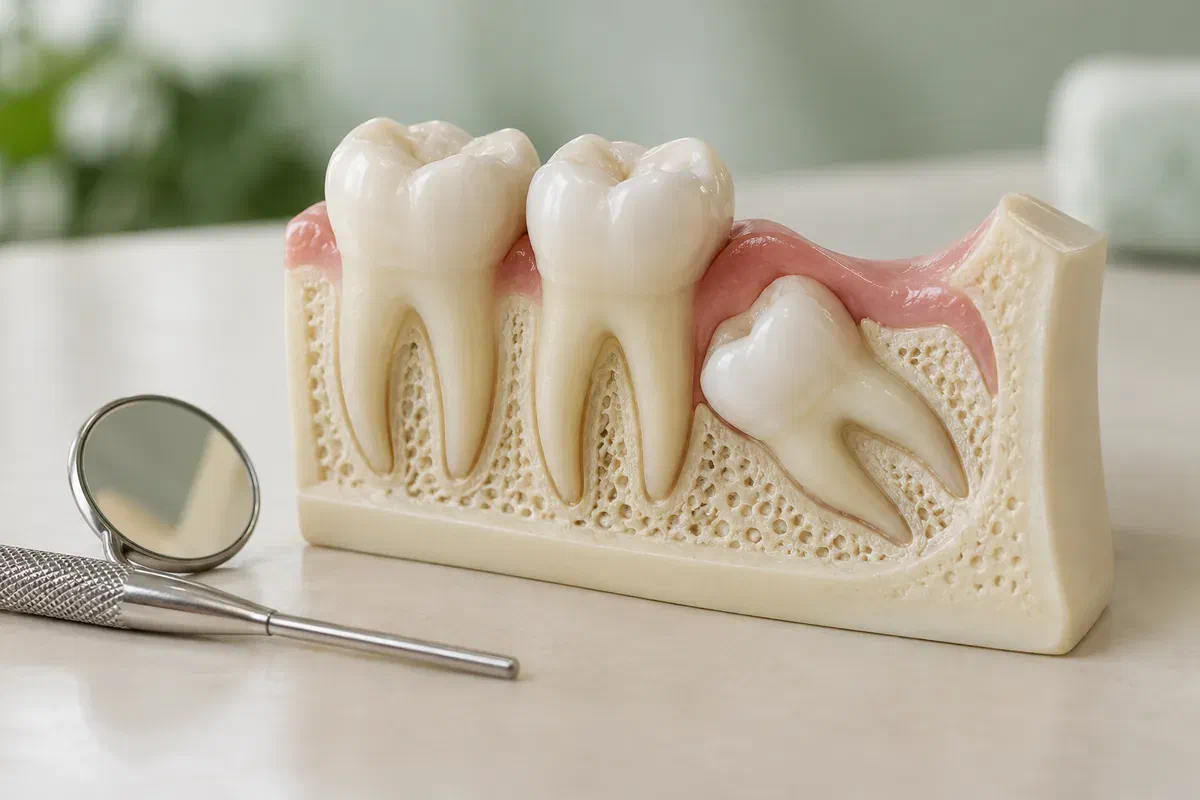
Illustrative physical jaw model with an angled wisdom tooth behind two upright molars
What the plan should point to

Find the finding behind the advice.

A good recommendation names a problem. Tell us whether the tooth has caused repeated trouble, something new, or nothing you have felt, so we can see whether the advice responds to active disease or to a judgement about future risk.

Repeated soreness around a half-erupted tooth

Swollen or tender gum, a flap that collects food, or an area that is hard to keep clean all point to inflammation. Mention how often it happens and how it was handled before. If it is active now, it may need care first; increasing swelling or a jaw that is harder to open should be reported promptly, not saved for the consultation.

Damage to the molar beside it

Decay or bone loss on the back of the second molar is a common reason given for removal, and it is often visible only on images. Ask whether that applies to you and how significant it is. If the neighbouring tooth needs its own treatment, ask how both steps fit together.

Removal suggested for a tooth you cannot feel

Sometimes surgery is proposed for a tooth that has never bothered you. That can be reasonable, but you should hear what disease, if any, is present and what future concern is driving the advice. Ask what monitoring would look like as an alternative.

Get in touch quickly about swelling that is increasing, a fever, or less movement when opening. Swelling around the eye, swelling that is spreading fast, or difficulty breathing or swallowing needs emergency medical attention instead of a wisdom-tooth appointment.

What a good reason looks like

Benefit should be specific.

An indicated removal should resolve something identifiable: an infection that keeps returning, disease involving a neighbour, or a carefully weighed risk. Ask what will be different afterward and whether further treatment will still be needed. Be cautious of the idea that taking the tooth out will fix unrelated jaw discomfort or prevent every change in how your teeth line up.

Complexity varies widely between impacted teeth. A deep lower tooth near the nerve that supplies feeling to the lip raises different considerations from an upper tooth sitting near the sinus. A second conversation is a good moment to understand how those details affect the method, the setting, and whether a specialist is the right person to treat it.

Patient information: British Association of Oral and Maxillofacial Surgeons — impacted wisdom-tooth treatment decisions and risks

Why removing beats leaving it, for this tooth

The comparison should use your examination and images, not a habit of removing all wisdom teeth. Ask what is likely if the tooth stays, what removing it risks, and what would trigger another look if monitoring is chosen instead.

A plan that accounts for nearby nerves and sinus

The tooth's position relative to other teeth, bone, the nerve canal, or the sinus shapes the surgery. If a further scan has been suggested, ask what question it would answer and how the result might change the plan. Not everyone needs the same imaging.

A full picture of recovery and risk

Expect a discussion of soreness, swelling, bleeding, dry socket, infection, and location-specific risks. With lower teeth, numbness or tingling occasionally does not fully resolve. Ask how likely that is in your case and what follow-up exists; consent should be informed even for a common operation.

From second look to a settled plan

What happens between this visit and any surgery?

Nothing has to be decided on the spot. The plan depends on your symptoms, anatomy, health history, the treatment available, and whether a specialist consultation or more information is needed.

  1. Gather what you already have

    Bring the original recommendation, earlier images or where they were taken, your medicine and allergy list, and relevant health details. Describe past pain, swelling, or infections. Mention anxiety or an earlier anaesthetic experience so comfort can be discussed honestly.

  2. Compare the reasoning with the findings

    We review why removal was proposed, whether monitoring is reasonable, and any alternative for this tooth. Ask how its position affects risk and whether referral is appropriate. Fees, the number of visits, and any outstanding questions should be clear before you choose.

  3. Proceed in the right setting if you agree

    The procedure may involve an incision in the gum, removal of some bone, and sectioning the tooth so it comes out under control. The approach and anaesthetic are explained beforehand. Sedation or general anaesthesia depends on a suitability assessment and on a provider being available to offer it.

  4. Finish with written aftercare and contacts

    You should leave knowing how to manage bleeding, cleaning, eating, medicines, activity, and stitches. Confirm your review and how to reach someone with a concern. After sedation, the treating provider's instructions on escort, supervision, driving, and activity apply.

Recovery, step by step

Protect the socket, then watch the trend.

Use the instructions written for your procedure and health. Healing differs between people, so ask what you should expect and which signs should prompt a call, rather than relying on how a friend recovered.

Gentle cleaning, sensible food

Ask how to keep your teeth and gums clean while leaving the socket and any stitches undisturbed. Avoid prodding the area or using improvised tools to clear it. Eat what was recommended and return to your usual routine on the treating team's timeline.

Medicines and a lighter schedule

Follow the pain-relief directions from your clinician or pharmacist with your health history in mind. Keep taking prescribed blood thinners and other medicines unless you are told otherwise. Plan help at home if needed and check anaesthetic limits before work, driving, or exercise.

Signs that need a call

Reach the treating provider about bleeding that the instructed steps do not control, pain or swelling that is getting worse, fever, or an unexpected change in feeling. Pain that builds after it had started easing should be assessed. Do not assume all discomfort is normal or that antibiotics will be needed.

Options to compare

Three choices, three different reasons.

Weigh the decision for each tooth separately. Ask how the expected benefit compares with the risks, and what each path means for reviews, possible symptoms, and future care.

Where no current problem justifies surgery

Monitor and review

If the tooth has no present indication, clinical review and imaging when justified may be enough for now. Ask what is being watched and what would change the recommendation. Observation is a plan with a purpose, and it cannot promise the tooth will stay quiet.

Where the benefit is clear for this tooth

Remove the tooth completely

Discuss the steps, the risks particular to this tooth, anaesthetic, and setting. Ask whether an oral surgeon should treat it and whether any other wisdom teeth deserve their own decision. Removal should be justified for this tooth rather than offered as an all-four package.

Where a lower tooth's roots lie near the nerve

Coronectomy

A surgeon may remove only the crown and leave suitable roots in place to reduce a specific nerve-injury risk. It is not suitable for everyone. Ask whether you qualify, how the roots would be followed, and whether another procedure could be needed.

Patient information: British Association of Oral and Maxillofacial Surgeons — coronectomy selection and retained-root considerations

Oakville second-opinion questions

Questions worth asking before you commit

Bring the plan you were given and your images, or the name of the office that holds them. The clearest answers link the proposed treatment to the tooth, the anatomy around it, and your health.

(905) 876-4488
Is it reasonable to get a second opinion on wisdom-tooth surgery?
Yes. Asking another clinician to review the findings is a normal part of making an informed choice, especially for a non-urgent procedure. Bring the original plan and images so the discussion can focus on the reasoning rather than starting from nothing.
My plan recommends removing all four. Should I question that?
It is fair to ask about each tooth. Some people do have a reason for treating several at once, but each tooth should have its own finding behind the advice. Ask how a combined procedure would affect anaesthetic and recovery compared with treating teeth separately.
Why was I told I need a 3D scan before surgery?
A cone beam scan may be suggested when a standard X-ray cannot show clearly how close the roots are to the nerve or sinus, and the answer would change the plan. Ask what the scan is meant to clarify. It is not needed for every impacted tooth.
The tooth leans sideways on my X-ray. Is that enough reason to remove it?
Not on its own. The angle is one factor, alongside disease, symptoms, nearby structures, future risk, and surgical risk. Ask which specific finding supports removal and what monitoring would involve if keeping the tooth is reasonable.
Will I be put to sleep for the surgery?
Not necessarily. Many impacted teeth are removed under local anaesthetic, while sedation or general anaesthesia depends on complexity, health, anxiety, and the setting. Ask which option is proposed and what preparation and escort arrangements it requires.
Who would actually perform the extraction?
That depends on the tooth’s difficulty and the setting needed. Some removals can be done by a general dentist, while others are better handled by an oral and maxillofacial surgeon. We will tell you which we recommend and why, and what referral would involve.
Wisdom-tooth consultations for Oakville

Get the reasoning before the appointment for surgery.

Contact our Bronte Street practice to review a recommendation, a recurring sore area, or an impacted wisdom tooth found on an X-ray. If swelling or pain is getting worse, say so when you call, and bring earlier records or the plan you were given.

Monitoring, removal, coronectomy, imaging, anaesthetic, setting, referral, and individual risk can only be advised after clinical assessment. We cannot guarantee any procedure or an urgent appointment.

Visit Milton Dental Clinic
Unit 1, 342 Bronte St. S, Milton, ON L9T 5B7
Get directions Clinic hours
Monday–Thursday
11am–7pm
Friday–Sunday
By appointment only

Areas we serve

  • Milton
  • Oakville
  • Mississauga
  • Georgetown
  • Halton Hills
  • Acton
  • Campbellville
  • Brampton
  • Burlington
  • Puslinch
  • Rockwood
  • Erin
  • Caledon
  • Etobicoke
  • Old Milton
  • Bronte Meadows
  • Timberlea
  • Dorset Park
  • Dempsey
  • Clarke
  • Beaty
  • Coates
  • Harrison
  • Scott
  • Willmott
  • Ford
  • Bowes
  • Cobden
  • Walker
  • Mountain View
  • Milton Heights
  • Hawthorne Village
  • Valley View
  • Fallingbrook
  • Nassagaweya
  • Trafalgar
  • Esquesing
  • Nelson
  • Brookville
  • Moffat
  • Glen Williams
  • Norval
  • Limehouse
  • Stewarttown
  • Ashgrove
  • Hornby
  • Silver Creek
  • Speyside
  • Scotch Block
  • North Oakville
  • River Oaks
  • Glen Abbey
  • West Oak Trails
  • Palermo
  • Bronte Creek
  • College Park
  • Joshua Creek
  • Uptown Core
  • Preserve
  • Iroquois Ridge
  • Lisgar
  • Meadowvale
  • Meadowvale Village
  • Churchill Meadows
  • Erin Mills
  • Central Erin Mills
  • Streetsville
  • East Credit
  • Creditview
  • Heartland
  • Sheridan
  • Mount Pleasant
  • Credit Valley
  • Huttonville
  • Churchville
  • Springbrook
  • Northwest Brampton
  • Bram West
  • Fletcher's Meadow
  • Fletcher's Creek South
  • Alton Village
  • Orchard
  • Millcroft
  • Headon Forest
  • Tansley
  • Brant Hills
  • Tyandaga
  • Kilbride
  • Lowville
  • Aberfoyle
  • Morriston
  • Arkell
  • Hillsburgh
  • Freelton
  • Carlisle
  • Waterdown
  • Flamborough
  • Mountsberg

How can we help?

Milton Dental Clinic

Have a question about your smile? Choose the option that works best for you.

For urgent dental concerns, please call.
Messages are reviewed during clinic hours.