

Illustrative patient discussing an infected tooth and treatment choices with a clinician
Specialized Care

Infected Tooth Extraction in Brampton

An infected tooth rarely picks a convenient week. For busy households in Brampton, we can assess the tooth promptly, explain whether it can be kept, and, if removal is right, plan the appointment and recovery so you know what the next few days involve.

In the middle of a busy week

When a swollen tooth collides with everything else on the calendar

It is tempting to take whatever calms the pain and push the tooth to next month. Unfortunately an infection tends to keep going until its source is dealt with. That might mean root canal care or it might mean extraction; the dentist first has to confirm which tooth is responsible and how much sound structure and support it has.

Swelling alone does not prove the tooth must come out. Equally, a few good days on antibiotics do not prove it is fixed. If you have already had a prescription, a warning from another dentist, or some drainage, those are useful clues for the examination, though they do not replace a definite plan made now.

Call to tell us what is happening and when you could come in. Flag it right away if the swelling is getting bigger or you feel feverish or run down. We can explain keeping, removing or referring the tooth. When care is needed immediately and we cannot see you, please contact another emergency dental provider.

Arrange an infected-tooth visit
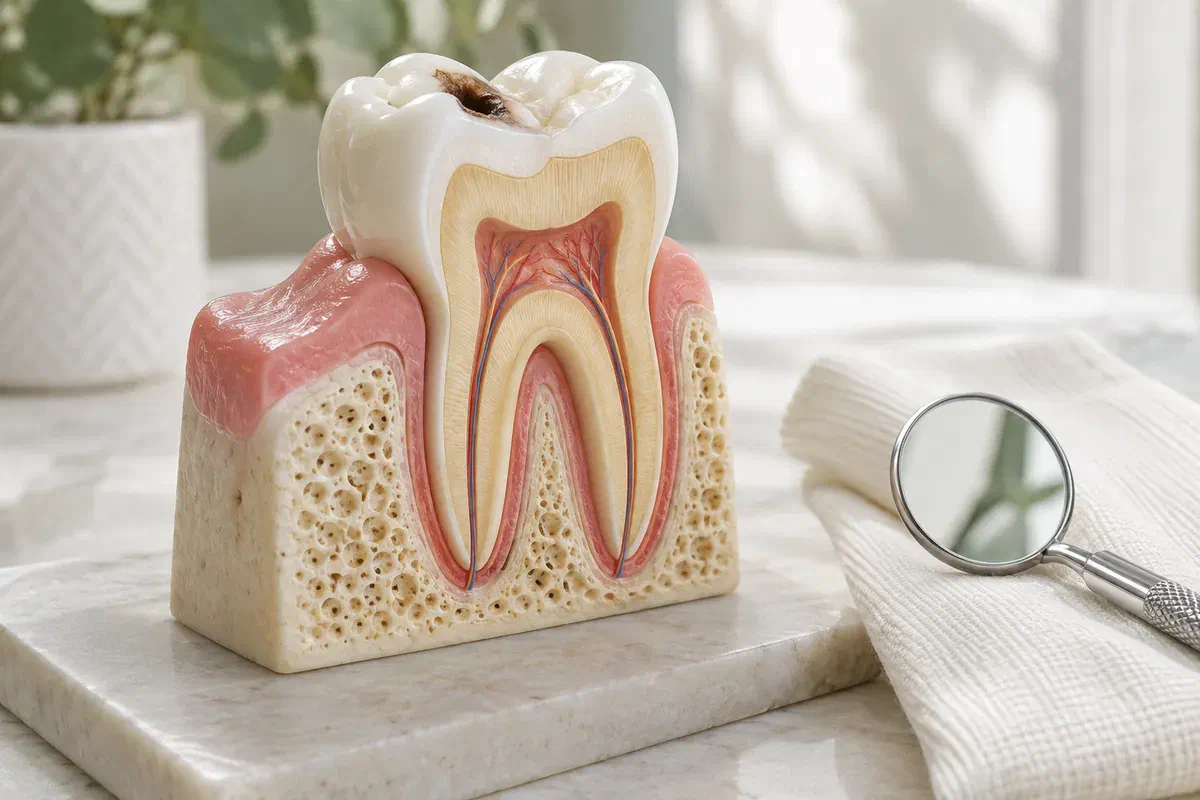
Illustrative physical molar cross-section showing decay within a supported tooth model
Useful to mention

A quick history saves time at the appointment.

Jot down the dates of any flare-ups and bring prescription details or records from elsewhere. Knowing what has already been done, and how the tooth is doing today, lets the dentist give clearer advice about removal.

Episodes that calm down, then flare again

Mention each time the area swelled or drained and what you took for it. A small gum bump, a lingering bad taste or pain when you bite down are all relevant. Improvement that does not last usually points to a source still in place, so ask which treatment would fix the cause.

Old fillings, cracks and past treatment

Describe any break, root canal, big filling or crown on the tooth, and anything you were told about gum or bone support. Ask which findings today make it hard to keep. Background is helpful, but the advice should be based on the tooth’s present prognosis.

Medicines everyone in the room should know about

Bring a list of your prescriptions and supplements, plus any immune, bleeding or healing concerns and past problems with surgery. Include the latest antibiotic and how you reacted. Do not stop regular medicines on your own; the team will say if your doctor should be involved.

Some signs mean you should go straight to emergency care: difficulty breathing or swallowing, swelling that is spreading or affecting the eye, or barely being able to open your mouth. Phone 911 if it is immediate rather than waiting for a dental appointment.

What a removal can settle

Done once, planned properly

When the tooth cannot realistically be kept, taking it out can address the dental source of infection that was diagnosed. Ask what else might need treatment or monitoring and how healing will be checked. A good plan treats the extraction as part of solving the problem and is straightforward about the recovery.

There is also the space to think about. Whether a replacement is discussed now or after healing depends on where the tooth is and what you would like. Timely treatment is important with infection, but it should not leave you unsure what losing the tooth could mean.

Patient information: American Dental Association — source-directed dental care and antibiotic decisions

Keeping the tooth, weighed fairly

Root canal treatment, retreatment or another approach may be reasonable for some teeth. Look at the structure left, the supporting tissues, the restoration needed and the follow-up. Knowing what this tooth would need to stay healthy is more useful than any label.

Antibiotics with a clear purpose

A prescription may be right in certain situations, including spreading or whole-body infection, but it does not remove the source. Your health, symptoms and how soon treatment can take place are considered. Ask what the medicine is meant to do and what still lies ahead.

An extraction you can schedule around

Discuss the freezing, how involved the removal is expected to be, the risks and whether a specialist is advisable. Ask what happens if extra surgical steps are needed, how long recovery usually takes for your type of extraction, and how to reach help afterward.

Your appointments, in order

What happens at each visit?

How soon and where treatment happens depends on the severity of the infection, the tooth’s anatomy, your health and the care available. There is no fixed rule that an infected tooth must be removed straight away or only after another step.

  1. First, find the responsible tooth

    The dentist asks about your history, examines the area and uses appropriate tests or images. Tell them about fever, spreading swelling or trouble eating and opening. Ask how urgent the situation is and whether another setting would be more appropriate.

  2. Next, choose a direction together

    You talk through the outlook and the realistic alternatives, including a specialist view if helpful. If extraction is the choice, confirm the tooth, the procedure, risks, fees and aftercare. Take the time to clear up any doubt before agreeing to a permanent step.

  3. Then, the procedure itself

    The dentist decides how to numb the area and remove the tooth. Let the team know if you are anxious or have had freezing problems before, and agree on a pause signal. Some teeth need surgical steps or a referral, which belong in your plan.

  4. Finally, recovery and review

    Before leaving, you are walked through stopping bleeding, keeping the area clean, what to eat, your medicines and stitch care if relevant. Find out the date for a recheck and the number to use if something worries you in the evening. Settle whether more visits are needed for other treatment or a replacement talk.

Back to normal life

Easy on the socket for a few days, quick to call if things change

Your aftercare depends on your specific extraction and health. Having had an infection does not make every later symptom expected, and new pain does not automatically mean another antibiotic.

Let the socket rest

Follow the bleeding-control steps you were shown and keep fingers, straws or other objects away from the area unless told otherwise. Ask when rinsing and nearby brushing can begin. If bleeding does not ease as expected, call the provider instead of repeatedly checking.

Keep medicines organised

Take pain relief and any antibiotic exactly as directed, and ask about interactions with other medicines. Avoid leftover prescriptions and do not raise doses out of worry. Keep taking your regular medicines unless the relevant clinician has specifically changed them.

Watch for changes and keep the review

Report worsening pain, returning swelling, fever, ongoing bleeding or unexpected numbness. Mention the extraction date and how symptoms have progressed. Even on a hectic week, keep the follow-up; feeling well is not the same as the dentist confirming the site has healed and the infection has cleared.

Patient information: Royal Devon — bleeding advice and prescribed anticoagulant precautions

Which way forward?

Three answers to an infected tooth

The right one depends on the diagnosis, the condition of the tooth and how severe the infection is. A plan might begin with urgent care and still need a later stage before it is complete.

When the tooth’s structure and outlook allow it

Keep it with root canal care

A root canal or another suitable approach may be advised, and the tooth would then need a lasting restoration and periodic checks. A specialist might see the tooth differently, so ask if that opinion is worth getting. A kept tooth should have a realistic future, not just a temporary truce with the infection.

When extraction is appropriate after the alternatives

Remove it with a recovery plan

The dentist should explain why the tooth is unsuitable to keep, or why removal is your chosen route. Go over the procedure, risks and the gap. Ask whether any replacement planning needs to happen before removal and what can wait.

When severity or complexity needs another setting

Refer it for urgent or specialist care

Severe infection, medical issues or difficult anatomy may require another provider or hospital assessment. Ask what the referral will address and how soon it should happen. Do not delay escalation while waiting for a preferred location.

Brampton questions

Practical questions about the extraction day

Bring prescriptions and earlier recommendations along. These answers help with planning, but only an examination can decide whether your tooth should be removed.

(905) 876-4488
Can I drive myself home after an infected tooth is taken out?
That depends on the type of freezing or any sedation used and on how you feel. Ask the dentist in advance so you can arrange a ride if needed.
What can I eat the evening after the extraction?
Your dentist will give specific advice, which often includes softer foods and chewing away from the site at first. Follow the instructions you receive, and ask if you are unsure about anything in particular.
Is it better to book the extraction near a weekend or early in the week?
Infection should be treated in a timely way rather than scheduled around convenience. That said, it helps to know how to reach help after hours. Ask the dentist what to expect and who to contact if a problem arises.
Does an infected tooth always have to wait for antibiotics before removal?
No single rule applies. The dentist considers severity, your health, the procedure and the setting. Some cases need prompt treatment of the source, while others need other steps or escalation first.
If the pain is gone, is the extraction still needed?
Possibly. Less pain does not mean the dental source has been resolved. The tooth still needs an assessment and a lasting plan, whether that is keeping or removing it.
Could the tooth be saved with a root canal instead?
Sometimes. It depends on the remaining structure, the support around the tooth and any previous treatment. Ask whether root canal care is realistic and what restoration would follow. Infection on its own does not decide the question.
Booking from Brampton

One call to get the plan started

Coming from Brampton, the quickest start is a phone call to (905) 876-4488, our Bronte Street office, to describe your symptoms and see what times are open. Bring your records and medicine list. If you need care urgently and we cannot fit you in, look for another emergency dental provider.

Removal, timing, antibiotics, referral and replacement are decided case by case. Email and online forms are suitable only for non-urgent questions.

Visit Milton Dental Clinic
Unit 1, 342 Bronte St. S, Milton, ON L9T 5B7
Get directions Clinic hours
Monday–Thursday
11am–7pm
Friday–Sunday
By appointment only

Areas we serve

  • Milton
  • Oakville
  • Mississauga
  • Georgetown
  • Halton Hills
  • Acton
  • Campbellville
  • Brampton
  • Burlington
  • Puslinch
  • Rockwood
  • Erin
  • Caledon
  • Etobicoke
  • Old Milton
  • Bronte Meadows
  • Timberlea
  • Dorset Park
  • Dempsey
  • Clarke
  • Beaty
  • Coates
  • Harrison
  • Scott
  • Willmott
  • Ford
  • Bowes
  • Cobden
  • Walker
  • Mountain View
  • Milton Heights
  • Hawthorne Village
  • Valley View
  • Fallingbrook
  • Nassagaweya
  • Trafalgar
  • Esquesing
  • Nelson
  • Brookville
  • Moffat
  • Glen Williams
  • Norval
  • Limehouse
  • Stewarttown
  • Ashgrove
  • Hornby
  • Silver Creek
  • Speyside
  • Scotch Block
  • North Oakville
  • River Oaks
  • Glen Abbey
  • West Oak Trails
  • Palermo
  • Bronte Creek
  • College Park
  • Joshua Creek
  • Uptown Core
  • Preserve
  • Iroquois Ridge
  • Lisgar
  • Meadowvale
  • Meadowvale Village
  • Churchill Meadows
  • Erin Mills
  • Central Erin Mills
  • Streetsville
  • East Credit
  • Creditview
  • Heartland
  • Sheridan
  • Mount Pleasant
  • Credit Valley
  • Huttonville
  • Churchville
  • Springbrook
  • Northwest Brampton
  • Bram West
  • Fletcher's Meadow
  • Fletcher's Creek South
  • Alton Village
  • Orchard
  • Millcroft
  • Headon Forest
  • Tansley
  • Brant Hills
  • Tyandaga
  • Kilbride
  • Lowville
  • Aberfoyle
  • Morriston
  • Arkell
  • Hillsburgh
  • Freelton
  • Carlisle
  • Waterdown
  • Flamborough
  • Mountsberg

How can we help?

Milton Dental Clinic

Have a question about your smile? Choose the option that works best for you.

For urgent dental concerns, please call.
Messages are reviewed during clinic hours.